Study
The Sent-Away Goat: Leviticus and Ancient Rites of Removing Evil
An extended study of a topic, with evidence and references.
From Leviticus’s goats to Samuha and Ambazzi, then Azazel, Mishnah and Barnabas: comparing removal, slaughter and later interpretation while assessing transmission limits.
Share article
Text
Not every animal that leaves a city is an offering, and not every rite that removes evil involves slaughter. This apparently small distinction changes the comparison between the sent-away goat in Leviticus and older practices in AnatoliaAnatoliaAnatolia is the region occupying the Asian part of present-day TurkeyGlossary · Click to read the explanation and the LevantThe LevantThe Levant is a regional name for lands along the eastern MediterraneanGlossary · Click to read the explanation.
The familiar image sometimes combines details from different periods: a goat bearing communal sins, a red strip, a cliff from which it is pushed, and AzazelAsael / AzazelName forms in Enochic tradition associated with corrupting teaching and punishment; witness variation cautions against one fixed form and identity everywhere.Glossary · Click to read the explanation seemingly known as a demon from the beginning. These details do not all come from the same source. Some occur in Leviticus, others in the Mishnah, and others in Enochic literature and subsequent interpretation. Research begins by separating them before tracing their origins.
Two goats performing different tasks
Leviticus 16 concerns entry into the holy place and its purification; it is not an isolated story about an unusual animal. Its opening connects the instructions with the death of Aaron’s two sons and regulates the priest’s entry behind the curtain. There is a bull concerning Aaron and his household, two goats assigned by lot, and other offerings. One goat falls to YHWHYahwehThe divine proper name written YHWH in the Hebrew Bible.Glossary · Click to read the explanation and the other to Azazel. [1]
The goat assigned to YHWH is slaughtered. Its blood participates in purifying the sanctuary from Israel’s impurities, transgressions and sins. The other goat remains alive. After completing purification of the sanctuary, tent of meeting and altar, Aaron places both hands on its head, confesses the community’s sins, and sends it into the wilderness with a designated man. The text describes the animal carrying the iniquities into a cut-off land. [1]
The sequence combines distinct actions: purification within the holy place, followed by removal of what the goat bears. The text does not say that both goats are slaughtered, nor that the living goat is pushed off a cliff. That last detail appears in a later source.
The chapter’s conclusion associates the rite with the tenth day of the seventh month, self-affliction and abstention from work. This is the textual setting of the Day of AtonementYom Kippur / Day of AtonementJewish observance whose Leviticus 16 setting involves sanctuary purification and the sent-away goat; distinguish ancient instructions from later practice and interpretation.Glossary · Click to read the explanation, but describing the ancient rite does not describe everything the occasion would include in later Judaism. [1]
What is transferred to the animal?
Here the transfer of iniquities is not simply a comparativist’s guess: confession, placement on the goat’s head and removal are explicit. This language does not make the animal morally responsible for human actions. It gives it the role of bearer within a ritualRitualAn organised or distinguished practice meaningful to a community; it may leave traces, but its form alone does not reveal an associated doctrine.Glossary · Click to read the explanation system.
We can call this aspect ritual removalRitual removalAnalytical term for removing what is considered harmful or polluting from communal or sacred space; transfer, expulsion and slaughter are distinct functions.Glossary · Click to read the explanation: something is taken out of the place or community that should become pure. This analytical term does not make everything removed identical. Communal sins, a curse, harmful speech and ritual impurityRitual impurityReligious classification concerning sacred access and purification; not automatically moral condemnation or a modern medical diagnosis.Glossary · Click to read the explanation are not interchangeable categories in every culture.
Boundaries matter too. The goat’s sender washes his clothes and body before returning to the camp. Instructions also require washing by the person who burns the slaughtered animals’ remains outside. In the text’s arrangement, departure and return are not ordinary geographical movements; they involve a change in ritual condition. [1]
We should neither reduce all this to an ancient public-health technique nor assume that historians can measure the religious efficacy of atonement as they measure an animal’s movement. Comparison concerns what the text says the rite accomplishes and how it organizes relations between the community, sacred space and the outside.
The bird returning to the field
Within the biblical collection itself, Leviticus 14 supplies another example combining a killed animal and a living one released. In the purification of a person after recovery, two living clean birds are taken. One is killed over running water in an earthen vessel. The living bird and other materials are dipped in the blood; after sprinkling, it is released into the field. A related arrangement recurs in the purification of a house. [2]
The resemblance to the goat is clear in the paired animals and release outside. Differences are equally clear: the living bird touches blood, and this passage lacks the two-handed placement and confession of all Israel’s sins found in Leviticus 16. We cannot attach an explanation of the goat to the birds as though the passages describe one undifferentiated process.
The chapter’s ṣaraʿat concerns bodies and houses; the broader context also applies the category to garments. The translation “leprosy” cannot by itself identify a particular modern disease. The historical question concerns the text’s classification of purity and affliction, rather than diagnosing an absent medical patient. [2]
This internal comparison reminds us that research need not begin outside the TorahTorah / PentateuchGenesis, Exodus, Leviticus, Numbers and Deuteronomy: Mosaic corpus with a compositional history. Torah can also mean teaching or law beyond these five books.Glossary · Click to read the explanation. Sometimes its own variety must be understood before resemblances with neighboring traditions can be assessed.
Anatolia: a distant bearer and a boat leaving sacred space
In the Hittite Samuha rite, CTH 480.1, animals are sent away to remove harmful speech, curse and impurity. Small figures also travel outward in a boat on water. The temple and royal setting differs from Israel’s annual communal confession. [3]
The bearer need not always be an animal. That comparative observation follows from the varied means: the harmful thing leaves the protected sphere and its return is prevented. Movement alone, however, is not an adequate interpretation. The accompanying words must be read to determine what participants believe they are removing.
In Ambazzi’s rite, CTH 391.1, tin previously bound to beneficiaries is transferred to a mouse released far away. The edition’s scholarly introduction distinguishes a late Hittite copy from older linguistic traditions and describes a rite also involving offerings to particular deities. [4]
A mouse is not a goat, and tin is not a spoken confession of a people’s sins. These differences make comparison useful: we encounter several ways of representing transfer and removal, rather than a matching description of Leviticus. The editorial overview does not establish that every offering in the rite is the released animal itself.
Chronology requires further precision. The date of a surviving cuneiformCuneiformWriting with wedge-shaped signs, developed from Mesopotamian recording traditions and used for several languages from the third millennium BCE.Glossary · Click to read the explanation copy, the possible age of its tradition and the redaction of Leviticus are separate questions. An earlier practice is an important condition for a transmission hypothesis, but it does not identify the route to a later author.
Resemblance is not a transmission record
Noga Ayali-Darshan proposes considering these comparisons within shared Syrian and Anatolian traditions rather than assuming direct borrowing from a particular Hittite text. She also notes a disputed reading of Ugaritic KTUKTU: Ugaritic Text ReferencesAbbreviation for a modern scholarly corpus of alphabetic cuneiform texts; its numbers are references, not dates.Glossary · Click to read the explanation 1.127: sending a goat away is not an agreed translation of that passage. [5]
It is useful to resist an appealing headline such as “The Torah’s ritual origin has been discovered.” To make that a historical finding requires more than two goats or an animal carrying evil. We need dated witnesses, comparison of actions, words and beneficiaries, a plausible channel of contact, and assessment of competing explanations.
A rite might travel with specialists, communities or political authority. Neighboring regions might share an older ritual repertoire, or practical and symbolic solutions might resemble one another without dependence on a single book. These are possibilities to weigh, not missing links to fill with a researcher’s imagination.
Nor does comparison make a rite “Babylonian in origin” merely because it belongs to the ancient Near EastAncient Near EastA historical and geographical term covering Mesopotamia, the Levant and neighbouring ancient societies.Glossary · Click to read the explanation. Anatolian examples do not become Sumerian texts by placing them all under MesopotamiaMesopotamiaA historical region associated with the Tigris and Euphrates, home to many societies and civilisations.Glossary · Click to read the explanation. Each witness must retain its language, location and date.
Azazel: where does the text end and interpretation begin?
Azazel occurs in the assignment by lot and the sending away of the goat. Leviticus 16 supplies no accompanying biography, bodily description or genealogy. The parallel between what belongs to YHWH and what belongs to Azazel has led some scholars to favor a wilderness being. Other readings concern a place, removal or the sent-away animal.
Anna Angelini presents an interpretation emphasizing a personal or demonic dimension and its later reception. In contrast, the publisher’s description of Judit Blair’s book outlines a methodological challenge to assumed demonic identities for certain biblical terms, including Azazel. Blair’s full study was not read here, so no unexamined details are attributed to her. [6][7]
We should preserve two levels: the text places the living goat in a procedure of departure from the community’s sphere; Azazel’s original identity remains a linguistic and historical interpretive question. A disputed derivation does not become fact because the spelling recalls a name familiar from later literature.
In 1 EnochFirst EnochLayered collection of Jewish writings about heaven, evil and judgment.Glossary · Click to read the explanation 10, in the Charles translation used here, God commands RaphaelRaphael / RephaelTheophoric name from healing and El; human Rephael in Chronicles and angel Raphael in Tobit. Distinct from Israfil, whose etymology is a separate question.Glossary · Click to read the explanation to bind AzazelAsael / AzazelName forms in Enochic tradition associated with corrupting teaching and punishment; witness variation cautions against one fixed form and identity everywhere.Glossary · Click to read the explanation beneath rocks in the wilderness, associating him with the world’s corruption and punishment. Here a defined character appears within a narrative. This is strong evidence for the name’s portrayal in that tradition, but not proof that all its features existed when Leviticus’s rite was formulated. [8]
Wilderness, rocks and expulsion offer a striking comparison. Saying that the rite arose from Enoch’s story, or that Enoch alone explains every word’s original meaning in Leviticus, requires further evidence. Resemblance does not erase literary differences: priestly instructions on one side, a narrative of heavenly corruption and divine judgment on the other.
The red strip and the cliff: a later witness
Mishnah Yoma 4:2 mentions a crimson strip at the sent-away goat’s head. In Yoma 6:6 it is divided between a rock and the animal’s horns. The goat is pushed backward off a cliff; the passage describes its limbs coming apart before it reaches halfway down. [9][10]
This differs from the live sending prescribed in Leviticus. The Mishnah, which Sefaria’s library metadata dates to compilation around 200 CE, preserves traditions about earlier worship. Its compilation date, however, is neither MosesMosesCentral figure in Exodus, Torah traditions and the Qur’an; childhood accounts differ in detail.Glossary · Click to read the explanation’s time nor the date of every detail it relates. Methodologically, its witness cannot be treated as a line accidentally omitted from Leviticus. [9]
The difference does not require choosing one text and discarding the other. We can study the instructions and then a later account of performing, recalling or organizing the rite, asking how the description expanded or changed. But the strip and cliff cannot automatically be projected into the earliest layer simply because a modern image combines them with the goat.
This supplies another reason for caution about “scapegoat.” In ordinary speech it may mean someone blamed for others’ actions, but it does not precisely describe every animal, function and fate in every witness. A living goat sent out, a slaughtered animal and a falsely accused person are not historically equivalent.
When the goat becomes an interpretation of Christ
Chapter seven of the Epistle of Barnabas provides a clearer type of textual relationship. Its author reads the two goats as figures of Christ, connecting humiliation, crimson coloring and suffering with his interpretation of the passion and subsequent appearance. The link is not a resemblance inferred from outside by a historian: the author announces the interpretation. [11]
The epistle, distinct from the later Gospel of Barnabas, is not a neutral copy of Leviticus’s instructions. Its description, the biblical text and its Christian polemical purpose must be distinguished. Scholarly disagreement about its precise date and place prevents reducing its origins to a certain year and city. That limit appears in the historical survey consulted; not every study listed there was read. [12]
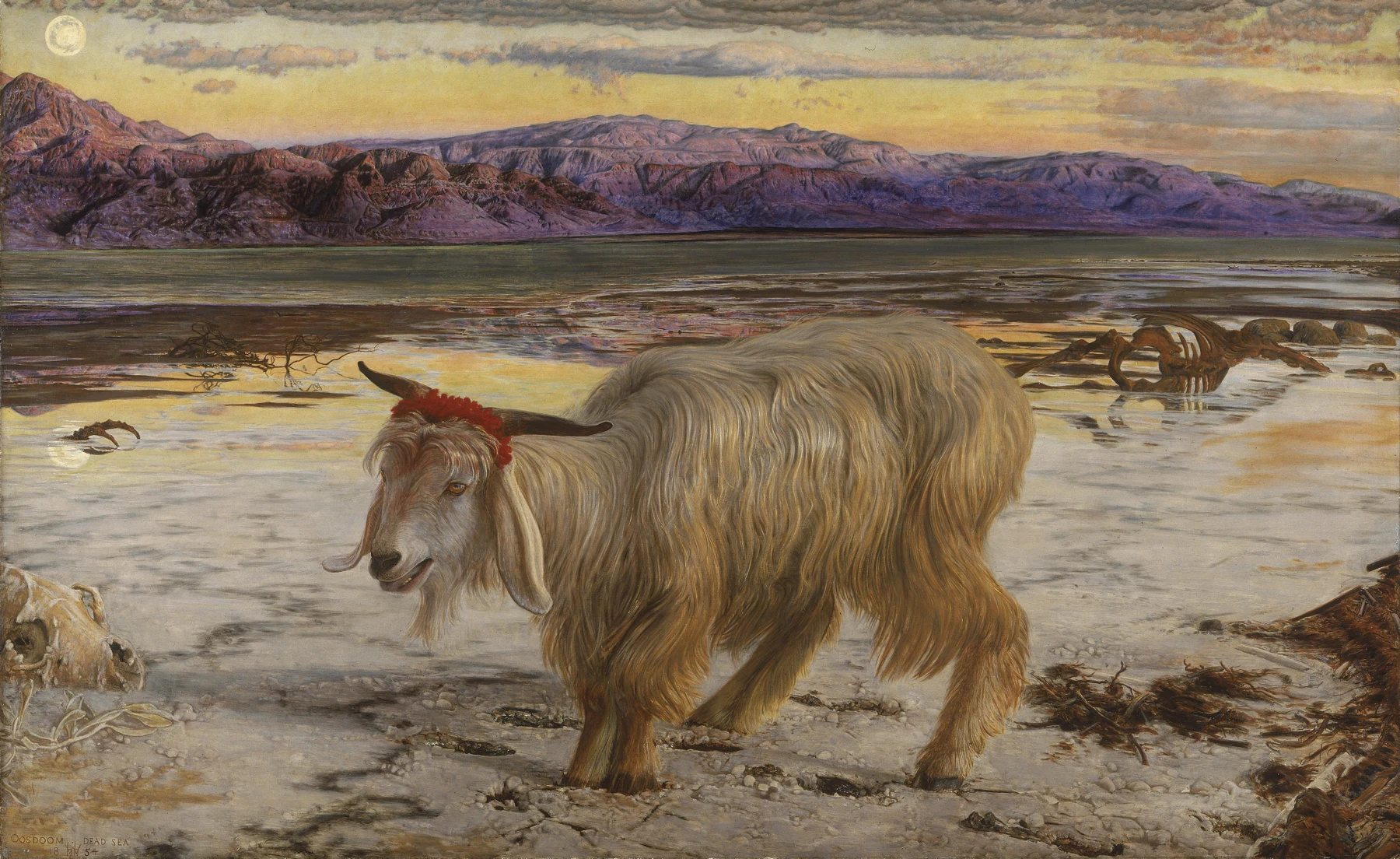
William Holman Hunt’s painting The Scapegoat provides a visual example many centuries later. The Lady Lever Art Gallery painting belongs to the mid-1850s; its catalogue dates the work to 1854. The image used here reproduces a public-domain artwork. It is not an archaeological photograph of the animal described in Leviticus. [13][14]
Art preserves a history of reading too. An animal in a Dead SeaDead SeaThe Dead Sea is a salt lake in the Jordan Rift Valley, near sites where ancient manuscripts were foundGlossary · Click to read the explanation landscape with a red strip does not establish the ancient rite’s appearance. It shows how texts, traditions and artistic choices can meet in an image that a later viewer might mistake for a direct depiction of the original scene.
Degrees of evidence and further research
The witnesses support clear findings without supplying a complete genealogy of every rite:
- Textually certain: Leviticus 16 distinguishes the goat slaughtered for sanctuary purification from the living goat carrying iniquities outside.
- Certain in the comparative witnesses: Hittite texts describe the outward removal of what is considered harmful through animals or carried objects. Similar function does not erase differences of setting, speech and performer.
- Plausible as an interpretive framework: the wider region’s traditions help explain transfer and removal, but no documented channel here connects a particular tablet with Leviticus’s author.
- Disputed: Azazel’s original identity, some translations of comparative witnesses, and the age of layers preceding surviving copies.
- Clearer in later reception: Barnabas explicitly offers a Christian reading of the goats. That can be distinguished from establishing the rite’s historical origin.
This research does not determine what believers should hold about atonement. It follows texts, actions and images while preventing a later witness from speaking for an earlier one that did not say the same thing.
The question “Where did the sent-away goat come from?” thus becomes broader and more precise: how did different societies construct boundaries between inside and outside, make things or animals carry what they wished to remove, and later reinterpret that movement? Some answers are documented, some plausible, and some remain open.
Continue reading: Resemblance and the limits of borrowing, Judaism between exile and Christianity, How the adversary became Satan, Sacrifice and covenant after the flood.
References and notes
- Complete chapter read in Hebrew and English; goats, confession, removal, washing and annual date distinguished. No cliff killing prescribed. Leviticus 16:1–34; Hebrew and facing English Return to the text ↑
- Complete chapter read; person/house birds distinguished from goat. Ṣaraʿat not treated as an identified modern disease. Leviticus 14:1–57; especially 1–9, 49–53 Return to the text ↑
- Full German scientific translation read in indexed delivery; direct access failed. Original tablets not examined. S. Görke – S. Melzer, CTH480.1, TRde10.02.2016; §§1–23, especially §§20–22, kola165–199 Return to the text ↑
- Complete indexed scientific introduction read; not the full primary translation or tablets. B. Christiansen, CTH391.1 introduction, INTR2017-02-07; ritual outline and manuscript dating Return to the text ↑
- Article and notes read; comparative framework is the author’s proposal; Ugaritic reading disputed. Noga Ayali-Darshan, 2020; conclusion and footnote16, KTU1.127 Return to the text ↑
- Article and notes read; demonic identity attributed to the scholar, not an agreed linguistic result. Anna Angelini, 2021; article body and35footnotes Return to the text ↑
- Publisher description and metadata only, not the complete book; documents the methodological objection’s existence. Judit M. Blair, De-Demonising the Old Testament, 2009; publisher description; DOI10.1628/978-3-16-151135-6 Return to the text ↑
- Complete chapter 10 in Charles read; not all Enoch or its original-language witnesses. 1Enoch10:1–22; R. H. Charles, public-domain translation, especially4–8 Return to the text ↑
- Hebrew paragraph and Sefaria translation read through text API; compilation date from library metadata, not every practice’s date. Mishnah Yoma4:2; William Davidson Edition via public text API; library compilation metadata Return to the text ↑
- Complete paragraph read: strip, rock and goat’s fate; not the whole Mishnah or Talmud. Mishnah Yoma6:6; William Davidson Edition via public text API Return to the text ↑
- Complete chapterVII read; declared Christian interpretation, not a neutral equivalent of Leviticus instructions. Epistle of Barnabas, chapterVII; Roberts–Donaldson public-domain translation Return to the text ↑
- Relevant historical survey read, not all listed books; dating and location disagreement retained. Epistle of Barnabas introductory historical survey; date and provenance discussion Return to the text ↑
- Official museum identification checked; direct catalogue unavailable. Lady Lever painting distinguished from Manchester version. National Museums Liverpool, Lady Lever Art Gallery, William Holman Hunt, TheScapegoat; dated1854 Return to the text ↑
- Identity/rights checked and original viewed; public-domain old-work reproduction, not archaeological evidence or assumed museum license. LL3623; 3716×2280 reproduction; PD-Art / Public DomainMark1.0 Return to the text ↑
Suggest a correction · Suggest a source for this record
Cite this record
IL Archive, «The Sent-Away Goat: Leviticus and Ancient Rites of Removing Evil», Edition 1, https://ilarchive.com/en/studies/scapegoat-and-ancient-purification
Continue reading