Entity
Book of the Watchers
A reference page linking a name, group, or concept to the materials that discuss it.
The Book of the Watchers (1 Enoch 1–36): descent, giants, forbidden instruction, judgment and Enoch’s journeys, assessed against Aramaic, Greek and Ethiopic evidence.
Estimated reading time: 10 min Published Last reviewed:
Share article

Text
Introduction
The Book of the Watchers is the opening section of 1 EnochFirst EnochA composite Second Temple Jewish apocalyptic collection on the Watchers, parables, celestial cycles, historical visions, and judgment, preserved complete in Geʽez.Glossary · Click to read the explanation, occupying chapters 1–36 in the familiar division. It begins with heavenly beings who cross prescribed boundaries in the era before the Flood, but it is not merely their fall: it includes an announcement of judgment, an account of violence and harmful spirits, EnochEnoch son of JaredEnoch son of Jared is a figure in the genealogy of Genesis 5, seventh when counted from Adam.Glossary · Click to read the explanation as scribe and mediator, and journeys that disclose cosmic places and the fates of the dead. This is a Second Temple Jewish literary collection attributed to a much older biblical character, not another name for the entire Enochic corpus and not a historical record of a verified antediluvian event. [1]
The scope and composition of the book
Chapters 1–5 open with a blessing for the righteous and a warning to the wicked, contrasting nature's ordered obedience with human disobedience. Chapters 6–11 recount the descent of the WatchersWatchersDesignation of a heavenly being in ancient Jewish literature: a holy messenger in Daniel, but a rebellious group in First Enoch. It is not automatically equivalent to demons or giants’ spirits.Glossary · Click to read the explanation, heavenly beings described in this setting as wakeful or vigilant, followed by unions, offspring, harmful instruction and punishment. Chapters 12–16 cast Enoch as the bearer of the Watchers' petition and the refusal of that petition. Chapters 17–19 describe a first cosmic journey, while chapters 20–36 list angels and present further travels involving prisons, waiting places, trees and the distant quarters of the world. This is an analytical division of the received text; it does not by itself prove that each unit was composed at a particular date or by a separate author. [1]
The interaction between a story centered on ShemihazahShemihazah: leader of the WatchersShemihazah is a leader of the Watchers in 1 Enoch, associated with their collective oath and binding until judgment.Glossary · Click to read the explanation and his followers and an account in which Asael / AzazelAsael / AzazelAsael is a punished angelic teacher in First Enoch; Azazel is a name whose referent in the wilderness rite of Leviticus 16 is disputed. Later traditions connect them, without establishing one unchanging identity across all witnesses.Glossary · Click to read the explanation teaches dangerous arts is one sign of literary combination. Enoch's role also changes across the sections. Scholars often distinguish these narrative strands as components woven into the extant version. Yet reconstructing hypothetical written sources is not the same as possessing complete, independent copies of them. The combined text must first be understood on its own terms, while hypotheses about its growth remain answerable to the evidence. [9]
Narrative time, composition and manuscript dates
The story is set in the generation of JaredJared, father of EnochJared is Enoch’s father in Genesis 5; the Watchers’ descent is set in his days.Glossary · Click to read the explanation, Enoch's father, before the Flood. This is time within the narrative, not a year that can be assigned to the book's authorship. Scholars generally place much of the composition of the Book of the Watchers in the third century BCE, allowing for stages of editing and disagreement about the dates of particular units. A manuscript provides evidence that a text, or part of it, already existed when that copy was made; it does not give its precise birth date. [2]
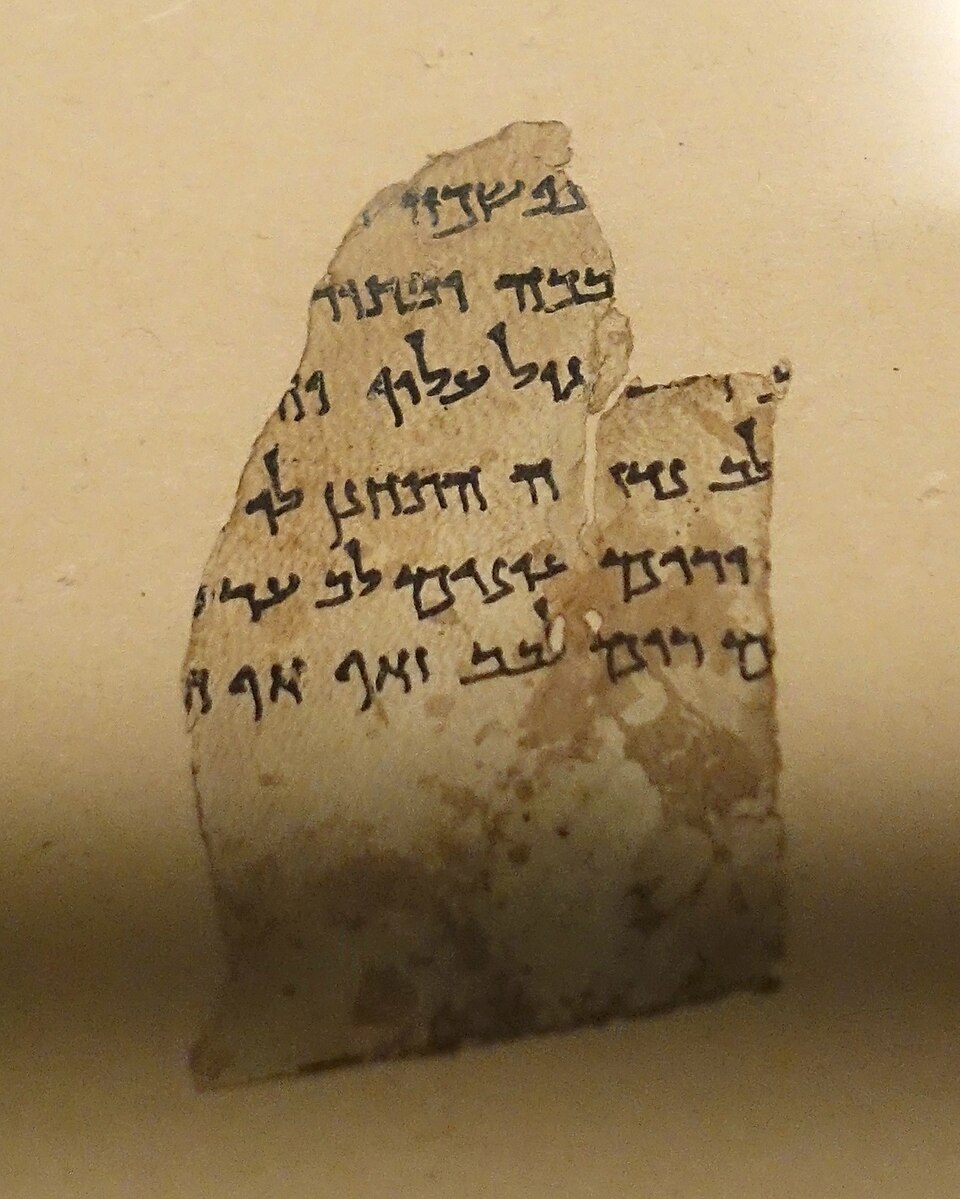
The Dead Sea ScrollsDead Sea ScrollsManuscript collections from the Judaean Desert, best known through Qumran: diverse works, languages and textual forms, with copying distinguished from composition.Glossary · Click to read the explanation from QumranQumranArchaeological site northwest of the Dead Sea near manuscript caves; its settlement and the groups who deposited the scrolls are studied together but not assumed identical. It is not synonymous with all Dead Sea Scrolls.Glossary · Click to read the explanation preserve Aramaic fragments, not a continuous Aramaic copy of all 36 chapters. 4Q201 contains portions corresponding to chapters 1–10 and possibly 12; 4Q202, parts of 5–10 and 14; 4Q204, traces of 1–6, 10, 13–15, 31–32 and 35–36; 4Q205, parts of 22 and 25–27; and 4Q206, parts of 20–22, 28–29 and 31–34. The quantity preserved varies greatly, and some identifications and restorations remain uncertain. Palaeographers date 4Q201 approximately to the first half of the second century BCE. It is an early physical witness, not a scroll written by Enoch. [3]
A substantial portion of the book survives in Greek, above all in Codex Panopolitanus, also called the Akhmim codex, probably copied in the fifth or sixth century CE. Its textual arrangement includes a repeated excerpt, and its longer sequence reaches approximately 1 Enoch 32:6a, not chapter 36. Other Greek quotations appear in George Syncellus, while a brief SyriacSyriacAn Aramaic literary language rooted in Edessa, first attested in non-Christian inscriptions and later prominent in Christian writing, scholarship, translation and liturgy.Glossary · Click to read the explanation witness preserves part of chapter 6. The connected text of chapters 1–36 chiefly survives in Ethiopic (Ge'ez), translated through Greek; the earliest surviving Ethiopic manuscripts date to around the fifteenth century CE. Those manuscript dates cannot be substituted for the date of composition, nor is every reading of a translation automatically the wording of the lost Aramaic. [3] [4]
The basic timeline is therefore: before the Flood, the story's setting; approximately the third century BCE, a commonly proposed period of composition and staged compilation; the second century BCE, some of the earliest surviving Aramaic copies; the fifth–sixth centuries CE, an approximate date for a major Greek manuscript; and around the fifteenth century CE, the earliest surviving Ethiopic manuscripts, not the original date of translation into that language. [2] [3] [4]
The distance between witnesses has practical consequences for quotation. Recent study of 4Q201 has shown that filling missing Aramaic letters from later Greek and Ethiopic versions can produce a composite reading that appears to preserve words the Aramaic fragment does not actually contain. Visible letters, an editor's restoration and the wording of a later text must be kept distinct. [5]
Descent, instruction and the giants
In chapter 6 the Watchers see human women and swear together to take them as wives. Shemihazah leads the group, which numbers two hundred and descends on Mount HermonMount HermonHermon, also Jabal al-Shaykh, is a Levantine mountain linked to the Watchers’ descent in 1 Enoch 6.Glossary · Click to read the explanation. The narrative associates the mountain's name with the group's oath; that is a story-internal explanation, not an established linguistic derivation of the place-name. Ancient copies need not agree in every detail of the leaders' names and number. [6]
Square brackets in this transcription identify restored letters or words, including part of Hermon's name. It should not be quoted as though the whole line were physically intact. The quotation was checked against an accessible transcription, not by firsthand examination of the parchment or a high-resolution image. [7]
In chapter 7 the offspring of these unions become giants whose appetite exhausts human provisions and turns into violence and bloodshed. Chapter 8 offers another explanation for the world's corruption: Asael teaches weapons, metalworking, ornaments and cosmetics, while other Watchers teach incantations and lore concerning stars and other phenomena. Aramaic and some Greek traditions have the name Asael, whereas Azazel is prominent in Ethiopic transmission and older translations. The variation does not, on its own, establish two unrelated figures or license silent harmonization. The story condemns knowledge used to corrupt and violate proper bounds; it is not historical evidence that these beings invented metallurgy or the observation of the heavens. [8] [9]
Complaint, sentence and Enoch's mediation
The earth and humanity cry out, and faithful angels intervene to carry out judgment. In the form of chapter 10, God orders a warning of the Flood to NoahNoahNoah is the flood-story figure in Genesis and a prophet in the Qur’anGlossary · Click to read the explanation, the binding of Asael in a dark place, the mutual destruction of the Watchers' offspring and the confinement of their leaders pending judgment. The destinies must be distinguished: the heavenly fathers do not turn into their offspring's spirits when punished, and the death of the giants does not immediately erase every consequence of evil. Several lines of punishment also help explain repetition and shifts of agency in this composite account. [10]
In chapters 12–16 Enoch is commissioned to announce the Watchers' fate. He writes their petition, reads it by the waters of Dan, and receives a vision of ascent into a heavenly structure and of the awe-inspiring divine throne; the answer is that the petition will not be accepted. His central roles are scribe, witness and messenger of authorized knowledge, not one who can overturn the sentence. The imagery of the heavenly houses is visionary religious literature, not an archaeological description of an identifiable building. [11] [13]
The giants' bodies and spirits
Chapter 15 draws a crucial distinction. The Watchers have a heavenly origin and have abandoned their appointed sphere; the bodies of their giant children die; but the spirits emerging from the offspring's bodies remain, within the narrative, evil spirits that harm people on earth. Thus the book does not assign an identical fate to the heavenly fathers, their offspring's bodies, and their offspring's spirits. [12]
This extract belongs to an old translation of a later textual witness, not to a surviving Aramaic line of the same sentence. Verses 15:9–12 continue describing the harmful spirits; 16:1 extends their activity toward the time of final judgment. The command to eliminate destructive spirits in 10:15 also appears to be in tension with the activity continuing until judgment in 16:1. The two passages should not simply be made identical; the literary combination may account for the difference. [10] [12] This is the story's explanation of evil and spirits, not independent evidence for supernatural creatures or the origin of every later doctrine about demons. [12]
Enoch's journeys and the geography of judgment
The book does not end with the angels' fall. Chapters 17–19 take Enoch to the extremities of the cosmos, places of fire and water and the destinations of offenders. Chapter 20 lists angels and their functions; chapters 21–36 portray bound stars and places of imprisonment, hollows where the souls of the dead await judgment, mountains and a fragrant tree, regions associated with blessing or curse, and the outer reaches and openings of the heavenly bodies. In chapter 22, for example, Greek and Ethiopic witnesses differ in their descriptions of the chambers for the dead; a single detailed arrangement should not be presented as unanimously preserved. [14]
These journeys combine imagined geography with judicial imagery: places disclose the significance of deferred punishment, cosmic order and the limits of human knowledge. Mention of the northern LevantThe LevantThe Levant is a regional name for lands along the eastern MediterraneanGlossary · Click to read the explanation, Mount Hermon or Dan does not make every landmark on the itinerary archaeologically or geographically identifiable. The fact that the long Greek sequence of the Akhmim codex stops near 32:6a, while Aramaic fragments preserve some corresponding material and the Ethiopic version proceeds to 36, also limits what can be attributed to that particular Greek manuscript. [4] [14]
Genesis, ancient comparisons and reception
The story is closely related to the brief episode in the Book of GenesisBook of GenesisHebrew book of the Torah containing Noah’s flood, survival offering and covenant with living creatures.Glossary · Click to read the explanation 6:1–4, which speaks of “sons of God,” human daughters and the NephilimNephilimHebrew name in Genesis 6:4 and Numbers 13:33, linked to ancient heroes and the scouts’ report; its identification with giants or heavenly offspring depends on interpretation.Glossary · Click to read the explanation, but says nothing about an oath on Hermon, named Watchers, weapon-making or the enduring spirits of giants. The Enochic tradition visibly elaborates the episode, turning an account of ancient figures into a searching account of corruption and punishment. Genesis itself, however, does not settle all later disputes about the identity of the “sons of God”; nor does the comparison establish the precise history of every earlier layer of the surviving texts. [17]
The Watchers' instruction has also been compared with traditions about the apkalluApkalluAn Akkadian term for a sage or expert. Specific texts describe seven primordial sages; rituals use related protective figures. Neither the titles nor the depicted forms are always identical.Glossary · Click to read the explanation, sages before the Flood in Mesopotamian literature. Amar Annus argues that Jewish authors constructed a counter-narrative to the sages' prestige; Henryk Drawnel links particular details of Asael's crafts and punishment to Late Babylonian artisans and anti-witchcraft practice. Such comparisons propose plausible cultural contexts but differ over the precise mechanism, for which a defensible chain of texts and dates is needed. Similarities in ancient learned arts alone prove neither direct borrowing from a specific composition nor a single origin for every layer of the Book of the Watchers. [15] [16]
The Book of JubileesBook of JubileesJewish retelling of Genesis and Exodus framed as angelic teaching to Moses, adding chronology, narratives and interpretation.Glossary · Click to read the explanation attests to Enochic traditions about the Watchers [19]; the New Testament Letter of Jude, verses 14–15, echoes 1 Enoch 1:9. Its Greek wording does not coincide exactly with the much later Akhmim manuscript, and scholars have debated divergent editions and revision. These are signs of the tradition's circulation and reception, not proof that the entire work always travelled in one unchanging volume. [18]
The Book of the Watchers can thus be read as an early Jewish attempt to account for spreading violence, misdirected knowledge and the persistence of evil within a world ordered by judgment. The evidence directly establishes early Aramaic witnesses, later versions with significant differences, and a composite narrative. The dates of every component, the extent of dependence on older traditions, and the wording of the lost Aramaic original remain scholarly questions rather than settled facts. [3] [5]
References and notes (19)
- Michael E. Stone discusses the units of the Book of the Watchers and Enoch’s changing role, using Nickelsburg’s division; Nickelsburg’s complete commentary was not consulted. Stone, 2022, introduction and Book of the Watchers section Return to the text ↑
- Proposed dates for composition and compilation, distinguished from the dates of the earliest surviving copies. Gurtner, Introducing the Pseudepigrapha, print pp. 24–26 Return to the text ↑
- Survey of Aramaic 4Q201–4Q206 and Greek/Ethiopic transmission; printed book pages are not the PDF’s page index. Gurtner, print pp. 23–24, “Language and Manuscripts” Return to the text ↑
- Study of the Akhmim Greek codex, its scribal structure and ending at 32:6a; the codex endpoint is not the endpoint of the Book of the Watchers. Jacobus, 2026, codex composition and discussion of 32:6a Return to the text ↑
- Documented caution against restoring Aramaic solely from later Greek and Ethiopic forms; indexed publisher passages were read but the publisher page itself was inaccessible. McCarron, Dead Sea Discoveries 31 (2024), 143–174, indexed sections 1–3 Return to the text ↑
- Chapter 6:1–8 in R. H. Charles’s historical public-domain English translation: oath, number and mountain; names vary in the witnesses. 1 Enoch 6:1–8; Charles, 1917 Return to the text ↑
- Published Aramaic transcription with restorations in square brackets; the excerpt was checked online, not against the parchment itself or a new palaeographic edition. 4Q201, fragment 1, col. iii, line 4; Abegg/Bowley/Cook transcription via The Ancient Bible Return to the text ↑
- Asael’s crafts and other teachings in chapter 8, in historical translation; the naming details vary by tradition. 1 Enoch 8:1–3; Charles, 1917 Return to the text ↑
- Gurtner distinguishes Shemihazah and Asael strands in the received work and notes uncertainty about reconstructing the component parts. Gurtner, print pp. 22–23, 25–26 Return to the text ↑
- Chapter 10 distributes penalties among Asael, the giants and the Watchers’ leaders; the summary does not flatten their fates into one punishment. 1 Enoch 10:1–16; Charles, 1917 Return to the text ↑
- The petition, its reading at Dan and Enoch’s mediation in chapter 13, from Charles’s historical translation. 1 Enoch 13:3–10; Charles, 1917 Return to the text ↑
- Verses distinguish Watchers, giant bodies and offspring spirits; the English extract follows Charles’s historical translation, retranslated editorially into Arabic and French. 1 Enoch 15:3–12, 16:1; Charles, 1917 Return to the text ↑
- The ascent vision, heavenly dwelling and rejection of the petition in chapter 14. 1 Enoch 14:1–25; Charles, 1917 Return to the text ↑
- Journey passages, especially the dead’s chambers in chapter 22; Charles explicitly juxtaposes different Greek and Ethiopic forms. 1 Enoch 17–22, 24–25; Charles, variant readings in ch. 22 Return to the text ↑
- Annus proposes a counter-narrative involving the apkallu sages; the publisher’s full text could not be opened, so only the academic abstract supports this limited characterization. Annus, Religions 15 (2024), article 1024; publisher abstract only Return to the text ↑
- Two specialist abstracts by Henryk Drawnel relate Asael’s skills to Late Babylonian crafts and his punishment to anti-witchcraft ritual; their full Polish articles were not read. Drawnel, Biblical Annals 3 (2015), 47–66 and 285–307; abstracts only Return to the text ↑
- Hebrew text of Genesis 6:1–4 and “sons of God,” compared with a modern interpretive translation; the passage lacks the Enochic narrative details. Genesis 6:1–4, Masoretic text on Sefaria Return to the text ↑
- Timothy Lee analyzes differences between Jude 14–15 and Akhmim Greek, proposing a Greek revision; the proposal is an interpretation, not a newly discovered manuscript. Lee, Journal for the Study of the Pseudepigrapha 34 (2025), abstract and opening Return to the text ↑
- Jubilees describes Enoch bearing witness against the Watchers: evidence for reception of a tradition, not a complete copy of the Book of the Watchers. Jubilees 4:17–23, historical Charles translation Return to the text ↑
Suggest a correction · Suggest a source for this record
Cite this record
IL Archive, «Book of the Watchers», https://ilarchive.com/en/entities/book-of-watchers
Continue reading