Entity
Book of Jubilees
A reference page linking a name, group, or concept to the materials that discuss it.
- Names
- Book of Divisions · Little Genesis
- Region
- Hellenistic Judaea (probable place of composition); Ethiopia (preservation of the complete version)
Jubilees is a Jewish rewriting of Genesis and early Exodus, probably dating to the second century BCE. The entry examines its 364-day calendar, its Hebrew witnesses from Qumran and its transmission in Geʽez.
Estimated reading time: 7 min Published Last reviewed:
Share article

Text
Introduction
What does the Book of Jubilees add to the stories told in the Book of GenesisBook of GenesisHebrew book of the Torah containing Noah’s flood, survival offering and covenant with living creatures.Glossary · Click to read the explanation and early ExodusBook of ExodusTorah book recounting Israel’s departure from Egypt and containing different formulations of seventh-day rest.Glossary · Click to read the explanation? This ancient Jewish work retells creation and the patriarchs as instruction delivered by an angel to MosesMosesCentral figure in Exodus, Torah traditions and the Qur’an; childhood accounts differ in detail.Glossary · Click to read the explanation at SinaiSinai: peninsula and biblical mountainSinai is a peninsula in eastern Egypt; in the Torah the name also denotes the mountain of revelation to MosesGlossary · Click to read the explanation. Reading it beside its scriptural counterparts shows how time, law and covenant could be reinterpreted in Hellenistic-period Judaism. [1] [2]
This entry considers the textual witnesses and the book's chronology, laws and major narratives, including NoahNoahNoah is the flood-story figure in Genesis and a prophet in the Qur’anGlossary · Click to read the explanation, MastemaMastemaFigure in Jubilees called Mastema or “prince of hostility”; leader of harmful spirits and proposer of trials under divine permission. Not automatically identical with every Satan or Belial tradition.Glossary · Click to read the explanation and AbrahamAbrahamCentral figure in Genesis, the Qur'an and Jewish, Christian and Islamic traditions; the sacrifice study compares what each text says about him.Glossary · Click to read the explanation. The period narrated is not the date of composition; the surviving complete Geʽez text is not the original HebrewHebrewA Northwest Semitic language of the Canaanite group, encompassing Iron Age epigraphy, Biblical, Rabbinic, medieval and Modern Hebrew; its scripts and pronunciations changed over time.Glossary · Click to read the explanation manuscript.
What is the book, and who narrates it?
In its conventional division, Jubilees has fifty chapters. It opens with Moses ascending the mountain, then surveys creation, the patriarchs and events leading towards the revelation of the law at Sinai. “Jubilees” is not a person's name. The work divides history into seven-year “weeks” and “jubilees” of seven such weeks—forty-nine years. Alternative titles include Little Genesis and Book of Divisions; they designate a literary work, not one surviving artifact. [1] [2]
Chapter 1 invokes heavenly tablets and knowledge of past and future events; the “angel of the presence” conveys material for Moses to record. This is the book's literary revelatory setting, not evidence that a manuscript written in Moses' lifetime survives. Its retelling selects some episodes from Genesis, expands others, and situates commandments in the age of the ancestors, long before Sinai in the story's chronology.
Composition, language and surviving witnesses
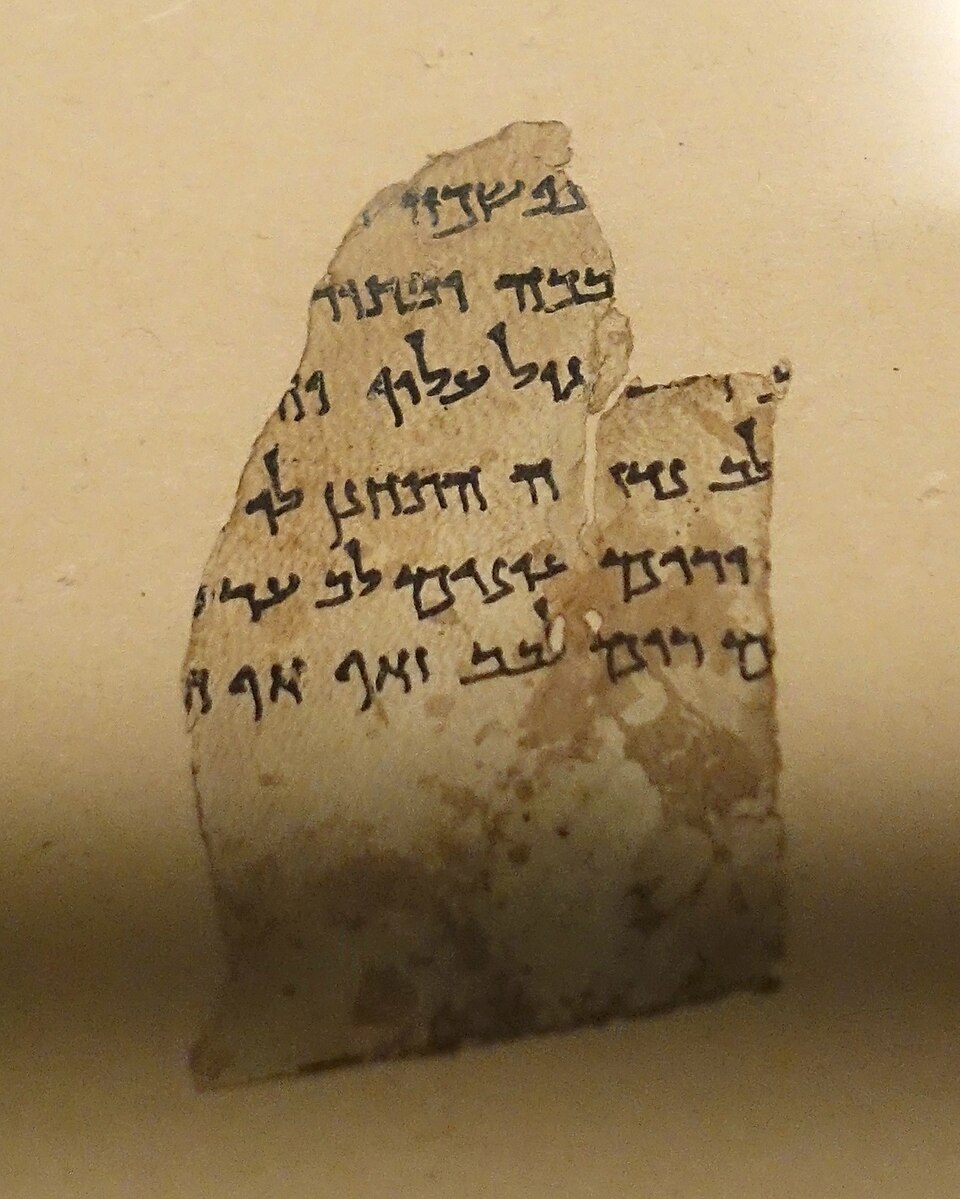
Most scholarship locates the book's composition in second-century BCE Jewish circles during the Second Temple periodSecond Temple JudaismDiverse Jewish traditions between the rebuilding of Jerusalem’s temple around 515 BCE and its destruction in 70 CE: institutions, diaspora, groups and texts, with distinctions between events, composition, manuscripts and the limits of evidence.Glossary · Click to read the explanation. Neither a precise year nor the author's identity is established. That historical assessment must be kept separate from the primeval dates claimed by the narrative. Hebrew fragments among the Dead Sea ScrollsDead Sea ScrollsManuscript collections from the Judaean Desert, best known through Qumran: diverse works, languages and textual forms, with copying distinguished from composition.Glossary · Click to read the explanation demonstrate the text's ancient circulation. One tangible witness is 4Q216, catalogued as “4Q Jubilees” by the Israel Antiquities Authority. It is fragmentary, not the complete work, and it does not prove that the Qumran copyists were its original authors. [3] [4]
The complete surviving form is transmitted in Geʽez, the classical literary and ecclesiastical language of Ethiopia. Partial evidence also survives through Greek, Latin and SyriacSyriacAn Aramaic literary language rooted in Edessa, first attested in non-Christian inscriptions and later prominent in Christian writing, scholarship, translation and liturgy.Glossary · Click to read the explanation transmission. Scholars commonly reconstruct a Greek stage between Hebrew and Geʽez; details of every copying or translation step remain uncertain. R. H. Charles's older English translation is useful for locating passages, but it is not a current critical edition collating all the witnesses. [1] [16]
Time divided: jubilees and the 364-day year
Chronology is an interpretive instrument, not mere bookkeeping. A jubilee is seven weeks of years, and chapter 6 prescribes a year of 364 days, precisely fifty-two seven-day weeks. The system places annual festivals in a stable weekly sequence and criticizes divergent reckoning of months and dates. It should not be equated automatically with every rule governing the biblical jubilee yearBiblical JubileeThe fiftieth-year law of Leviticus 25: family land restoration, limited release from servitude, and debate over debt remission and Deuteronomy 15.Glossary · Click to read the explanation, nor projected onto all contemporary Jewish groups. [5] [7]
Chapter 2 connects the SabbathSabbath, the weekly rest daySacred seventh day in Jewish traditions, linked by commandments to household rest, creation and liberation.Glossary · Click to read the explanation to creation and to angels who keep it. Chapter 50 closes the work with demanding rules for resting, travelling and worship on that day. Sacred time thus becomes part of communal identity. How a 364-day schematic calendar was reconciled, if at all, with the longer astronomical solar year remains debated; the literary text by itself does not document the practical adjustments of every community. [8] [15]
Covenant and law before Sinai
Chapter 6 retells Noah's emergence from the ark and the covenant after the Flood. It joins the prohibition on blood and the bow in the clouds to the Feast of Weeks and the renewal of covenant. This is Jubilees' interpretation of the covenant tradition, not a word-for-word copy of Genesis 9The Noahic Covenant in GenesisGenesis’s covenant with Noah, descendants and animals: promised in 6:18 and proclaimed in 9:8–17, assuring no flood will again destroy all flesh, with the cloud-bow as its sign.Glossary · Click to read the explanation. Chapter 15 makes circumcision the enduring sign of the covenant with Abraham and his descendants and emphasizes its eighth-day observance. [7] [10]
References to “heavenly tablets” authorize rules about purity, festivals and kinship long before Moses' era in the story. The writer therefore does more than fill gaps in biblical narrative: laws acquire a deeper antiquity and a heavenly warrant. John Endres argues that covenant and legal obligation are closely integrated in the work, though its retelling must still be distinguished from the underlying Torah narratives. [1]
Enoch, Watchers and dangerous spirits
Chapter 4 portrays Enoch son of JaredEnoch son of JaredEnoch son of Jared is a figure in the genealogy of Genesis 5, seventh when counted from Adam.Glossary · Click to read the explanation as learning writing and celestial knowledge and recording the deeds of generations. Chapter 5 explains disorder before the Flood through angels often called “Watchers,” their unions with women, their giant offspring and their punishment. These themes overlap with the wider Enoch tradition, especially the Book of the WatchersBook of the WatchersOpening unit of 1 Enoch (chapters 1–36), concerning the Watchers’ descent, offspring and judgment, Enoch’s mission and cosmic journeys; a composite work with multiple textual witnesses.Glossary · Click to read the explanation, but these are distinct writings; overlap alone does not establish one simple line of textual borrowing. [18] [9]
Angels in Jubilees teach, inscribe, warn and administer judgment. Distinguishing those functions prevents us from reducing its supernatural world to demons alone. Its account of cosmic and moral disorder is an ancient literary interpretation, not a historical inventory of spirits or a verifiable report of primeval events.
Noah, Mastema and remedies in chapter 10
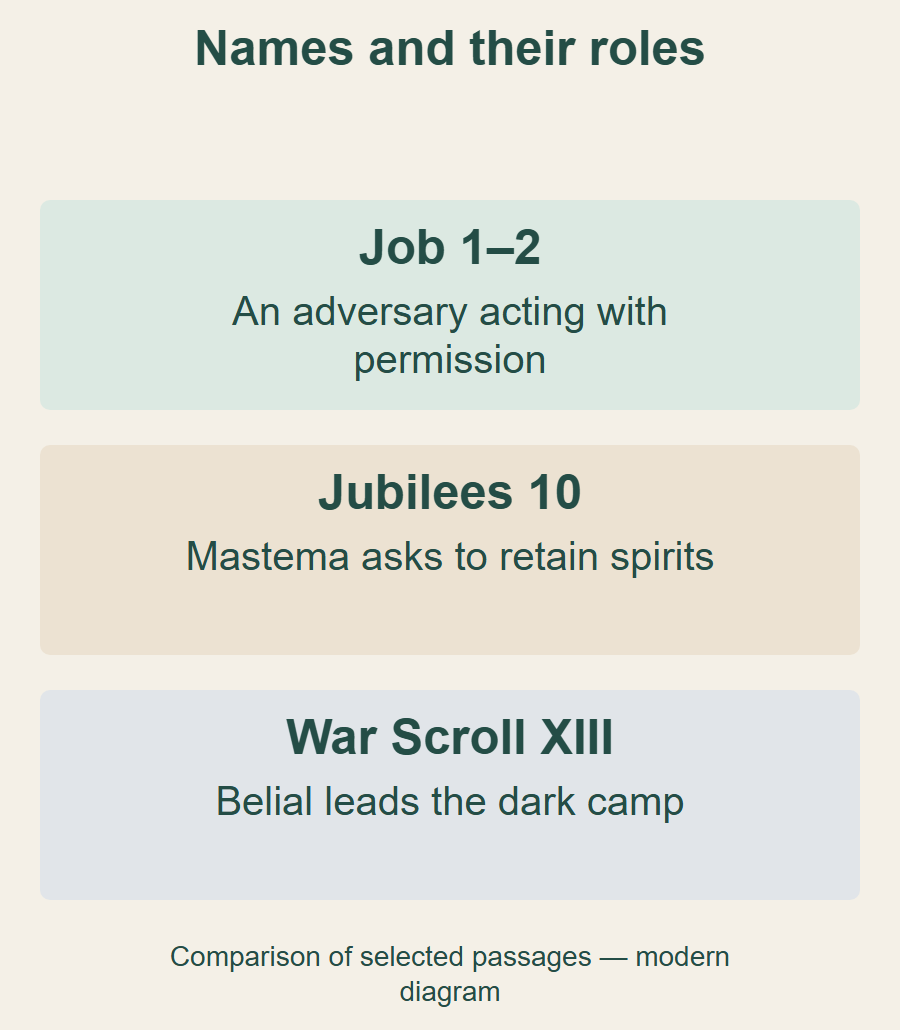
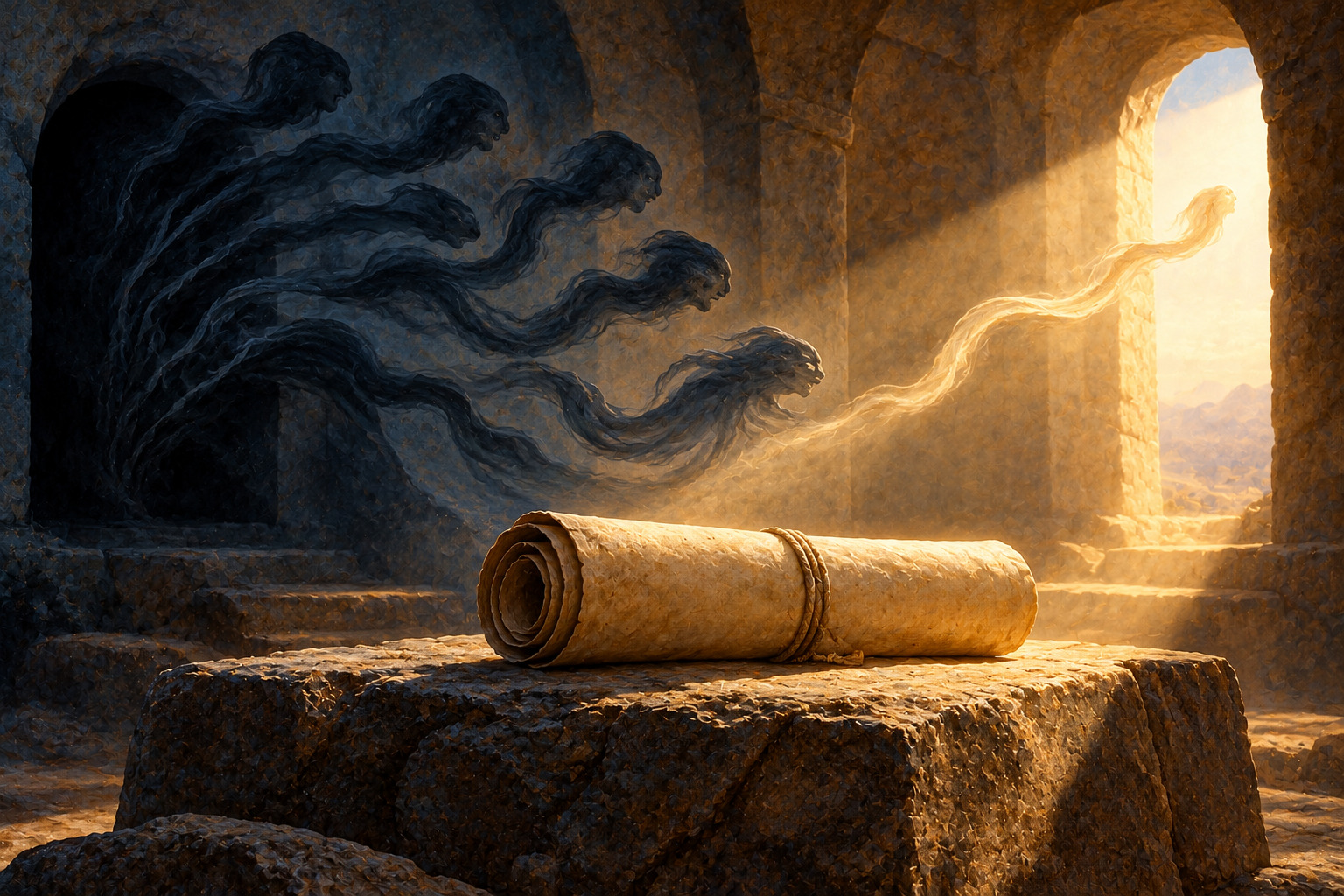
After the Flood, Noah's descendants complain that harmful spirits are attacking their children; Noah prays for their confinement. The command is given to bind them, but their leader Mastema requests that some remain under his authority. The narrative allows one tenth to remain and consigns nine tenths to confinement. Angels then teach Noah cures using plants of the earth; he records the instruction and passes it to his son ShemShem, son of NoahNoah’s son who receives his book of remedies in Jubilees 10, representing transmission of knowledge between generations within the account.Glossary · Click to read the explanation. These are consecutive elements of Jubilees 10:1–14, not a historical count of spirits or a separate medical handbook that survives as such. [6]
The episode couples a divinely limited allowance for harmful powers with knowledge that enables humans to resist them. The present cover is instead explicitly a newly generated imaginative illustration, not an ancient manuscript or authenticated reconstruction.
Abraham and the reshaping of narrative
In chapter 12, Abraham challenges his father Terah's idols; the tale adds the burning of an idol house and Haran's death in the fire. This expansion can be compared with Genesis but is not the same narrative verbatim. In Jubilees 17:15–18, Mastema urges a test in which Abraham would offer IsaacIsaacSon of Abraham and Sarah in Genesis; named explicitly in Genesis 22's sacrifice episode, while named after the unnamed-son scene in Qur'an 37.Glossary · Click to read the explanation. Chapter 18 narrates the binding of IsaacAkedah (binding of Isaac)Jewish name for Isaac’s binding in Genesis 22; his killing is stopped and a ram is offered instead. The story acquired varied interpretations and ritual uses.Glossary · Click to read the explanation, his rescue, and Mastema's humiliation. Genesis 22, by contrast, reports a test without identifying Mastema as its instigator. [11] [13] [14]
Scholar Kristen H. Lindbeck analyzes this scene in relation to the accuser in the Book of JobBook of JobHebrew wisdom text exploring suffering, justice and the limits of human knowledge through dialogue and poetry.Glossary · Click to read the explanation and later rabbinic interpretations. Her comparison shows how interpreters expanded a previous story in response to a theological question. It neither proves that every later treatment borrowed directly from Jubilees nor makes Mastema identical with every “Satan” figure in unrelated sources. [20]
Genealogies, purity and group boundaries
The author supplies names for women left unnamed in portions of GenesisBook of GenesisHebrew book of the Torah containing Noah’s flood, survival offering and covenant with living creatures.Glossary · Click to read the explanation, and places legal admonitions within ancestral speeches and family episodes. Chapter 30 turns the account of Dinah and Shechem into a forceful rationale for restrictions on intermarriage, purity rules and Levi's priestly role. Those demands express the text's position in ancient disputes; reporting them does not endorse them as modern ethics or describe the views of all Jews at the time. [12]
Chapter 23 also sketches a future of decline followed by renewed study of the law and restored wellbeing. Its chronology and moral history are vehicles of interpretation, not independently measured life expectancies or demonstrably dated events. [19]
Qumran, Ethiopia and reception
Hebrew copies at QumranQumranArchaeological site northwest of the Dead Sea near manuscript caves; its settlement and the groups who deposited the scrolls are studied together but not assumed identical. It is not synonymous with all Dead Sea Scrolls.Glossary · Click to read the explanation indicate circulation in certain late Second Temple Jewish settings, while calendrical and legal affinities with other scrolls invite comparison. Their presence alone does not establish Qumran authorship or universal Jewish acceptance. Conversely, complete Geʽez preservation allows us to read far more than the surviving Hebrew fragments contain. [3] [4]
Jubilees has a place among the scriptures of the Ethiopian Orthodox tradition, while its canonical standing differs across other Jewish and Christian traditions. Scholarship on Ethiopian biblical canon cautions that the content and use of canonical lists are more complicated than an unchanging, universally applied checklist. The book's present religious standing must therefore be distinguished from its ancient Jewish composition. [16] [17]
How to read Jubilees critically
The book is especially valuable as early evidence for rereading the Torah: structuring sacred time, extending legal obligations into the ancestral past, explaining disorder and covenant, and locating all this in Sinai revelation. These ideas reach modern readers through a layered manuscript and translation history. Any close claim requires a chapter and verse, identification of the witness, and clarity about whether a phrase comes from an old translation or a modern scholar's interpretation. [1] [4]
The narrated date of creation cannot date composition; a photographed Hebrew fragment is not the whole book; and a new illustration is not an archaeological document. Comparing Jubilees with related writings illuminates both continuity and change without reducing the work to one supposed source, or to the story of Mastema alone.
References and notes (20)
- John C. Endres, “Book of Jubilees,” Oxford Bibliographies, 2012; publicly accessible introduction only. Introduction: date, scope, Sinai frame and transmission. Return to the text ↑
- Book of Jubilees 1:1–4, 26–28, in the historical English translation of R. H. Charles hosted by CCEL; not a direct collation of Geʽez. Jubilees 1:1–4, 26–28. Return to the text ↑
- Israel Antiquities Authority, Leon Levy Dead Sea Scrolls Digital Library, “4Q Jubilees,” manuscript 4Q216; catalogue and image list, not a full reading of all fragments. 4Q216 catalogue, with DJD XIII pp. 1–22 as listed bibliographic reference (pages not consulted). Return to the text ↑
- James C. VanderKam, “Recent Scholarship on the Book of Jubilees,” Currents in Biblical Research 6, no. 3 (2008); abstract and bibliography only, full article restricted. Published abstract and reference list; textual witnesses, calendar, women and eschatology. Return to the text ↑
- Helen R. Jacobus, “calendars, Jewish,” Oxford Classical Dictionary, 2026; institutional abstract only. Abstract on 364-day schemes and calendrical diversity. Return to the text ↑
- Book of Jubilees 10:1–17, R. H. Charles’s historical English translation on Sacred Texts; the full passage was read in translation, not in Hebrew or Geʽez. Jubilees 10:1–17, especially 1–14 (Mastema and Noah’s remedies). Return to the text ↑
- Book of Jubilees 6, Charles’s English translation at CCEL; chapter page consulted. Jubilees 6:1–38, especially 4–22 and 29–38. Return to the text ↑
- Book of Jubilees 2, Charles’s English translation at CCEL; chapter inspected. Jubilees 2:1–33, especially 1–2 and 17–32. Return to the text ↑
- Book of Jubilees 5, Charles’s English translation at CCEL; the Watchers, giants and corruption before the Flood. Jubilees 5:1–10. Return to the text ↑
- Book of Jubilees 15, Charles’s English translation at CCEL; circumcision and covenant. Jubilees 15:3–34. Return to the text ↑
- Book of Jubilees 12, Charles’s English translation at CCEL; Abraham and his father’s idols. Jubilees 12:1–14. Return to the text ↑
- Book of Jubilees 30, Charles’s English translation at CCEL; Dinah, Shechem and community laws. Jubilees 30:1–26. Return to the text ↑
- Book of Jubilees 17, Charles’s English translation at CCEL; Mastema and the test of Abraham. Jubilees 17:15–18. Return to the text ↑
- Book of Jubilees 18, Charles’s English translation at CCEL; binding of Isaac and the trial’s outcome. Jubilees 18:1–19. Return to the text ↑
- Book of Jubilees 50, Charles’s English translation at CCEL; closing Sabbath rules. Jubilees 50:1–13. Return to the text ↑
- Leslie Baynes, “Enoch and Jubilees in the Canon of the Ethiopian Orthodox Church,” Brill publisher preview; opening paragraph only. Accessible introductory paragraph on Ethiopian canon lists. Return to the text ↑
- Bruk A. Asale, “The Ethiopian Orthodox Tewahedo Church Canon of the Scriptures: Neither Open nor Closed,” 2016; abstract only. Published abstract on Ethiopian canonical-list complexity. Return to the text ↑
- Book of Jubilees 4, Charles’s English translation at CCEL; genealogies, Enoch and his record of generations. Jubilees 4:1–26, especially 16–25. Return to the text ↑
- Book of Jubilees 23, Charles’s English translation at CCEL; degeneration, renewed study of law and the future. Jubilees 23:9–32. Return to the text ↑
- Kristen H. Lindbeck, “The Satan Provokes God into Testing Job and Abraham,” TheTorah.com, 2025 (updated 2026); article read, notably the Jubilees, Job and Akedah sections. “Bringing Mastema into the Akedah” and rabbinic parallels; teaser’s C.E. date conflicts with the article body’s B.C.E. Return to the text ↑
Suggest a correction · Suggest a source for this record
Cite this record
IL Archive, «Book of Jubilees», https://ilarchive.com/en/entities/book-of-jubilees
Continue reading