Entity
Essenes
A reference page linking a name, group, or concept to the materials that discuss it.
A Jewish movement of the late Second Temple period described by several ancient sources; the review compares communal life, admission, purity and afterlife with the texts and archaeology of Qumran.
Estimated reading time: 6 min Published Last reviewed:
Share article
Text
Introduction
The Essenes were a Jewish movement of the late Second Temple periodSecond Temple JudaismDiverse Jewish traditions between the rebuilding of Jerusalem’s temple around 515 BCE and its destruction in 70 CE: institutions, diaspora, groups and texts, with distinctions between events, composition, manuscripts and the limits of evidence.Glossary · Click to read the explanation, conventionally situated between the middle of the second century BCE and the first revolt against Rome (66–73 CE). Their historical setting is Judaea, not simply one desert settlement. Ancient descriptions, communal rules and excavated remains must be compared without assuming that they speak for an identical population. [2]
A movement described from outside
The Jewish historian JosephusFlavius JosephusFirst-century Jewish historian who retold older narratives, including Abraham’s test, in Jewish Antiquities.Glossary · Click to read the explanation, writing in the later first century CE, and the Alexandrian Jewish philosopher Philo of AlexandriaPhilo of AlexandriaGreek-writing Jewish interpreter in Roman Alexandria (roughly first century CE), who read the Torah philosophically while defending its practices; his works survive through Greek copying and Armenian translation.Glossary · Click to read the explanation, active earlier in that century, describe demanding forms of Jewish communal life: shared resources, discipline, religious learning and carefully regulated admission. Their accounts nevertheless select different features. Josephus presents the Essenes among Jewish philosophical schools; Philo makes their conduct an example of freedom through virtue. These are interpretations of a community, not its surviving membership register. [1][3]
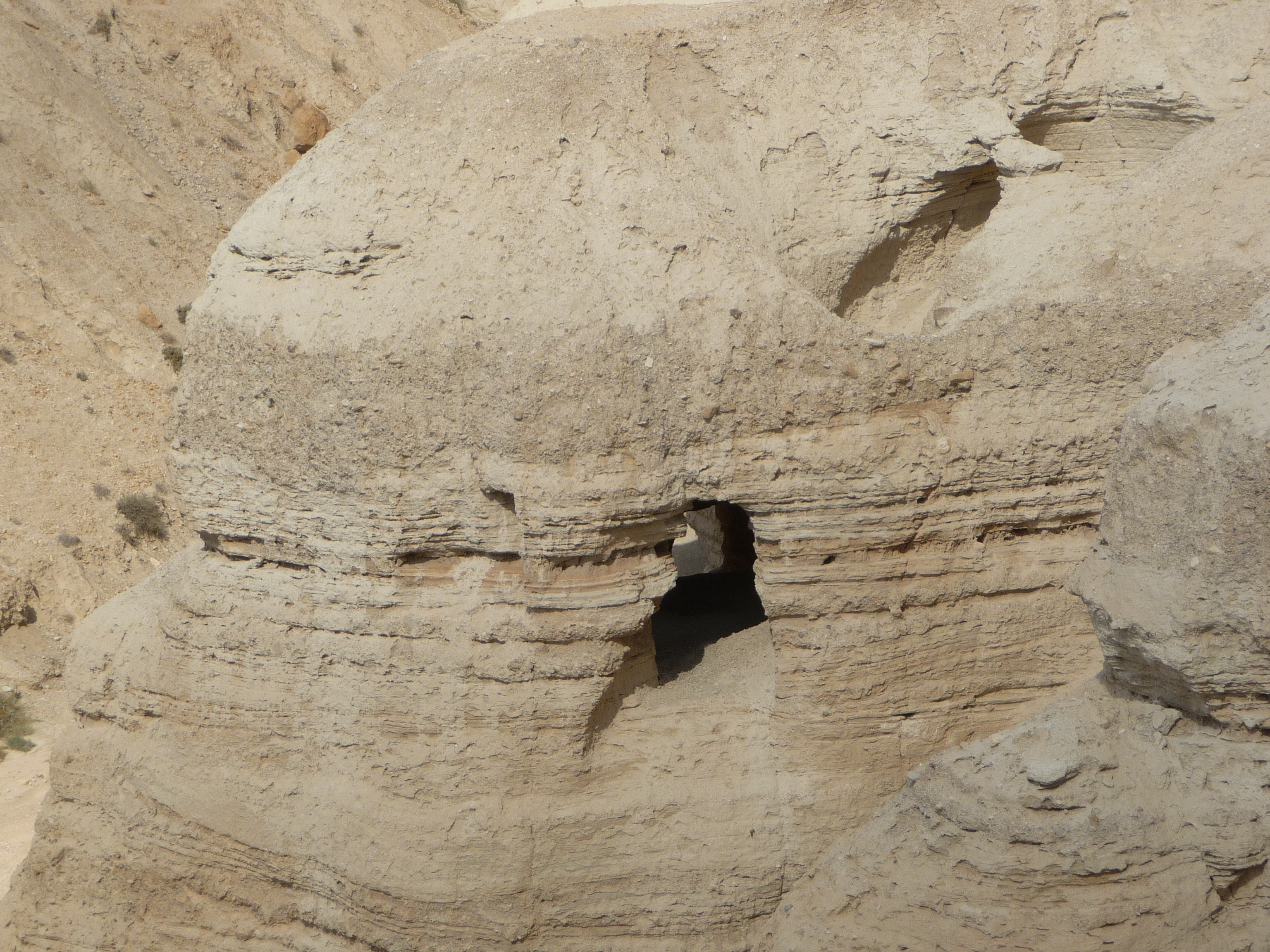
The association with QumranQumranArchaeological site northwest of the Dead Sea near manuscript caves; its settlement and the groups who deposited the scrolls are studied together but not assumed identical. It is not synonymous with all Dead Sea Scrolls.Glossary · Click to read the explanation, an archaeological site near the northwestern shore of the Dead SeaDead SeaThe Dead Sea is a salt lake in the Jordan Rift Valley, near sites where ancient manuscripts were foundGlossary · Click to read the explanation, is influential, but the name Essenes does not explicitly occur in the Dead Sea ScrollsDead Sea ScrollsManuscript collections from the Judaean Desert, best known through Qumran: diverse works, languages and textual forms, with copying distinguished from composition.Glossary · Click to read the explanation. Connecting a named movement with anonymous writings therefore requires an argument, rather than recognition of a self-identifying label. Neither a manuscript found near the site nor an ancient description automatically represents every Essene. [2][7]
Cities, villages and networks
Josephus states in Jewish War 2.124:
Our translation: “No single city is theirs; rather, many of them reside in each.” [1]
He follows this with arrangements for hospitality: travellers can receive supplies from fellow members rather than transport everything themselves. This describes a network whose cohesion need not depend on permanent residence in one place. [1]
Philo's Every Good Man Is Free 76 instead locates them in villages, avoiding the moral dangers of cities. Yet his Hypothetica 11.1 includes cities of Judaea, villages and larger communities. The contrast is therefore not simply “Josephus says cities, Philo says villages.” Philo himself preserves two geographical portraits. They may emphasize different settings or serve different arguments; neither licenses reducing the movement to a secluded monastery. [3]
Work, solidarity and differing households
Philo describes farming and peaceful crafts, pooled earnings and support for people unable to work through age or illness. His rejection of slavery connects communal practice with an argument about human equality. Sabbath gatherings include reading and exposition, so the group is portrayed as a learning community as well as an economic association. Josephus similarly makes shared property and organized meals central to membership. [1][3]
Celibacy, however, cannot define every Essene. After describing a nonmarrying community, Josephus introduces another order in War 2.160–161 that shares its customs but accepts marriage for procreation. His distinction is substantive, not an accidental exception to erase. Likewise, Philo's rejection of arms manufacture does not establish universal absolute pacifism: Josephus allows travellers weapons against robbers. These details show why a single modern stereotype obscures the ancient accounts. [1][3]
Purification and the Jerusalem Temple
In Antiquities 18.19, offerings sent to the Temple coexist with separation associated with distinctive purification. The sacrifice wording is difficult: textual witnesses and translations differ over whether the Essenes perform sacrifices differently or do not offer them. Archaeologist Jodi Magness also notes ambiguity in Philo's contrast between animal sacrifice and sanctifying the mind. [4]
The important historical question is thus not merely whether the Essenes were “for” or “against” the Temple. Sending offerings, entering a shared sacred enclosure and participating in sacrifice are different acts. Disagreement over acceptable purity could regulate access without making JerusalemJerusalemJerusalem is a city of religious importance in Judaism, Christianity and IslamGlossary · Click to read the explanation religiously irrelevant. Conversely, this passage does not by itself locate a separate sacrificial altar at Qumran. [4]
A rule for eating, blessing and deliberation
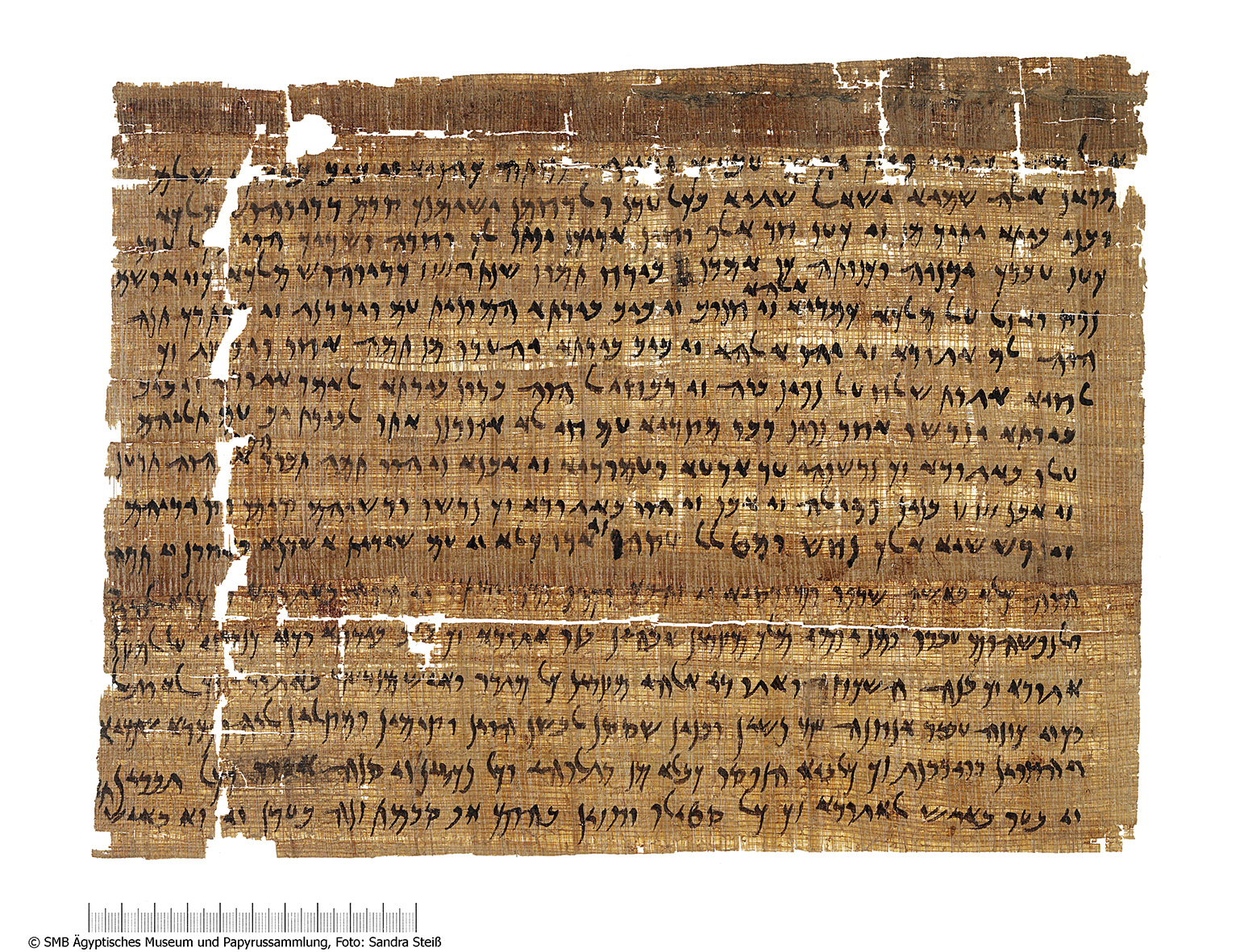
The Community RuleCommunity RuleHebrew text among the Dead Sea Scrolls; the copy designated 1QS includes teaching on the spirits of truth and perversity and conflict within the human heart.Glossary · Click to read the explanation provides a different kind of evidence: instructions for organized communal conduct rather than an outsider's portrait. In manuscript 1QS, column VI, lines 2–3, a compact sequence connects three activities. [5]
Own translation: “Together they shall eat, together they shall bless, and together they shall deliberate.” [5]
The repeated “together” joins material sustenance, worship and decision-making. The adjoining provisions arrange assemblies by rank and require a priest in a group of ten. Shared life therefore does not mean the absence of authority or distinctions. The passage tells us what this rule prescribes; it does not demonstrate how consistently every community followed it. [5]
Admission sharpens the comparison. In 1QS 6.13–23, examination and instruction precede successive years of restricted participation. After the first year, review governs acceptance of property into supervised custody; access to the community's drink awaits completion of the second year and further assessment. Josephus instead describes one initial year, followed by two further years before full admission. Graduated testing resembles the rule, but the timetables are not identical. [1][5]
Scrolls scholar Charlotte Hempel treats the Community Rules as an evolving, multiple-witness tradition. Copy dates differ from literary development; prescribed communities are not transparent social records. [6]
Death and the soul
In War 2.154, the core clause of Josephus’s account reads:
Our translation: “Bodies are perishable and their matter is not lasting, whereas souls remain immortal forever.” [1]
In 2.154–158 he describes release from bodily confinement and different destinies for good and wicked souls. He explicitly compares this with Greek accounts of the blessed and punishment after death. His exposition links expectation of future judgement to virtuous conduct. [1]
This is the author's formulation of immortality. It is not sufficient evidence to call the belief bodily resurrection, nor should a different eschatological passage among the scrolls silently replace what Josephus actually says. The wording, its philosophical comparison and the identity of the speaking author all matter to the historical claim. [1]
What Qumran contributes
Magness's archaeological case draws on communal installations, purity facilities, burial patterns and pottery connections between settlement and caves. Such converging observations support a sectarian interpretation more strongly than one isolated object does. They still require interpretation: a bath is not an inscription naming its users, and proximity does not make every manuscript a local composition. [7]
Chronology remains contested even among scholars accepting an Essene connection. Magness challenges Joan Taylor's reconstruction of occupation after 68 CE, pointing to the reduced settlement and disuse of communal assembly spaces; Taylor's response corrects the review's account of her proposal: she places final abandonment around 115 CE, not 135, and distinguishes Roman occupation from possible subsequent Essene reoccupation. Their disagreement should not be converted into consensus. [7]
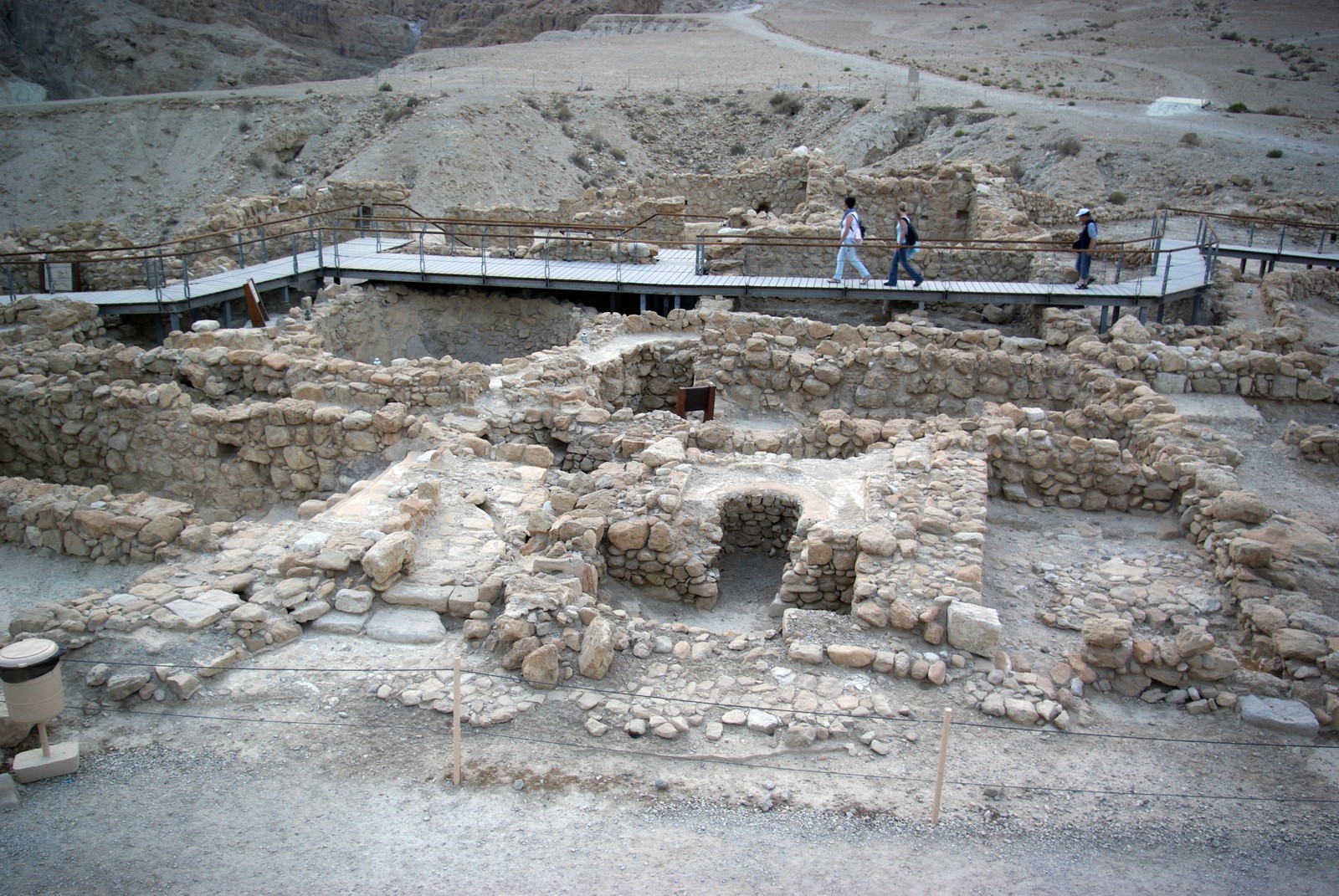
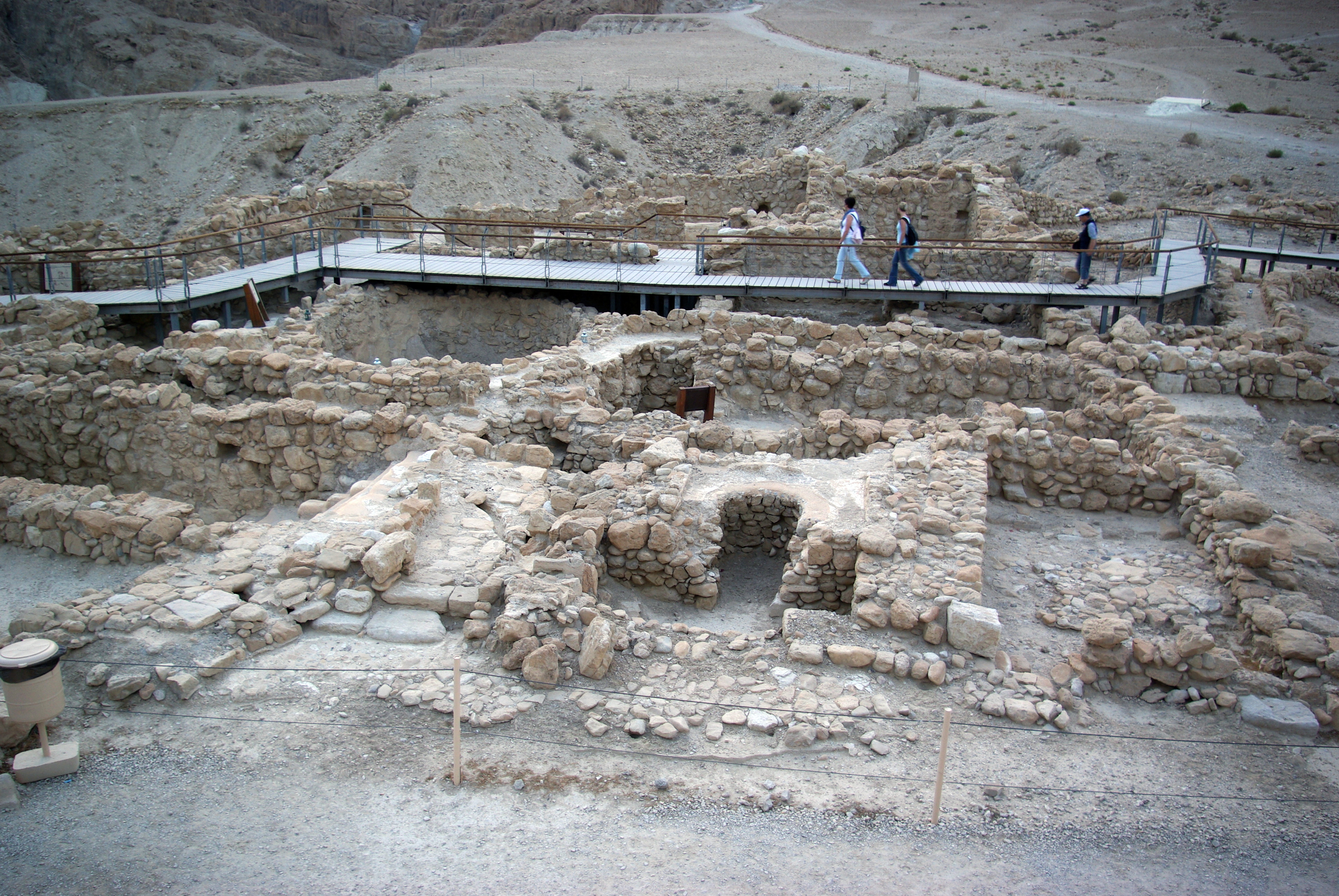
The modern photograph by Berthold Werner situates the reader at the excavated site. It is contextual evidence of the place as photographed, not a portrait of ancient Essenes or proof that the visible remains constituted their temple. [9]
A new estimate is not a new composition date
Hempel's 2020 discussion reports the conventional palaeographic dating of 1QS to 100–75 BCE. The 2025 Enoch study, combining radiocarbon training data with handwriting analysis, instead proposes a second-century BCE date for its copying. Its supplementary blind-test table gives 190–100 BCE, alongside the palaeography experts’ evaluation of 150–100 BCE in the same table. These are distinct evaluations, not interchangeable calibrated radiocarbon intervals. [6][8]
The result is a probabilistic model prediction, not a new direct carbon measurement of 1QS. The study explicitly recognizes earlier radiocarbon testing in the 1990s. Even if the earlier copying estimate gains acceptance, it would not date the composition of every layer of the rule, establish when the Essenes originated, or prove when Qumran first housed them. Historical activity, textual formation and surviving copies remain connected but different questions. [8]
References and notes (9)
- Flavius Josephus, Jewish War, book 2; Greek attributed by the host to Niese (1895), with William Whiston’s English translation (1826), in Luke Dysinger’s parallel presentation. Selected passages read: 2.124–129 on residence and hospitality; 2.137–139 on an initial year and two further years of admission; 2.154–158 on bodily decay, immortal souls and the Greek comparison; 2.160–161 on the other order admitting marriage. Greek and English were compared at these passages, not the whole book. Displayed Greek excerpts are continuous text from 2.124 and 2.154, without internal omission; translations our own. Return to the text ↑
- Otto Betz, “The Essenes,” The Cambridge History of Judaism, vol. 3 (Cambridge University Press, 1999), pp. 444–470. Publisher’s public summary only, not the full chapter: approximate span from the mid-second century BCE to the first Jewish revolt, outside sources and the absence of the explicit Essene name from the scrolls. The summary was checked anew for this revision. For the revolt’s 66–73 CE dates: Andrew S. Jacobs, “Independence: From Hasmoneans to Herodians,” RLST 124I handout 4, 9 April 2009, p. 1; Josephus paragraph consulted for the war dates only: https://andrewjacobs.org/ancientjudaism/handout4.pdf . Return to the text ↑
- Philo of Alexandria, Every Good Man Is Free 75–91; Hypothetica 11.1–18, preserved in Eusebius, Preparation for the Gospel 8.11; C. D. Yonge’s English translation, hosted by Early Christian Writings. The two specified passages were read in translation, not a complete Greek edition. Free 76 describes villages; 78–87 cover work, slavery, Sabbath and shared resources. Hypothetica 11.1 includes Judaean cities and villages; 11.14–17 discuss nonmarriage. Second text: https://www.earlychristianwritings.com/yonge/book37.html . Their difference does not establish a sequence or a later correction by Philo. For Philo’s first-half-of-the-first-century CE setting: Betz’s public summary cited in note 2, Sources paragraph. Return to the text ↑
- Josephus, Jewish Antiquities 18.18–19, English translation at the Center for Online Judaic Studies; Jodi Magness, “Were Sacrifices Offered at Qumran? The Animal Bone Deposits Reconsidered,” in David Hellholm and Dieter Sänger (eds.), The Eucharist—Its Origins and Contexts, vol. I (Mohr Siebeck, 2017). Jewish Antiquities 18.18–19 read; Magness, printed pp. 134–135, especially p. 135 and notes 20–23, not the whole chapter. Preview: https://api.pageplace.de/preview/DT0400.9783161539190_A32750918/preview-9783161539190_A32750918.pdf . Return to the text ↑
- Sarianna Metso, The Community Rule: A Critical Edition with Translation, with a contribution by Michael A. Knibb, Early Judaism and Its Literature 51 (SBL Press, 2019). Printed pp. 32–37 (PDF pp. 42–47) read, with visual checks of Hebrew on pp. 32 and 36: quotation at 1QS 6.2–3 and admission stages at 6.13–23. Spelling checked against Qumran-Digital: https://lexicon.qumran-digital.org/transcriptions/1QS/2023-12-08/index.html?end_reading_id=5770&v=2023-12-08 . Metso compares multiple witnesses; her translation is not a continuous diplomatic transcription of a single manuscript. Neither the entire edition nor every apparatus entry was read. Return to the text ↑
- Charlotte Hempel, The Community Rules from Qumran: A Commentary, TSAJ 183 (Mohr Siebeck, 2020), DOI: 10.1628/978-3-16-157027-8. Preview reading: preface V–VI and introduction pp. 1–3 and 8–9 only; not the whole book or its detailed commentary on column 6. Return to the text ↑
- Jodi Magness, “The Archaeology of Qumran and the Dead Sea Scrolls (Grand Rapids, MI: Eerdmans, 2002),” Bible Interpretation, June 2003; her review “The Essenes and the Qumran Settlement,” Marginalia, 1 May 2014; Joan Taylor, “MRBlog: Joan Taylor responds to Jodi Magness,” Marginalia, 15 December 2014. Complete bodies of the 2003 article and 2014 review read, not Magness’s or Taylor’s books. Review: https://themarginaliareview.com/the-essenes-and-the-qumran-settlement-by-jodi-magness/ . Taylor’s reply: points 1–3 and 7–11 with context, https://themarginaliareview.com/mrblog-joan-taylor-responds-jodi-magness/ . Return to the text ↑
- Mladen Popović et al., “Dating ancient manuscripts using radiocarbon and AI-based writing style analysis,” PLOS ONE 20(6), e0323185, 4 June 2025; supplement S7. Abstract, sections 1–2.1 and 6, and discussion paragraphs on model limitations read; S7 sections 7.4–7.5 and Table S11 (PDF p. 9), not all supplements. Section 6 suggests a second-century BCE date for the 1QS copy through probabilistic handwriting analysis, not a new direct carbon measurement or a composition date for every textual layer. S7.5 acknowledges 1990s carbon tests. Supplement: https://journals.plos.org/plosone/article/file?id=10.1371/journal.pone.0323185.s007&type=supplementary . Return to the text ↑
- Berthold Werner, Palestine Qumran BW 4.jpg, photograph of Qumran, 12 November 2008, Wikimedia Commons. Specific file page and the photographer’s public-domain dedication (PD-self). A modern view of the excavated site, not identification of an ancient temple or proof that all Essenes lived at Qumran. Image inspected in full and at 340 pixels wide. Return to the text ↑
Media
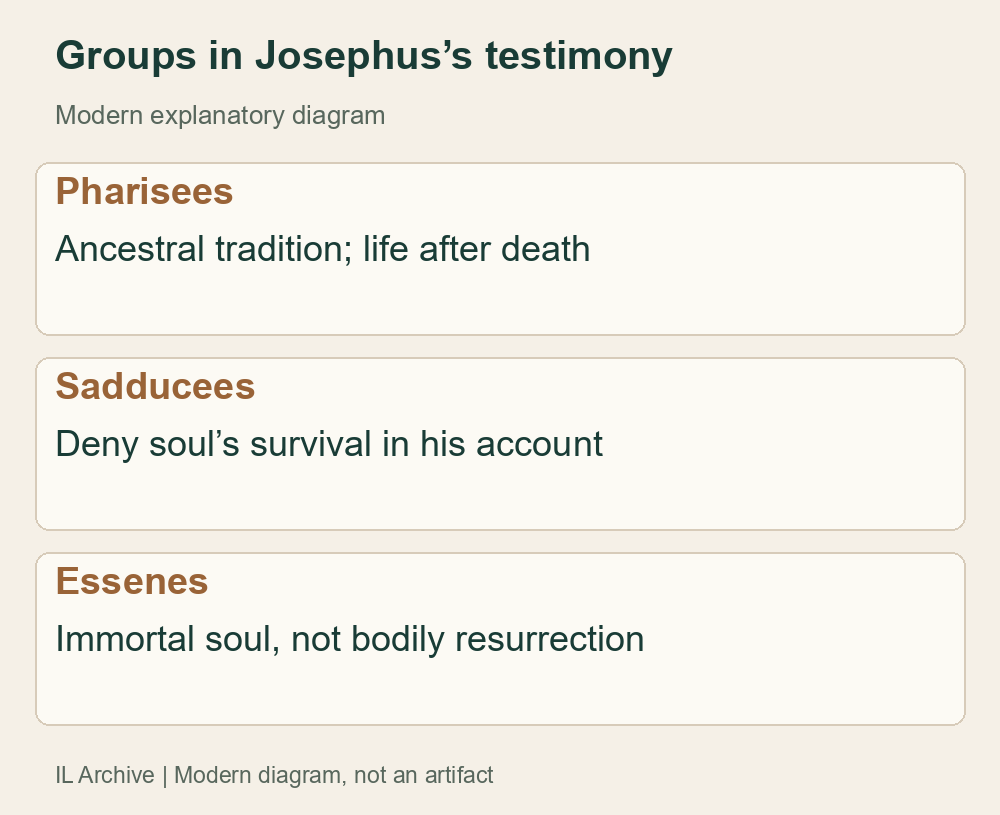
Illustration — not a photograph of the original object
Modern comparison of an ancient outside author’s account. Josephus uses Greek philosophical language; this is neither the groups’ own manifesto nor an account of all Jews
IL Archive · original diagram · CC BY
Image sourceSuggest a correction · Suggest a source for this record
Cite this record
IL Archive, «Essenes», https://ilarchive.com/en/entities/essenes
Continue reading