Study
El at Ugarit
An extended study of a topic, with evidence and references.
- Region
- Ugarit (Ras Shamra), Syrian coast
El’s fatherly and royal authority at Ugarit beside Baal’s martial kingship: titles, Dagan’s son, Athirat’s intercession and her “seventy sons,” separating narrative claims from history.
Estimated reading time: 11 min Published Last reviewed:
Share article
Video
The Name that Crossed Millennia: Who is El?
Our first documentary follows the name El back through 4,000 years of surviving evidence, from names we use today to the tablets of Ugarit and Ebla. Some scenes are AI-generated illustrations.
The YouTube player loads only when you press play. Watch on YouTube
Dates
Dates have distinct roles. The timeline uses creation, composition or historical coverage, rather than publication or discovery dates.
- Historical coverage
- Approximately From 1400 BCE to 1200 BCE
Text
Introduction
How could El preside over UgaritUgaritAncient city and kingdom at Ras Shamra on the Syrian coast, flourishing between the fourteenth and early twelfth centuries BCE and preserving multilingual archives.Glossary · Click to read the explanation’s divine household while Baal drives the most dramatic action in its myths? This study examines titles, parenthood, the council and the episode in which Baal obtains permission to build his palace, comparing the father-king’s standing with the storm god’s active kingship.
The evidence comes from Late Bronze AgeLate Bronze AgeAn archaeological period around 1600–1200 BCE in much of the Near East, with international diplomacy, exchange and religious diversity; its endpoints vary by region.Glossary · Click to read the explanation tablets and explicitly delimited scholarship. It is essential to distinguish what the ancient texts say from scholarly interpretation, and an actual archaeological object from a conjectural identification of the god it portrays. [1][6][11]
Father, King and Head of the Council
At Ugarit, ElElEl is a senior deity in Late Bronze Age Ugaritic texts, portrayed as father of the divine family and a council authority, alongside his consort Athirat. This entry does not cover every linguistic use of El.Glossary · Click to read the explanation emerges from the brief name into narrative. We are no longer dealing with an element in a personal name that might mean “god,” but with a character who speaks, decides and grants offspring, and whom other gods approach for approval. He has a dwelling and belongs to a household and council; his titles evoke father, king and bull.
Yet the most active god in the Baal CycleBaal CycleA group of Late Bronze Age Ugaritic religious texts recounting Baal’s conflicts, relationships with the gods and the building of his palace.Glossary · Click to read the explanation is BaalBaalUgaritic storm god and warrior king who defeats Yamm, builds his palace with El’s consent and confronts Mot. References to El and Dagan as fathers do not define a single genealogy.Glossary · Click to read the explanation: he fights Yamm, the Sea, confronts Mot, Death, and builds his palace. How can El remain head of the divine world while Baal occupies the centre of the action?
The texts allow us to distinguish two overlapping forms of authority: El’s seniority, fatherhood and approval, and Baal’s martial power and active sovereignty. This is an interpretation of the myths, not a rule that every act of Baal requires advance permission. The clearest example is the palace episode. [3][6]
The city that let El speak again
Ugarit lies at Ras Shamra on the Syrian coast, about eleven kilometres north of LatakiaLatakiaA coastal city in Syria, south of ancient Ugarit at Ras Shamra.Glossary · Click to read the explanation. Excavations began in 1929 and recovered a Late Bronze Age archive. The material summarized by Nicolas Wyatt runs from the late fourteenth century to the first decade of the twelfth century BCE. These are dates of surviving evidence, not the birth date of El or the myths. [1]
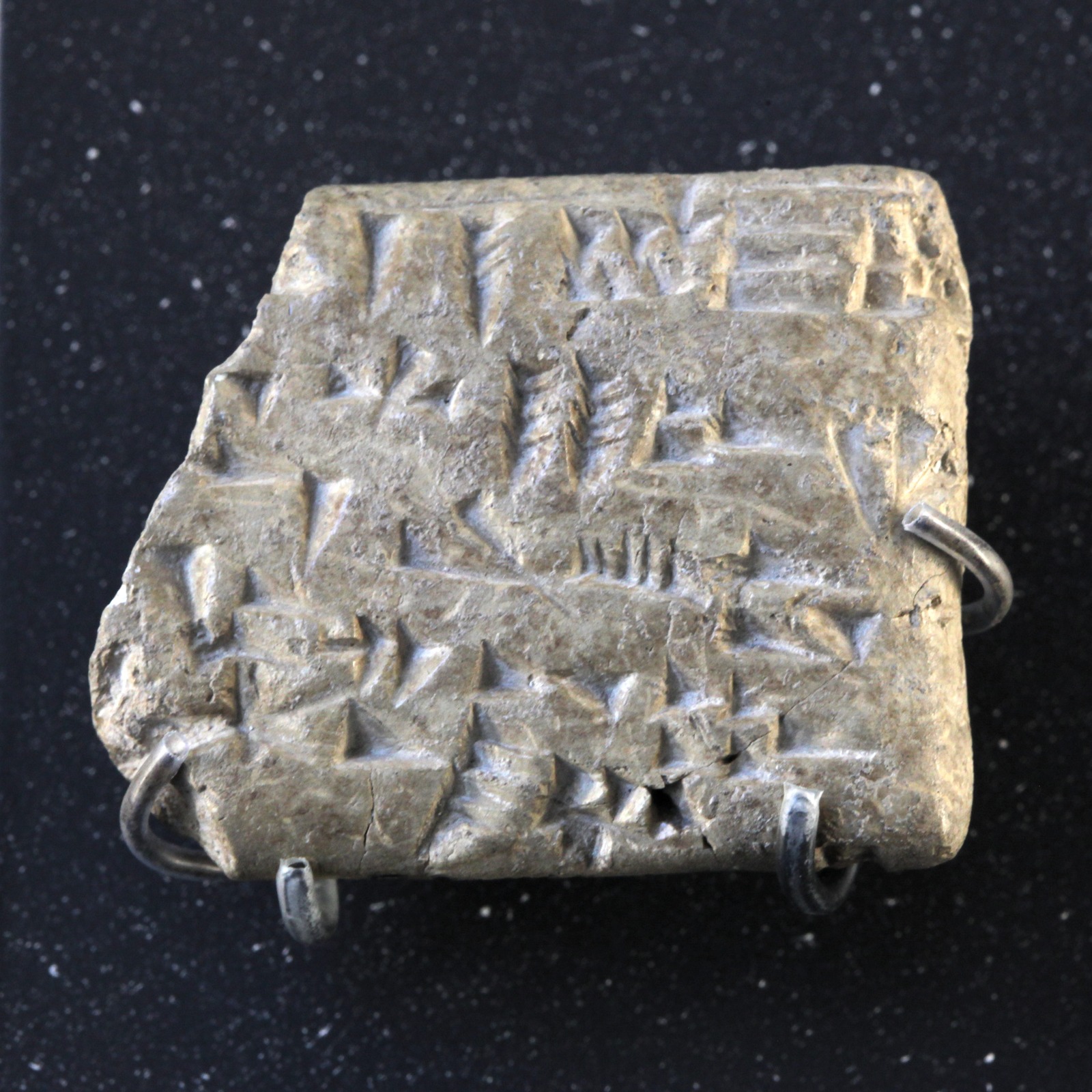
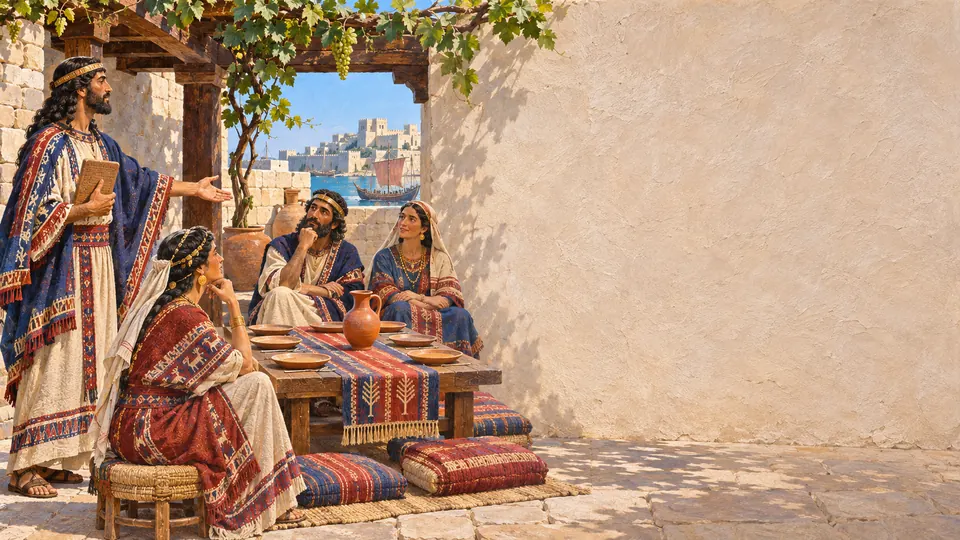
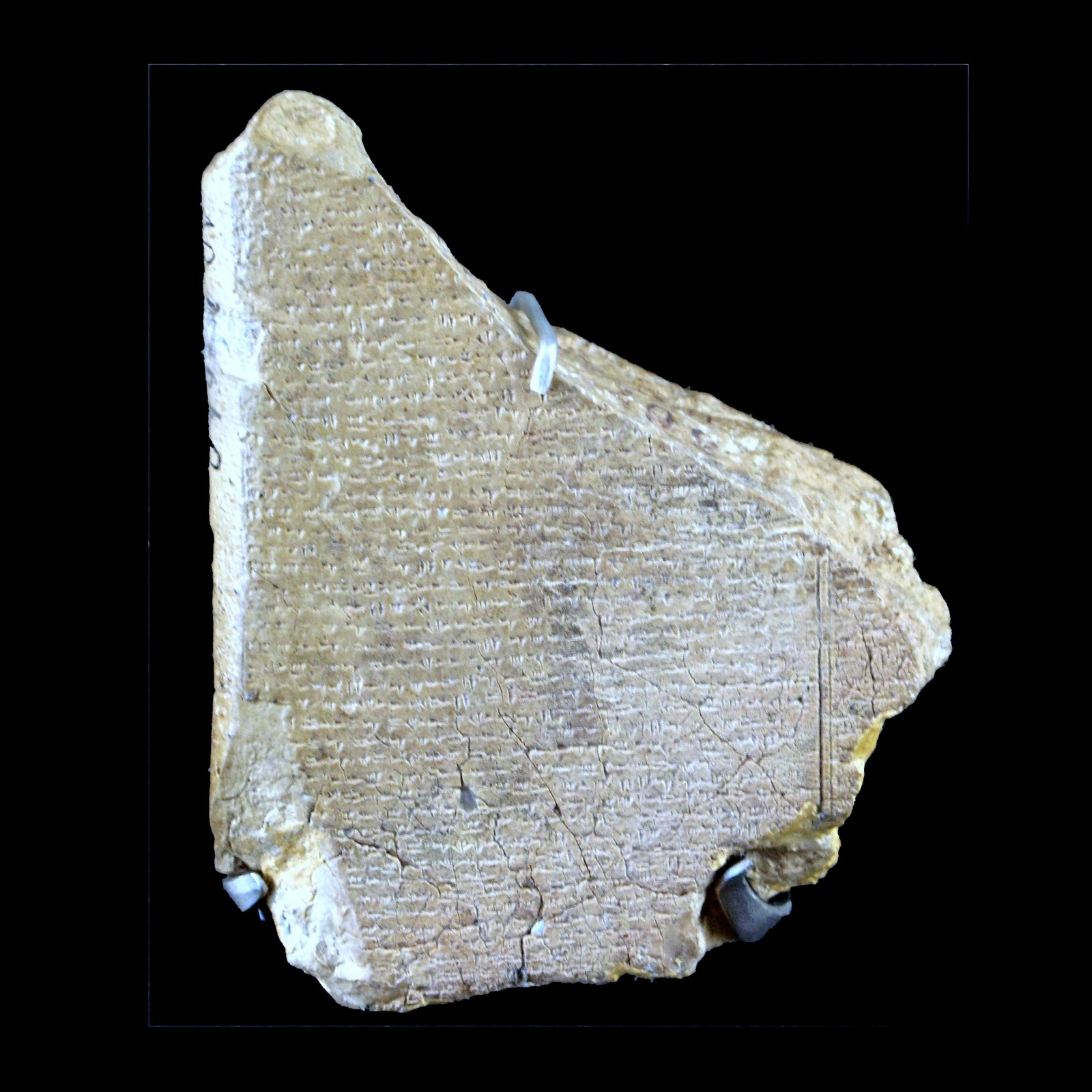
Administrative records and Ugaritic religious poems written in alphabetic cuneiformUgaritic alphabetAlphabetic cuneiform system of Late Bronze Age Ugarit, using thirty chiefly consonantal written signs, distinct from Akkadian syllabic cuneiform.Glossary · Click to read the explanation illuminate different parts of this city’s life. The study’s cover shows the actual Louvre tablet AO 16640 / RS 3.367, associated with KTU 1.2 of the Baal Cycle, not the tablet narrating palace authorization in KTU 1.4. The Louvre describes it as fragmentary and cautions that its supposed join to AO 16640 bis may be mistaken; the visible signs have not been deciphered from this photograph. [11]
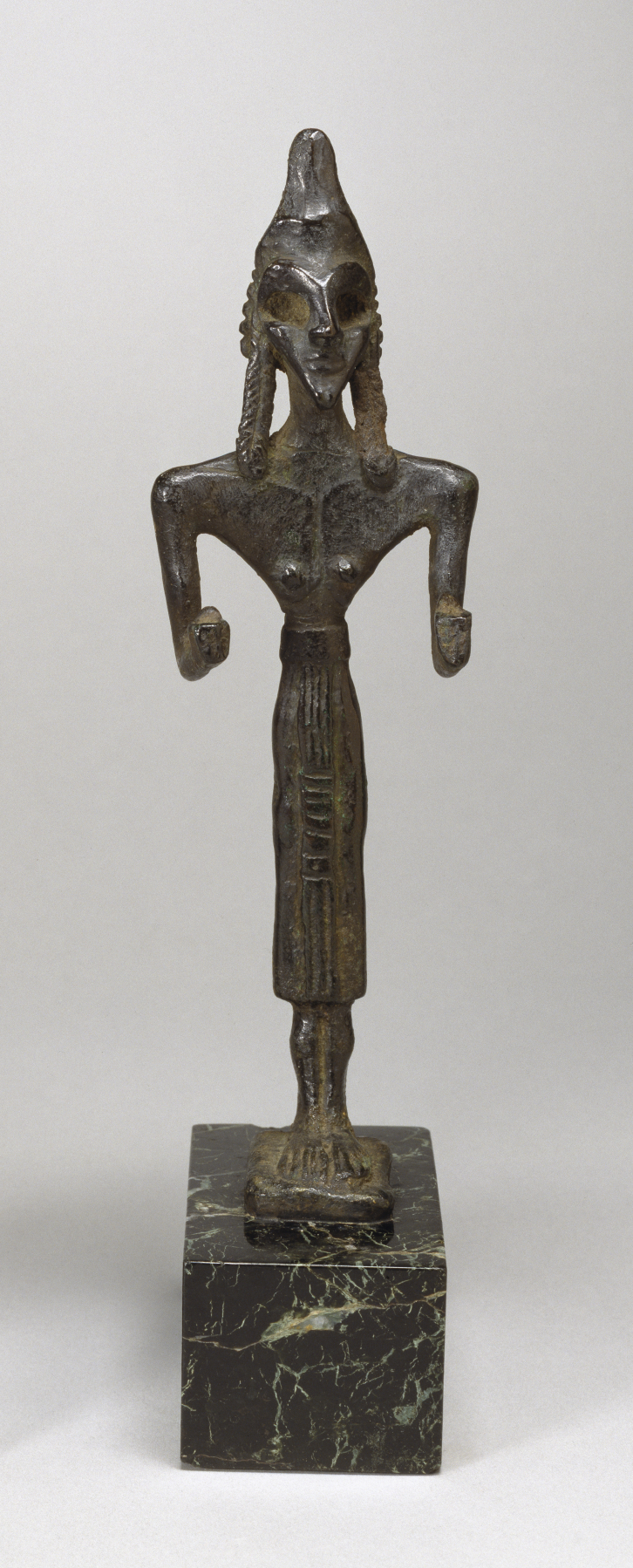
The small figurineFigurineA small shaped object depicting a human, animal or abbreviated form, in clay, stone or another medium. Its form alone does not establish its use; manufacture, handling traces and find context matter.Glossary · Click to read the explanation illustrated below, S 3573 / RS 23.394, is a seated bronze-and-gold god from Ugarit, about 1400–1300 BCE, in Damascus. Its museum attribution to El is a stylistic possibility, not a label inscribed on the object. [9]
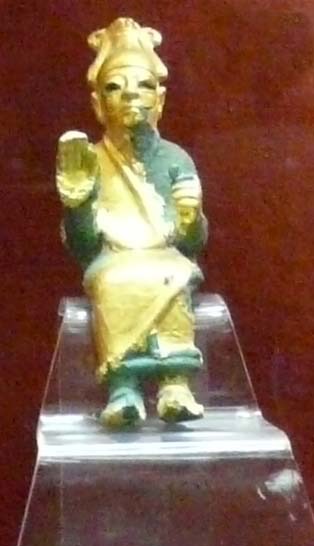
El: the word “god” and a particular character
Ugaritic ʾil can mean “god,” but literary context also identifies El as the name of a particular deity. AnatAnatAnat is an ancient Near Eastern goddess attested at Mari, Ugarit and in Egypt. In Ugaritic narratives she is a warrior, Baal’s ally and a mourner for him; her roles vary by tradition and context.Glossary · Click to read the explanation addresses him, AthiratAthiratA prominent goddess commonly understood as El’s consort in Ugaritic texts; she bears the progenitress epithet and intercedes for Baal’s palace.Glossary · Click to read the explanation intercedes with him, and he appears in specific familial and royal relationships.
The texts preserve expressions such as bn il, “sons of El,” dr il, El’s circle or company, and pḫr ilm, “assembly of the godsDivine councilA divine council is a religious and literary scene in which divine beings gather before a superior authority for discussion, commissioning or judgment; it is not identical to a pantheon list.Glossary · Click to read the explanation.” These designations are not interchangeable everywhere; none necessarily includes every god without exception. Their presence nevertheless shows that the texts envisage an organized divine society. [2]
Fatherhood beyond the divine family
Fatherhood is central to El. It describes more than his relationship to one god: it helps organize the divine household and its head. The expression ʾab ʾadm also describes him as “father of humankind.”
In the Kirta and Aqhat texts, El is associated with family continuity, offspring and an heir; relevant passages include KTU 1.15 II 16–28 and 1.17 I 25, 42. Joel Burnett interprets these roles within the patriarchal household model linking the divine and human worlds. [3]
But “father” can combine descent, protection, seniority and authority over the household. The title alone does not settle its meaning in every speech. The pantheon therefore cannot be reduced to a modern birth register that admits no variation between traditions.
Was Baal the son of El or Dagan?
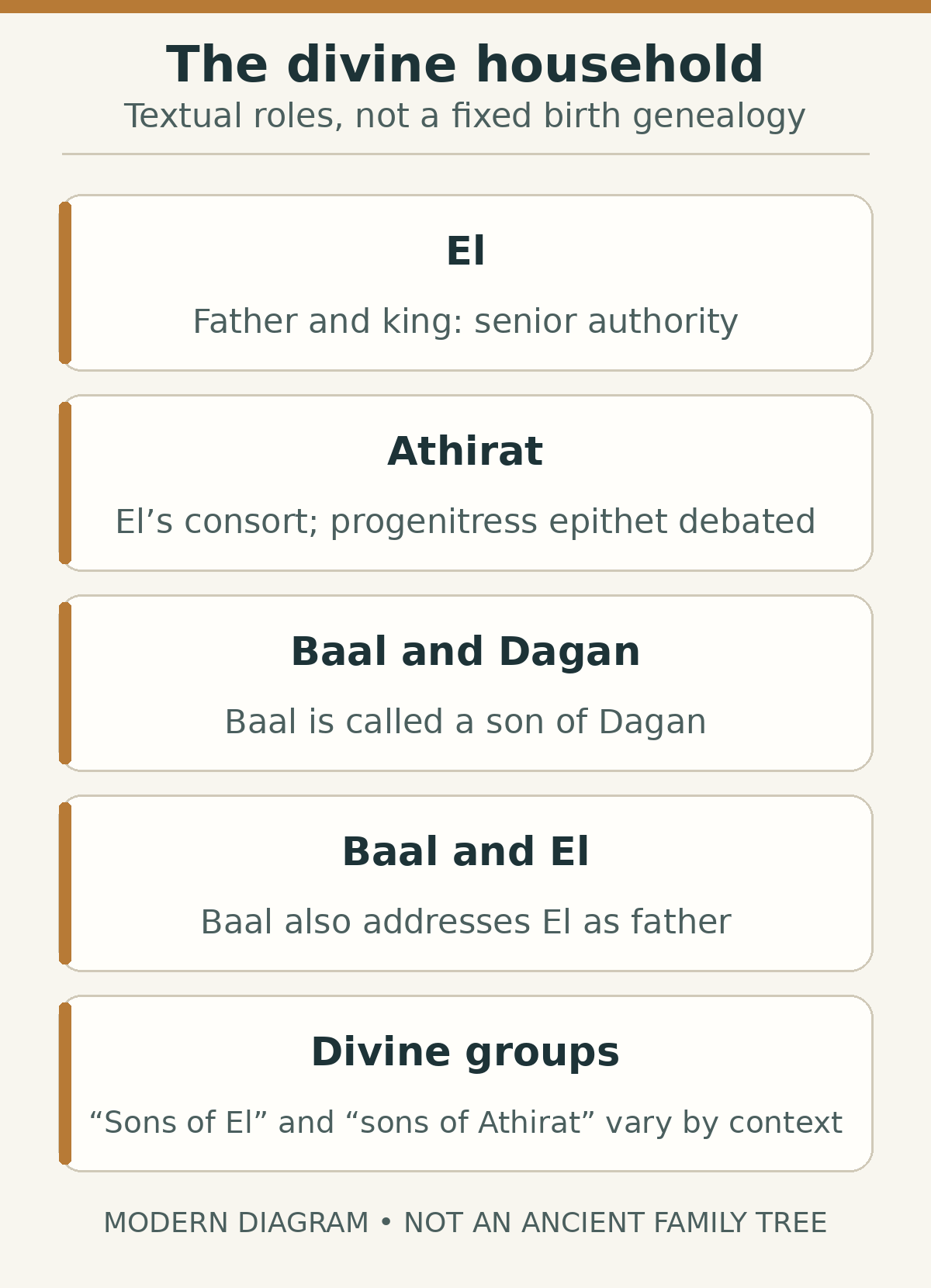
Both relationships occur in Ugaritic material. Baal is called the son of DaganDaganA god worshipped in Syria and Mesopotamia, especially at Tuttul and Terqa on the Euphrates, and associated with royal authority. His name appears as Dagon in the Hebrew Bible; no ancient image of him is securely identified.Glossary · Click to read the explanation, for example in KTU 1.2 I 19 and 1.5 V 23–24. In KTU 1.3 V 35–36, with a parallel passage in 1.4 IV, he cries to “Bull El his father” and to El the king who established or produced him, depending on the verb’s interpretation. [2][3]
This overlap does not allow us to erase Dagan, or prove that every reference to fatherhood is purely metaphorical. It calls for reading the relationship within its poem and tradition: divine descent may coexist with membership in El’s household and authority. Household membership, kinship and rank do not always coincide.
Bull El: virility and power
The title ṯr ʾil, “Bull El,” recurs in his literary portrait. Theodore Lewis reads Father, Bull and King as mutually reinforcing titles of potency, reproductive power and sovereignty, drawing on the Baal Cycle and KTU 1.23, which narrates El’s procreation. [4]
The epithet does not reduce El to an animal form or identify every archaeological bull as his image. It does, however, prevent old age from being equated with incapacity: the texts can combine seniority and virility in one character.
The elder and the wise god
Anat refers to El’s gray hair and beard when threatening him in KTU 1.3 V. In the same passage, around lines 30–31, she calls his words wise. Respect for his judgment coexists with the possibility of challenge: a tension within the text, not a portrait of a god absent from events. [5]
The title mlk ʾab šnm is conventionally translated “King, Father of Years.” The reading and interpretation of šnm remain debated; Lewis also mentions “Shunama.” The familiar translation should retain that qualification, rather than be treated as a literal statement of El’s age. [4]
The combined elder, wise god and bull imagery helps explain why physical activity alone cannot determine the highest rank. A household head may perform a different role from a warrior without holding merely honorary authority.
Baal’s palace: the clearest case for El’s approval
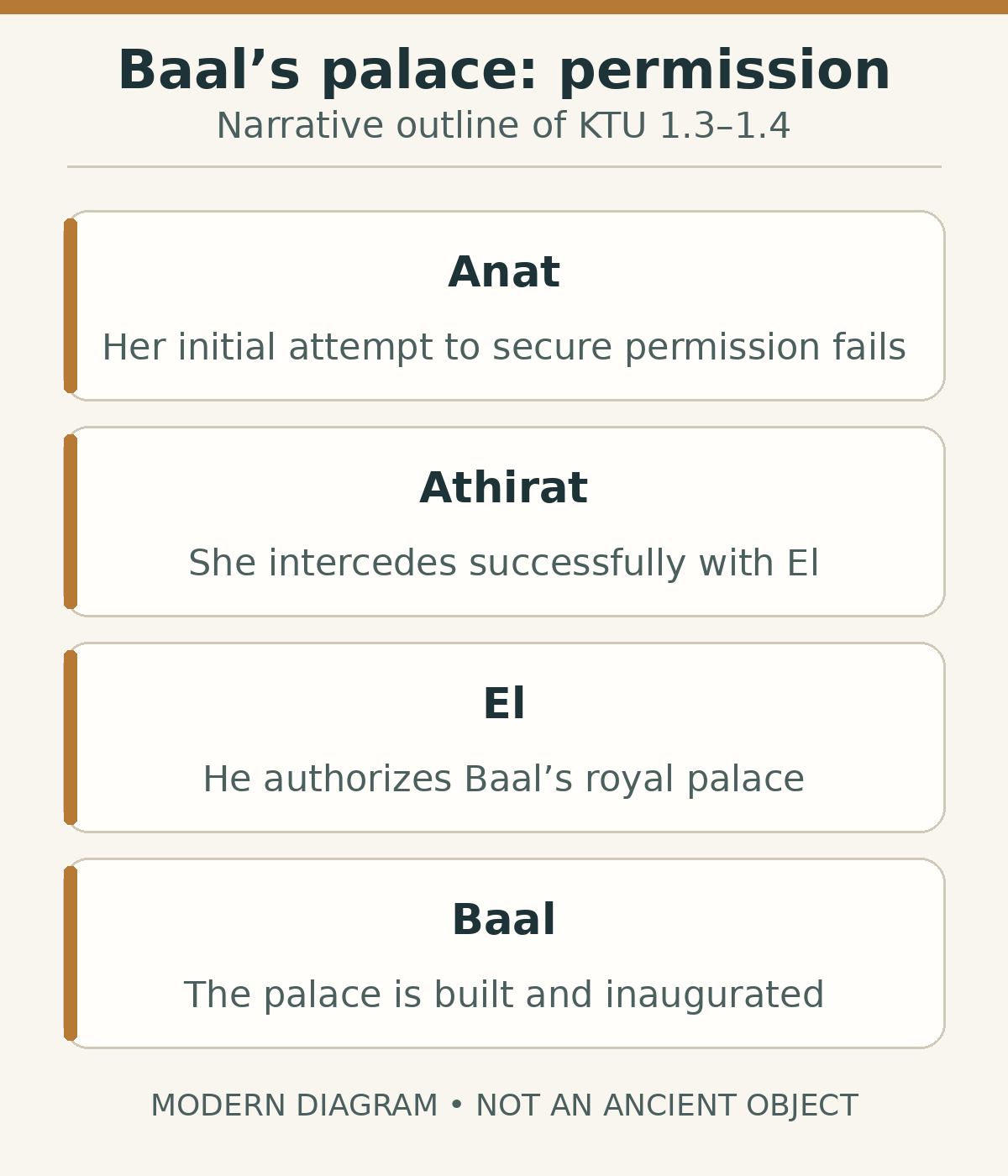
KTU 1.3–1.4 concern Baal’s acquisition of permission to build his palace and its construction. This is Smith and Pitard’s description of their second commentary volume. Here their published abstract is used alongside the accessible passages discussed by Lloyd; no full reading of that volume is claimed. [5][6]
Anat presses the case for the house, Athirat intercedes with El, and permission is obtained. The palace is associated with the completion of Baal’s royal standing, so El’s approval plays a substantive role in organizing the divine world.
A “heavenly constitution” cannot be deduced from this story. The evidence concerns a particular issue and the authority exercised within it. The diagram summarizes the characters’ roles in the narrative; it reconstructs no archaeological temple or palace.
Authority that can be pressured
In KTU 1.3 V 24–25, Anat threatens to make blood flow over El’s gray hair and beard. Their relationship continues through his reply and her subsequent speech. The passage is partly preserved, and other portions of the speech contain gaps and differing readings; not every restoration should become a certain statement. [5]
This is not unchallengeable sovereignty. Yet the need to obtain permission also shows that El cannot simply be bypassed without consequence.
A further witness to El’s capacity to support or withdraw legitimacy occurs in KTU 1.6 VI 27–29: the goddess ShapshuShapshuShapshu, the Ugaritic sun goddess, helps mourn Baal and warns Mot under El’s authority; her links with the dead and drought remain debated.Glossary · Click to read the explanation warns Mot that El might overturn his kingship and break his sceptre. As presented by Lewis, this is a threatened possibility, not a report that El actually performs those acts in the scene. [4]
The divine council and the great household
Mark Smith analyses council and family as organizing images that give Ugaritic divine plurality coherence. They bring together seniority, kinship, rank and service in forms intelligible to people familiar with a court and a great household. [7]
The council is neither a democracy nor a modern ministry, and it is not a complete description of Ugarit’s human institutions. It is a literary and religious conception of divine society.
Likewise, pḫr bʿl, Baal’s company or assembly, does not by itself prove the existence of an independent heavenly government beside El’s. Cho discusses its limited implications and the group it may denote in a particular context. Multiple designations require attention to each passage rather than an assumed fixed system of parallel councils. [2]
Athirat beside El
Athirat, also rendered Asherah, holds a high position within the divine family. Her epithet qnyt ilm is translated “progenitress of the gods” or “creator of the gods,” with debate over the verb’s meaning. Scholarship commonly understands her as El’s consort, not a minor goddess on the margins of his world. [2][8]
Her practical importance emerges in the palace episode: she approaches El and intercedes for Baal. Family here is not merely theoretical descent; it is a network of relationships and negotiation.
The diagram below is not a definitive genealogy. It collects attested roles and designations while retaining both Baal’s relationship to Dagan and his address to El.
Seventy sons of Athirat
In KTU 1.4 VI 44–46, Baal gathers his brothers and kinsmen, and “seventy sons of Athirat” are mentioned. This passage does not literally say “seventy sons of El.” [2]
Scholars have discussed seventy as a number expressing multitude or an extensive divine group, but its significance and scope are not settled. Cho sets out differing readings and questions some conclusions. The passage yields neither a fixed list of seventy names nor an assured census of the whole pantheon.
The strong evidence is familial language. The exact number and identities of all its members cannot be recovered from this line.
Baal: sovereignty active in the world
Baal is the storm god and protagonist of the narrative cycle bearing his name. He is associated with conflict, kingship, rain and Mount Saphon. The texts recount his encounters with Yamm and Mot and place him at the centre of dramatic action. Narrative prominence does not necessarily mean the highest rank in every divine relationship. [3][5]
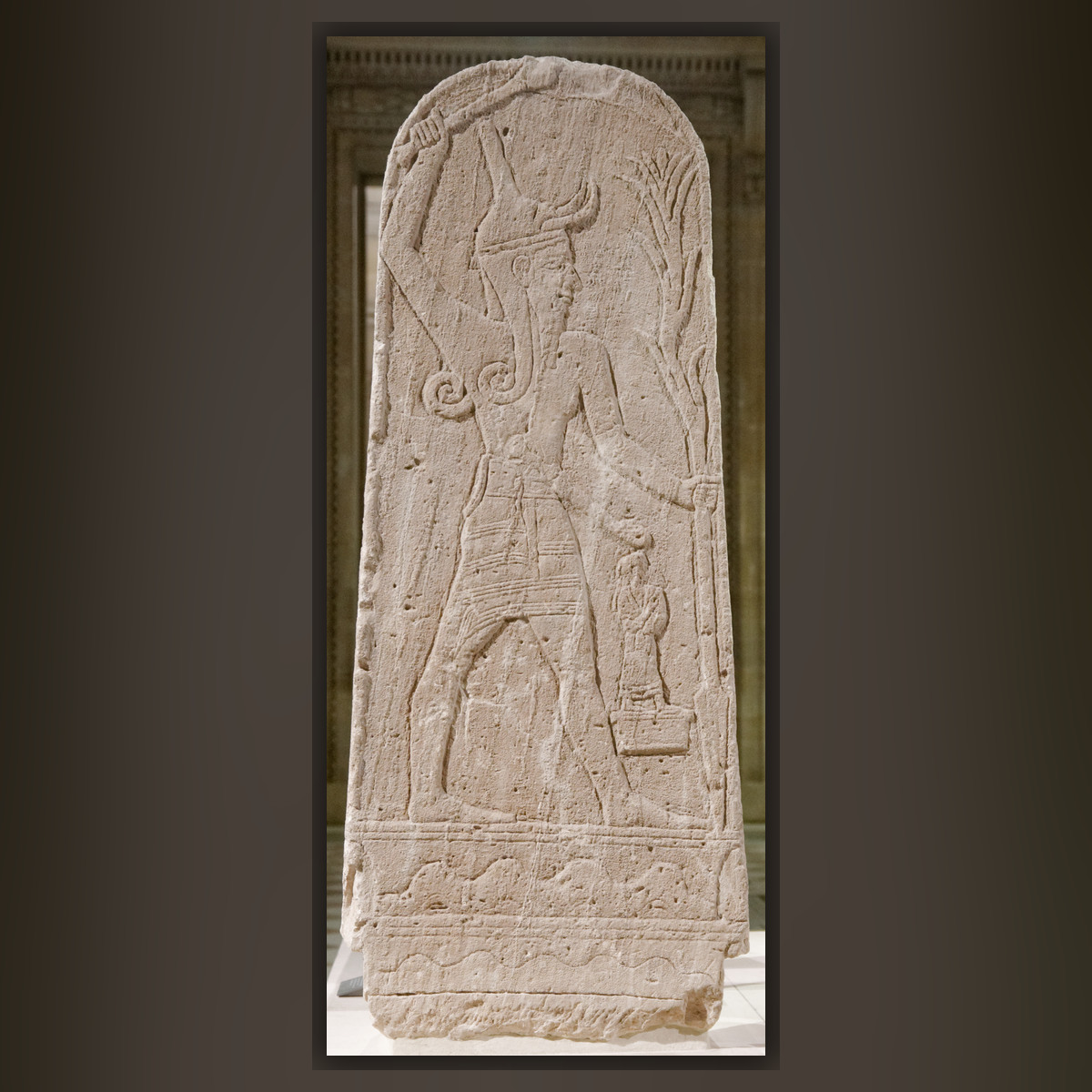
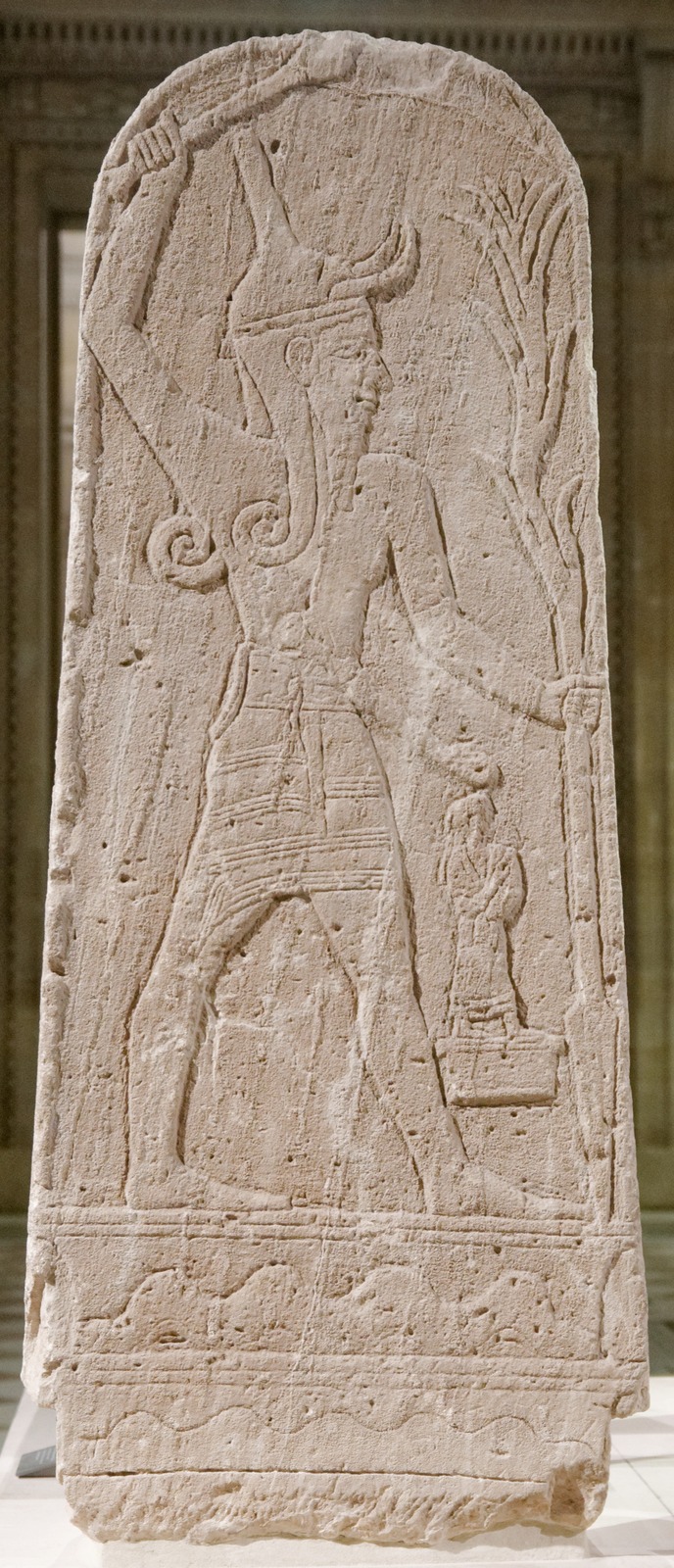
The stela shown here, AO 15775 / RS 4.427, comes from Ugarit and is catalogued by the Louvre as “Baal with Thunderbolt.” It is evidence for Baal’s representation, not an image of El or independent proof of which deity was considered stronger. The Louvre dates it within a broad Bronze Age range; a precise year is not assigned here from a widely circulated image title. [10]
Did Baal overthrow El?
The contrast between the seated elder and the active warrior has encouraged readings in which Baal rises at El’s expense. In 1994, Lloyd reviewed the disagreement between advocates and opponents of El’s decline, especially in relation to the palace authorization. [5]
Burnett instead interprets El and Baal as successive generations within the divine household: its senior head sanctions the warrior god’s kingship, rather than one deity simply replacing the other. Lewis’s interpretation of Father, Bull and King likewise emphasizes that El’s portrait cannot be confined to weakness or inactivity. [3][4]
These are readings of literature, not a record proving that a religious overthrow occurred—or did not occur—in Ugarit’s history. The surviving texts combine Baal’s kingship with El’s continuing importance; they do not supply a simple story that ends by eliminating the father.
Was El a creator?
Fatherhood, divine procreation and bny bnwt point to a productive or creative role. The epithet’s translation varies: Cunchillos discusses the familiar “creator of creatures,” while Burnett uses “he who builds progeny” and notes the disputed meaning. [3][8]
- ʾab ʾadm: fatherhood toward humankind; the title alone does not establish a detailed doctrine of cosmic creation.
- ṯr ʾil: bull imagery, power and virility; it does not identify every bull image or figurine.
- mlk ʾab šnm: a royal title conventionally translated “Father of Years”; not a final linguistic reading or literal age.
- bny bnwt: a creative epithet with differing translations; not a surviving story of the creation of heaven and earth.
The known Ugaritic archive does not let us narrate a complete cosmic creation performed by El alone. The epithets are genuine evidence; a story imagined behind them is not a preserved text.
Poem, cult and history: distinct kinds of evidence
The Baal Cycle is mythic poetry, not a day-by-day record of every Ugaritian’s religious practice. Scenes about a palace and negotiations show how a literary work imagines relationships between gods; they do not date a real transfer of cultic authority to a particular year. When Lewis relates KTU 1.23 to kingship, procreation and ritualRitualAn organised or distinguished practice meaningful to a community; it may leave traces, but its form alone does not reveal an associated doctrine.Glossary · Click to read the explanation, he is offering an interpretation of royal and parental imagery, not evidence that all temples followed a single identical ceremony. [4][6]
Ritual texts, god listsGod ListsTexts collecting divine names for preservation, teaching and classification, with varying theological organization.Glossary · Click to read the explanation and palace records survive as well, but they have different purposes. A poetic epithet is not automatically an administrative title. This distinction helps explain why El may remain head of the divine household in a story without every action of Baal being governed by a fixed, recoverable code. [1][4]
What kind of authority did El possess?
Ugarit presents a richly defined character: father, king and bull, senior and wise, approached by others whose affairs depend on his approval, within a world where other gods exercise real power and agency. Athirat is central to this household, while Baal practices active, martial kingship. [2][3][4]
Calling El the paternal and royal head of the divine world is therefore strongly supported. But headship does not monopolize all action, fatherhood does not turn relationships into a fixed birth register, and age does not equal lost authority.
The useful question is not only “Who is stronger, El or Baal?” but “How does each one’s power operate?” Baal occupies the centre of battle and storm. In the palace episode, recognition comes from El. This distinction preserves the texts’ tension and plurality without eliminating either god or turning literary interpretation into a certain history of religious rise and decline.
Previous reading: El Before Ugarit. For the wider formation of divine groups: What Came Before the Anunnaki?.
References and notes (11)
- Nicolas Wyatt (2007). Religion in ancient Ugarit. In A Handbook of Ancient Religions, ed. John R. Hinnells, pp. 105–160. doi:10.1017/CBO9780511488429.004. Publisher summary: Ras Shamra, excavation from 1929, archive from late fourteenth century to first decade of twelfth century BCE. Print 2007; online 2012. Summary and metadata read, not the full chapter. Return to the text ↑
- Sang Youl Cho (2007). Pro-Angelology in the Ugaritic Texts and the Hebrew Bible: A Comparative Study of the Nature and Roles of Lesser Deities. PhD thesis, University of Edinburgh. Page references supplied by the earlier source note: pp. 13–15 on group labels and pḫr bʿl; p. 77 on parenthood; pp. 93–94 on Athirat and KTU 1.4 VI 44–46. Only Cho’s repository entry and abstract were read directly, not those thesis pages. These locators are not a newly verified full-text reading. Return to the text ↑
- Joel S. Burnett (2022). The Persistence of El in Iron Age Israel and Ammon. In Biblical and Ancient Near Eastern Studies in Honor of P. Kyle McCarter Jr., eds. Christopher Rollston, Susanna Garfein and Neal H. Walls. SBL Press. The earlier source note identifies Burnett’s pp. 301–303 for El/Baal, parentage, fertility and epithets. The full PDF returned HTTP 403; only Baylor publication data and a search-indexed opening excerpt were consulted. No new visual inspection of p. 303 or direct rereading of pp. 301–303 is claimed; the suggested relationship remains Burnett’s interpretation. Return to the text ↑
- Theodore J. Lewis (2022). God (ʾIlu) and King in KTU 1.23. In “Like ʾIlu Are You Wise”: Studies in Northwest Semitic Languages and Literatures in Honor of Dennis G. Pardee, eds. H. H. Hardy II, Joseph Lam and Eric D. Reymond. SAOC 73, Chicago. Direct consultation of Lewis, printed pp. 34–40 (PDF pp. 87–93) in the open SAOC 73 volume: kingship and fertility, “Father of Years / Šunama,” and Shapshu’s warning in KTU 1.6 VI 27–29. Selected pages only; authorial interpretations differentiated from ancient wording. Return to the text ↑
- Jeffery B. Lloyd (1994). The Goddess Anat: An Examination of the Textual and Iconographic Evidence from the Second Millennium B.C. PhD thesis, University of Edinburgh. The earlier source note pointed to Lloyd, pp. 182–185 on Anat’s threat, El’s wisdom, textual gaps and rival readings, and p. 192 on Athirat’s mediation. Only the repository record and abstract were read directly; the large PDF exceeded access limits. No fresh visual inspection of p. 184 or other thesis pages is claimed. Earlier detailed page attributions should be rechecked if full text is available. Return to the text ↑
- Mark S. Smith & Wayne T. Pitard (2009). The Ugaritic Baal Cycle, Volume II: Introduction with Text, Translation and Commentary of KTU/CAT 1.3–1.4. Brill. doi:10.1163/ej.9789004153486.i-864. University abstract: Baal obtains El’s permission to build the palace and constructs it in KTU 1.3–1.4. Volume metadata and abstract only; full 864-page commentary not read. Return to the text ↑
- Mark S. Smith (2001). The Divine Council. In The Origins of Biblical Monotheism: Israel’s Polytheistic Background and the Ugaritic Texts, pp. 41–53. Oxford University Press. doi:10.1093/019513480X.003.0003. Indexed publisher abstract: council, family and the coherence of Ugaritic plurality. Direct access unavailable; abstract only, not the whole chapter. No fixed detailed ranking of every deity derived from it. Return to the text ↑
- Jesús-Luis Cunchillos (1985). Conférence de M. Jesús-Luis Cunchillos. École pratique des hautes études, Section des sciences religieuses, Annuaire 94 (1985–1986), pp. 279–282. P. 279: bny bnwt and “créateur des créatures,” qnyt ilm and the discussion of qny. Selected page read in Persée; no complete cosmic creation story inferred. Return to the text ↑
- Virtual Museum of Syria / National Museum of Damascus. Seated God Figurine (possibly El), S 3573 / RS 23.394. Object record: Ugarit, bronze and gold, 1400–1300 BCE, possible El attribution. Photograph rights separately checked on Commons: ywpark2003, CC0. No certain identification or full reading of listed older bibliography claimed. Return to the text ↑
- Musée du Louvre. Stèle du Baal au foudre, AO 15775 / RS 4.427. Museum record: limestone, Ugarit, range 2000–1150 BCE. Jastrow (Marie-Lan Nguyen) photograph on Commons released into the public domain; no narrower date taken from the image title. Return to the text ↑
- Musée du Louvre. Tablette AO 16640 / RS 3.367: cycle mythologique de Baal, KTU 1.2. Louvre object entry read directly: incomplete AO 16640 / RS 3.367, c. 1400–1200 BCE, KTU3 1.2, possible mistaken join with AO 16640 bis. No autopsy of tablet signs or full reading of the KTU edition. Return to the text ↑
Suggest a correction · Suggest a source for this record
Cite this record
IL Archive, «El at Ugarit», https://ilarchive.com/en/studies/el-at-ugarit
Continue reading
Related readings