Study
El at Ugarit
An extended study of a topic, with evidence and references.
Father, king and head of the council: how Ugaritic texts combine El’s authority and palace approval with Baal’s martial power, and the limits of kinship, creation epithets and seventy.
Share article
Dates
Dates have distinct roles. The timeline uses creation, composition or historical coverage, rather than publication or discovery dates.
- Historical coverage
- Approximately From 1400 BCE to 1200 BCE
Text
Father, King and Head of the Council
At UgaritUgaritAncient city and kingdom at Ras Shamra on the Syrian coast, flourishing between the fourteenth and early twelfth centuries BCE and preserving multilingual archives.Glossary · Click to read the explanation, ElEl at UgaritA deity prominent in West Semitic traditions, especially as head of the divine family in Ugaritic texts.Glossary · Click to read the explanation emerges from the brief name into narrative. We are no longer dealing with an element in a personal name that might mean “god,” but with a character who speaks, decides and grants offspring, and whom other gods approach for approval. He has a dwelling and belongs to a household and council; his titles evoke father, king and bull.
Yet the most active god in the Baal CycleBaal CycleA group of Late Bronze Age Ugaritic religious texts recounting Baal’s conflicts, relationships with the gods and the building of his palace.Glossary · Click to read the explanation is BaalBaalStorm god and protagonist of Ugarit’s Baal Cycle; exercises active kingship while El retains importance and authorizes the palace.Glossary · Click to read the explanation: he fights Yamm, the Sea, confronts MotMotGod of death in the Baal Cycle; an adversary who returns even after a violent attack.Glossary · Click to read the explanation, Death, and builds his palace. How can El remain head of the divine world while Baal occupies the centre of the action?
The texts allow us to distinguish two overlapping forms of authority: El’s seniority, fatherhood and approval, and Baal’s martial power and active sovereignty. This is an interpretation of the myths, not a rule that every act of Baal requires advance permission. The clearest example is the palace episode. [3][6]
The city that let El speak again
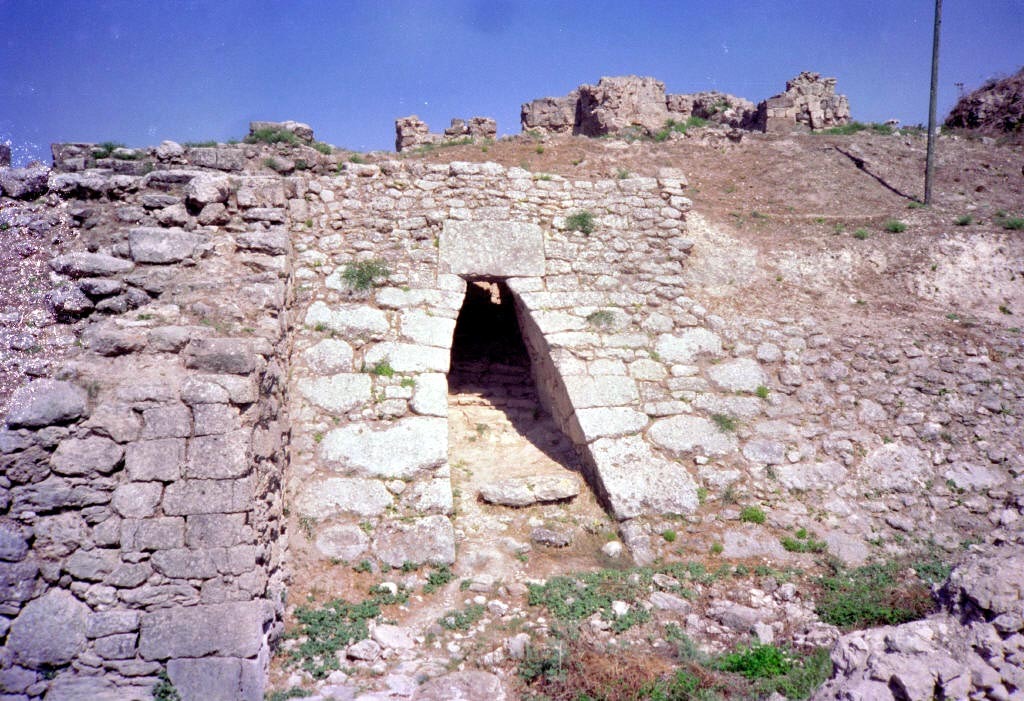
Ugarit lies at Ras Shamra on the Syrian coast, about eleven kilometres north of LatakiaLatakiaA coastal city in Syria, south of ancient Ugarit at Ras Shamra.Glossary · Click to read the explanation. Excavations began in 1929 and recovered a Late Bronze AgeLate Bronze AgeAn archaeological period conventionally around 1600–1200 BCE in much of the Near East, with regional variation.Glossary · Click to read the explanation archive. The material summarized by Nicolas Wyatt runs from the late fourteenth century to the first decade of the twelfth century BCE. These are dates of surviving evidence, not the birth date of El or the myths. [1]
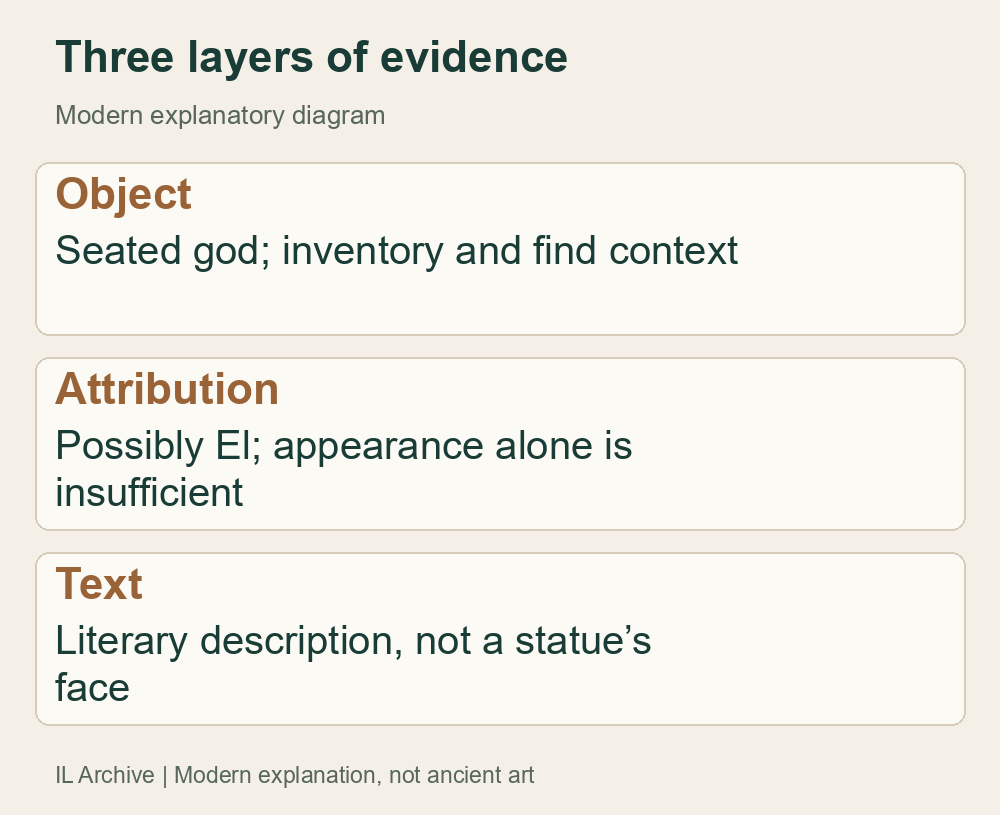
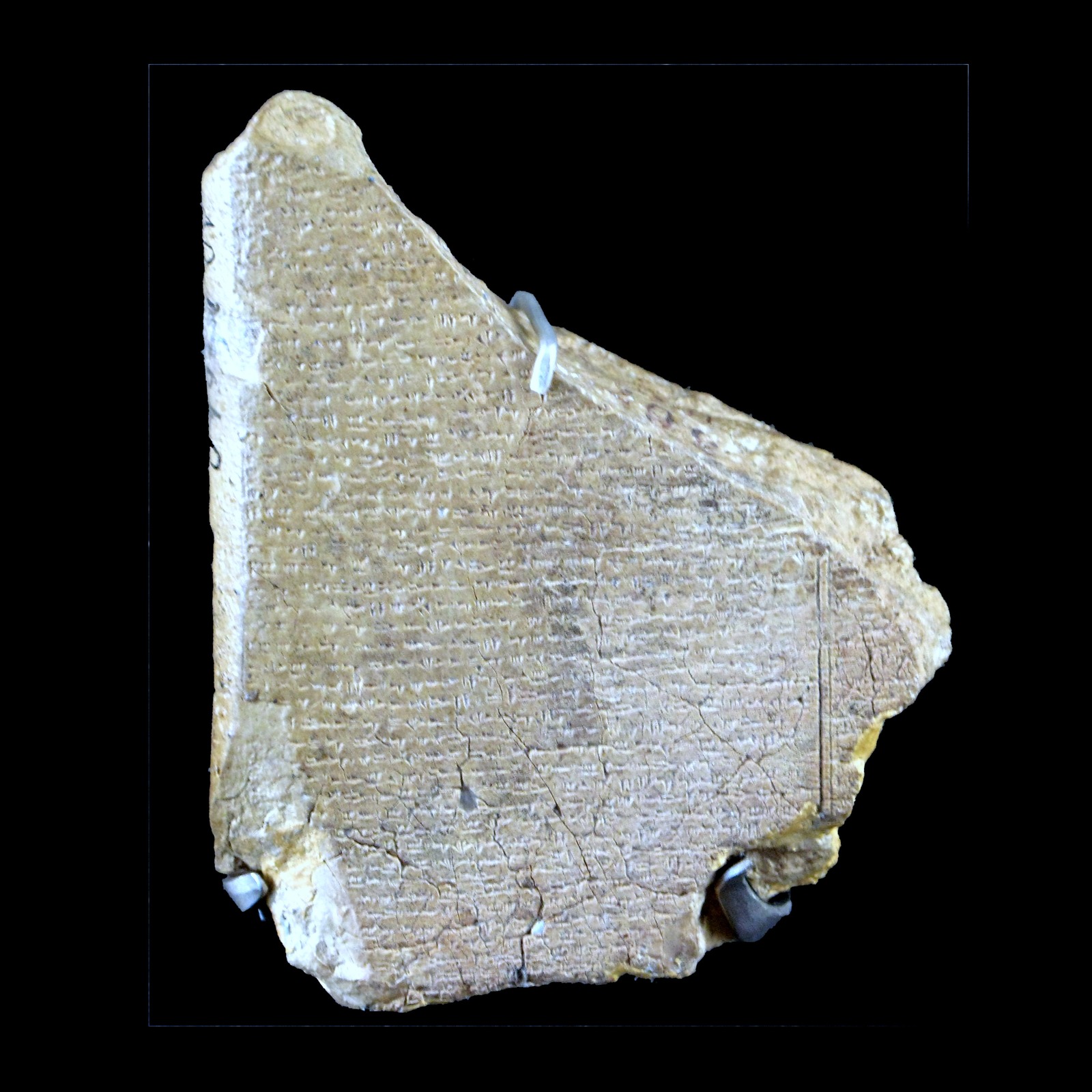
Among administrative documents and texts in several languages were Ugaritic texts in an alphabetic cuneiformUgaritic alphabetLong cuneiform alphabet of 30 signs, chiefly consonantal. Its wedge shapes do not imply Akkadian syllabic principles or priority as the first alphabet.Glossary · Click to read the explanation script, including religious literature in which we encounter El. The photograph below shows a real Baal Cycle tablet, AO 16640, associated with KTUKTU: Ugaritic Text ReferencesAbbreviation for a modern scholarly corpus of alphabetic cuneiform texts; its numbers are references, not dates.Glossary · Click to read the explanation 1.2; it is not the tablet containing the palace authorization in KTU 1.4. The cover statuette, S 3573 / RS 23.394, depicts a seated bronze-and-gold god, about 1400–1300 BCE. Its identification as El is possible, not certain. [9][11]
El: the word “god” and a particular character
Ugaritic ʾil can mean “god,” but literary context also identifies El as the name of a particular deity. AnatAnatAn active and violent goddess in Ugaritic literature; pressures El over Baal’s palace and addresses him with paternal and wisdom language.Glossary · Click to read the explanation addresses him, AthiratAthiratA high-ranking goddess commonly understood as El’s consort in Ugaritic texts; associated with the progenitress epithet and the palace intercession.Glossary · Click to read the explanation intercedes with him, and he appears in specific familial and royal relationships.
The texts preserve expressions such as bn il, “sons of El,” dr il, El’s circle or company, and pḫr ilm, “assembly of the godsDivine councilA representation of divine beings acting as an assembly with authority and differentiated roles.Glossary · Click to read the explanation.” These designations are not interchangeable everywhere; none necessarily includes every god without exception. Their presence nevertheless shows that the texts envisage an organized divine society. [2]
Fatherhood beyond the divine family
Fatherhood is central to El. It describes more than his relationship to one god: it helps organize the divine household and its head. The expression ʾab ʾadm also describes him as “father of humankind.”
In the Kirta and Aqhat texts, El is associated with family continuity, offspring and an heir; relevant passages include KTU 1.15 II 16–28 and 1.17 I 25, 42. Joel Burnett interprets these roles within the patriarchal household model linking the divine and human worlds. [3]
But “father” can combine descent, protection, seniority and authority over the household. The title alone does not settle its meaning in every speech. The pantheonPantheonThe set of deities associated with a religious tradition, including their roles and relationships.Glossary · Click to read the explanation therefore cannot be reduced to a modern birth register that admits no variation between traditions.
Was Baal the son of El or Dagan?
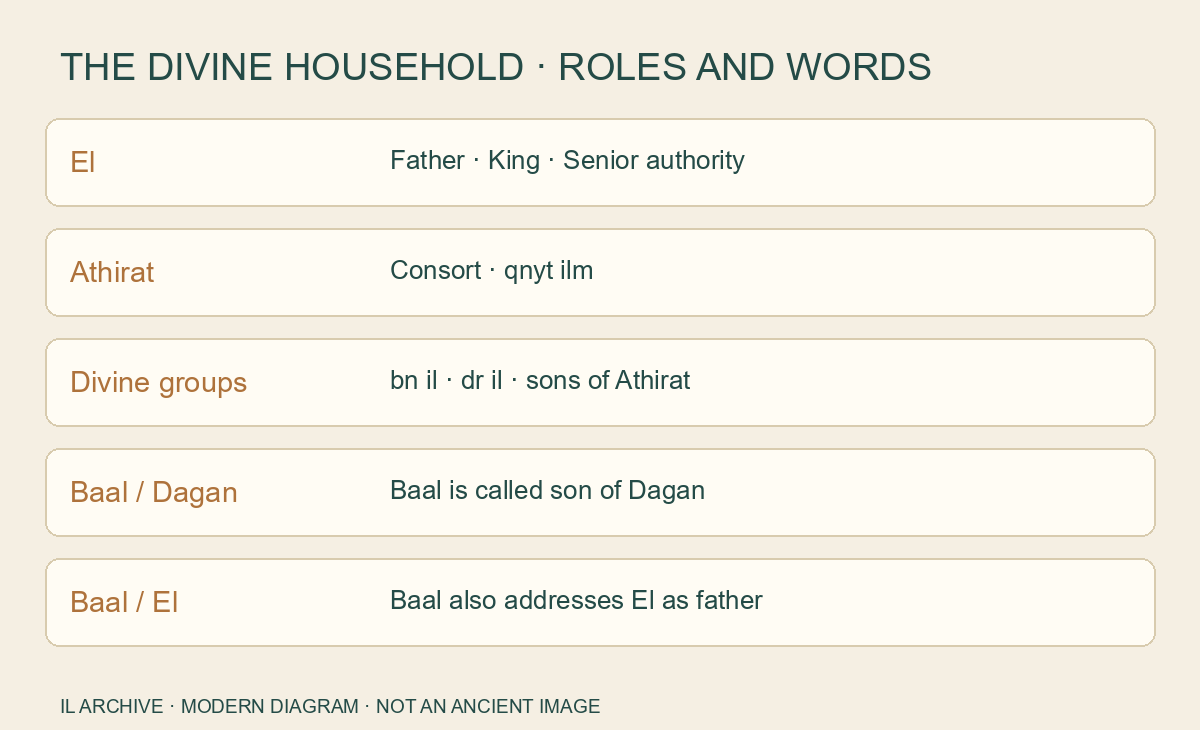
Both relationships occur in Ugaritic material. Baal is called the son of DaganDaganDeity known in Syria and Mesopotamia, attested in Ugaritic lists, offerings and names; Baal is called his son. Temple attribution remains debated.Glossary · Click to read the explanation, for example in KTU 1.2 I 19 and 1.5 V 23–24. In KTU 1.3 V 35–36, with a parallel passage in 1.4 IV, he cries to “Bull El his father” and to El the king who established or produced him, depending on the verb’s interpretation. [2][3]
This overlap does not allow us to erase Dagan, or prove that every reference to fatherhood is purely metaphorical. It calls for reading the relationship within its poem and tradition: divine descent may coexist with membership in El’s household and authority. Household membership, kinship and rank do not always coincide.
Bull El: virility and power
The title ṯr ʾil, “Bull El,” recurs in his literary portrait. Theodore Lewis reads Father, Bull and King as mutually reinforcing titles of potency, reproductive power and sovereignty, drawing on the Baal Cycle and KTU 1.23, which narrates El’s procreation. [4]
The epithet does not reduce El to an animal form or identify every archaeological bull as his image. It does, however, prevent old age from being equated with incapacity: the texts can combine seniority and virility in one character.
The elder and the wise god
Anat refers to El’s gray hair and beard when threatening him in KTU 1.3 V. In the same passage, around lines 30–31, she calls his words wise. Respect for his judgment coexists with the possibility of challenge: a tension within the text, not a portrait of a god absent from events. [5]
The title mlk ʾab šnm is conventionally translated “King, Father of Years.” The reading and interpretation of šnm remain debated; Lewis also mentions “Shunama.” The familiar translation should retain that qualification, rather than be treated as a literal statement of El’s age. [4]
The combined elder, wise god and bull imagery helps explain why physical activity alone cannot determine the highest rank. A household head may perform a different role from a warrior without holding merely honorary authority.
Baal’s palace: the clearest case for El’s approval
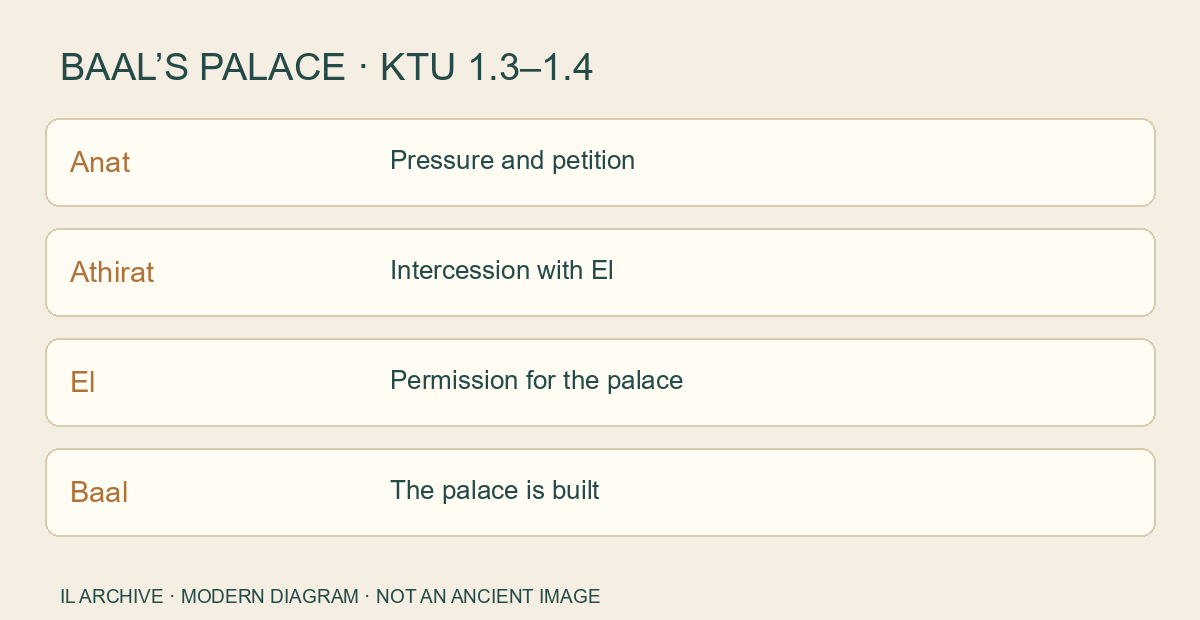
KTU 1.3–1.4 concern Baal’s acquisition of permission to build his palace and its construction. This is Smith and Pitard’s description of their second commentary volume. Here their published abstract is used alongside the accessible passages discussed by Lloyd; no full reading of that volume is claimed. [5][6]
Anat presses the case for the house, Athirat intercedes with El, and permission is obtained. The palace is associated with the completion of Baal’s royal standing, so El’s approval plays a substantive role in organizing the divine world.
A “heavenly constitution” cannot be deduced from this story. The evidence concerns a particular issue and the authority exercised within it. The diagram summarizes the characters’ roles in the narrative; it reconstructs no archaeological temple or palace.
Authority that can be pressured
In KTU 1.3 V 24–25, Anat threatens to make blood flow over El’s gray hair and beard. Their relationship continues through his reply and her subsequent speech. The passage is partly preserved, and other portions of the speech contain gaps and differing readings; not every restoration should become a certain statement. [5]
This is not unchallengeable sovereignty. Yet the need to obtain permission also shows that El cannot simply be bypassed without consequence.
A further witness to El’s capacity to support or withdraw legitimacy occurs in KTU 1.6 VI 27–29: the goddess ShapshuShapshuUgaritic sun goddess; involved in Baal’s crisis and intervening verbally in the Mot conflict.Glossary · Click to read the explanation warns Mot that El might overturn his kingship and break his sceptre. As presented by Lewis, this is a threatened possibility, not a report that El actually performs those acts in the scene. [4]
The divine council and the great household
Mark Smith analyses council and family as organizing images that give Ugaritic divine plurality coherence. They bring together seniority, kinship, rank and service in forms intelligible to people familiar with a court and a great household. [7]
The council is neither a democracy nor a modern ministry, and it is not a complete description of Ugarit’s human institutions. It is a literary and religious conception of divine society.
Likewise, pḫr bʿl, Baal’s company or assembly, does not by itself prove the existence of an independent heavenly government beside El’s. Cho discusses its limited implications and the group it may denote in a particular context. Multiple designations require attention to each passage rather than an assumed fixed system of parallel councils. [2]
Athirat beside El
Athirat, also rendered Asherah, holds a high position within the divine family. Her epithet qnyt ilm is translated “progenitress of the gods” or “creator of the gods,” with debate over the verb’s meaning. Scholarship commonly understands her as El’s consort, not a minor goddess on the margins of his world. [2][8]
Her practical importance emerges in the palace episode: she approaches El and intercedes for Baal. Family here is not merely theoretical descent; it is a network of relationships and negotiation.
The diagram below is not a definitive genealogy. It collects attested roles and designations while retaining both Baal’s relationship to Dagan and his address to El.
Seventy sons of Athirat
In KTU 1.4 VI 44–46, Baal gathers his brothers and kinsmen, and “seventy sons of Athirat” are mentioned. This passage does not literally say “seventy sons of El.” [2]
Scholars have discussed seventy as a number expressing multitude or an extensive divine group, but its significance and scope are not settled. Cho sets out differing readings and questions some conclusions. The passage yields neither a fixed list of seventy names nor an assured census of the whole pantheon.
The strong evidence is familial language. The exact number and identities of all its members cannot be recovered from this line.
Baal: sovereignty active in the world
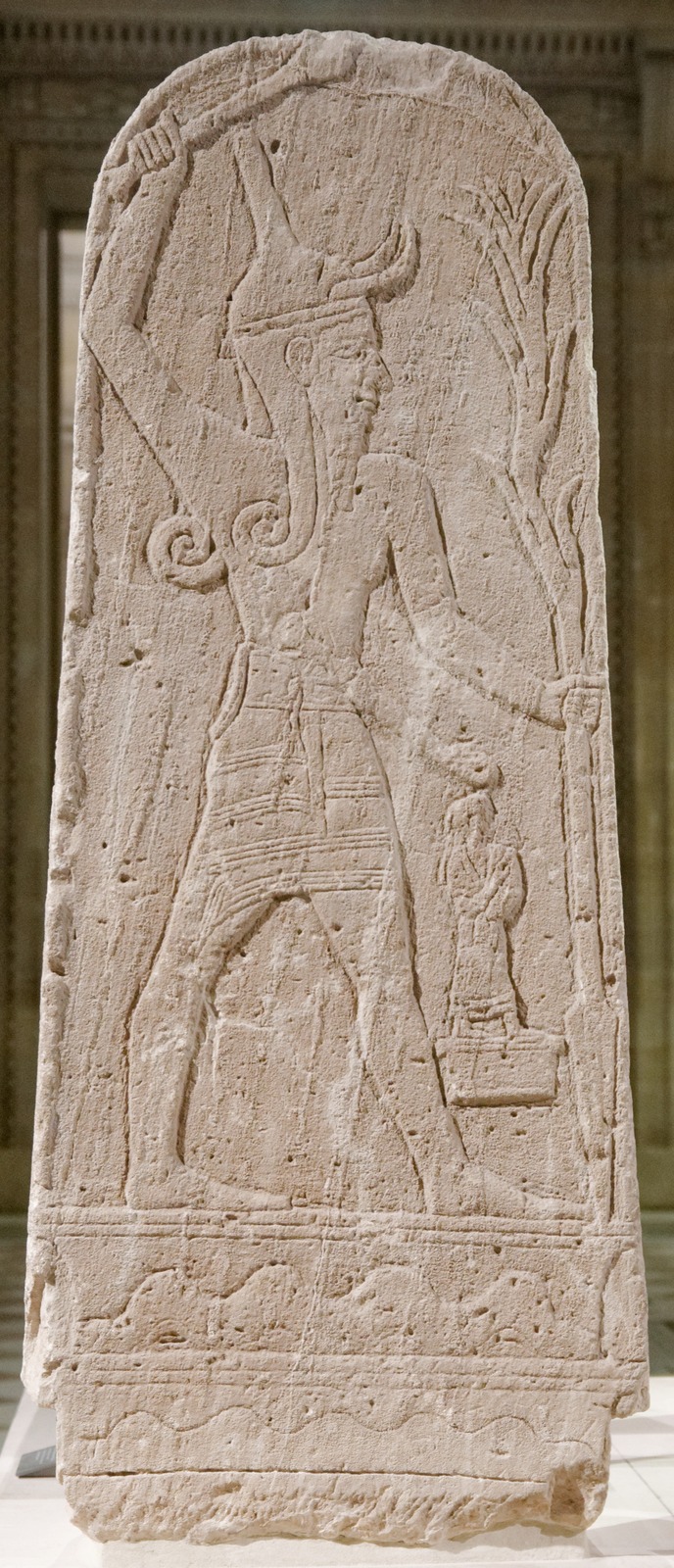
Baal is the storm god and protagonist of the narrative cycle bearing his name. He is associated with conflict, kingship, rain and Mount Saphon. The texts recount his encounters with Yamm and Mot and place him at the centre of dramatic action. Narrative prominence does not necessarily mean the highest rank in every divine relationship. [3][5]
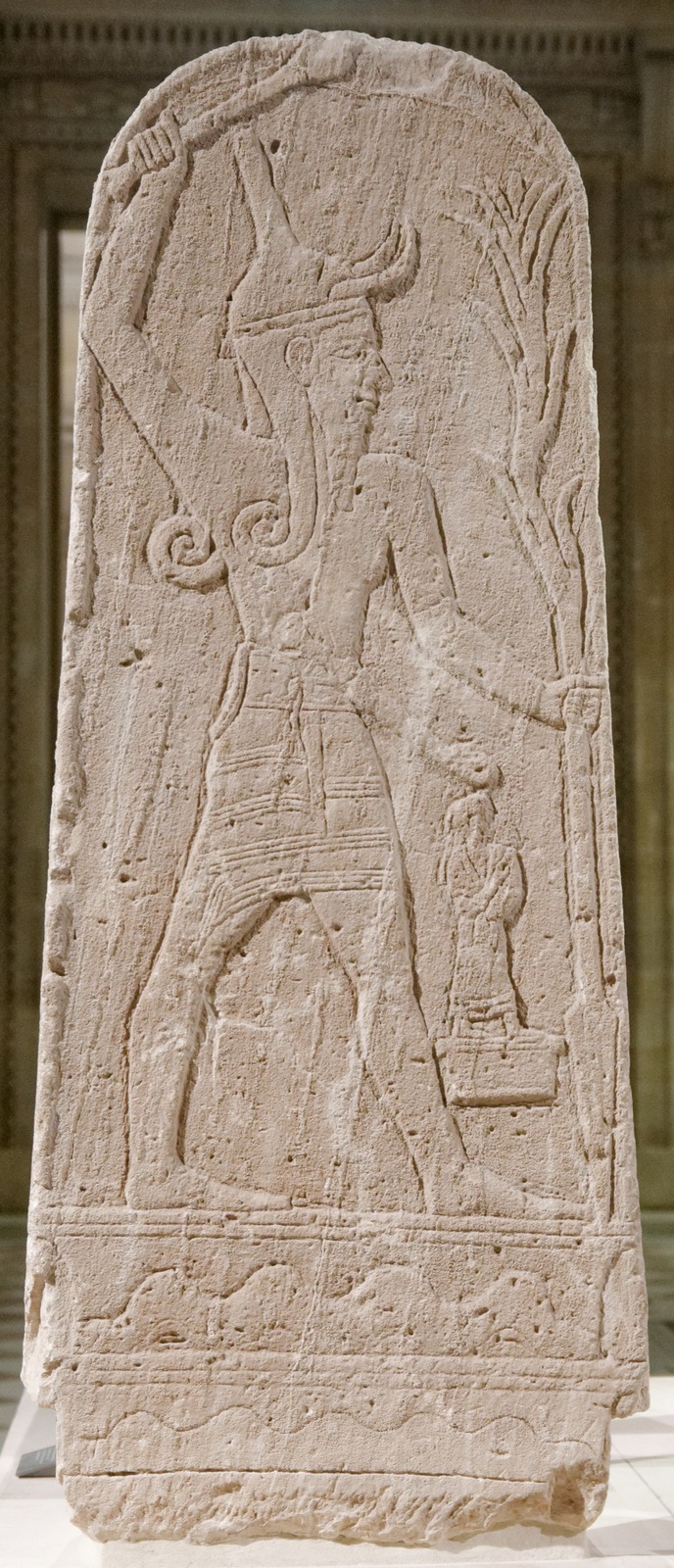
The stela shown here, AO 15775 / RS 4.427, comes from Ugarit and is catalogued by the Louvre as “Baal with Thunderbolt.” It is evidence for Baal’s representation, not an image of El or independent proof of which deity was considered stronger. The Louvre dates it within a broad Bronze Age range; a precise year is not assigned here from a widely circulated image title. [10]
Did Baal overthrow El?
The contrast between the seated elder and the active warrior has encouraged readings in which Baal rises at El’s expense. In 1994, Lloyd reviewed the disagreement between advocates and opponents of El’s decline, especially in relation to the palace authorization. [5]
Burnett instead interprets El and Baal as successive generations within the divine household: its senior head sanctions the warrior god’s kingship, rather than one deity simply replacing the other. Lewis’s interpretation of Father, Bull and King likewise emphasizes that El’s portrait cannot be confined to weakness or inactivity. [3][4]
These are readings of literature, not a record proving that a religious overthrow occurred—or did not occur—in Ugarit’s history. The surviving texts combine Baal’s kingship with El’s continuing importance; they do not supply a simple story that ends by eliminating the father.
Was El a creator?
Fatherhood, divine procreation and bny bnwt point to a productive or creative role. The epithet’s translation varies: Cunchillos discusses the familiar “creator of creatures,” while Burnett uses “he who builds progeny” and notes the disputed meaning. [3][8]
- ʾab ʾadm: fatherhood toward humankind; the title alone does not establish a detailed doctrine of cosmic creation.
- ṯr ʾil: bull imagery, power and virility; it does not identify every bull image or figurineFigurineSmall three-dimensional representations of people, animals or other beings. Size and appearance alone do not establish a toy, portrait, ritual object or deity; manufacture, discovery context and use require study.Glossary · Click to read the explanation.
- mlk ʾab šnm: a royal title conventionally translated “Father of Years”; not a final linguistic reading or literal age.
- bny bnwt: a creative epithet with differing translations; not a surviving story of the creation of heaven and earth.
The known Ugaritic archive does not let us narrate a complete cosmic creation performed by El alone. The epithets are genuine evidence; a story imagined behind them is not a preserved text.
What kind of authority did El possess?
Ugarit presents a richly defined character: father, king and bull, senior and wise, approached by others whose affairs depend on his approval, within a world where other gods exercise real power and agency. Athirat is central to this household, while Baal practices active, martial kingship. [2][3][4]
Calling El the paternal and royal head of the divine world is therefore strongly supported. But headship does not monopolize all action, fatherhood does not turn relationships into a fixed birth register, and age does not equal lost authority.
The useful question is not only “Who is stronger, El or Baal?” but “How does each one’s power operate?” Baal occupies the centre of battle and storm. In the palace episode, recognition comes from El. This distinction preserves the texts’ tension and plurality without eliminating either god or turning literary interpretation into a certain history of religious rise and decline.
Previous reading: El Before Ugarit. For the wider formation of divine groups: What Came Before the Anunnaki?.
References and notes
- Nicolas Wyatt (2007). Religion in ancient Ugarit. In A Handbook of Ancient Religions, ed. John R. Hinnells, pp. 105–160. doi:10.1017/CBO9780511488429.004. Publisher summary: Ras Shamra, excavation from 1929, archive from late fourteenth century to first decade of twelfth century BCE. Print 2007; online 2012. Summary and metadata read, not the full chapter. Return to the text ↑
- Sang Youl Cho (2007). Pro-Angelology in the Ugaritic Texts and the Hebrew Bible: A Comparative Study of the Nature and Roles of Lesser Deities. PhD thesis, University of Edinburgh. Selected passages: pp. 13–15 group designations and pḫr bʿl; p. 77 Baal/Anat parentage; pp. 93–94 Athirat, qnyt ilm, KTU 1.4 VI 44–46 and seventy. Interpretive disagreements retained, not a consensus on pantheon membership. Not a full-thesis reading. Return to the text ↑
- Joel S. Burnett (2022). The Persistence of El in Iron Age Israel and Ammon. In Biblical and Ancient Near Eastern Studies in Honor of P. Kyle McCarter Jr., eds. Christopher Rollston, Susanna Garfein and Neal H. Walls. SBL Press. Pp. 301–303 only: Ugaritic background, son of Dagan, ʾab ʾadm, offspring in Kirta/Aqhat, disputed bny bnwt, and interpretation of El/Baal authority. P. 303 also visually checked. Later Israel/Ammon discussion not imported; whole book not read. Return to the text ↑
- Theodore J. Lewis (2022). God (ʾIlu) and King in KTU 1.23. In “Like ʾIlu Are You Wise”: Studies in Northwest Semitic Languages and Literatures in Honor of Dennis G. Pardee, eds. H. H. Hardy II, Joseph Lam and Eric D. Reymond. SAOC 73, Chicago. Selected pp. 34–40: King Father of Years/Shunama, Shapshu’s warning to Mot in KTU 1.6 VI 27–29, and Father/Bull/King and procreation. P. 40 visually checked; threatened action not described as performed by El. Selected open-PDF reading, not the entire volume. Return to the text ↑
- Jeffery B. Lloyd (1994). The Goddess Anat: An Examination of the Textual and Iconographic Evidence from the Second Millennium B.C. PhD thesis, University of Edinburgh. Pp. 182–185: KTU 1.3 V, gray-hair threat, wisdom and El’s fatherhood, textual gaps and debate over El’s decline. P. 192: Athirat’s intercession and successful palace request. P. 184 visually checked. Thesis not read in full; restorations retained as restorations. Return to the text ↑
- Mark S. Smith & Wayne T. Pitard (2009). The Ugaritic Baal Cycle, Volume II: Introduction with Text, Translation and Commentary of KTU/CAT 1.3–1.4. Brill. doi:10.1163/ej.9789004153486.i-864. University abstract: Baal obtains El’s permission to build the palace and constructs it in KTU 1.3–1.4. Volume metadata and abstract only; full 864-page commentary not read. Return to the text ↑
- Mark S. Smith (2001). The Divine Council. In The Origins of Biblical Monotheism: Israel’s Polytheistic Background and the Ugaritic Texts, pp. 41–53. Oxford University Press. doi:10.1093/019513480X.003.0003. Indexed publisher abstract: council, family and the coherence of Ugaritic plurality. Direct access unavailable; abstract only, not the whole chapter. No fixed detailed ranking of every deity derived from it. Return to the text ↑
- Jesús-Luis Cunchillos (1985). Conférence de M. Jesús-Luis Cunchillos. École pratique des hautes études, Section des sciences religieuses, Annuaire 94 (1985–1986), pp. 279–282. P. 279: bny bnwt and “créateur des créatures,” qnyt ilm and the discussion of qny. Selected page read in Persée; no complete cosmic creation story inferred. Return to the text ↑
- Virtual Museum of Syria / National Museum of Damascus. Seated God Figurine (possibly El), S 3573 / RS 23.394. Object record: Ugarit, bronze and gold, 1400–1300 BCE, possible El attribution. Photograph rights separately checked on Commons: ywpark2003, CC0. No certain identification or full reading of listed older bibliography claimed. Return to the text ↑
- Musée du Louvre. Stèle du Baal au foudre, AO 15775 / RS 4.427. Museum record: limestone, Ugarit, range 2000–1150 BCE. Jastrow (Marie-Lan Nguyen) photograph on Commons released into the public domain; no narrower date taken from the image title. Return to the text ↑
- Musée du Louvre. Tablette AO 16640 / RS 3.367: cycle mythologique de Baal, KTU 1.2. Object record: clay, Ugarit, 1400–1200 BCE. KTU 1.2 identification retained; palace authorization in KTU 1.4 not assigned to it. Rama photograph under CC BY-SA 2.0 FR; no claim to have read the tablet from the photograph. Return to the text ↑
Media
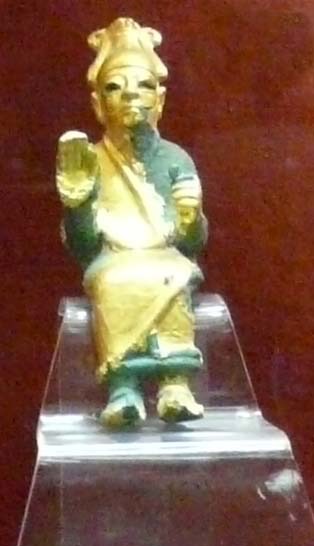
Original photograph
Seated god from Ugarit, bronze and gold, about 1400–1300 BCE; Damascus Museum S 3573 / RS 23.394. Possibly El. The small original photograph is preserved without upscaling or reconstruction.
Public domain · ywpark2003 · CC0 1.0 · CC0 1.0 · https://creativecommons.org/publicdomain/zero/1.0/ · display resized only; original preserved
Suggest a correction · Suggest a source for this record
Cite this record
IL Archive, «El at Ugarit», Edition 1, https://ilarchive.com/en/studies/el-at-ugarit
Continue reading