Entity · Deity
Mot
A reference page linking a name, group, or concept to the materials that discuss it.
God of death in the Baal Cycle; an adversary who returns even after a violent attack.
Estimated reading time: 5 min Published Last reviewed:
Share article
Video
The Baal Cycle: The Sea, a palace and the meeting with Death
The Sea, a palace and the meeting with Death. The whole story in three illustrated chapters, told from the ancient clay tablets; where the tablets are broken, the narration says so. Illustrations, narration voice and visual effects were created with AI tools by IL Archive; the text is a faithful retelling based on the ancient tablets.
The YouTube player loads only when you press play. Watch on YouTube
Text
Introduction
How do Ugaritic texts portray death when they make it a god who speaks to and fights the storm god? This entry follows Mot through his threat to swallow his opponent, AnatAnatAnat is an ancient Near Eastern goddess attested at Mari, Ugarit and in Egypt. In Ugaritic narratives she is a warrior, Baal’s ally and a mourner for him; her roles vary by tradition and context.Glossary · Click to read the explanation's attack and his return to conflict. The question is not whether these events happened historically, but what the narrative and its surviving witnesses reveal about death, authority and renewed life.
Name and witnesses
Mot is the god of death in the literature of UgaritUgaritAncient city and kingdom at Ras Shamra on the Syrian coast, flourishing between the fourteenth and early twelfth centuries BCE and preserving multilingual archives.Glossary · Click to read the explanation, the ancient city at Ras Shamra on the Syrian coast. He appears in the Baal CycleBaal CycleA group of Late Bronze Age Ugaritic religious texts recounting Baal’s conflicts, relationships with the gods and the building of his palace.Glossary · Click to read the explanation, a group of mythological texts about BaalBaalUgaritic storm god and warrior king who defeats Yamm, builds his palace with El’s consent and confronts Mot. References to El and Dagan as fathers do not define a single genealogy.Glossary · Click to read the explanation, the storm god, his conflicts, divine relationships and claim to kingship. Here the name identifies a divine character in these texts, rather than every ordinary reference to death.
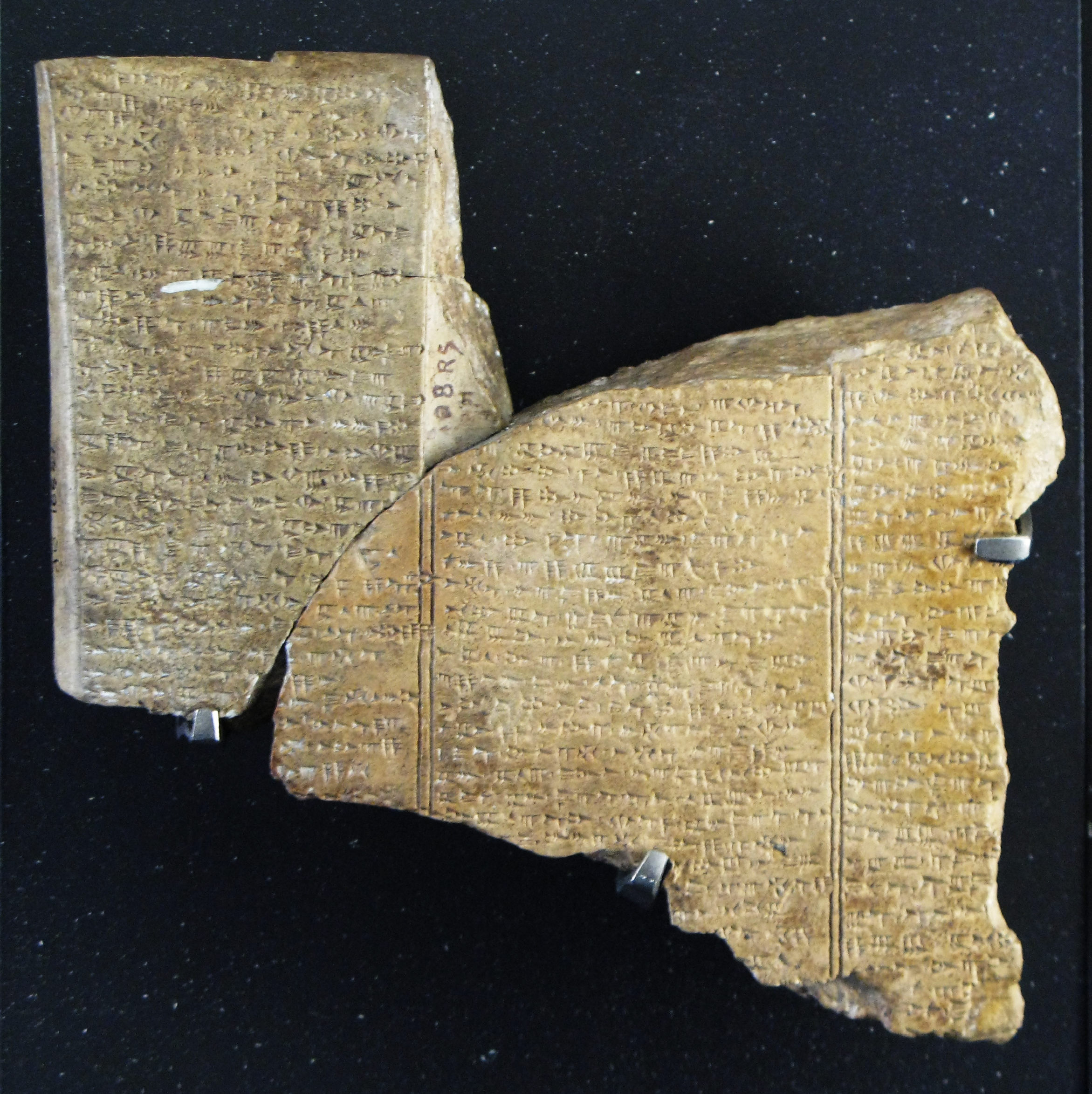
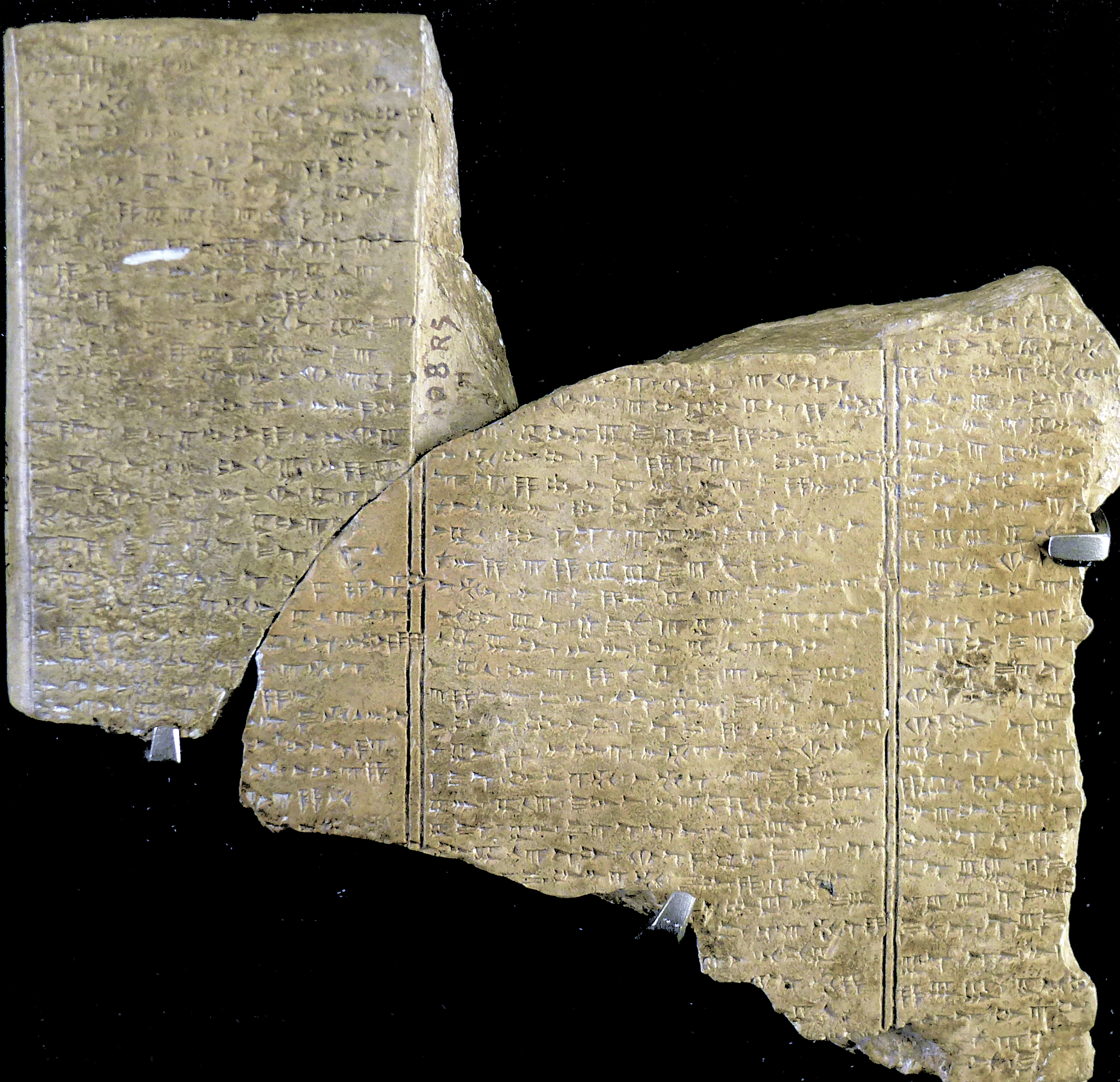
Louvre tablet AO16641/AO16642 preserves part of this textual dossier. The museum dates it to approximately 1400–1200 BCE and identifies it as text 1.5 in KTUKTU: Ugaritic Text ReferencesAbbreviation for a modern edition of alphabetic cuneiform texts. Its text references can be cross-identified with find numbers such as RS or RIH; they are not dates.Glossary · Click to read the explanation, an edition and catalogue of alphabetic-cuneiform texts from Ugarit and other sites. That dates the material witness, not the events of the story or the beginnings of its traditions. Anat's attack and the final fight are discussed below with references to KTU 1.6, not as lines on the photographed tablet itself. [3]
An opponent who threatens to swallow
The narrative warns Baal's messengers against approaching Mot, using mouth, throat and swallowing imagery to convey his danger. He then threatens Baal himself in KTU 1.5 I 1–8. This conflict is associated with the storm god's absence and reported death. However, the translation of some expressions and the relationship between drought imagery and narrative sequence remain debated; not every detail of a modern translation represents an uncontested meaning. [4] [5]
Anat: destruction does not prevent return
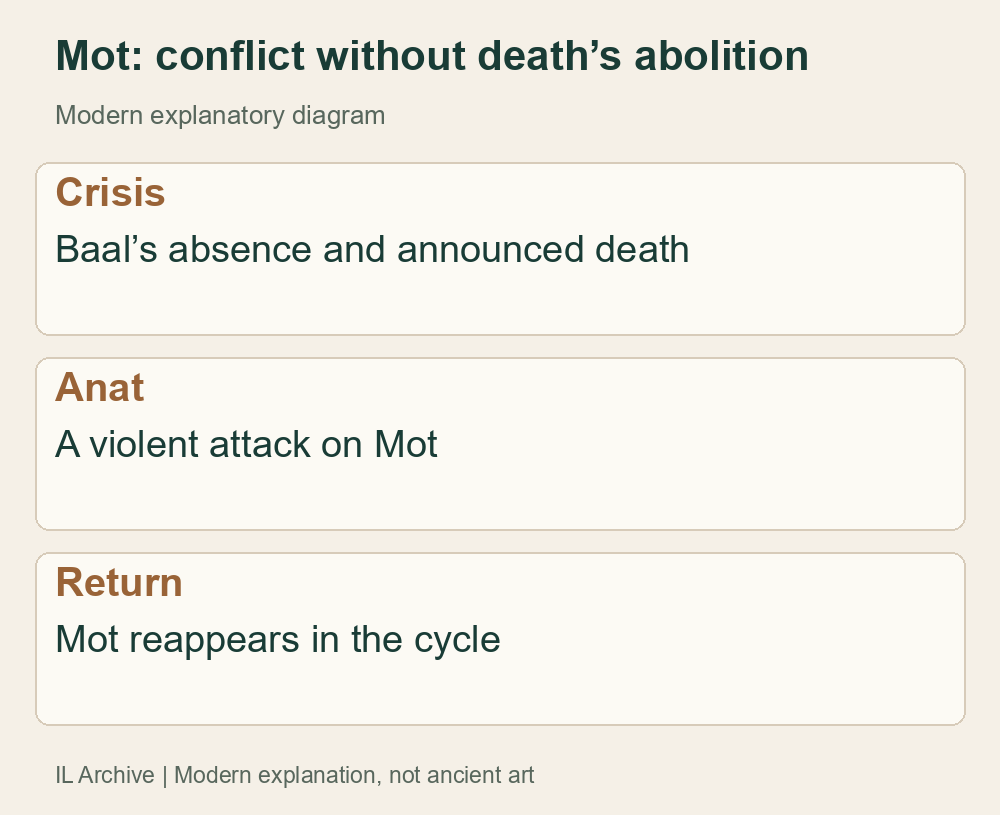
AnatAnatAnat is an ancient Near Eastern goddess attested at Mari, Ugarit and in Egypt. In Ugaritic narratives she is a warrior, Baal’s ally and a mourner for him; her roles vary by tradition and context.Glossary · Click to read the explanation, the goddess who searches for and avenges Baal, attacks Mot in KTU 1.6 II 30–37. Splitting, winnowing, burning, grinding and scattering or sowing follow one another. This is forceful narrative destruction, not a minor skirmish. The vocabulary recalls agricultural work, but treating his body like grain does not by itself establish that he was a grain god or that people performed an equivalent annual rite. [1]
The passage itself includes these words, in the Latin transliteration of Ugaritic printed in reference [1], KTU 1.6 II 33–34:
Burning followed by grinding clearly conveys destruction. Moving from agricultural imagery to human ritualRitualAn organised or distinguished practice meaningful to a community; it may leave traces, but its form alone does not reveal an associated doctrine.Glossary · Click to read the explanation, however, requires additional evidence: this extract names neither an officiant nor a festival date. The two lines are transcribed without bracketed restoration; reference [1] discusses disputed readings and interpretations elsewhere in the scene.
Reports of Baal being alive and the search for him follow. Damage to the text obscures part of the transition, however; a complete mechanism for his return cannot be described, nor can a particular operation be said with certainty to have restored him to life. Mot himself subsequently returns to conflict: a seven-year formula precedes the renewed confrontation in KTU 1.6 V 7–9. The attack's ending is not the character's end. [4] [1]
How does the fight end?
In KTU 1.6 VI 16–22 physical strength does not settle the battle: Mot's power matches Baal's, and both fall. ShapshuShapshuShapshu, the Ugaritic sun goddess, helps mourn Baal and warns Mot under El’s authority; her links with the dead and drought remain debated.Glossary · Click to read the explanation, the sun goddess, intervenes and warns Mot what ElElEl is a senior deity in Late Bronze Age Ugaritic texts, portrayed as father of the divine family and a council authority, alongside his consort Athirat. This entry does not cover every linguistic use of El.Glossary · Click to read the explanation, whom her speech identifies as Mot's father, may do: withdraw support from his seat, overturn his kingship and break his sceptre. Mot is afraid and relinquishes his challenge to Baal's kingship. The warning is a threat within a speech, not a report that El actually deposes him in this scene. [2] [5]
The combat formula shows why that intervention matters. The text repeats “mt ʿz bʿl ʿz”: “Mot is strong, Baal is strong” (KTU 1.6 VI 16–22). Shapshu then says, in line 28: [5] [2]
The Latin transcription follows reference [2]; the subject of the threat is El and its addressee Mot. The outcome is not death's annihilation by superior strength, but the ending of Mot's royal challenge through a threat to his authority. That makes a political and divine reading of this scene better grounded than reducing it to a change of seasons alone. [2] [5]
Death, seasons and interpretive limits
Rain and drought imagery matters; Ola WikanderOla WikanderScholar of ancient Near Eastern texts and the Hebrew Bible at Lund University, studying Ugaritic and shared poetic imagery.Glossary · Click to read the explanation, a scholar of ancient Near Eastern texts and the HebrewHebrewA Northwest Semitic language of the Canaanite group, encompassing Iron Age epigraphy, Biblical, Rabbinic, medieval and Modern Hebrew; its scripts and pronunciations changed over time.Glossary · Click to read the explanation Bible, examines its relationship to death and Shapshu's power. Its significance does not make the cycle a simple agricultural calendar. Baal's loss and return, Mot's continuing threat, contested kingship and other gods' interventions all belong to the narrative. Connections with specific rites remain interpretive, and divine kinship in the speeches is not a documented human pedigree. Reading the whole sequence is more accurate than reducing it to a god who dies and returns every year. [4] [1] [5]
Divine character and evidence of worship
Mythological prominence does not establish a cult. Christopher B. HaysChristopher B. HaysChristopher B. Hays studies the Hebrew Bible, Semitic languages and the ancient Near East.Glossary · Click to read the explanation, a scholar of the Hebrew Bible and its ancient context, discusses Mot's absence from the god listsGod ListsTexts collecting divine names for preservation, teaching and classification, with varying theological organization.Glossary · Click to read the explanation, offerings and personal names he surveys, alongside ambiguous extra-cycle evidence. “Personified Death” is therefore useful, but this silence does not prove that Ugaritians attributed no real power to him. [6]
An important case is KTU 1.23, combining ritual and myth. Lewis reads mt wšr in lines 8–11 as “Mot the Ruler,” citing bereavement and widowhood sceptres and vine-like binding. The alternative “man/warrior-prince” rests on mt also meaning “man.” Bereavement favours Death without eliminating the lexical ambiguity. Even that reading establishes ritual resistance to a harmful power, not offerings to it. [2]
References and notes (6)
- Jeffery B. Lloyd, The Goddess Anat: An Examination of the Textual and Iconographic Evidence from the Second Millennium B.C., PhD thesis, University of Edinburgh, 1994. pp. 202–210 and opening p. 211: context, Anat’s attack, agricultural interpretation and the gap before Baal’s return. Latin transcription of KTU 1.6 II 33–34 visually checked on printed p. 205 (PDF page 214). No independent tablet collation or whole-thesis reading. Return to the text ↑
- Theodore J. Lewis, “God [ʾIlu] and King in KTU 1.23,” in “Like ʾIlu Are You Wise”: Studies in Northwest Semitic Languages and Literatures in Honor of Dennis G. Pardee, edited by H. H. Hardy II, Joseph Lam and Eric D. Reymond, SAOC 73, University of Chicago, 2022. pp. 33–35 (PDF pages 87–89): KTU 1.6 VI 27–29 and warning in n. 18; line 28 transcribed without restoration. P. 35 n. 19: mt wšr and alternative “Warrior-Prince” in KTU 1.23. These pages read, not the whole volume. Return to the text ↑
- Musée du Louvre, catalogue record AO16641/AO16642, ‘tablette ; fragment’. Identity, script, date 1400–1200 BCE and findspot; bibliography identifies KTU³ (2013), 1.5. No independent collation of lines on the photographed face. Return to the text ↑
- John C.L. Gibson, ‘Death in Canaanite Thinking’, Aula Orientalis 17–18 (1999–2000), 91–95. Indexed excerpts read from pp. 91–92: warning to envoys KTU 1.4 VIII 7–31, Anat's violence KTU 1.6 II 30–37, seven-year formula KTU 1.6 V 7–9 and critique of an annual reading. Not the full article. Return to the text ↑
- Ola Wikander, Drought, Death, and the Sun in Ugarit and Ancient Israel: A Philological and Comparative Study, Coniectanea Biblica, Old Testament Series 61, Eisenbrauns, 2014. pp. 52–54, selected translation/discussion of KTU 1.5 I 1–8; pp. 70–74, transition and final fight, including KTU 1.6 VI 16–31. Matched combatants and Shapshu's warning invoking El; drought interpretation attributed to the author. Return to the text ↑
- Christopher B. Hays, Death in the Iron Age II and in First Isaiah, FAT 79 (2011). pp. 123–124: Mot, limits of cult evidence and readings of mt outside the Baal Cycle. These pages read in a book excerpt, not the whole book. Return to the text ↑
Suggest a correction · Suggest a source for this record
Cite this record
IL Archive, «Mot», https://ilarchive.com/en/entities/mot
Continue reading
Related readings