Entity · deity
Mot
A reference page linking a name, group, or concept to the materials that discuss it.
God of death in the Baal Cycle; an adversary who returns even after a violent attack.
Text
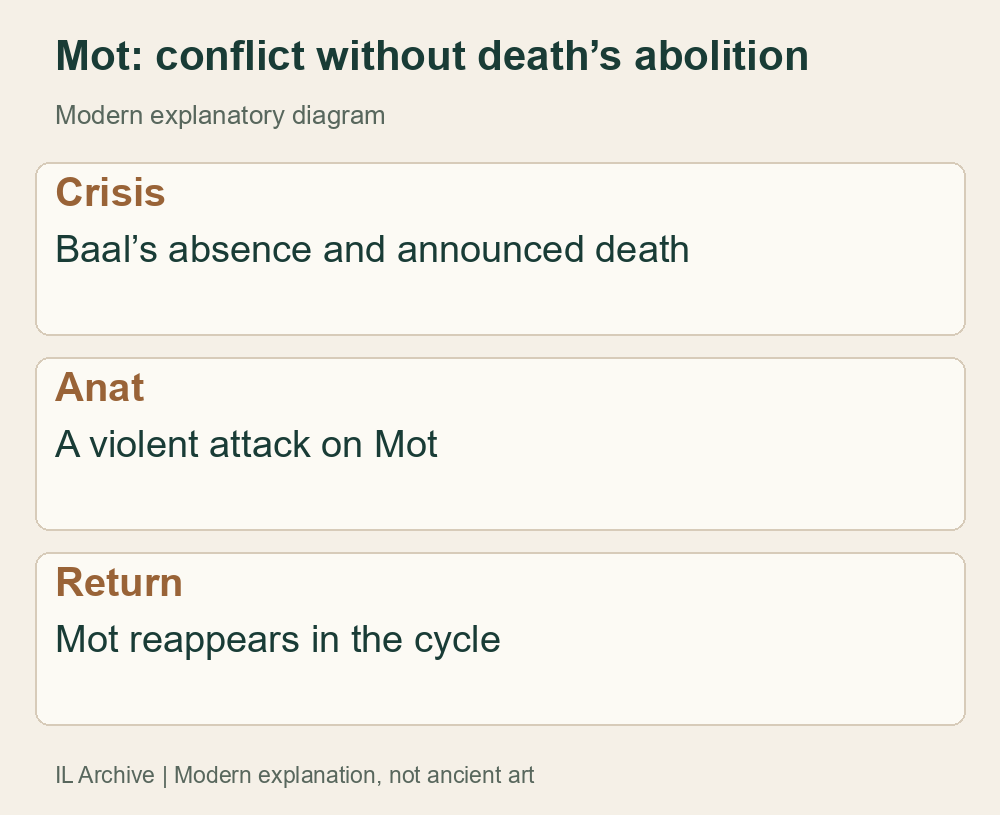
Mot is associated with BaalBaalStorm god and protagonist of Ugarit’s Baal Cycle; exercises active kingship while El retains importance and authorizes the palace.Glossary · Click to read the explanation’s absence and announced death. AnatAnatAn active and violent goddess in Ugaritic literature; pressures El over Baal’s palace and addresses him with paternal and wisdom language.Glossary · Click to read the explanation attacks him in KTU1.6II using language of splitting, winnowing, burning, grinding and sowing; he later reappears.[1] Agricultural imagery invites interpretation without proving an annual ritualRitualAn organised or distinguished practice meaningful to a community; it may leave traces, but its form alone does not reveal an associated doctrine.Glossary · Click to read the explanation. In the final confrontation ShapshuShapshuUgaritic sun goddess; involved in Baal’s crisis and intervening verbally in the Mot conflict.Glossary · Click to read the explanation warns him of El’s anger threatening his throne, rather than narrating an actual deposition by El.[2] Mot is the deity’s name here, not every ordinary reference to death.
References and notes
- Jeffery B. Lloyd (1994). The Goddess Anat: An Examination of the Textual and Iconographic Evidence from the Second Millennium B.C. University of Edinburgh doctoral thesis. Selected pp.181–184,191–192,197–198,203–208: palace request/threat/permission, mourning in KTU1.5VI, Anat’s attack in KTU1.6II, gap before El’s dream and agricultural-reading limits. Restorations/interpretations distinguished from secure wording. Whole thesis not read. Return to the text ↑
- Theodore J. Lewis (2022). God [ʾIlu] and King in KTU 1.23. In “Like ʾIlu Are You Wise”: Studies in Northwest Semitic Languages and Literatures in Honor of Dennis G. Pardee. SAOC 73. P.34, especially n.18: KTU1.6VI27–29, Shapshu warns Mot of throne support withdrawn, throne overturned and scepter broken; no executed deposition in the scene. Royal titles in n.17. Whole volume not read. Return to the text ↑
Research history
Substantive changes are retained here. Minor copy edits remain in the internal operational log.
-
Substantive record update
-
Substantive record update
Suggest a correction · Suggest a source for this record
Cite this record
IL Archive, «Mot», Edition 3, https://ilarchive.com/en/entities/mot