Study
El Before Ugarit
An extended study of a topic, with evidence and references.
From Ebla to Amorite names and Mari: distinguishing “god” from “El,” and assessing fatherhood and kinship language before Ugaritic literature.
Share article
Dates
Dates have distinct roles. The timeline uses creation, composition or historical coverage, rather than publication or discovery dates.
- Historical coverage
- Approximately From 2400 BCE to 1200 BCE
Text
From Ebla to the Amorites and Mari
When Late Bronze AgeLate Bronze AgeAn archaeological period conventionally around 1600–1200 BCE in much of the Near East, with regional variation.Glossary · Click to read the explanation tablets from UgaritUgaritAncient city and kingdom at Ras Shamra on the Syrian coast, flourishing between the fourteenth and early twelfth centuries BCE and preserving multilingual archives.Glossary · Click to read the explanation open a window onto the divine world, ElEl at UgaritA deity prominent in West Semitic traditions, especially as head of the divine family in Ugaritic texts.Glossary · Click to read the explanation is already a recognizable figure: father of the gods and a deity of considerable standing within an organized religious tradition. We encounter a personality, not simply an obscure word. Where did this El come from? [1]
About a millennium earlier, the Semitic element il / ilumAkkadian iluThe Akkadian word for “god”; its occurrence does not automatically identify the deity El.Glossary · Click to read the explanation occurs in personal names at EblaEblaAn ancient city at Tell Mardikh in Syria, known for its third-millennium BCE tablet archive.Glossary · Click to read the explanation. It appears again in Amorite material and MariMariAn ancient city and kingdom on the Euphrates, at Tell Hariri in eastern Syria.Glossary · Click to read the explanation’s documents. Yet these witnesses do not supply a continuous biography. The further back we go, the harder it becomes to distinguish the word “god” from the name “El.”
At Ugarit we can ask about the deity’s actions and relationships. At Ebla the first question is whether a name identifies a particular god called El, or “the god” known to its bearer and family. The history begins with that ambiguity.
Ebla, a millennium before Ugarit
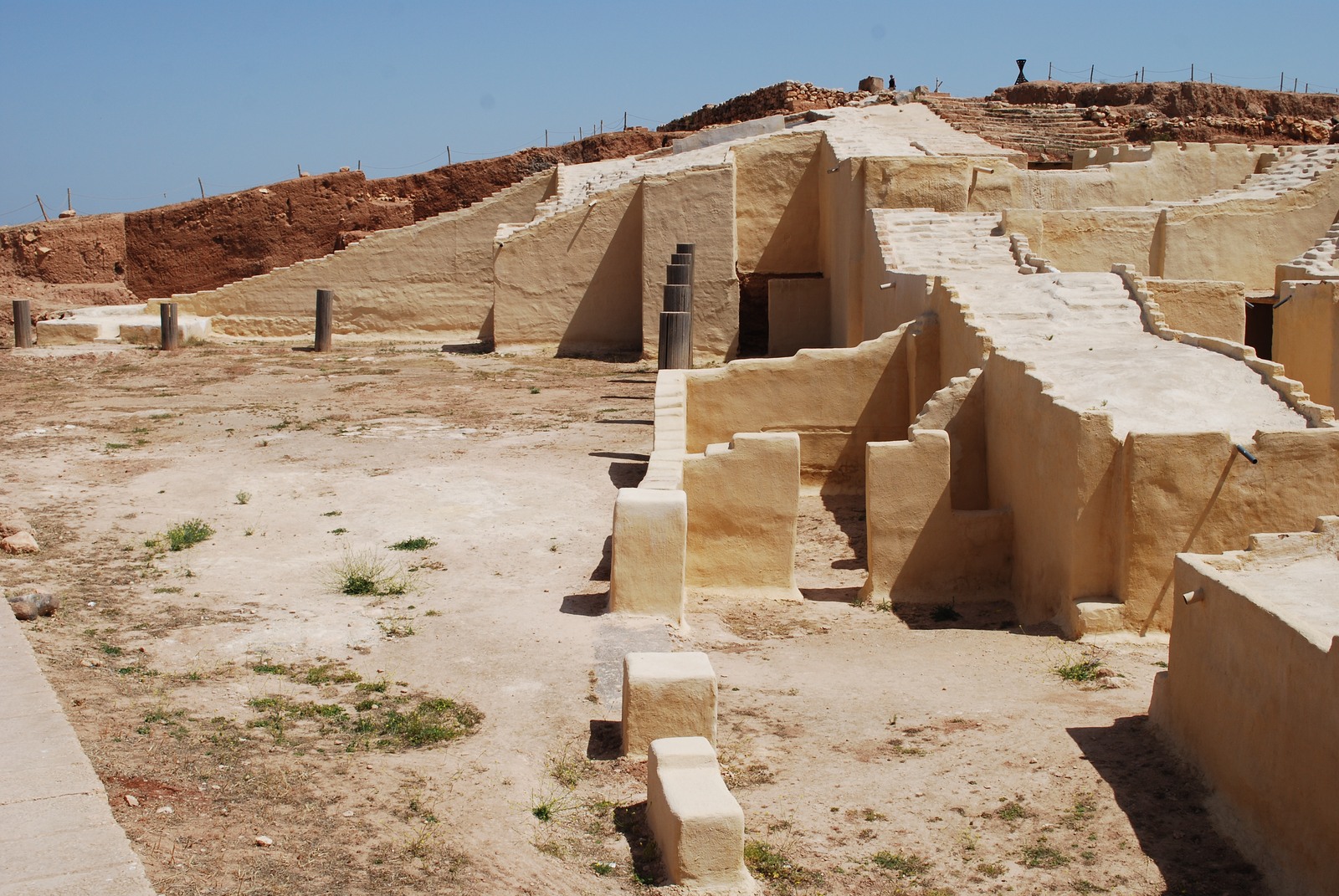
Ebla lies at Tell Mardikh in Syria. Documents from its royal palace, approximately the twenty-fourth century BCE, preserve a world of administration, ritualRitualAn organised or distinguished practice meaningful to a community; it may leave traces, but its form alone does not reveal an associated doctrine.Glossary · Click to read the explanation and relations between cities. They allow personal names and institutional worship to be studied together, while remaining different kinds of evidence. [2]
Examples of the divine element include forms transcribed i₃-lum in J. M. Pagan’s database. This material belongs to the linguistic family that also includes Ugaritic il and AkkadianAkkadianAn ancient East Semitic language written in cuneiform in Mesopotamia.Glossary · Click to read the explanation ilu. Linguistic kinshipLinguistic relatednessA relationship through shared linguistic ancestry, distinct from direct borrowing or identical beliefs.Glossary · Click to read the explanation does not identify every occurrence with the same deity. The expression may function as the common nounCommon nounA word naming a class of things, such as “god”, rather than one particular individual.Glossary · Click to read the explanation “god,” or, in other contexts, the proper nameProper nameA name identifying a particular individual, place or other entity.Glossary · Click to read the explanation “El.” [3]
The resemblance starts an investigation. It does not replace analysis of a name’s construction, spelling, context and date.
What do Ebla’s names actually say?
Pagan’s database provides concrete examples. Entry 2721 interprets i₃-lum a-hi as “god is my brother”; entry 2717 interprets i₃-lum BALA as “god is support.” Other constructions are analysed with the divine element as an agent, such as “Il knows” or “Il helped.” These are modern analyses and translations of ancient material. [3]
One detail matters: language expressing kinship and closeness to a god is already present at Ebla. It should not be presented as an Amorite innovation centuries later.
The database itself uses “god” in some analyses and “Il” in others. The debate cannot therefore be reduced to an absolute rule that every il is always a common noun or always a proper name. The evidence is older than our ability to identify its religious referent in each case.
Was this the Ugaritic El?
Alfonso Archi argued for distinguishing the early name material from El as a clearly defined figure in the Ugaritic pantheonPantheonThe set of deities associated with a religious tradition, including their roles and relationships.Glossary · Click to read the explanation. In a 2013 study, he placed the formation of that figure in the West Semitic milieu of the second millennium BCE and did not identify Ugaritic El in Ebla’s early pantheon. This is a scholar’s historical thesis, not a statement from an Ebla tablet or a consensus closing the question. [4]
Research on Ebla’s worship documents the standing of named deities such as Kura, Hadda, Ishhara, IshtarInanna / IshtarProminent Mesopotamian goddess with a major centre at Uruk, whose parentage and cult traditions vary rather than forming one fixed genealogy.Glossary · Click to read the explanation and DaganDaganDeity known in Syria and Mesopotamia, attested in Ugaritic lists, offerings and names; Baal is called his son. Temple attribution remains debated.Glossary · Click to read the explanation. Personal names need not reproduce their ranking in royal ritual. [2]
“The god” might designate a deity already familiar to a family, without naming it explicitly. Naming may also preserve a particular tradition. Moving from either possibility to “all these names concern Ugaritic El” requires further evidence.
The Amorites: a language preserved in people’s names
From the late third and early second millennia BCE, material classified as Amorite appears across Syria and MesopotamiaMesopotamiaA historical region associated with the Tigris and Euphrates, home to many societies and civilisations.Glossary · Click to read the explanation. Many names survive in documents written in Sumerian or Akkadian. A document’s language is not necessarily the language of a name within it.
Ignace J. GelbIgnace J. GelbUniversity of Chicago Assyriologist (1907–1985), studying ancient languages, writing and personal names, including Amorite names.Glossary · Click to read the explanation’s project, published in 1980, assembled 6,662 names, mainly from Old Babylonian texts, with earlier Ur III material. Ebla’s names were excluded. This is the size of a research collection, not a census of a uniform ethnic population or thousands of El’s worshippers. [5]
Names reveal sounds, constructions and religious elements, but require individual analysis. This is the work of onomasticsOnomasticsThe study of names, their origins, forms and contexts: evidence for language and religion, not a substitute for mythological or ritual texts.Glossary · Click to read the explanation: studying names as contextual linguistic and historical evidence, rather than merely translating a list of words.
An essential update: more than names
Most research on Amorite long depended on personal names. But saying that we know it “only from names” is now too restrictive. George and Krebernik’s study “Two Remarkable Vocabularies: Amorite-Akkadian Bilinguals!”, published in the 2022 volume, presented two Old Babylonian tablets whose non-Akkadian material they interpreted as a variety of Amorite. [6]
This considerably extends the linguistic evidence, while the language identification should remain attributed to the authors. It does not supply a preserved Amorite mythological cycle about El comparable to Ugarit’s literature.
Additional linguistic witnesses and a text describing the god’s family, council and attributes are different things. The former have become available; the names underlying this comparison do not provide the latter.
“God is father” or “El is father”?
Giorgio Buccellati offers a revealing example in his study of the AmoritesAmoritesGroups associated with West Semitic speech in the Levant and Mesopotamia, whose dynasties were particularly prominent in the nineteenth and eighteenth centuries BCE (ca. 1900–1700 BCE).Glossary · Click to read the explanation of the Ur III period. He gives the written form A-BU-UM-DINGIR an Akkadian analysis, abum-ilum, “god is father,” and an Amorite analysis, abum-El, “El is father.” A shared spelling does not remove the difference between the analyses. [7]
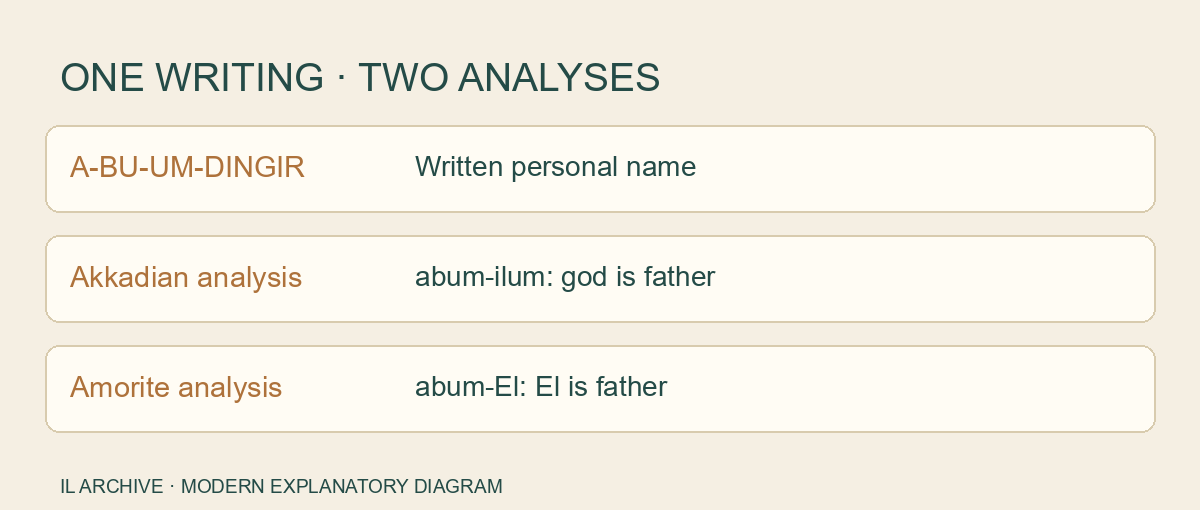
Both interpretations express divine fatherhood. Reading a proper name additionally identifies the god, and that judgment requires explanation.
Buccellati also cites A-ḫu-um-ma-DINGIR among examples of “brother” in divine personal names. Translating this type as “El is brother” likewise depends on how the final element is read. Kinship vocabulary alone does not reconstruct a complete doctrine about human origins or divine genealogy. [7]
When grammar becomes evidence
Distinguishing “god” from “El” need not depend on intuition alone. In 1975 Ichiro Nakata discussed Mari names alternating El, Il and DINGIR and argued from grammatical forms for a particular divine name. His arguments included Il after certain verbs and in a construction such as Puzur-Il, where the spelling does not always match the inflection expected for the common Akkadian noun ilum. [8]
This is stronger linguistic evidence than simply encountering the same letters. It concerns analysed examples and particular contexts, however. It does not turn every DINGIR in every period into El, or give similar-looking names one necessary linguistic and religious origin.
The question is therefore which analysis the form of a particular name in a particular text supports.
A god in the language of the household
Father, brother and support bring the deity into family language. They can express protection, belonging and trust without being literal genealogies in every case. A name making the divine element an agent also differs from one merely naming a distant title.
This leads to the concept of a personal godPersonal godAn analytical concept for a deity’s relationship with an individual or family; it may overlap city worship and does not identify the god from a name alone.Glossary · Click to read the explanation or family god: a religious relationship viewed through its connection with an individual or small group. It is a modern analytical term and need not denote a deity distinct from the city’s gods.
An institutional deity may also be close to a family. A family may say “the god” because the identity is already understood. Names may preserve traditions less prominent in offering lists. These possibilities frame questions; they do not select one identity for every name.
Mari: an archive allowing comparison
At Mari, Tell Hariri on the Euphrates, Zimri-Lim’s palace preserved thousands of cuneiformCuneiformWriting with wedge-shaped signs, developed from Mesopotamian recording traditions and used for several languages from the third millennium BCE.Glossary · Click to read the explanation documents. The important Old Babylonian material belongs to the early second millennium BCE, especially the world of the eighteenth century. The archaeological project describes the royal archive’s exceptional resources for textual study. [9]
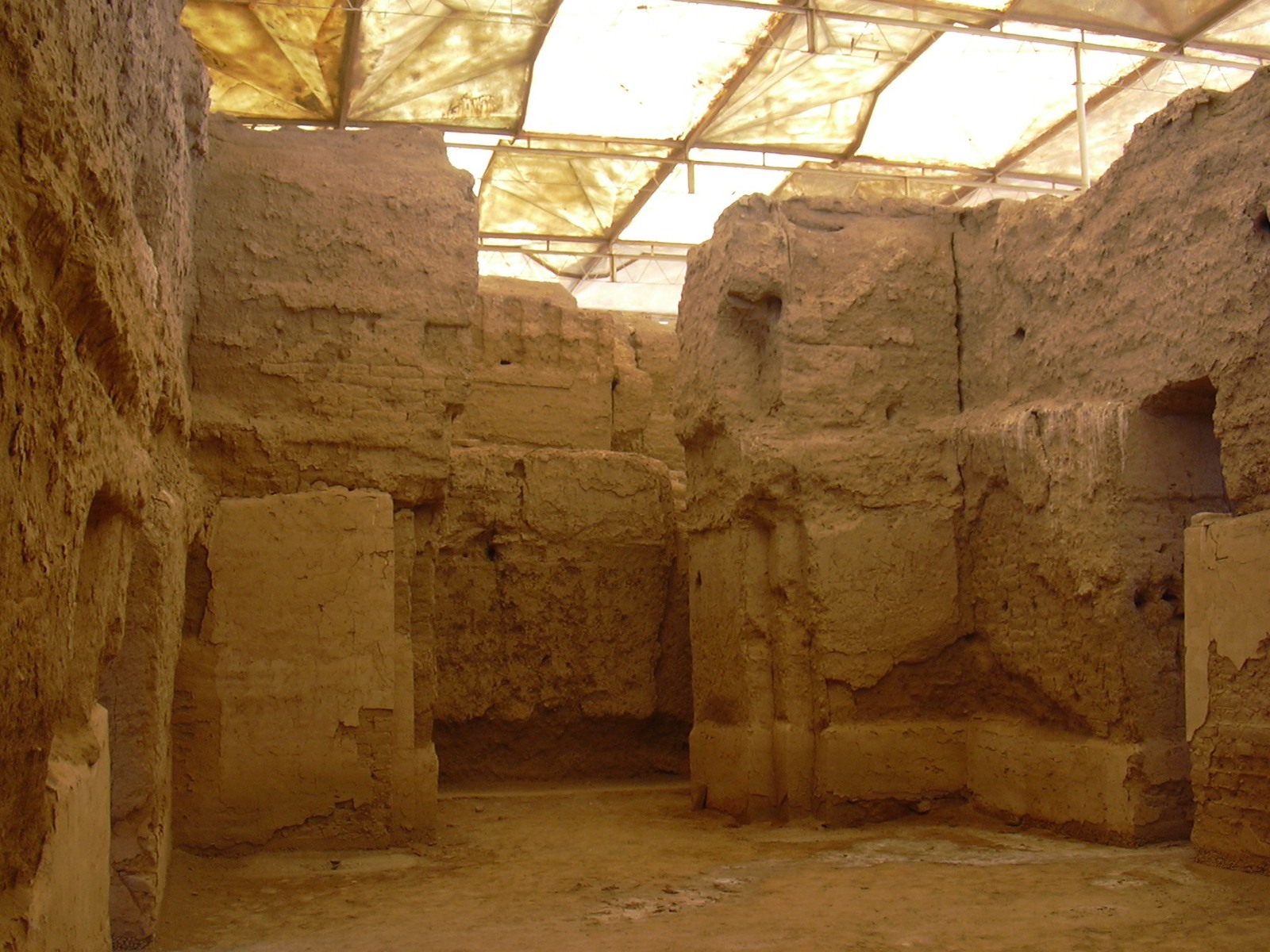
Here personal names can be compared with documents recording institutional worship. Each serves a different purpose: an offering list records an official act; a personal name preserves a naming choice. Neither alone maps the city’s entire religious life.
Even “popular religion” needs definition. In this comparison it means what the researcher infers from names, not interviews with inhabitants or a record of everything practised in their homes.
El is more prominent in names than official documents
In a 1976 study, Nakata compared twenty selected deities in the material then available. Some, including Addu, Dagan, ShamashShamashMesopotamian god of the sun and justice, shown before Hammurabi on an eighteenth-century BCE stele preserved in the Louvre.Glossary · Click to read the explanation and EaEnkiMesopotamian deity associated with deep fresh water, wisdom and Eridu, known as Ea in Akkadian tradition. The earliest preserved written mention does not date his cult’s origin or identify Ubaid Eridu’s deity.Glossary · Click to read the explanation, were prominent in both spheres; others in official worship but less in names; a third group showed the reverse. He placed El/Il in the third: prominent in names, weak or absent in his official list. [10]
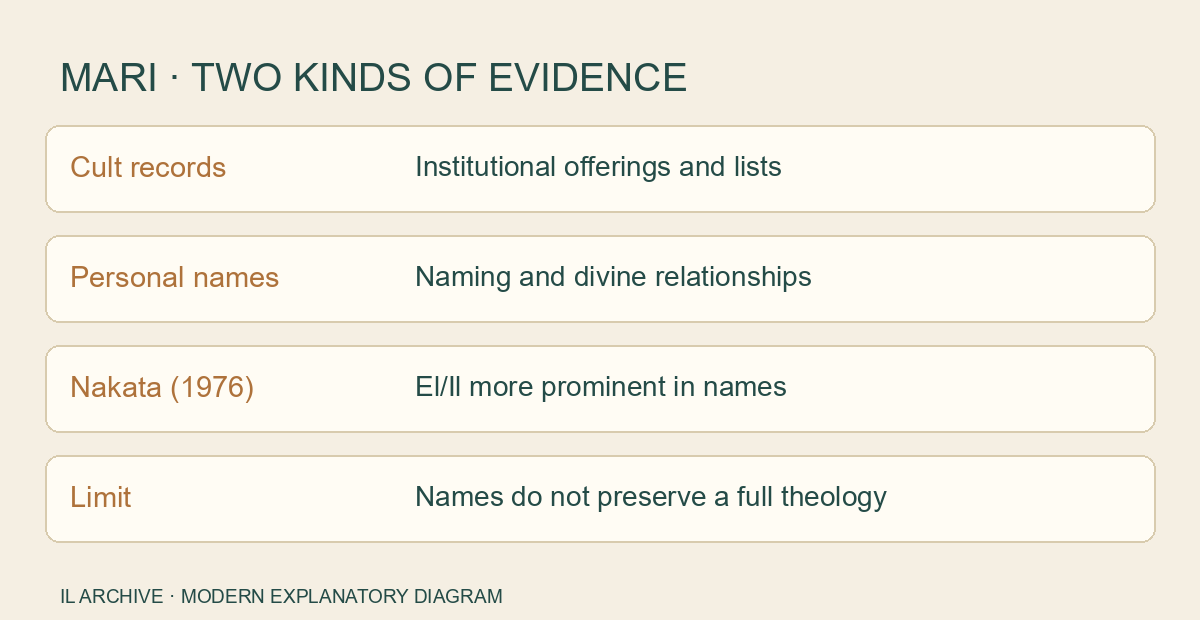
Nakata interpreted the difference through the encounter between Akkadian traditions and an Amorite West Semitic component. The explanation should remain his, and the finding within his sample. It proves neither that all Amorites worshipped one identical deity nor that Mari lacked any official worship of El throughout its history.
The comparison nonetheless exposes a faulty measure: a god’s importance to people cannot be assessed only by frequency in temple or palace records.
Did a family god become head of the pantheon?
An attractive sequence suggests itself: a god close to a family, then father of a wider community, then father of Ugarit’s divine family. The names give us a real reason to test this model.
Arranging witnesses that way does not establish that the transformation happened. Brotherhood already occurs at Ebla; some fatherhood names admit two analyses; Mari’s result compares two document groups. We lack a textual sequence describing one personality changing stage by stage.
Mythological conceptions may also be older than the names reveal. Their bearers might have known a god with a family, council and stories that have not survived. “Family god becoming father of the gods” remains a historical possibility, alongside the possibility that early evidence records only a narrow aspect of an already richer figure.
How does “the god” become El’s name?
A title can become a proper name. An expression can function as a general noun and a personal name in neighbouring traditions. Different local usages can converge over time.
These are scenarios for explaining the distance between il meaning “god” and El as the name of a recognized deity. No surviving moment dates the change to a particular year. Capitalization in modern Latin transcription is an editorial choice, not a device the ancient writer used to resolve the problem.
Drawing a line between Ebla, Mari and Ugarit is consequently insufficient. Language, date, document function, contact and specific resemblance must be examined, alongside changing meanings and independent developmentIndependent developmentSimilar elements arising without historical transmission between them.Glossary · Click to read the explanation.
What can the evidence establish?
- Documented: il / ilum occurs in Ebla’s names roughly a millennium before Ugaritic literature, with analyses expressing kinship and support.
- Documented in particular examples: neighbouring Amorite and Akkadian material contains fatherhood and brotherhood names; some permit different readings of “god” and “El.”
- A specific research finding: Nakata found El/Il more prominent in Mari’s names than in the official cult list used for comparison.
- Possible: a historical connection links some personal-god traditions and Ugarit’s father El.
- Unproven: every il at Ebla or every similar Amorite name identifies one figure possessing all Ugaritic El’s attributes.
It is also unproven that those attributes were absent simply because a text describing them has not survived. Evidence limits inference in both directions: it prevents projecting the later picture backwards and turning silence into certainty.
A name is not a biography
If only names such as Abdullah and Ataullah survived from a society’s religion, they would reveal something real about its religious vocabulary. They would not recover all its prayers, stories and institutions. Ancient names likewise preserve short expressions from a larger, partly lost world.
“God is my brother” establishes that kinship entered religious language. “God is father” establishes fatherhood within a name’s meaning. Neither expression alone identifies whether the father is father of an individual, family, community or gods.
A community may retain a name after its interpretation changes, or transmit it without each bearer expressing an elaborate doctrine. A name illuminates a relationship; it does not replace a narrative about the deity.
El before he comes clearly into view
We cannot yet trace El from Ebla to Ugarit as one established biography. We can follow a thread of vocabulary, names and relationships: “god” or “El,” father, brother and support, with connections prominent in people’s names but not always equally visible in official records.
Ugarit then opens a different window. We move from an element inside a human name to a figure within the divine world. This leap in evidence does not by itself date an equivalent leap in belief.
Before El becomes clearly visible at Ugarit, the word and name element appear in settings close to human life. When those traditions converged in the personality we know, and how, remain open questions. Earlier centuries preserved people’s names more fully than the god’s stories.
References and notes
- Yves Calvet. Ras Shamra, l’ancienne Ougarit. Clio (January 1999). Excavation director’s account, Bronze Age city, archives and art passages: El as father of the gods. Not used to date his earliest worship. Return to the text ↑
- Walther Sallaberger (2018). Kura, Youthful Ruler and Martial City-God of Ebla. In Ebla and Beyond. Pp. 108–109: royal archive date, Kura and deities of Ebla and neighbouring centres. Full chapter not read; does not identify il in every name. Return to the text ↑
- J. M. Pagan (1998). A Morphological and Lexical Study of Personal Names in the Ebla Texts, ARET Studi III. Browser edition prepared by Giorgio Buccellati (2012). Digital-edition introduction and selected entries: 2707 “Il knows,” 2717 “god is support,” 2721 “god is my brother,” 2737 “Il helped.” Analyses attributed to the database; not all names or original tablets inspected. Introduction: https://laa.cyb-mes.net/ebla_pns.html Return to the text ↑
- Alfonso Archi (2013). The West Hurrian Pantheon and Its Background. In Beyond Hatti: A Tribute to Gary Beckman, pp. 1–21. Pp. 17–18, especially p. 18 and note 102; p. 18 checked textually and visually. Archi places El’s formation in the second millennium and distinguishes Ebla’s pantheon. Attributed thesis. The 2015 Il in the Personal Names of Ebla reference was checked bibliographically only; full chapter not read. Return to the text ↑
- Ignace J. Gelb et al. (1980). Computer-Aided Analysis of Amorite. Assyriological Studies 21, Oriental Institute, Chicago. Institutional collection description: 6,662 names, mainly Old Babylonian with Ur III material; Ebla excluded. Not all book entries read. Historical description of reliance on names is read with newer evidence in reference 6. Return to the text ↑
- Andrew R. George & Manfred Krebernik (2022). Two Remarkable Vocabularies: Amorite-Akkadian Bilinguals! Revue d’assyriologie et d’archéologie orientale 116, pp. 113–166. doi:10.3917/assy.116.0113. Indexed publisher abstract: two Old Babylonian tablets and material interpreted by the authors as Amorite. Volume dated 2022; online publication 1 November 2023. Direct page access unavailable; full article not read. Return to the text ↑
- Giorgio Buccellati (1966). The Amorites of the Ur III Period. Ricerche I, Naples: Istituto Orientale. Author/project-hosted Part 1. P. 129: A-BU-UM-DINGIR and the Akkadian/Amorite analyses, text and visual check. P. 164: A-ḫu-um-ma-DINGIR (ARM VII 190:2,7) cited for brotherhood language. Selected passages, not a full-book reading. Return to the text ↑
- Ichiro Nakata (1975). A Mari Note: Ikrub-El and Related Matters. Orient 11, pp. 15–24. doi:10.5356/orient1960.11.15. Pp. 15–17: El/Il/DINGIR spellings and grammatical arguments, including Puzur-Il. Proper-name analysis attributed to the scholar, not generalized to every DINGIR. Later discussion of the deified person not used. Return to the text ↑
- Mari archaeological project / French Ministry of Culture. Studying texts from Mari. Project account of the royal archive in Zimri-Lim’s palace and textual collections. Not used to quantify El’s worship. Return to the text ↑
- Ichiro Nakata (1976). Official Pantheon and Popular Pantheon of Mari. Bulletin of the Society for Near Eastern Studies in Japan 19(1), pp. 1–15, 103. doi:10.5356/jorient.19.1. English abstract: twenty selected deities and three groups comparing official documents with names; El/Il in the third. Finding limited to this comparison and material then available; full Japanese article not read. Return to the text ↑
Suggest a correction · Suggest a source for this record
Cite this record
IL Archive, «El Before Ugarit», Edition 1, https://ilarchive.com/en/studies/el-before-ugarit
Continue reading