Entity · Concept
Personal god
A reference page linking a name, group, or concept to the materials that discuss it.
In ancient Mesopotamian sources, a personal deity could protect and intercede for individuals or families. This entry examines Ebla names, Mari lists, and prayers, distinguishing evidence from interpretation.
Estimated reading time: 5 min Published Last reviewed:
Share article

Text
Introduction
What did a “personal god” mean in the ancient Near EastAncient Near EastModern scholarly label for ancient societies of Mesopotamia, the Levant, Anatolia and Iran, sometimes extending to Egypt and other neighbours depending on the study; not one civilization or religion.Glossary · Click to read the explanation? The phrase does not imply a deity owned exclusively by one person or a religion separate from the gods of the city. It describes a relationship in which an individual or family sought a deity’s care, protection, or intercession; the particulars changed across texts, periods, and communities.
This entry brings together three kinds of evidence: personal names from EblaEblaAncient city at Tell Mardikh, southwest of Aleppo, Syria. Its Palace G archives illuminate third-millennium BCE administration, language, and cult; the site has later occupation phases.Glossary · Click to read the explanation, a comparison of the official pantheon list with personal names from Mari, and Sumerian and AkkadianAkkadianAn ancient East Semitic language written in cuneiform from the third millennium BCE; its varieties include Babylonian and Assyrian, and it served in international diplomacy.Glossary · Click to read the explanation prayers. The aim is to see what each source actually reveals about human–divine relationships—and where interpretation begins.
A personal name is not a temple register
Personal names, particularly theophoric namesTheophoric nameA personal name including a deity’s name or another divine element, often as part of a short sentence or invocation, interpreted in its original language and context.Glossary · Click to read the explanation, may express prayers, praise, kinship, or hopes. Yet a recorded name does not necessarily disclose its bearer’s everyday practice. An official list of deities reflects an institutional or scribal selection and may omit a god mentioned in ordinary names. Neither a count of names nor a single official list amounts to a census of everyone’s religion.[1][2]
Three levels must be kept distinct: the document’s actual wording, a linguist’s analysis of a name, and the wider historical interpretation proposed by a scholar. In onomasticsOnomasticsStudy of proper names, especially personal and place names, through their forms, languages, histories and social uses; a name alone does not establish its bearer’s identity or religion.Glossary · Click to read the explanation, a written divine element may signify “god” as a common nounCommon nounA noun referring to a member of a class, such as “city” or “god”, unlike a proper name designating a particular entity. Semitic il/El may fulfill either function in context.Glossary · Click to read the explanation or identify a particular deity; similarity of spelling alone will not settle the question.
What makes a deity “personal”?
In studies of MesopotamiaMesopotamiaHistorical region associated with the Tigris and Euphrates: Uruk, Ur, Eridu, cuneiform, Sumer, Akkad, Babylon and Assyria, their languages and cults, and the limits of archaeological evidence.Glossary · Click to read the explanation, a personal god was associated with an individual as a helper and protector, sometimes interceding with higher-ranking deities. Texts also speak of a personal goddess; the relationship was not exclusively with a male god. Familial language, notions of good fortune, and the fear that a guardian deity might withdraw are recurring features of some prayers. They do not describe a single uniform religious system throughout the region’s history.[3][4]
The relationship was not always that of an isolated individual. Families and inheritance figure prominently in textual evidence and scholarly interpretations, while occupation and locality could also affect the deity’s identity. Personal deities were often of comparatively modest rank, but there were exceptions: the term does not mean an inherently minor or separate god. An individual’s devotion could coexist with attendance at a city’s festivals and public rites.[3]
Prayer: parenthood, hope, and estrangement
The University of Oxford’s Electronic Text Corpus of Sumerian Literature (ETCSL) preserves an English translation of the Sumerian composition A man and his god (5.2.4). In the poem a suffering young man addresses his god as a father, calls upon his mother, sister, and wife in his lament, and ultimately receives relief from his god. This is a literary representation of complaint and reconciliation—not a biographical report about an identifiable man, nor evidence that prayers always produced this outcome.[5]
In Alan LenziAlan LenziAlan Lenzi studies Babylonian literature and religion and the Hebrew Bible, and is a professor at the University of the Pacific in Stockton.Glossary · Click to read the explanation’s presentation of Akkadian dingiršadibba prayers to personal deities, petitioners acknowledge an offense—or their ignorance of it—and ask a god or goddess for renewed favor and protection. The division of one sequence into two or three prayers differs among manuscript witnesses. Such material shows that the relationship was not merely one of affection or assured success: it could encompass anxiety about a deity’s anger or absence.[3]
Ebla: is Il a name or a common noun?
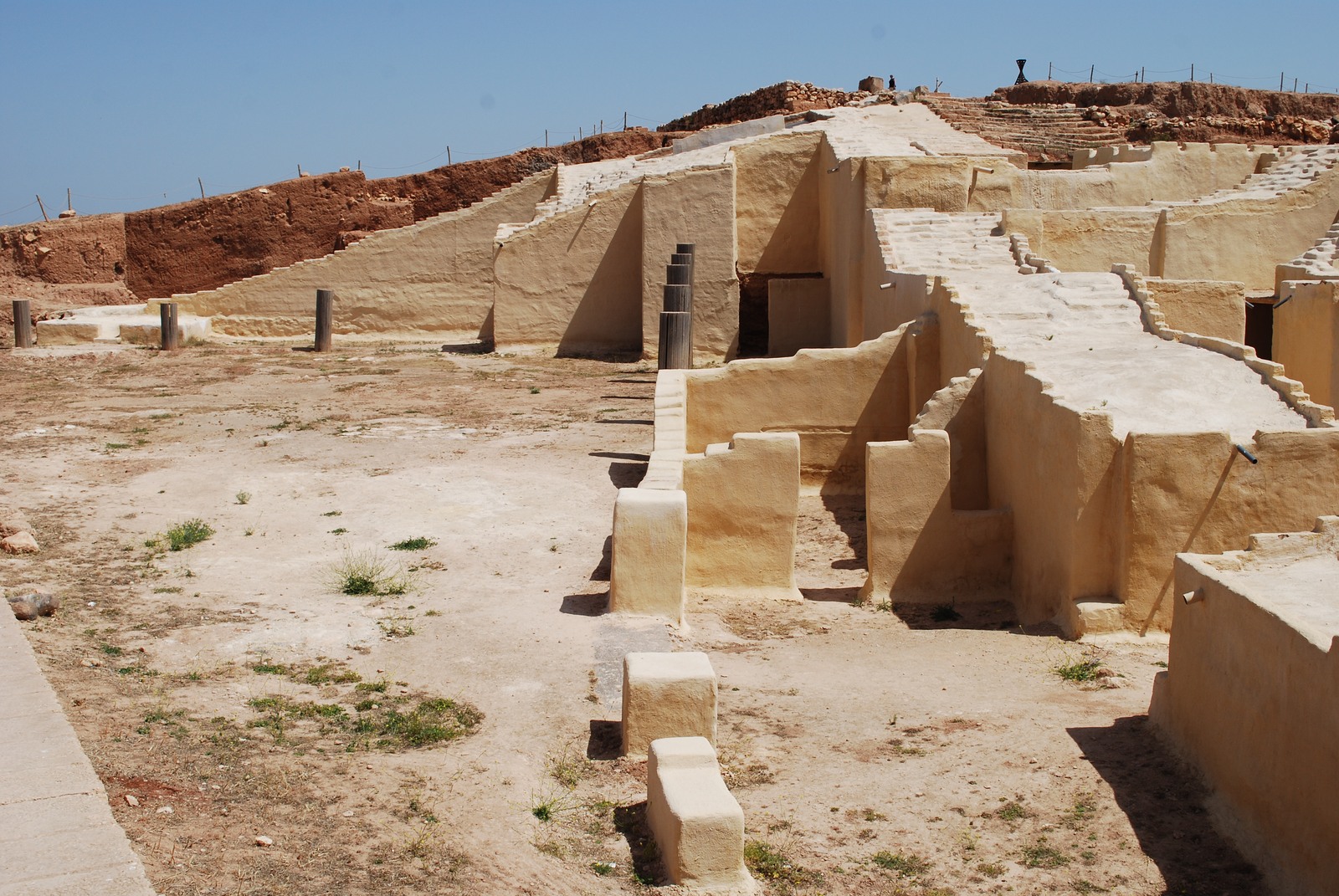
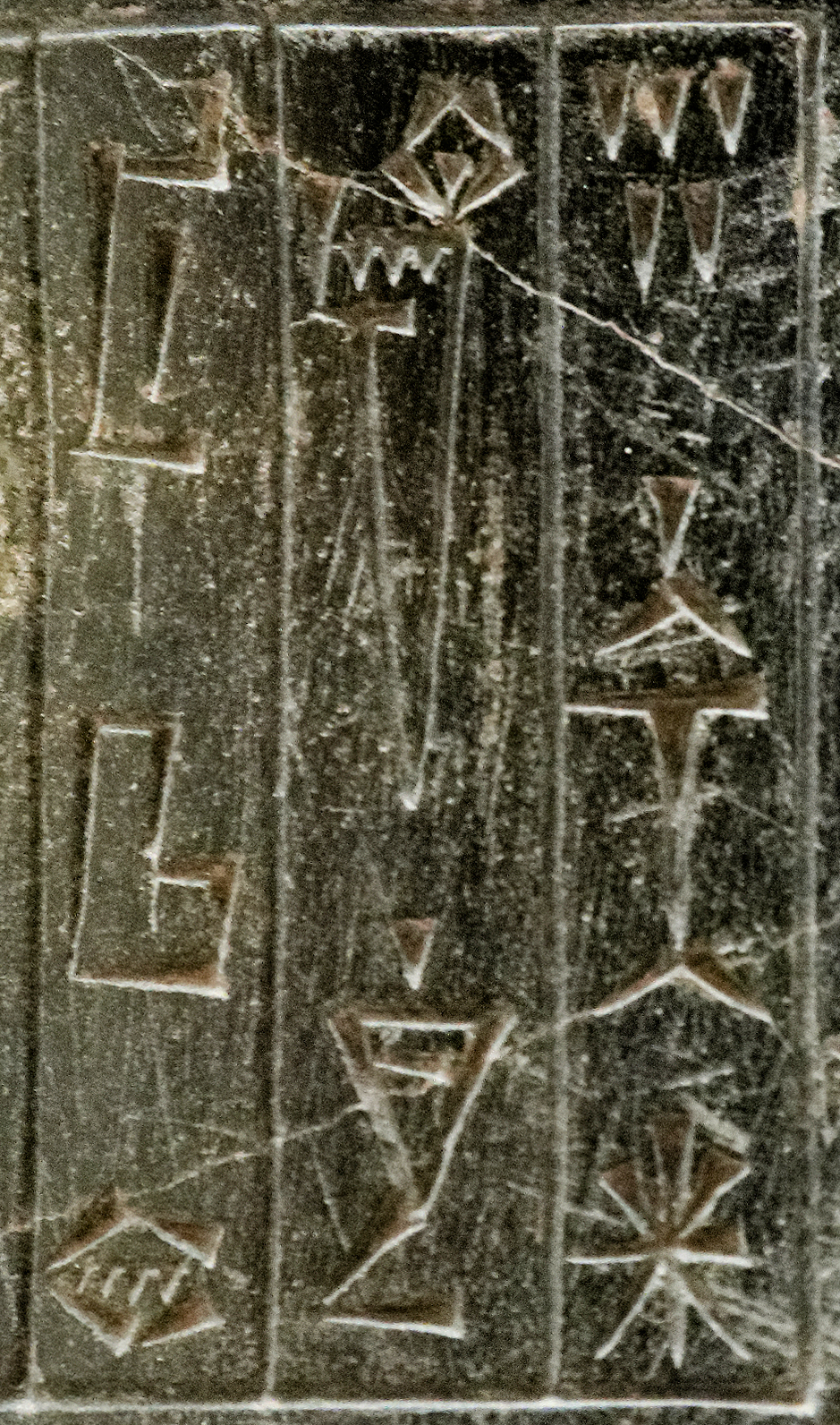
The third-millennium BCE archives of Syrian EblaEblaAncient city at Tell Mardikh, southwest of Aleppo, Syria. Its Palace G archives illuminate third-millennium BCE administration, language, and cult; the site has later occupation phases.Glossary · Click to read the explanation preserve numerous personal names. Joseph Martin Pagan’s onomastic database, made available in browser form by Giorgio Buccellati in 2012, offers specific analyses: entry 2707 is glossed “Il knows,” 2717 “god is support,” 2721 “god is my brother,” and 2737 “Il helped.” Entry 100 is also glossed “Il is father.” These are the database’s linguistic interpretations of names, not independent testimony about each name bearer’s worship.[1]
“Father,” “brother,” and “support” convey closeness and trust, not necessarily literal divine parentage or the identification of one deity behind all the names. The Semitic element il/ilu can function as a common noun, “god,” while other contexts may support the proper nameProper nameA name that identifies a particular person, place, group, or entity in context, unlike a common noun denoting a class. Spelling alone may not settle the distinction.Glossary · Click to read the explanation Il or El. Consequently, the later characterization of El at UgaritElEl is a senior deity in Late Bronze Age Ugaritic texts, portrayed as father of the divine family and a council authority, alongside his consort Athirat. This entry does not cover every linguistic use of El.Glossary · Click to read the explanation cannot simply be projected onto every Eblaite name. Formal resemblance does not itself prove the transmission of a theology between communities.[1][6]
Mari: two sources, not two religions
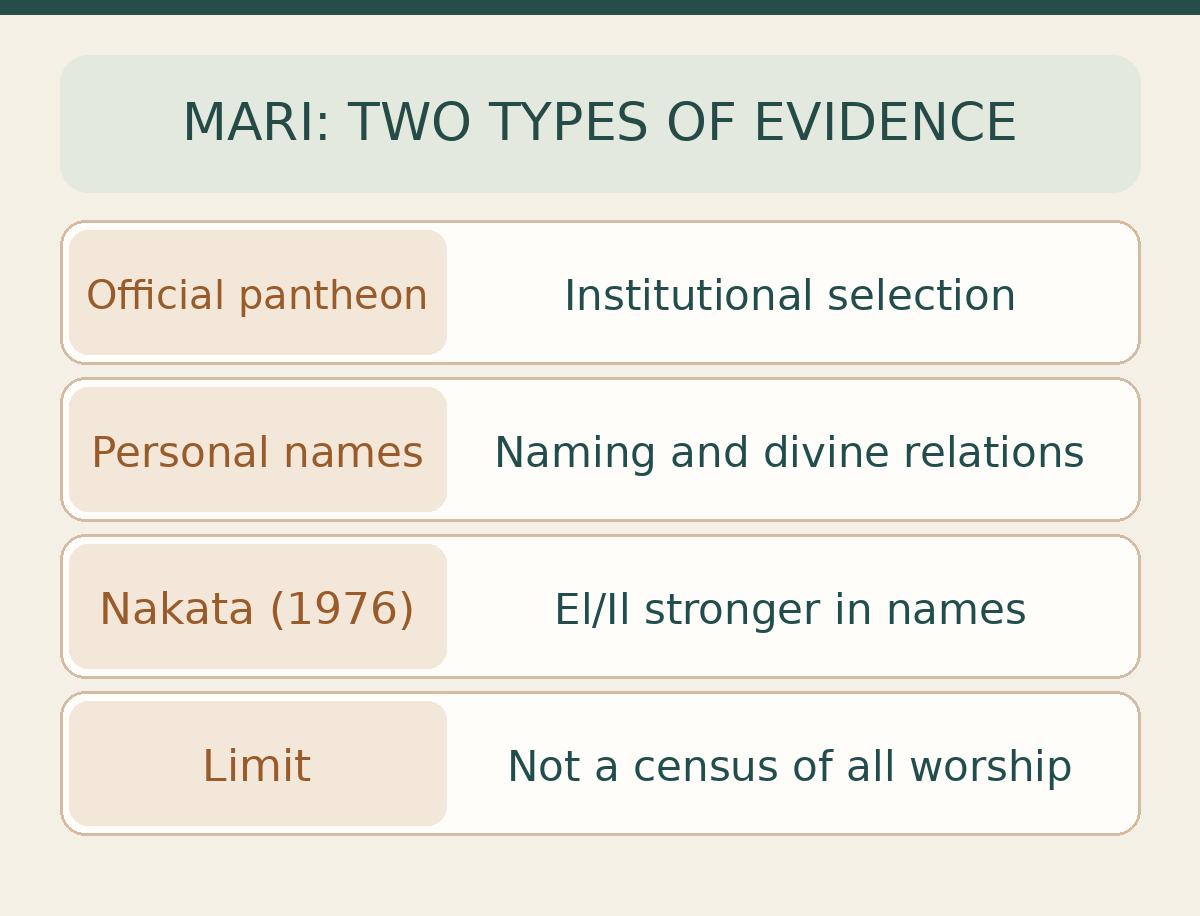
In 1976 Ichiro Nakata compared the official Mari Pantheon List with deities inferred from personal names in MariMariMari at Tell Hariri on the Syrian Euphrates was founded around 2900 BCE and rebuilt through three major urban phases. Its palace and cuneiform archives illuminate trade, royal government and religious practice, especially in the eighteenth century BCE.Glossary · Click to read the explanation of the Old Babylonian period, in the early second millennium BCE. He selected twenty gods from around 130 then known in the published material and divided them into three groups. In the English abstract, El/Il belongs to a group well represented in personal names but poorly represented or absent in the official list, while Addu, DaganDaganA god worshipped in Syria and Mesopotamia, especially at Tuttul and Terqa on the Euphrates, and associated with royal authority. His name appears as Dagon in the Hebrew Bible; no ancient image of him is securely identified.Glossary · Click to read the explanation, ShamashShamashMesopotamian god of the sun and justice, shown before Hammurabi on an eighteenth-century BCE stele preserved in the Louvre.Glossary · Click to read the explanation, and EaEnkiMesopotamian deity also known as Ea, linked with Eridu and the Abzu (deep fresh waters), wisdom, incantations, and narratives of creation and cosmic order. Later written attestations do not identify the deity of Eridu’s earliest layers.Glossary · Click to read the explanation feature strongly in both.[2]
Nakata proposed that part of this discrepancy could be explained by Akkadian and Amorite components of Mari’s population. That is his historical interpretation, not a demographic census or proof of two self-contained religions. His term “popular” is an analytical label for evidence drawn from names; it is not a direct inventory of private ritualsRitualAn organised or distinguished practice meaningful to a community; it may leave traces, but its form alone does not reveal an associated doctrine.Glossary · Click to read the explanation. The comparison alone does not reveal how many people worshipped El, where they did so, or whether each occurrence refers to the deity known from UgaritUgaritAncient city and kingdom at Ras Shamra on the Syrian coast, flourishing between the fourteenth and early twelfth centuries BCE and preserving multilingual archives.Glossary · Click to read the explanation.[2]
Reading images—and their limits
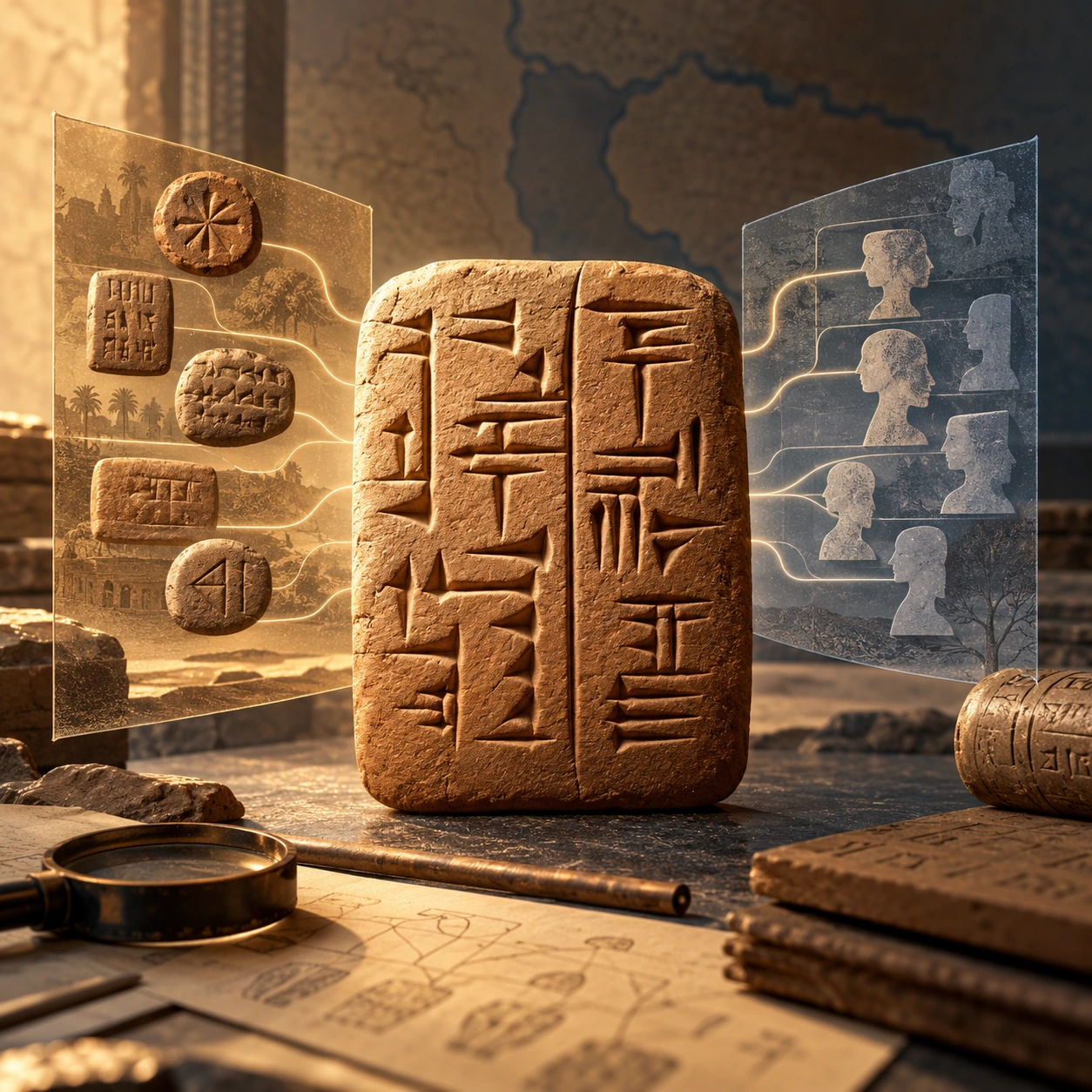
The diagram above compares types of evidence at Mari, not social classes or geographically separate populations. The cover is a newly generated conceptual illustration about seeking protection; it is neither an excavated statue nor an ancient inscription nor a verified reconstruction of a deity’s appearance. Illustrations cannot replace the reading of texts or artifacts.
Ancient cylinder-seal scenes may show a person led into a deity’s presence, but an introduction scene alone does not identify that figure’s own “personal god”: an inscription or secure context would be required. Nor is a personal deity automatically identical with a different class of protective spirit, or every kinship epithet evidence of ancestor worship.[3][4]
Conclusion: a relationship, not another pantheon
Mesopotamian prayers speak of care, punishment, and hope; names from Ebla and Mari suggest how individuals and families expressed divine relationships. But the evidence varies in date, place, and purpose. Names preserve naming formulas, lists reflect institutional selections, and prayers depict devotional relationships within particular literary genres. “Personal god” is useful only when tied to such specific sources; it does not establish a single identifiable El behind every divine-looking element in a name.
References and notes (6)
- Joseph Martin Pagan, A Morphological and Lexical Study of Personal Names in the Ebla Texts, Archivi Reali di Ebla, Studi III (Rome, 1998); digital name database made browser-accessible by Giorgio Buccellati (2012). Actually read Buccellati’s digital introduction and specific name entries 100 (“Il is father”), 2707 (“Il knows”), 2717 (“god is support”), 2721 (“god is my brother”), 2737 (“Il helped”). Database analyses; original tablets and complete printed book not examined. Return to the text ↑
- Ichiro Nakata, “Official Pantheon and Popular Pantheon of Mari,” Bulletin of the Society for Near Eastern Studies in Japan 19, no. 1 (1976): 1–15, 103. DOI: 10.5356/jorient.19.1. English abstract only: 20 deities selected from about 130; A/B/C groupings, El/Il in group C, proposed population explanation. Full Japanese article not read; figures are not a demographic census. Return to the text ↑
- Alan Lenzi, “Dingirshadibbas to Personal Deities,” in Reading Akkadian Prayers and Hymns: An Introduction, ed. Alan Lenzi (Society of Biblical Literature, 2011), 431–445. Read relevant HTML-transcribed portions: pp. 431–433 on deities, family context and varying prayer divisions, plus selected textual commentary up to p. 439. Publisher PDF gave HTTP 403; not the entire chapter nor a check of cuneiform witnesses. Return to the text ↑
- Karen Rhea Nemet-Nejat, “Religion of the Common People in Mesopotamia,” Religion Compass 1/2 (2007): 245–259. DOI: 10.1111/j.1749-8171.2007.00019.x. PDF opening and pp. 245–248 read, notably “Personal Gods,” p. 248, on household devotion, offerings and intercession. Whole article not read for this review. Return to the text ↑
- Oxford Electronic Text Corpus of Sumerian Literature (ETCSL), “A man and his god,” composition 5.2.4, English online translation (site update 19 December 2006). Read the displayed English translation of lines 1–146, especially 64–68 (family), 97–105 (father), and 120–136 (response). No independent collation of Sumerian transliteration/tablet witnesses; lacunae and editorial questions retained. Return to the text ↑
- Sakae Shibayama, “Man of God”: So-called Eblaic-Hebrew Personal Name,” Bulletin of the Society for Near Eastern Studies in Japan 25/1 (1982): 32–49. DOI: 10.5356/jorient.25.32. English abstract only: cautions against deriving historical continuity directly from similar onomastic patterns in Ebla and Hebrew sources. Full Japanese paper not read; caution is not a blanket ruling on every il element. Return to the text ↑
Suggest a correction · Suggest a source for this record
Cite this record
IL Archive, «Personal god», https://ilarchive.com/en/entities/personal-god
Continue reading