Entity · Concept
Iconography
A reference page linking a name, group, or concept to the materials that discuss it.
A method for reading divine images, figurines and reliefs: distinguishing visible attributes from identification and symbolic interpretation, through two Ugaritic examples.
Estimated reading time: 6 min Published Last reviewed:
Share article

Text
Introduction
Iconography is an approach to studying what images, sculptures, reliefs, and symbols depict, and how figures and subjects may be identified. The inquiry begins with what can actually be seen—a seated posture, a crown, a weapon, or a raised arm—and moves toward possible identity and historical meaning. No single striking attribute, on its own, establishes the name of a deity or the meaning of a ritualRitualAn organised or distinguished practice meaningful to a community; it may leave traces, but its form alone does not reveal an associated doctrine.Glossary · Click to read the explanation.
This entry uses two objects from UgaritUgaritAncient city and kingdom at Ras Shamra on the Syrian coast, flourishing between the fourteenth and early twelfth centuries BCE and preserving multilingual archives.Glossary · Click to read the explanation to distinguish levels of evidence: a seated statuette tentatively associated with ElElEl is a senior deity in Late Bronze Age Ugaritic texts, portrayed as father of the divine family and a council authority, alongside his consort Athirat. This entry does not cover every linguistic use of El.Glossary · Click to read the explanation[1], and a stele catalogued as BaalBaalUgaritic storm god and warrior king who defeats Yamm, builds his palace with El’s consent and confronts Mot. References to El and Dagan as fathers do not define a single genealogy.Glossary · Click to read the explanation with Thunderbolt. The images are material evidence with histories and limits, not codes whose messages can be deciphered automatically.
What does iconography mean?
In widespread art-historical and archaeological usage, the term denotes the description of pictured subjects and the identification of figures, attributes, and conventions of representation. It is not simply stylistic analysis or an assessment of craftsmanship. Calling a statuette “bronze covered with gold” describes its material; calling it a “seated deity” identifies a type of figure; naming that deity “El” requires further evidence and comparison. Some historians distinguish iconography, concerned with subjects and attributes, from iconology, concerned with broader cultural significance. In practice the terms overlap, and there is no single boundary accepted by all scholars.[2]
From observation to interpretation
Erwin Panofsky famously distinguished three connected operations: pre-iconographic description, the identification of conventional subjects or figures, and the interpretation of meanings within a cultural and historical horizon. The scheme helps organize questions; it is not a ladder that automatically turns the third stage into certainty. A name attributed to an image is not an immediate observation, and assigning political or religious functions goes beyond describing visible form.[3]
Before interpretation, one should record the object's condition, material, dimensions, missing or restored elements, and whether one is looking at the original, a photograph, a drawing, or a modern reproduction. A broken arm can turn a conjectural posture into a supposedly meaningful “gesture”; lighting in a museum photograph can make a minor surface mark resemble an original inscription.
Attributes are comparative clues, not identity tags
A horned crown, beard, throne, weapon, or hand gesture may reveal a representational tradition, yet such features can occur with more than one figure. The Metropolitan Museum of Art describes a Late Bronze AgeLate Bronze AgeAn archaeological period around 1600–1200 BCE in much of the Near East, with international diplomacy, exchange and religious diversity; its endpoints vary by region.Glossary · Click to read the explanation Levantine tradition featuring seated deities and youthful figures raising weapons. It considers the former likely to represent El and the latter probably Baal. Those qualifications are part of the scholarly conclusion; they should not disappear when a catalogue description becomes a picture caption.[4]
A sound comparison also asks whether the detail is actually preserved on the object and whether its association with a name recurs in independently dated pieces. One visual coincidence does not establish a universal dictionary of symbols for every time and place.
Inscriptions, texts, and find context
Identification may become stronger when a written name accompanies a figure, although the inscription must be read correctly and its relationship to that figure determined: it might name a donor or owner rather than the deity portrayed. Original findspot, archaeological layer, associated finds, intended setting, and excavation records also matter. Objects that circulated through collections without a secure find context permit narrower conclusions.
Ugaritic texts certainly attest El and Baal within the city's religious world, as the Ras Shamra excavations demonstrated. They do not, however, prove that every seated figure depicts El or every raised weapon belongs to Baal. Excavator Claude Schaeffer published a discussion of archaeological and textual evidence for their cults in 1966. His interpretations form part of the history of research; they should not be mistaken for labels literally inscribed on every figurineFigurineA small shaped object depicting a human, animal or abbreviated form, in clay, stone or another medium. Its form alone does not establish its use; manufacture, handling traces and find context matter.Glossary · Click to read the explanation.[5]
Case study: the seated figure possibly representing El
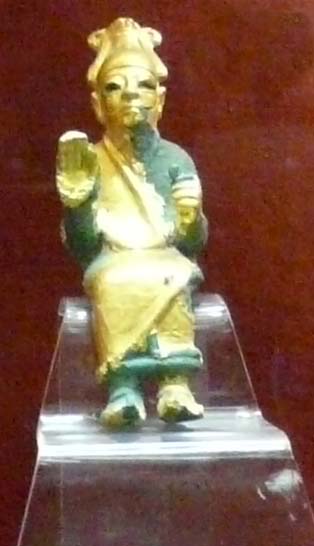
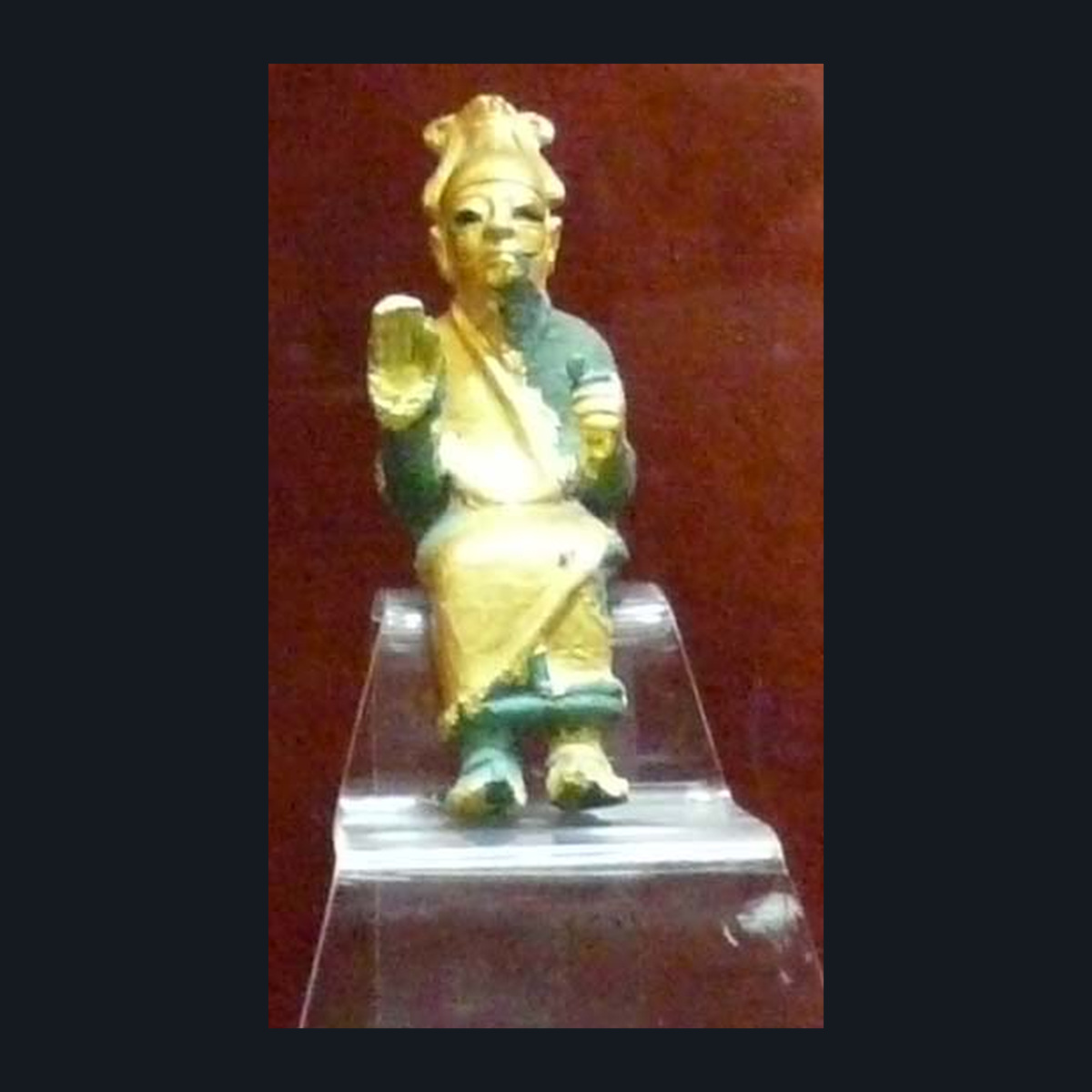
The small statuette numbered `RS 23.394`, recorded in the Damascus Museum documentation as `S 3573`, depicts a seated divine figure made of bronze with gold-foil covering. The Virtual Museum of Syria records its discovery in the southern city of Ugarit, assigns it an approximate date of 1400–1300 BCE, notes a height of 13.5 cm, and describes holes for two now-missing horns. Its catalogue heading explicitly says “El?”: this is a proposed identification rather than an established inscriptional name. A cultic function is likewise inferred rather than directly demonstrated.[1]
What is observable is the seated pose, dress, ornament, and physical condition. Comparison makes an eminent deity a plausible interpretation, but the precise name and original display function cannot be established through form alone. The photograph was taken by ywpark2003 and published under CC0. It records a modern view of the object, not an ancient ceremony; an open licence does not strengthen the proposed identification.[6]
Case study: the Baal with Thunderbolt stele
The Louvre catalogues a limestone monument as the “Stele of Baal with Thunderbolt,” inventory `AO 15775`, excavation number `RS 4.427`. It was discovered on 28 May 1932 on the Ras Shamra acropolis, west of the Temple of Baal. The relief shows a large figure with an uplifted arm and weapons, features the museum inventories as including a thunderbolt and branch, and a smaller figure nearby. The museum assigns it a broad Middle-to-Late Bronze Age dating range rather than a precisely known year of manufacture.[7]
The dynamic posture, weapons, and find context strongly support identifying the principal figure as the storm god Baal. Yet identifying the smaller figure as a king, or assigning a particular fertility symbolism to each attribute, involves further interpretation. A museum title preserves an informed scholarly reading; it is not a verbal statement made by every element in the relief.
Borrowed motifs do not necessarily retain their meaning
Crowns, raised arms, and victory gestures could move from Egyptian imagery into Levantine craftsmanship without retaining their original referents. The Met describes a Canaanite bronze of the fifteenth–fourteenth centuries BCE wearing an Egyptian-style atef crown. It nevertheless depicts a local Levantine deity, not necessarily OsirisOsirisOsiris was an ancient Egyptian deity associated with the dead, life after death, renewal, and kingship. His roles appear in changing funerary texts, rituals, and judgment scenes, notably the weighing of the heart.Glossary · Click to read the explanation or an Egyptian ruler; the museum expressly states that the exact divine identity cannot be securely determined.[8]
This guards against two opposite errors: denying visible artistic exchange, or assuming that borrowing a visual motif also means adopting the same god and beliefs. Similarity offers a reason to investigate historical contact, not independent proof of the direction or date of transmission.
Medium and function change what an image can tell us
Cylinder sealsCylinder sealSmall engraved cylinder rolled over soft clay to leave an extended image. Used to secure, document and identify administrative actions; its pictures do not automatically constitute writing.Glossary · Click to read the explanation carry miniature compositions that repeat when rolled; their manufacture and circulation differ from those of a large public stele or a figure possibly installed in a sanctuary. The Met catalogues an Old Syrian hematite seal and modern impression as depicting a smiting weather god before a king and goddess, dated approximately 1720–1650 BCE. That is the curator's classification of an image; the object does not directly name every participant.[9]
A reading therefore needs to connect visual attributes to the object's format and possible audience, while remaining open to revision if a better archaeological context, accompanying text, or closer examination becomes available.
Degrees of certainty in a catalogue entry
- Direct observation: “The figure is seated”; “there is a horn-attachment socket”; “one arm is raised.”
- Documented archaeological fact: “excavation number RS 4.427”; “the recorded findspot is the acropolis”; “the material is bronze.”
- Probable or possible identification: “probably Baal” or “possibly El,” accompanied by the relevant comparisons.
- Broader interpretive hypothesis: “perhaps a cult statue” or “possibly symbolizing kingship under divine protection,” clearly marked as interpretation rather than sight.
Conclusion
The strongest iconographic analysis is not the one that supplies a name for every face, but one that preserves the difference between what an object shows, what the converging evidence suggests, and what remains unknown. An ancient image is valuable historical evidence, yet it cannot speak apart from its material, provenance, and the texts of its time. When any of these is absent, confidence should diminish rather than speculation expand.
References and notes (9)
- Virtual Museum of Syria, “Seated God Figurine (possibly El),” catalogue entry RS 23.394 / Damascus S 3573. Catalogue heading, description, findspot, date, dimensions, function, condition, references; entire visible object entry, not the studies cited by it. Return to the text ↑
- Paul Taylor, “Iconology and Iconography,” Oxford Bibliographies (2011; version dated 2020), accessible introduction. Accessible Introduction/extract only; complete bibliography and paywalled material not read. Return to the text ↑
- Daniel Sherer, “Panofsky on Architecture: Iconology and the Interpretation of Built Form, 1915–1956, Part I,” History of Humanities 5.1 (2020), DOI: 10.1086/707699. Abstract and opening discussion of Panofsky’s levels and scope; not the entire article. Return to the text ↑
- The Metropolitan Museum of Art, “Enthroned deity,” accession 32.161.45, object overview and qualified typological comparison. Object Overview and Artwork Details, including seated and smiting types; no physical examination. Return to the text ↑
- Claude F.-A. Schaeffer, “Nouveaux témoignages du culte de El et de Baal à Ras Shamra-Ugarit et ailleurs en Syrie-Palestine,” Syria 43 (1966): 1–19. Printed p. 1 in the visible Persée transcription plus article metadata; pp. 2–19 not read. Return to the text ↑
- Wikimedia Commons, “Seated God El Ugarit Damascus.jpg,” photograph by ywpark2003, file provenance and CC0 1.0 licence. File description, photographer, CC0 terms, history and 314×546 dimensions; supplied image inspected locally. Return to the text ↑
- Musée du Louvre, “Stèle du Baal au foudre,” collection catalogue AO 15775 / RS 4.427. Full visible collection entry: title, description, inventories, 28 May 1932 findspot, dating, dimensions, bibliography; cited scholarship not read in full. Return to the text ↑
- The Metropolitan Museum of Art, “Smiting god, wearing an Egyptian atef crown,” accession 1986.42, object overview. Curatorial overview, date, medium and dimensions; no exhaustive corpus study. Return to the text ↑
- The Metropolitan Museum of Art, “Cylinder seal and modern impression: smiting weather god before king and goddess,” accession 1988.380.3. Catalogue title and object details (date, geography, material, measurements); no independent close reading of the seal. Return to the text ↑
Suggest a correction · Suggest a source for this record
Cite this record
IL Archive, «Iconography», https://ilarchive.com/en/entities/iconography
Continue reading