Entity
Osiris
A reference page linking a name, group, or concept to the materials that discuss it.
- Names
- Osiris · Wsjr
- Region
- Ancient Egypt
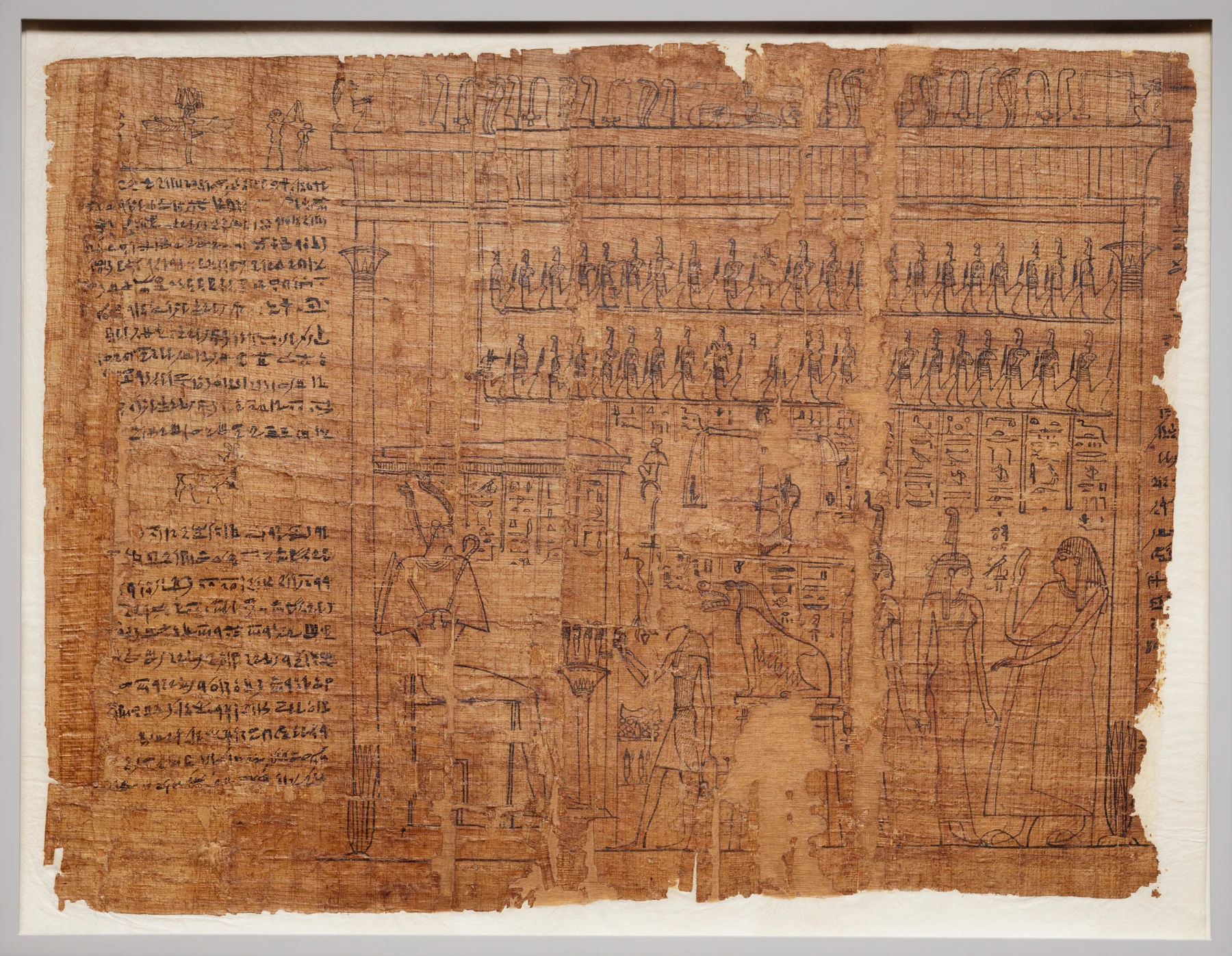
An Egyptian god linked to the fate of the dead, renewal and kingship. The entry traces the evidence from the Pyramid Texts to Abydos rites and heart-weighing scenes, reading the Met papyrus dated ca. 230–150 BCE.
Estimated reading time: 10 min Published Last reviewed:
Share article
Text
Introduction
Osiris was not a historical person whose lifetime can be dated. He was an ancient Egyptian deity associated with the dead, life beyond death, and the legitimacy of kingship. His portrayal changed across periods, settings, and texts: a recipient of rites, a slain ruler restored in myth, and a sovereign of the dead before whom judgment could take place. This entry distinguishes religious narrative, archaeological evidence, and modern interpretation.
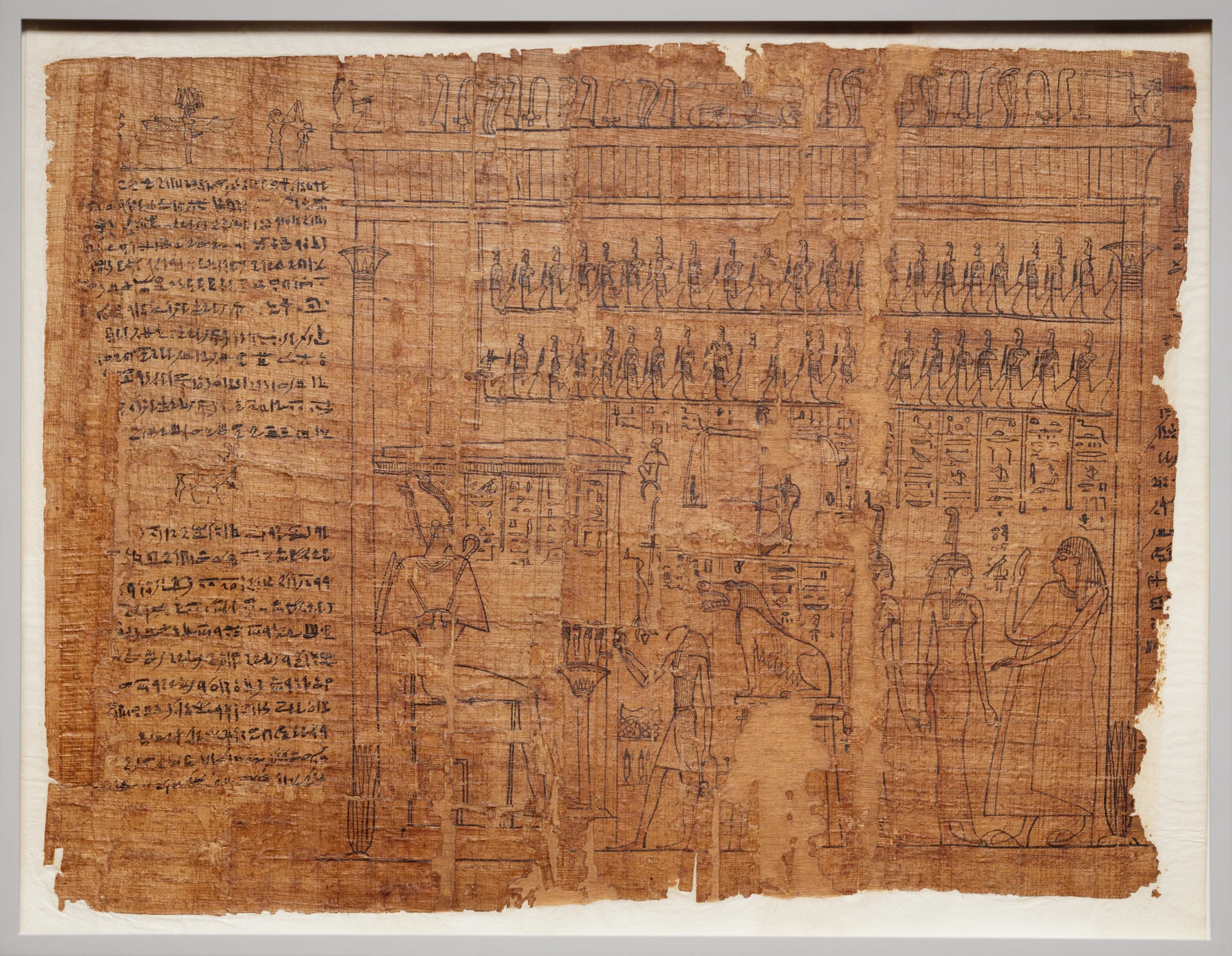
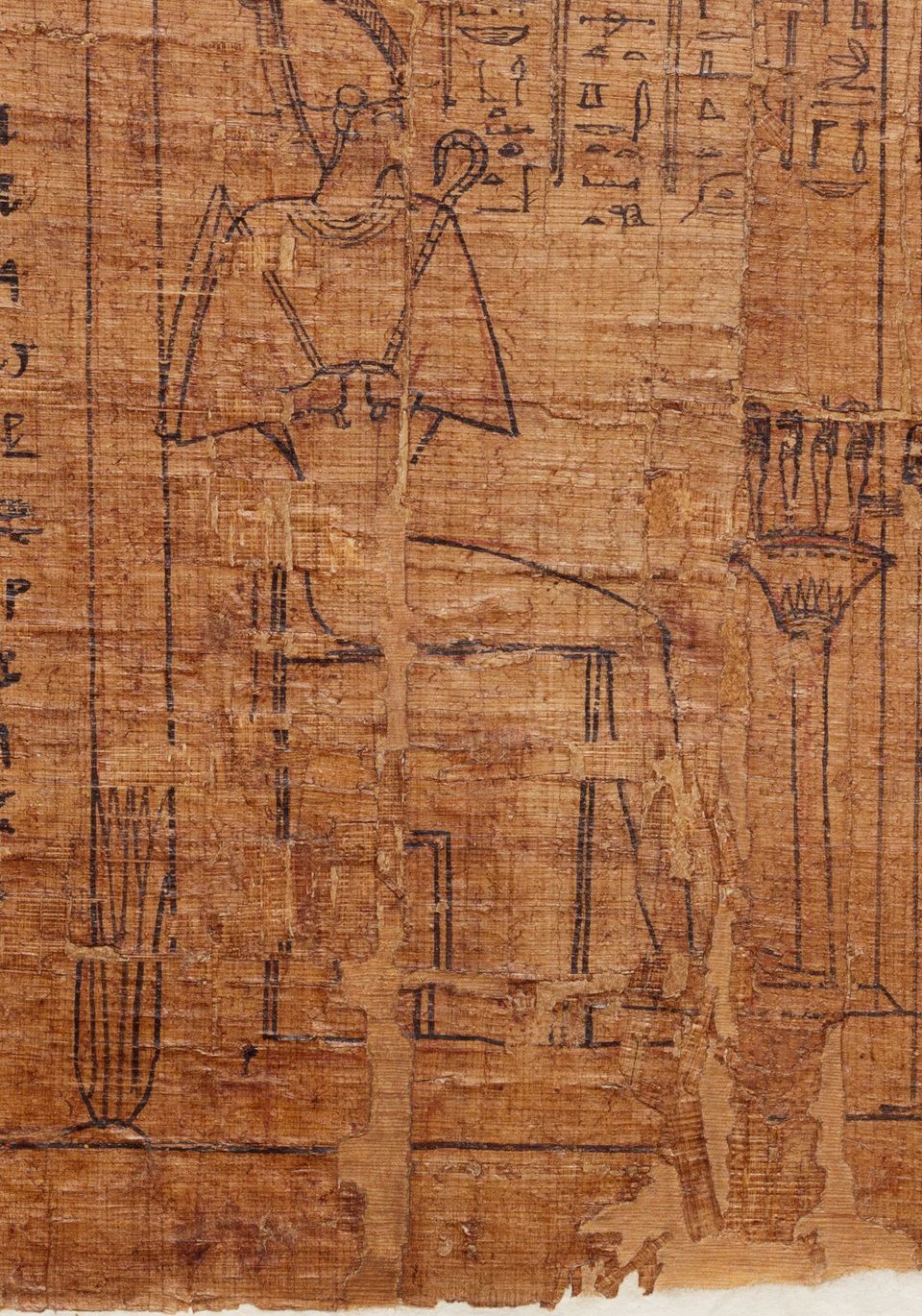
A funerary papyrus in the Metropolitan Museum of Art, dated approximately 230–150 BCE, provides a clearly identified visual starting point. But this late Ptolemaic artifact cannot stand for over two millennia of changing Egyptian religion. It must be considered alongside earlier texts and historical scholarship that treats the Osirian afterlife as an evolving tradition, not a story with one immutable version.
Contents
- Identity, name, and spheres of influence
- Earliest documentation is not a birth date
- Death, recovery, and the limits of late narrative
- Horus and the struggle for kingship
- Abydos: sacred geography and an evolving memory
- From royal destiny to wider hopes: resisting a simple story
- Coffin traditions and the Book of the Dead
- MaatMaatAn Egyptian principle of truth, justice, and right order, also embodied by the ostrich-feather goddess Maat; differently expressed in rule, ritual, and funerary judgment.Glossary · Click to read the explanation, ethical accountability, and the judges
- Reading the Metropolitan Museum papyrus
- Differences between weighing scenes
- Seeds, growth, and ritualsRitualAn organised or distinguished practice meaningful to a community; it may leave traces, but its form alone does not reveal an associated doctrine.Glossary · Click to read the explanation of renewal
- What is established, inferred, or unproven?
Identity, name, and spheres of influence
The name Osiris is the conventional English form of a name transmitted through Greek from Egyptian, commonly transliterated in scholarship as Wsir or Wsjr. Variations in transliteration should not be mistaken for a universally accepted etymology. The god was linked to the deceased king, burial, continued existence, and renewal; none of these associations on its own describes his role fully in every period.[6]
Funerary statuettes, including a bronze figure in the Metropolitan Museum's collection, depict Osiris in a mummy-like wrapping with royal insignia such as the crook and flail, often crowned with a tall headdress. These are iconographic conventions identifying the deity, not portraits of a living individual or evidence that a single version of his myth existed from the beginning.[15]
Earliest documentation is not a birth date
The name and roles of Osiris occur in the Pyramid Texts, funerary compositions inscribed on royal pyramid walls toward the end of the Old Kingdom. Among the earliest surviving witnesses are the inscriptions in the pyramid of UnasUnasUnas was the last king of Egypt’s Fifth Dynasty, in the late third millennium BCEGlossary · Click to read the explanation, a Fifth Dynasty ruler. Their formulas concern the dead king's fate, interactions with deities, and transformations. They were not composed all at once as a single work with a fixed sequence.[3]
We must therefore distinguish the earliest surviving attestation from the beginning of the god's worship or the emergence of the stories about him. The former marks a limit in the preserved evidence, not the date on which belief began. Mark Smith's diachronic study of the Osirian afterlife argues for attention to changing beliefs and practices: one much later papyrus cannot establish the worldview of Egyptians living many centuries earlier.[2]
Death, recovery, and the limits of late narrative
In a widely known configuration of the myth, Seth—a rival and in some tellings a brother—kills Osiris. Isis searches for the body and restores enough life or power for her to conceive Horus. Nephthys joins mourning and protective actions in several versions and rituals. This narrative pattern helps relate the god's death, his generative force, and the persistence of rightful kingship; it must not be turned into a compulsory sequence for every Egyptian witness.[5]
The particularly detailed account of a chest, the body's travels, and its dismemberment comes from Plutarch's On Isis and Osiris, written in Greek during the Roman period. Chapters 12–19 offer episodes and numerical details that must be credited specifically to Plutarch's later narration, rather than presented as words from an Old Kingdom Egyptian text. For this review an English translation of those chapters was read, not the ancient Greek original.[4]
Horus and the struggle for kingship
The world of the dead and that of the living are connected through HorusHorusEgyptian god associated with kingship and the sky, also appearing as the child protected by his mother Isis in marsh and nursing traditions.Glossary · Click to read the explanation, son of Osiris and Isis in the familiar mythological configuration. Horus contends with Seth over the position held by his father: the succession represents a return of order after a ruler's death. Versions of the dispute and its resolution differ among periods and texts. A mention of Horus or Seth is not, by itself, proof that a source told Plutarch's full later plot.
A distinction, rather than a contradiction, emerges: Horus occupies the role of the living king, while Osiris is strongly associated with the deceased ruler and existence after death. References to Osiris being “revived” need not imply a return to governing an earthly kingdom. Many funerary witnesses place his sovereignty in the realm of the dead. These relationships are mythic and ritual concepts, not documentary records of a historical dynasty.[4]
Abydos: sacred geography and an evolving memory
Osiris became closely associated with AbydosAbydos in EgyptAncient Upper Egyptian site associated with royal burials and the cult of Osiris.Glossary · Click to read the explanation, in Upper Egypt, a landscape of early royal burials and later processions. University College London's site history notes that the area's major Old Kingdom deity was Khentyamentyu (“Foremost of the Westerners”), who was identified with Osiris by the First Intermediate Period. In the Middle Kingdom, a First Dynasty royal tomb was regarded as Osiris's burial place. That was a later cultic identification, not the discovery of a historically deceased human called Osiris.[7]
People sought association with the sanctuary through memorial stelae, chapels, and symbolic presence along procession routes, even when their own burials were elsewhere. The Met's object record for a Ta-wer emblem—also termed the Abydos fetish—documents an emblem linked to the Osirian cult, while leaving elements of its original use open to interpretation.[8]
From royal destiny to wider hopes: resisting a simple story
The history of the Egyptian afterlife was once often framed as a sudden “democratization” after the Old Kingdom: privileges previously limited to kings supposedly became available to everyone. But “democratization” is a modern metaphor that can misleadingly imply equal or guaranteed access. Smith's research on the Pyramid Texts and the subsequent transition calls for distinguishing who possessed inscribed funerary equipment from what religious traditions envisaged for non-royal persons.[9]
Coffins, monuments, and rites attest to changing formulas and changing users; access to elaborate burial arrangements and literate expertise was not equal. A stronger historical account follows the dates and media of the surviving evidence and the social groups represented by it, rather than assuming a single and irreversible trajectory of progress.[10]
Coffin traditions and the Book of the Dead
Funerary texts preserve multiple ways of speaking about the deceased person's relation to Osiris, Ra, and other gods. Such formulations can coexist instead of canceling one another. The Book of the DeadEgyptian Book of the DeadA modern name for a variable collection of Egyptian funerary spells and images intended for the afterlife, not a single book with a fixed sequence.Glossary · Click to read the explanation is a corpus of spells and funerary instructions selected and arranged differently in different manuscripts; it was not one Egyptian book with a definitive master edition. No individual papyrus need contain all its chapters, nor depict every scene in the same manner.[11]
In Chapter 17, an educational translation supplied by UCL's Digital Egypt project brings Osiris into meaningful relation with RaRe, Egyptian sun godRe is the Egyptian sun god, associated with creation, life and renewal of cosmic orderGlossary · Click to read the explanation and includes interpretations associated with expressions such as “yesterday” and “tomorrow.” Here this is evidence for a varied language of continuity and renewal, not a claim to have translated hieroglyphic Egyptian directly. The online text is an edited composite presentation with a published translation, not one papyrus personally collated in full.[11]
Maat, ethical accountability, and the judges
Judgment after death belongs to the sphere of MaatMaatAn Egyptian principle of truth, justice, and right order, also embodied by the ostrich-feather goddess Maat; differently expressed in rule, ritual, and funerary judgment.Glossary · Click to read the explanation: truth, justice, and the right ordering of the cosmic and social worlds. Maat is more than the feather with which she is sometimes symbolized. Chapter 125 of the Book of the Dead presents the deceased denying wrongdoing before judges of the afterlife. UCL's presentation describes addresses to forty-two assessors. This ritual representation is not evidence that every Egyptian underwent a literally identical hearing.[12]
It matters to distinguish a ritual declaration of purity from a historical legal deposition recording someone's actual behavior. Nor should lists from much later funerary compilations simply be imposed on the earlier Pyramid Texts. As a comparison between the papyrus of Maiherperi and Cairo papyrus 2512 shows, sequences, divine addressees, and even the number of denials varied. Forty-two is an important recurring number, not an inflexible property of all surviving texts.[13]
Reading the Metropolitan Museum papyrus
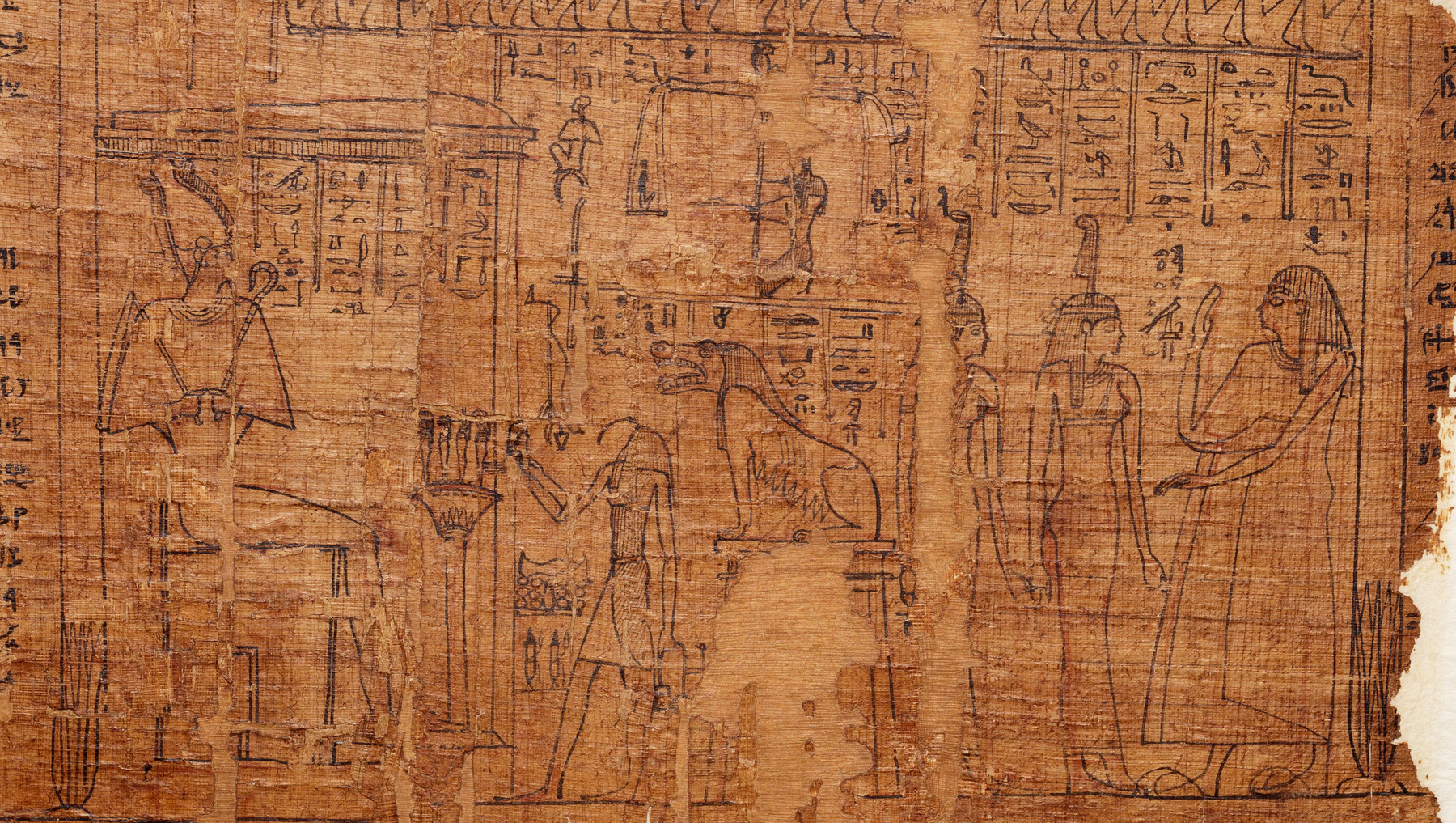
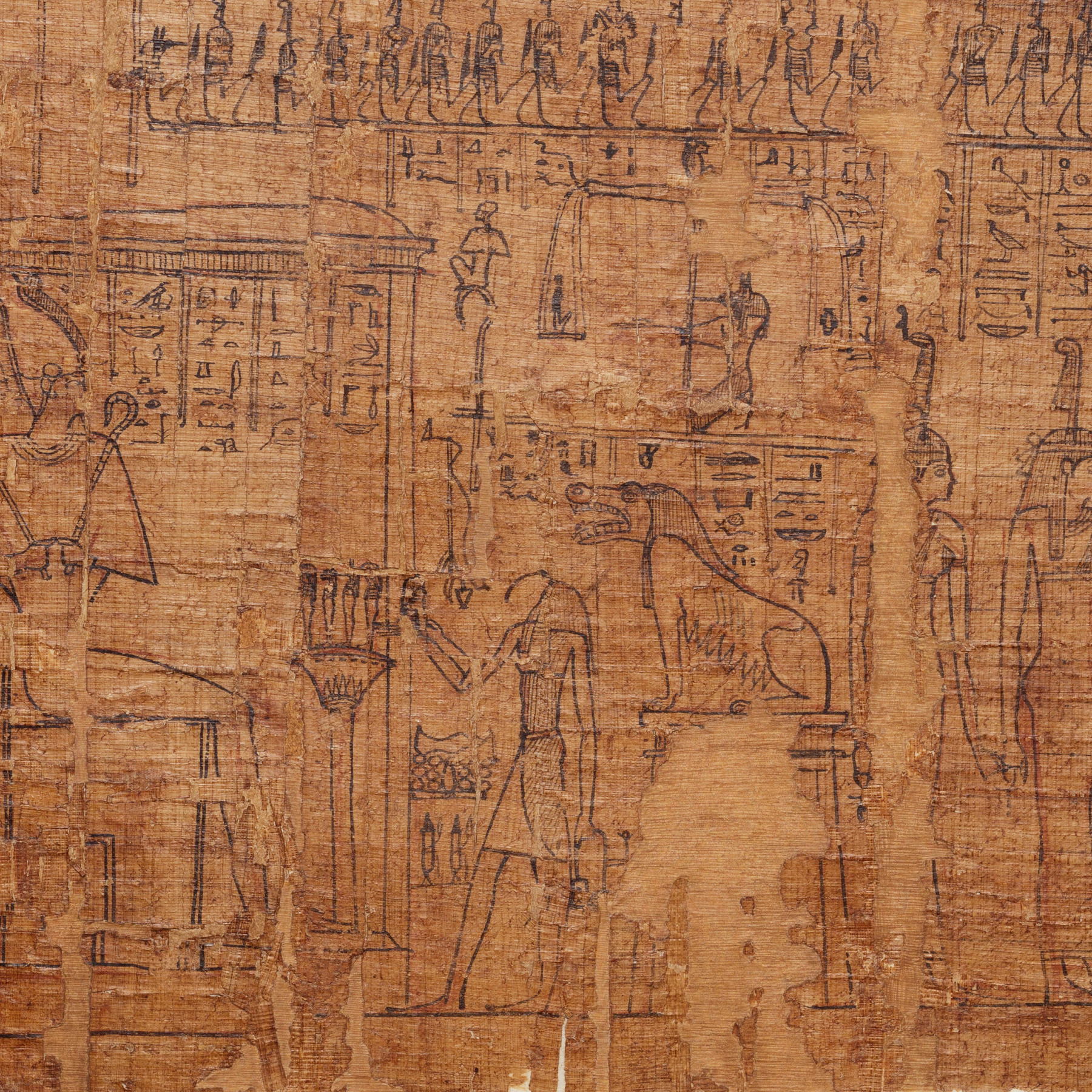
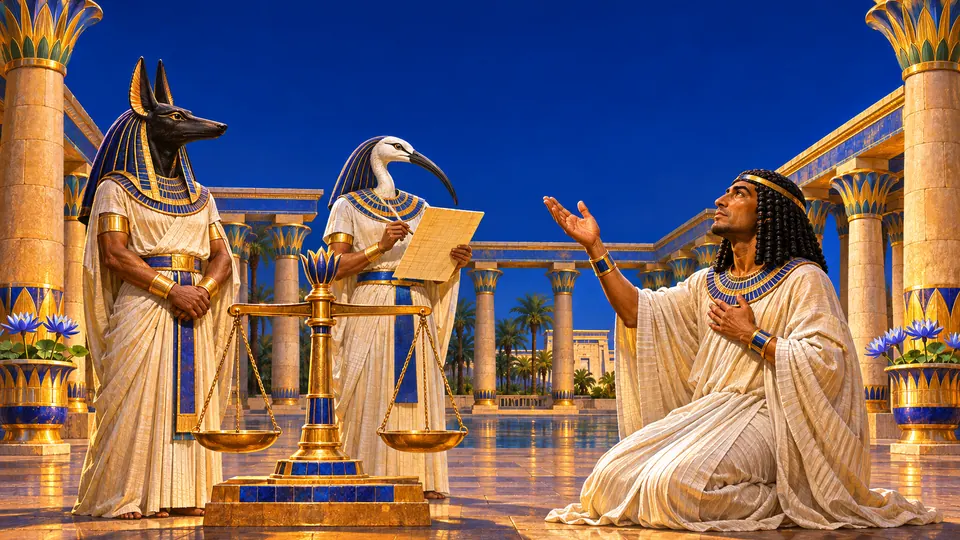
The photograph accompanying this entry shows a fragment of a funerary papyrus, dated by the museum to about 230–150 BCE in the Ptolemaic period, inventory number 66.99.142. Made of papyrus and ink, it is neither a wall painting from a royal tomb nor an Old Kingdom object. The Met describes Osiris enthroned within a kiosk at the left, ThothThothThoth is an Egyptian god of knowledge and writing, also associated with recording funerary judgment.Glossary · Click to read the explanation, the god associated with writing, presenting the verdict, AnubisAnubisAnubis is an Egyptian deity associated with the dead and the balance in heart-weighing scenes.Glossary · Click to read the explanation attending the heart's weighing, and two upper rows of judges. Crucially, a small squatting figure of Maat appears in the balance; the detail should not be silently replaced with an isolated feather.[1]
Also included is AmmitAmmitAmmit is a composite being in Egyptian judgment imagery, associated with devouring those who fail the trial.Glossary · Click to read the explanation, the devourer of an unsuccessful heart within this scene's religious logic, alongside other divine protectors. These observations concern this specific object, verified against the museum's description and the image, not a claim that every Egyptian papyrus contained forty-two judges, a small Maat figure, and the same composition. The complete scene within the text displays the relationships among the participants; the cover isolates the seated Osiris from the very same artifact.
Differences between weighing scenes
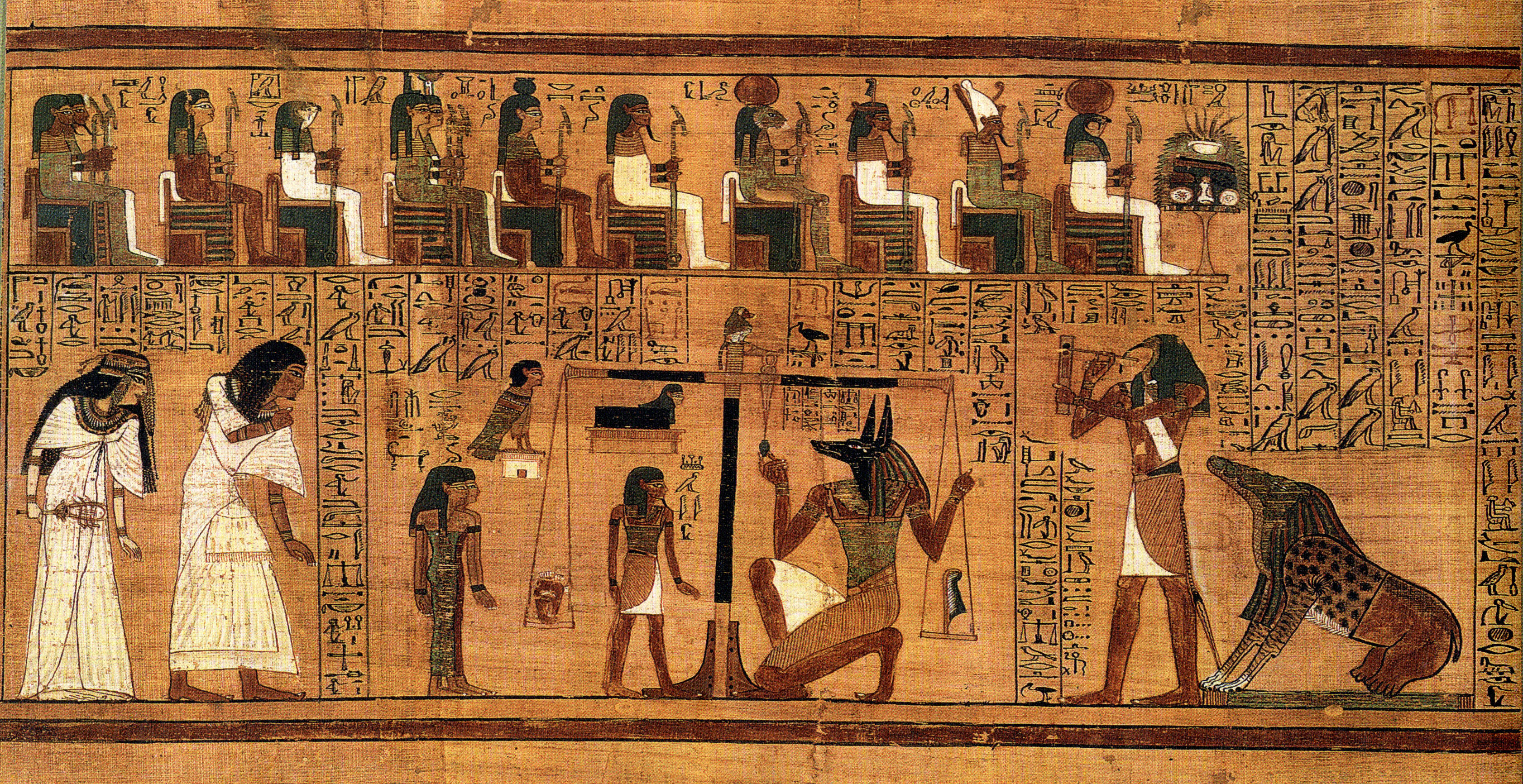
Other witnesses vary in the placement of figures, the form of the scale's counterweight, the deceased's companions, and the accompanying texts. A British Museum catalog excerpt concerning the Papyrus of Hor describes Anubis, Horus, Thoth, and Osiris in another composition. It is a separate artifact, whose participants, accession number, and dating must not be merged with those of the Met papyrus. That comparison uses only a brief collection-catalog excerpt; it does not rest on a full personal examination of the British Museum papyrus.[14]
Comparison lets us distinguish recurrent conventions from features unique to a given document. A powerful image of ethical weighing in later papyri does not establish that all Egyptian individuals endorsed every detail or that a supernatural hearing can be demonstrated as a historical event. These images are ritual and theological representations, to be interpreted through provenance, time, medium, and intended funerary use.
Seeds, growth, and rituals of renewal
Osiris's relation to continued life was not confined to a courtroom scene. Rites associated with the month of Khoiak used enacted forms of the god's death and restoration, sometimes with soil-and-seed models that germinated as signs of renewed growth. A museum object described as a “Germinating Osiris Brick” provides material evidence for this later ritual idiom; it does not demonstrate that each detail of a late narrative was already present in all previous centuries.[16]
These practices connected the fertility of land, burial, seasonal cycles, and renewal through overlapping images. The germination symbol is not scientific proof of literal resurrection, but neither is Osiris adequately reduced to a mere “vegetation god.” His attested functions also encompass afterlife judgment, royal legitimacy, city cults, and the hopes of the dead and their families.[5]
What is established, inferred, or unproven?
Directly documented: early royal funerary texts naming Osiris, the importance of the cult at Abydos, a particular Ptolemaic papyrus showing the weighing, and artifacts and rites linking the god with renewal. Well-grounded but revisable historical interpretations: how motifs passed between periods, how far non-royal people shared in Osirian hopes, and the development of the detailed conflict narratives. Not established: that Plutarch preserved the one “original” myth, that the late papyrus represents the beliefs of every Egyptian, or that the Abydos shrine was the literal grave of a human Osiris.
This entry therefore asks readers to keep two perspectives in view: Osiris as an agent within ancient Egyptian religious texts and practices, and Osiris as a subject of historical study whose portrayal is shaped by unevenly preserved sources. Egyptian belief was not uniform over three millennia. Dating, identifying, and reading each witness on its own terms is essential to understanding the god's lasting significance.[2]
References and notes (16)
- Ptolemaic funerary papyrus depicting judgment before Osiris; elements read from this particular object, not assumed universal. Met 66.99.142; ca. 230–150 BCE Return to the text ↑
- Mark Smith, Following Osiris: Perspectives on the Osirian Afterlife from Four Millenia, Oxford University Press, 2017; publisher’s book abstract and table of contents only, not the full book. Book abstract and table of contents; published 23 February 2017 Return to the text ↑
- UCL Digital Egypt, “Pyramid Texts”; complete short overview page, not the full ancient corpus. Complete “Pyramid Texts” introductory page, including the pyramid of Unas Return to the text ↑
- Plutarch, On Isis and Osiris, Moralia, English translation by Frank Cole Babbitt (Loeb, 1936), sections 12–19 of the English translation only; Greek not consulted. §§12–19, English translation Return to the text ↑
- UCL Digital Egypt, “The Festivals of Khoiak”; full overview and comparison table read. Introductory text and source-comparison table, ca. 1150 BCE–100 CE Return to the text ↑
- Richard Gordon, “Osiris,” Oxford Classical Dictionary, 2016; publicly visible extract only, not the full reference article. Public extract of “Osiris,” dated 7 March 2016 Return to the text ↑
- UCL Digital Egypt, “Abydos”; complete short archaeological-historical overview. Full “Abydos” page: Khentyamentyu, earlier royal tomb, Middle Kingdom processions Return to the text ↑
- Metropolitan Museum of Art, “Ta-wer emblem (Abydos Fetish)”; museum object record and description, not an excavation report. Museum object record 11.150.46 Return to the text ↑
- Mark Smith, “Unreading the Pyramid Texts. So Who is Osiris?”, ch. 3 of Following Osiris, OUP, 2017; publisher’s chapter abstract only, not pp. 107–165. Chapter abstract only; pp. 107–165 listed but not read Return to the text ↑
- Mark Smith, “Democratizing the Afterlife?”, ch. 4 of Following Osiris, OUP, 2017; publisher’s chapter abstract only, not pp. 166–270. Chapter abstract; pp. 166–270 listed but not read Return to the text ↑
- UCL Digital Egypt, “Book of the Dead: Chapter 17”; introduction and opening of part A, especially passages 1–3, in published English translation/transliteration only. Introduction and part A, edited passages 1–3 only; not the whole chapter Return to the text ↑
- UCL Digital Egypt, “Book of the Dead Chapter 125A”; complete short page in the published English presentation, not independent hieroglyphic reading. Full short teaching page on Chapter 125A and the declaration before judges Return to the text ↑
- UCL Digital Egypt, “Book of the Dead Chapter 125B”; complete teaching page, Maiherperi list and Cairo 2512 comparison; Egyptian text not independently deciphered. Entire page: 42 declarations and comparison with the 32-item Cairo 2512 set Return to the text ↑
- British Museum, “Papyrus of Hor,” EA10479,6; search-index catalog excerpt only; direct collection page returned HTTP 403 and was not read in full. Search-result catalog snippet only; museum page HTTP 403 Return to the text ↑
- Metropolitan Museum of Art, bronze Osiris statuette, 04.2.575; museum object record and description; iconography only, no image reused. Museum object record 04.2.575, dated ca. 664–30 BCE Return to the text ↑
- Metropolitan Museum of Art, “Germinating Osiris Brick,” 20.2.30, ca. 1100–300 BCE; full online object record on seed-and-earth ritual. Object 20.2.30; date, medium, and explanation of possible use Return to the text ↑
Suggest a correction · Suggest a source for this record
Cite this record
IL Archive, «Osiris», https://ilarchive.com/en/entities/osiris
Continue reading
Related readings