Entity · Concept
Marziḥu
A reference page linking a name, group, or concept to the materials that discuss it.
A banqueting institution or association in Ugaritic documents, with religious functions not reducible to one ritual.
Estimated reading time: 5 min Published Last reviewed:
Share article
Text
Introduction
Marziḥu denotes a banqueting association or institution, and the banquet itself, in Late Bronze AgeLate Bronze AgeAn archaeological period around 1600–1200 BCE in much of the Near East, with international diplomacy, exchange and religious diversity; its endpoints vary by region.Glossary · Click to read the explanation evidence from UgaritUgaritAncient city and kingdom at Ras Shamra on the Syrian coast, flourishing between the fourteenth and early twelfth centuries BCE and preserving multilingual archives.Glossary · Click to read the explanation, the ancient city at Ras Shamra on the Syrian coast. Documents reveal property and social organization; a literary story depicts a divine feast. Combining these witnesses requires distinguishing what a document says from a reconstruction of ritualRitualAn organised or distinguished practice meaningful to a community; it may leave traces, but its form alone does not reveal an associated doctrine.Glossary · Click to read the explanation or the cult of the dead.[1][2][3]
Name, date and type of evidence
The Ugaritic consonants are transliterated mrzḥ; syllabic spellings in local AkkadianAkkadianAn ancient East Semitic language written in cuneiform from the third millennium BCE; its varieties include Babylonian and Assyrian, and it served in international diplomacy.Glossary · Click to read the explanation documents help reconstruct the pronunciation. Hence forms such as marziḥu and marzeaḥ occur in scholarship. Etymology does not settle the association’s function: connecting the name with falling or collapse belongs to a disputed interpretation, not an established translation of the institution’s meaning.[2]
Three chronological levels need separating. The tablets belong to Ugarit’s world in the late second millennium BCE; El’s feast takes place in mythical time, not at the date of a human event. A tablet’s date alone cannot establish when its story originated. The “contract” KTU 3.9 has neither an internal date nor a documented excavation context. Alice MandellAlice MandellScholar of the Hebrew Bible, Northwest Semitic languages and ancient Levantine scribal practices.Glossary · Click to read the explanation, a specialist in the HebrewHebrewA Northwest Semitic language of the Canaanite group, encompassing Iron Age epigraphy, Biblical, Rabbinic, medieval and Modern Hebrew; its scripts and pronunciations changed over time.Glossary · Click to read the explanation Bible and Northwest Semitic languages, places it provisionally from the mid-thirteenth century BCE onward, within experimentation with alphabetic cuneiformUgaritic alphabetAlphabetic cuneiform system of Late Bronze Age Ugarit, using thirty chiefly consonantal written signs, distinct from Akkadian syllabic cuneiform.Glossary · Click to read the explanation for legal writing. This is an inference connected with her argument, not a date written on the document. The discovery of the feast tablet KTU 1.114 in 1961 is a modern discovery date, not a composition date.[2][3]
Association and property
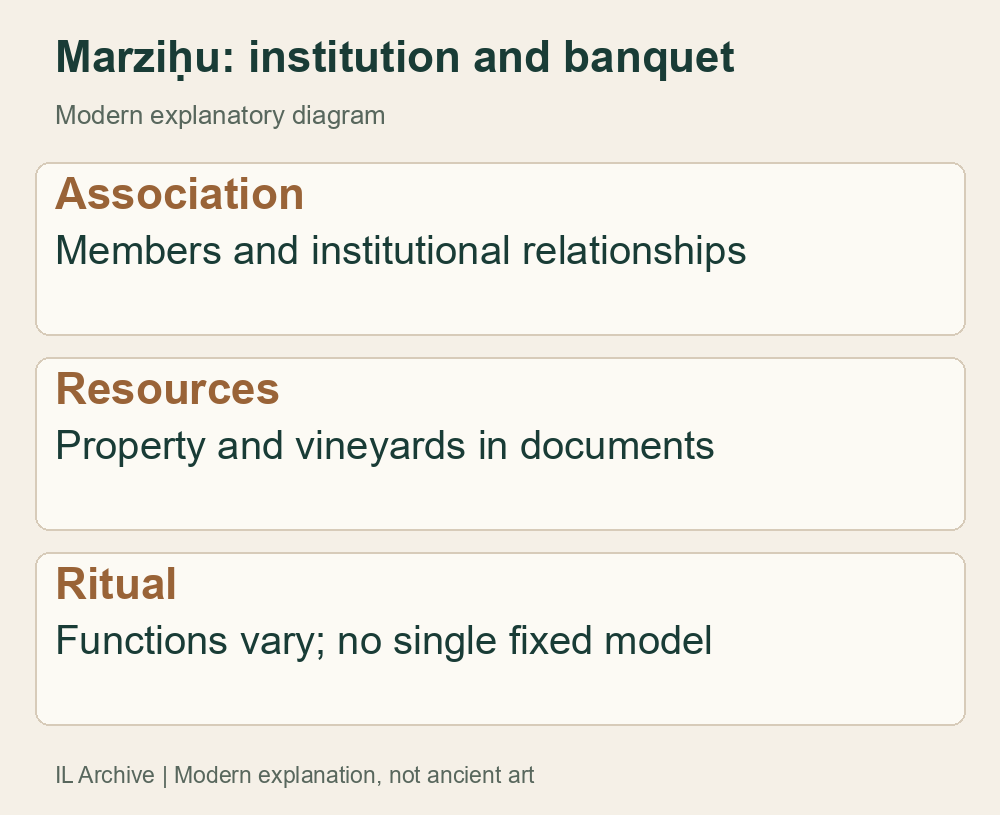
Houses, vineyards and members appear in connection with the marziḥu. RS 15.88 mentions a house for members and rights passing to their successors; RS 18.01 concerns a vineyard of Hurrian IshtarInanna / IshtarA prominent Mesopotamian goddess whose Sumerian name Inanna became associated with Akkadian Ishtar across diverse traditions. She was associated with desire, war, royal authority and Venus, while local forms and genealogies varied among texts.Glossary · Click to read the explanation divided between the groups of Aru and Siyannu. Resources, transactions and legal recognition favor understanding an institution rather than merely an occasional meal. Groups might be named after a locality or patron deity; they need not all constitute a single organization.[1][2][3]
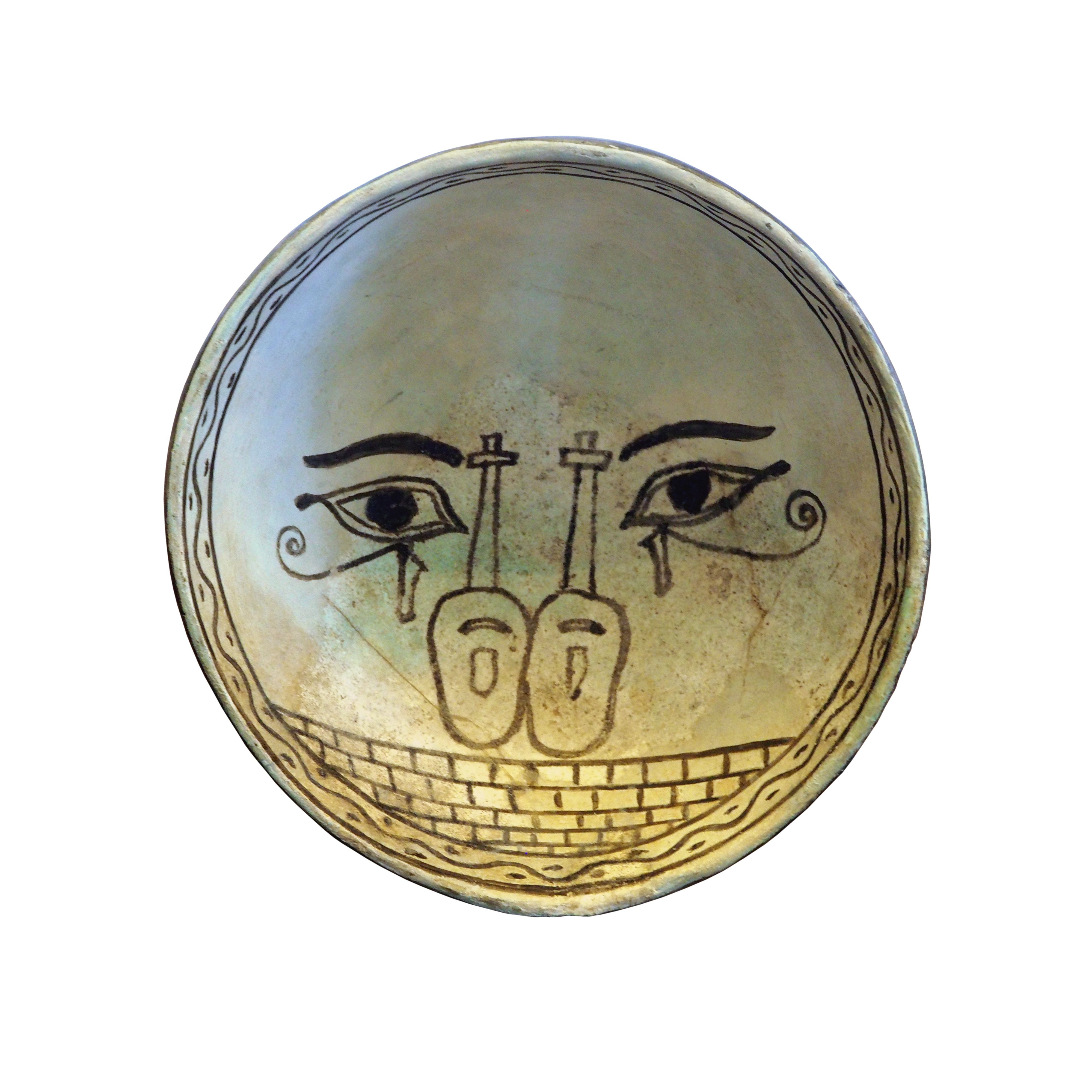
Resources do not, however, provide a complete membership list or uniform membership rules. Identifying particular archaeological buildings as marziḥu meeting places also remains interpretive: drinking vessels alone do not establish that identification. The cup illustrated here therefore supplies regional material context, not an object demonstrably used by one of these associations.[3]
Was KTU 3.9 an executed contract?
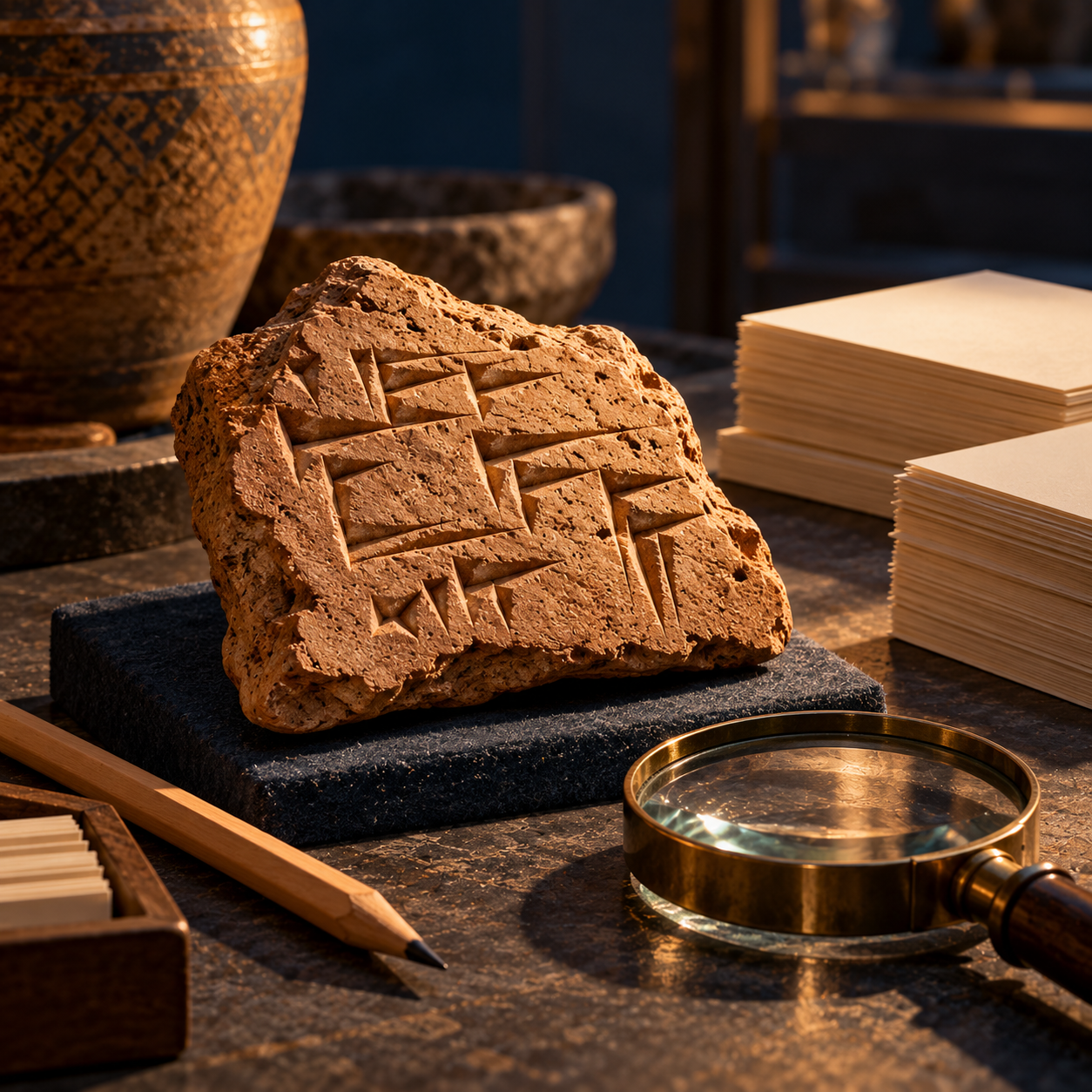
KTUKTU: Ugaritic Text ReferencesAbbreviation for a modern edition of alphabetic cuneiform texts. Its text references can be cross-identified with find numbers such as RS or RIH; they are not dates.Glossary · Click to read the explanation is a catalogue designation for Ugaritic texts. KTU 3.9, also numbered RS 1957.702, is not the house document RS 15.88. It opens with the following consonantal transliteration, taken from Mandell’s study. Word spacing is regularized for reading; this is not a new collation of the object. Obverse, lines 1–4:[3]
This reading treats šmmn as a personal name and the act of establishment as referring to the association; setting up its meeting place remains another possibility. The following lines contain financial obligations, direct speech and two witnesses’ names, supporting the traditional legal reading. Yet the details of payment and departure from the association remain disputed.[3]
Mandell proposes a scribal exercise rather than an executed agreement. Her case is cumulative: unusual wording and spelling, awkward sign execution, absence of dating and some legal formulae, and use of the local alphabet in a field dominated by Akkadian. Witness names and organized content remain significant legal features, but could also occur in a training model. Poor handwriting alone therefore cannot prove an exercise, just as witnesses alone cannot prove execution of the contract. The practical consequence is not to turn the disputed tablet’s sums into fixed membership dues or a standard membership count for all associations.[3]
El’s feast and the decisive passage
In KTU 1.114, excavation number RS 24.258, ElElEl is a senior deity in Late Bronze Age Ugaritic texts, portrayed as father of the divine family and a council authority, alongside his consort Athirat. This entry does not cover every linguistic use of El.Glossary · Click to read the explanation, the senior god in Ugaritic tradition, hosts a divine banquet, becomes drunk and collapses; a therapeutic prescription closes the tablet. Line 15 reads, in the transcription of Gregorio del Olmo LeteGregorio del Olmo LeteScholar of comparative Semitic linguistics and Ugaritic; professor emeritus at the University of Barcelona.Glossary · Click to read the explanation, a scholar of Semitic languages:[2]
This explicitly connects El with the marziḥu. The inference concerning the world of the dead particularly turns on lines 21–22:[2]
The transcription and translation are mediated through the study, not an independent reading of the original. Neither excerpt restores broken words in the version used here. The comparative wording matters: the text likens El’s condition to death and descent, but these lines do not narrate questioning a dead person or receiving an answer. Nor are the dead named among the feast’s guests. Readings of the ingredients in the closing prescription also differ; no single rendering should become assured medical instructions.[2]
Weighing religious interpretations
Christopher B. HaysChristopher B. HaysChristopher B. Hays studies the Hebrew Bible, Semitic languages and the ancient Near East.Glossary · Click to read the explanation, a scholar of the Hebrew Bible and Semitic languages, surveys how comparison with Rapiuma texts and later mourning evidence generated the connection with the cult of the dead. Yet readings of the broken witness KTU 1.21 and its connection with the marziḥu are disputed, as Mandell explains. Such comparison cannot make a funerary function necessary to every use of the name.[1][3]
Del Olmo Lete reads El’s feast as a mythical representation of seeking knowledge through contact with the dead, rather than feeding them. He draws on the death simile, the tablet’s find context near divinatory objects and texts, and a reading of the remedy as a return from an exceptional condition. The hypothesis gains strength by relating text and context. Its limitation is the move from simile and archive context to a reconstructed ritual purpose not explicitly stated through an invocation or response in the excerpt. Neither the etymology nor the disputed remedy provides an independently secure foundation.[2]
This entry therefore favors the minimum supported by converging evidence: resource-holding associations and banqueting gatherings that could have religious connections, together with an explicit literary image of drinking and drunkenness in El’s story. The evidence does not establish summoning the dead as every marziḥu’s necessary purpose. This does not exclude funerary or commemorative functions in particular settings. It distinguishes historical possibility from general definition, and the surviving story from a reconstruction of a ritual behind it.[1][2][3]
References and notes (3)
- Christopher B. Hays, Death in the Iron Age II and in First Isaiah, FAT 79 (2011). Printed pp. 115–116 of the available extract: institution, property and the history of linking the marziḥu with the cult of the dead. The extract jumps from p. 116 to p. 123; pp. 117–119 and the whole book were not read from this file. Return to the text ↑
- Gregorio del Olmo Lete, The Private Archives of Ugarit, Barcino Monographica Orientalia 11 (2018), Appendix III, “The Marzeaḥ and the Ugaritic Magic Ritual System: A Close Reading of KTU 1.114.” Pp. 135–155 read in full: p. 137 n. 6 for legal witnesses RS 15.88 and RS 18.01; pp. 154–155 for the translation of El’s banquet and preceding pages for the divination argument. Evidence mediated through the study and its translation, not an independent collation of the tablets. Return to the text ↑
- Alice Mandell, “When Form is Function: A Reassessment of the Marziḥu Contract (KTU 3.9) as a Scribal Exercise,” Maarav 23/1 (2019), pp. 39–67. DOI: 10.1086/MAR201923104. Author-posted text read at pp. 39–45 and 50–67: text and translation p. 54, institution pp. 55–57, exercise argument and dating pp. 58–67. Transcription reproduced through the study, not a collation of the tablet or an independent reading of its photographs. Return to the text ↑
Suggest a correction · Suggest a source for this record
Cite this record
IL Archive, «Marziḥu», https://ilarchive.com/en/entities/marzihu
Continue reading