Ancient text
El’s Banquet at Ugarit (RS 24.258)
A text for line-by-line reading, with transliteration, translation, and resources.
- Timeline
- From 1300 BCE to 1190 BCE
- Region
- The Levant
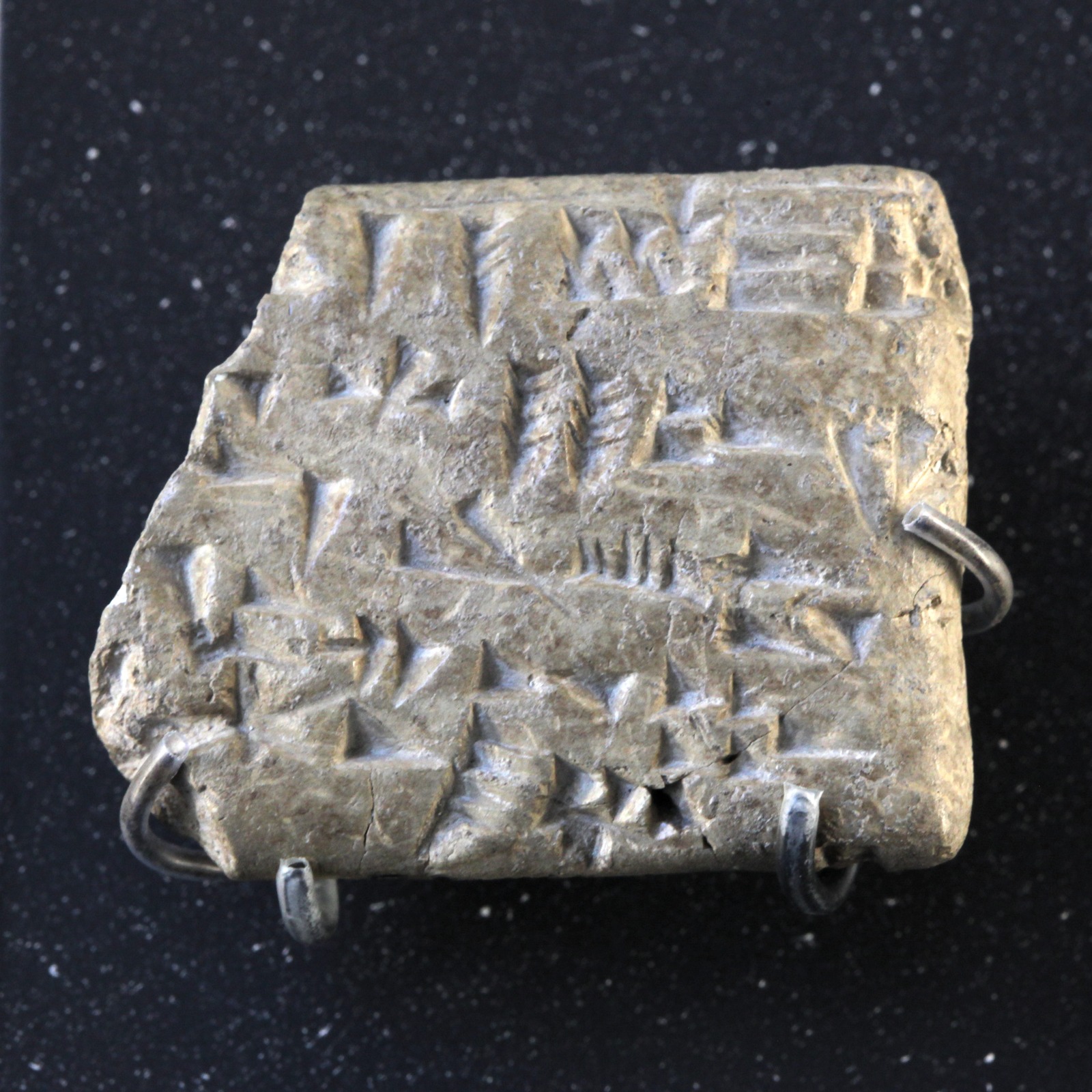
An Ugaritic clay tablet tells how El hosted a feast, drank until he collapsed and came to his senses again. On the damaged tablet from Ras Shamra, a line in the clay separates the story of the gods from a short remedy.
Estimated reading time: 4 min Published Last reviewed:
Share article
Text
Introduction
The first line of a clay tablet from UgaritUgaritAncient city and kingdom at Ras Shamra on the Syrian coast, flourishing between the fourteenth and early twelfth centuries BCE and preserving multilingual archives.Glossary · Click to read the explanation describes ElElEl is a senior deity in Late Bronze Age Ugaritic texts, portrayed as father of the divine family and a council authority, alongside his consort Athirat. This entry does not cover every linguistic use of El.Glossary · Click to read the explanation slaughtering game in his own house. The gods gather to eat and drink. Later, two gods have to support their host as he makes his way home. He falls, and the story likens him to someone who has died. The surviving text ends with instructions for a remedy. The tablet is known by its excavation number, RS 24.258, and by its place in the KTUKTU: Ugaritic Text ReferencesAbbreviation for a modern edition of alphabetic cuneiform texts. Its text references can be cross-identified with find numbers such as RS or RIH; they are not dates.Glossary · Click to read the explanation catalogue, 1.114. [1][2][3]
A tablet from the southern acropolis
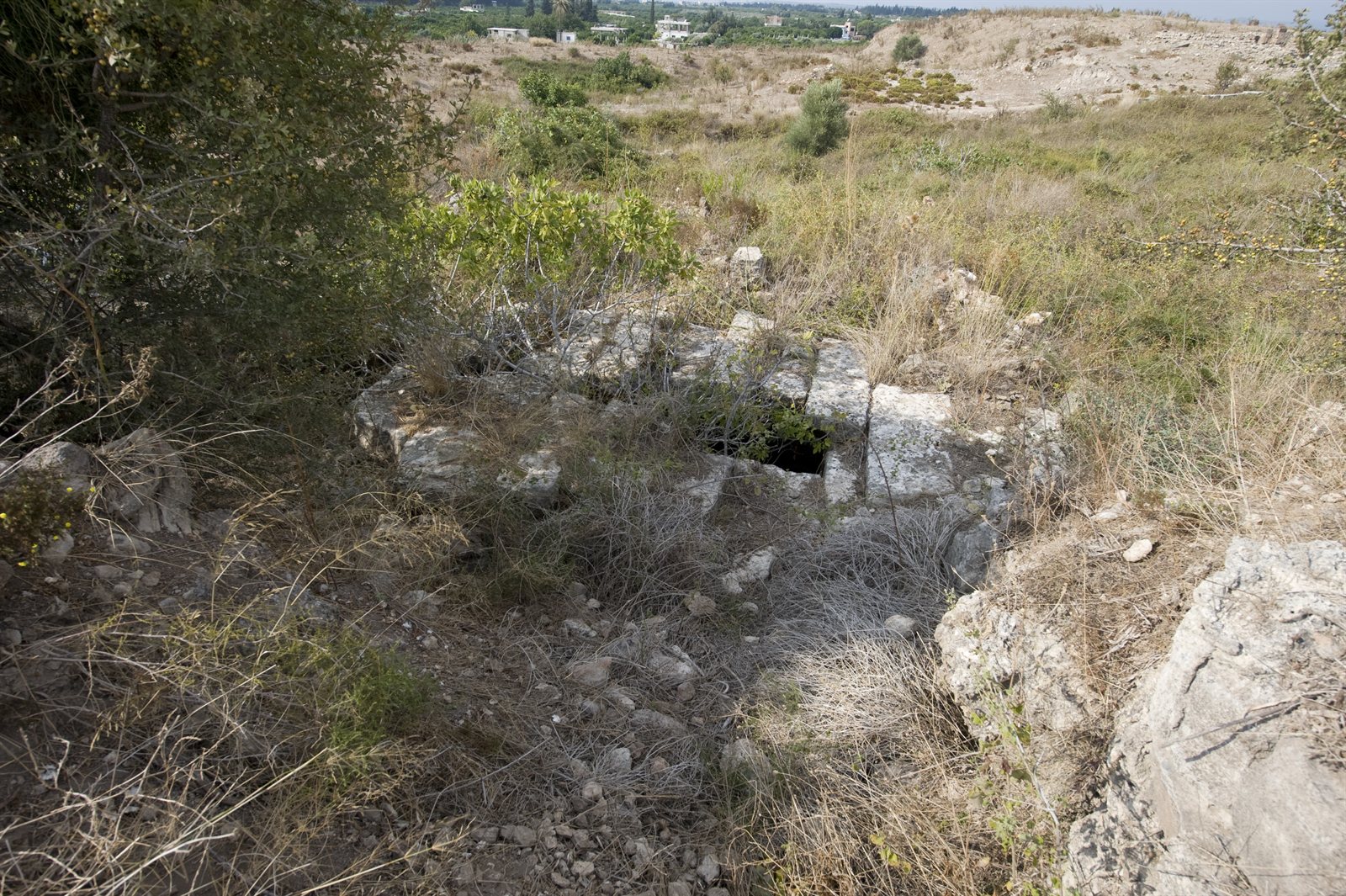
The expedition found the tablet in 1961 at Ras Shamra on the Syrian coast, the site of ancient Ugarit. It lay flat at a depth of 1.20 metres in a room on the southern acropolis. Excavators call the building the House of the Priest with Lung and Liver Models, after finds associated with the interpretation of signs in animal organs. The same room yielded ritualRitualAn organised or distinguished practice meaningful to a community; it may leave traces, but its form alone does not reveal an associated doctrine.Glossary · Click to read the explanation tablets. Jean-Claude Courtois places RS 24.258 at excavation point 3780, west of a short interior wall. The tablet is registered as DO 6600 in the National Museum in Damascus. [1][2][4]
Dennis Pardee’s edition gives the surviving tablet as 17.9 centimetres high and 14.1 centimetres wide. Courtois gives 17.5 by 14.0 centimetres in his excavation report. About three centimetres of the lower edge are missing. The break takes out part of the story between the last preserved lines of the front and the first surviving lines of the back. Lower down on the back is a blank space of about eleven centimetres, which suggests that the surviving final lines were the end of the composition on this tablet. It is written in Ugaritic alphabetic cuneiformUgaritic alphabetAlphabetic cuneiform system of Late Bronze Age Ugarit, using thirty chiefly consonantal written signs, distinct from Akkadian syllabic cuneiform.Glossary · Click to read the explanation, a script that records consonants and leaves most vowels unstated. Written Ugaritic is attested from about 1300 to 1190 BCE, in the Late Bronze AgeLate Bronze AgeAn archaeological period around 1600–1200 BCE in much of the Near East, with international diplomacy, exchange and religious diversity; its endpoints vary by region.Glossary · Click to read the explanation. The year in which this copy was made is unknown. [2][5][6][7]
Under the tables
Wine appears at the beginning of the feast. After the gods have eaten and drunk, the narrative follows Yariḫ under the tables, where it compares his behaviour to a dog’s. The gods who recognize him give him food. Those who fail to recognize him hit him with a stick. He approaches Athtart and AnatAnatAnat is an ancient Near Eastern goddess attested at Mari, Ugarit and in Egypt. In Ugaritic narratives she is a warrior, Baal’s ally and a mourner for him; her roles vary by tradition and context.Glossary · Click to read the explanation, who give him cuts of meat. The doorkeeper objects that such cuts are being served to a dog. Both goddesses return later, though the damage obscures part of what they do. [2][3][5]
El takes his seat at his marziḥuMarziḥuA banqueting institution or association in Ugaritic documents, with religious functions not reducible to one ritual.Glossary · Click to read the explanation, a gathering for drinking in this passage. The description of his drinking echoes the earlier lines about the gods at the feast. Pardee reads the two scenes as successive activities, with a banquet following the slaughter of game and a drinking gathering afterwards. The text supplies a sequence of events and mentions El’s house and courtyards. The layout of the rooms in which the events take place remains a matter of interpretation. [2][3][5]
El’s collapse and the last lines
Two gods, Tukamuna and Shunama, support El on his way home. A figure named Ḥby, described as having horns and a tail, meets him. The identity of that figure remains uncertain. El falls amid his own excrement and urine. The following lines compare him to the dead and to people descending into the earth. On the damaged reverse, the narrative arrives at a line Pardee reads as El waking when someone acts to heal him. The loss of intervening lines leaves details of the recovery unclear. [2][3][5]
A horizontal line separates that passage from the final instructions. The last three lines mention dog hair, fresh olive oil in Pardee’s reading and an ingredient written pqq whose identification remains uncertain. Pardee takes part of the directions to concern El’s forehead. Pardee reads a word divider after the group of letters he takes to mean ‘on his forehead’. Clemens Steinberger’s re-examination of the photographs supports reading the sign as the consonant ḫ. Pardee also notes that the dog provides a link between the earlier scene under the tables and the instructions at the end. [2][3][5]
Quick answers
What are RS 24.258, KTU 1.114 and DO 6600?
They identify the same tablet by its excavation number, its text catalogue number and its Damascus museum inventory number, respectively. [1][2][4]
Where was the tablet found?
It was excavated in 1961 in the House of the Priest with Lung and Liver Models on the southern acropolis of Ugarit. [1][2]
What does marziḥu mean here?
It refers to the gathering at which El takes his seat and drinks after the banquet scene. [2][3][5]
Does the remedy survive?
The last three lines survive, though the identification of one ingredient and the reading of some signs remain uncertain. [2][3][5]
References and notes
- Edition des ugaritischen poetischen Textkorpus, Universität Göttingen, ‘Korpus’ Entry RS 24.258. Concordance of excavation, museum and text numbers, with the findspot in the tablet cella of the southern acropolis. Return to the text ↑
- Dennis Pardee, Les textes para-mythologiques de la 24e campagne (1961), Ras Shamra-Ougarit IV, Paris, 1988 Jean-Claude Courtois, pp. 8 and 10, fig. 2/2 and find point 3780. Chapter I, pp. 13–16, describes the surviving clay, measurements and break, with a copy and photographs. Commentary, pp. 41–42 and 61–63, 71–74, discusses the dog, Ḥby, the remedy and its ingredients. Return to the text ↑
- Dennis Pardee, Ritual and Cult at Ugarit, Society of Biblical Literature, Atlanta, 2002 Chapter IX, text 51, pp. 167–170. Translation and discussion of the banquet and drinking gathering (lines 1–16), the collapse and damaged recovery account (lines 17–28′) and the instructions below the line (lines 29′–31′). Return to the text ↑
- West Semitic Research Project, University of Southern California, ‘Ugaritic Texts’ PDF p. 2, catalogue entry ISF_TXT_01277 for RS 24.258. Gives the museum location as the National Archaeological Museum, Damascus, Syria. Return to the text ↑
- Clemens Steinberger, ‘Die ugaritischen Texte in Umschrift: KTU 1.114’, Ugarit-Portal Göttingen, 16 February 2022 Both pages, transliteration of lines 1–31. Notes 1, 5–7 discuss faint signs, uncertain reconstructions and the photograph-based reading of the sign after llṣbh in line 29. Return to the text ↑
- Paolo Merlo, ‘Ugaritic’, Mnamon, Scuola Normale Superiore Sections ‘Introduction’ and ‘Spread’, on alphabetic cuneiform, the notation of vowels and the Late Bronze Age context of the language. Return to the text ↑
- Dennis Pardee, ‘Ugaritic’, in Roger D. Woodard (ed.), The Ancient Languages of Syria-Palestine and Arabia, Cambridge University Press, 2008, pp. 5–35 Opening summary, ‘Historical and Cultural Contexts’. Dates the surviving written Ugaritic record to roughly 1300–1190 BCE. The range describes the corpus and the date of this copy remains unknown. Return to the text ↑
Archive records may be reviewed and refined as better evidence or sources become available. Suggest a correction
Suggest a correction · Suggest a source for this record
Cite this record
IL Archive, «El’s Banquet at Ugarit (RS 24.258)», https://ilarchive.com/en/texts/el-banquet-rs24258
Continue reading