Artifact
The Dagan Stele from Ugarit (Louvre AO 19931)
An object record bringing together its image, metadata, rights, and context.
- Timeline
- From 1400 BCE to 1100 BCE
- Region
- The Levant
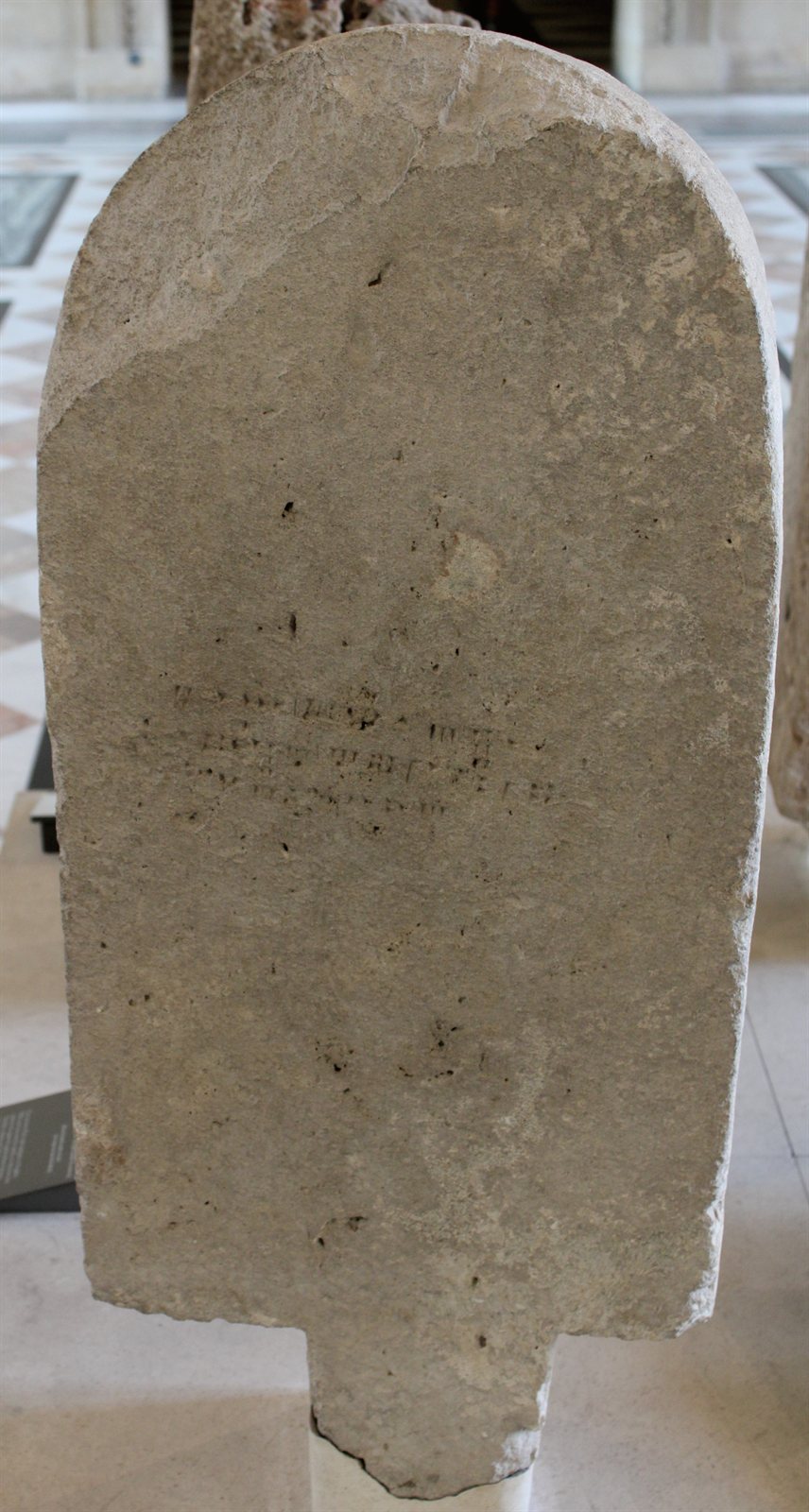
Three lines on a limestone stele name Dagan, the woman who made the dedication and a bull for a meal. A second stele found near the same sanctuary helps explain what the offering meant and why the building’s name is still debated.
Estimated reading time: 4 min Published Last reviewed:
Share article
Photograph
Zunkir / Wikimedia Commons, CC BY-SA 4.0. Image resized.
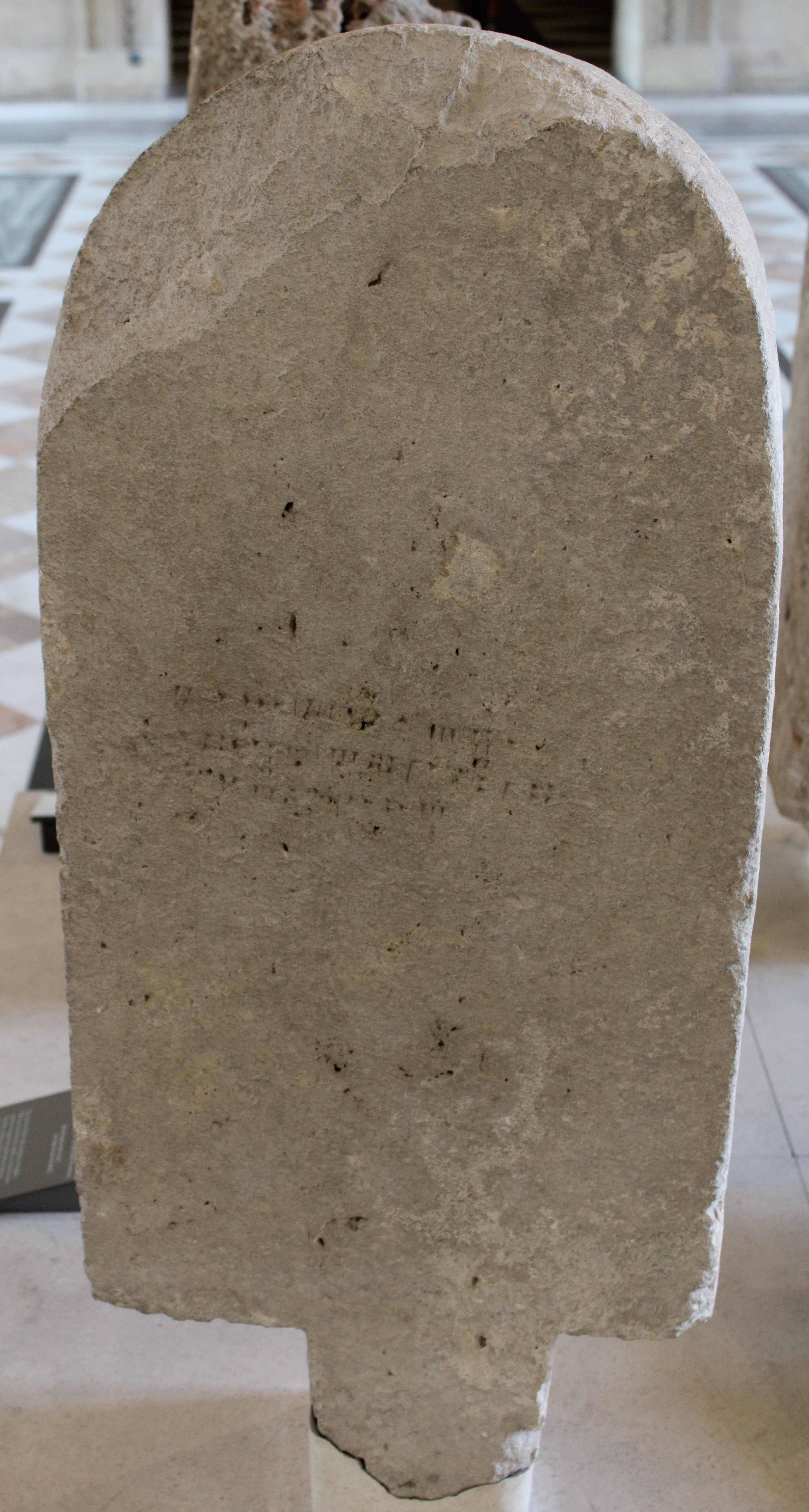
Limestone stele dedicated to Dagan, from Ras Shamra. Three lines of Ugaritic alphabetic cuneiform are engraved above the projecting base (Louvre AO 19931)
License · Image sourceObject details
- Title
- The Dagan Stele from Ugarit (Louvre AO 19931)
- Timeline
- From 1400 BCE to 1100 BCE
- Region
- The Levant
- Rights
- CC BY-SA
Text
Introduction
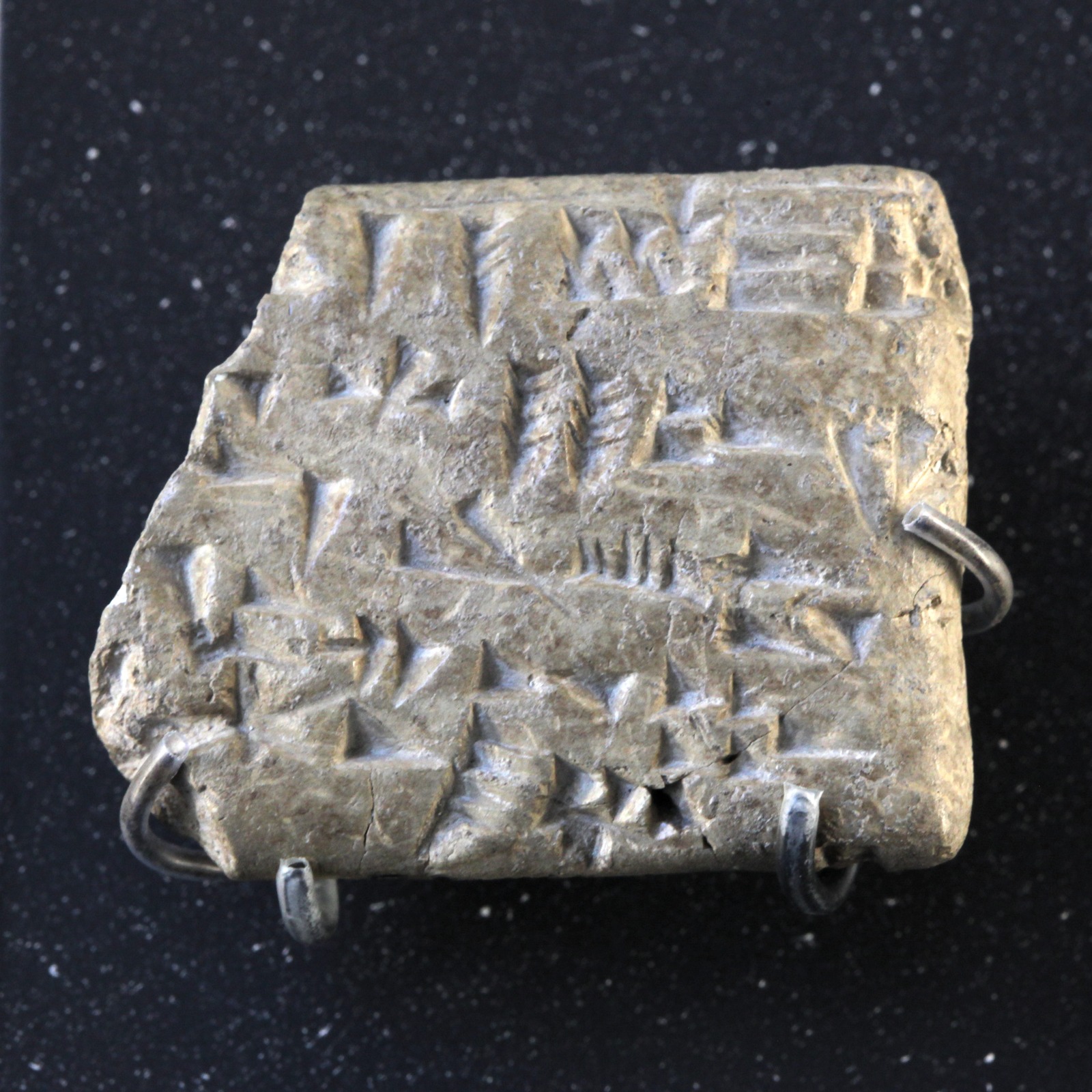
On the second line of a limestone stele from UgaritUgaritAncient city and kingdom at Ras Shamra on the Syrian coast, flourishing between the fourteenth and early twelfth centuries BCE and preserving multilingual archives.Glossary · Click to read the explanation, a short group of wedges spells the name of DaganDaganA god worshipped in Syria and Mesopotamia, especially at Tuttul and Terqa on the Euphrates, and associated with royal authority. His name appears as Dagon in the Hebrew Bible; no ancient image of him is securely identified.Glossary · Click to read the explanation. The same line gives the name of the person who made the offering. The third line records a bull for a meal. The stele came from the acropolis of Ras Shamra on the Syrian coast. The Louvre holds it as AO 19931, the expedition registered it as RS 6.021 and the inscription is KTUKTU: Ugaritic Text ReferencesAbbreviation for a modern edition of alphabetic cuneiform texts. Its text references can be cross-identified with find numbers such as RS or RIH; they are not dates.Glossary · Click to read the explanation 6.13. [1][3][6]
A stone set upright
The Louvre describes a limestone monument with a rounded top and a projecting base, or tenon. It measures 87 centimetres high, 38 wide and 15.5 thick. René Dussaud, who published the two inscriptions in 1935, specifies that the height includes the tenon. The projection allowed this kind of stone to be set upright in a socket. The museum gives a broad range of 1400 to 1100 BCE, extending from the Late Bronze AgeLate Bronze AgeAn archaeological period around 1600–1200 BCE in much of the Near East, with international diplomacy, exchange and religious diversity; its endpoints vary by region.Glossary · Click to read the explanation into the beginning of the Iron Age. [1][2][5]
The museum records the discovery date as 27 March 1934 and the findspot as the court of the building traditionally called the Temple of Dagan. Claude Schaeffer reported that its general plan and orientation matched those of the nearby temple of BaalBaalUgaritic storm god and warrior king who defeats Yamm, builds his palace with El’s consent and confronts Mot. References to El and Dagan as fathers do not define a single genealogy.Glossary · Click to read the explanation. He took the two dedicatory stones as grounds for naming the sanctuary after Dagan. The Louvre received the larger stone through the division of finds after excavation. The second stele, RS 6.028, is the smaller, incomplete monument registered in the text catalogue as KTU 6.14. [1][2][4][5][6]
The offering and the meal
The first line begins with skn, a word for a stele. The second names the dedicator, whose name Dennis Pardee renders Tarriyelli, and the recipient, Dagan. Pardee identifies Tarriyelli with the queen mother named in the Ugaritic funerary text RS 34.126. The word pgr, which he reads as a sacrifice connected with the dead, comes just after Dagan’s name. In the second stele, pgr opens the inscription itself. The dedicator there is Uzzinu, and he calls Dagan his lord. Reading the pair makes it possible to distinguish the wording peculiar to each stone. [1][3][5]
The Louvre reproduces a translation by Pierre Bordreuil and Dennis Pardee that supplies the word for a sheep in the damaged opening of the last line. Brian B. Schmidt’s translation likewise puts the sheep in brackets. In his later edition, Pardee leaves the species sacrificed in the mortuary rite unspecified and takes the bull to be for the accompanying meal. The expression about food is preserved on the stone. The difference between the translations turns on whether to supply a missing word for the other animal. [1][3][7]
A dedication in a sanctuary precinct
Alessandra Gilibert places both steles in front of the terrace on the acropolis. She interprets that platform as an adaptation of the second temple and situates it in an open space suited to public ceremony. She proposes the funeral of King Niqmaddu III, around 1215 to 1210 BCE in her chronology, as a possible occasion for erecting the stones. The inscription gives neither a year nor the name of a deceased person. Theodore J. Lewis discusses two possibilities for the pair, the remembrance of unnamed ancestors and the dedicators’ provision for their own commemoration. [3][5][8]
The names on the stone help establish what took place in the precinct. Identifying the building’s principal deity remains a separate question. Schaeffer’s identification accounts for the name retained in the Louvre catalogue. Gilibert notes that the same structure has also been identified as a temple of ElElEl is a senior deity in Late Bronze Age Ugaritic texts, portrayed as father of the divine family and a council authority, alongside his consort Athirat. This entry does not cover every linguistic use of El.Glossary · Click to read the explanation. The surviving dedication establishes Dagan as the recipient of Tarriyelli’s offering, while the excavated setting places it beside the sanctuary. [1][3][4][5]
Quick answers
What does the Dagan stele record?
The three-line inscription records Tarriyelli’s dedication to Dagan and a bull for a meal. The word pgr is usually read here in connection with a mortuary sacrifice. [1][3]
Where was it found?
The Louvre records its discovery in 1934 in the courtyard traditionally associated with the Temple of Dagan on the acropolis of Ras Shamra. [1][4]
Which stele is Louvre AO 19931?
It is the larger, more complete of the two Dagan steles from the precinct. Its excavation number is RS 6.021 and its text is KTU 6.13. [1][2][5][6]
Does it give the date of the offering?
The inscription gives no year. Gilibert proposes a possible connection with the funeral of Niqmaddu III, while the Louvre dates the object broadly to about 1400 to 1100 BCE. [1][3][5]
References and notes
- Musée du Louvre, ‘Stèle de Dagan’, AO 19931 / RS 6.021 Description, Inscriptions, Physical characteristics, Places and dates, and History. Gives the form, limestone, dimensions, recorded date and court findspot, acquisition, and translation from Bordreuil and Pardee (in Yon, 1991, pp. 302–303). Return to the text ↑
- René Dussaud, ‘Deux stèles de Ras Shamra portant une dédicace au dieu Dagon’, Syria 16 (2), 1935, pp. 177–180 P. 177, opening and section A. Distinguishes the complete stele from the incomplete one, specifies that the height includes the tenon and begins the first edition of the inscription. Return to the text ↑
- Dennis Pardee, Ritual and Cult at Ugarit, Society of Biblical Literature, Atlanta, 2002 Chapter IV, pp. 123–125, texts 32 and 33 and nn. 1–5. Gives both readings, identifies the queen mother, and distinguishes the named bull for the meal from the unspecified animal of the mortuary sacrifice. Return to the text ↑
- Claude F.-A. Schaeffer, ‘Compte rendu de la sixième campagne de fouilles à Ras Shamra (Syrie) et des recherches à Enkomi (Chypre)’, Comptes rendus des séances de l’Académie des Inscriptions et Belles-Lettres 78 (4), 1934, pp. 308–310 P. 309, report on the sanctuary, its plan and orientation, and the excavator’s attribution on the basis of the steles. Return to the text ↑
- Alessandra Gilibert, ‘Urban Squares in Late Bronze Age Ugarit: A Street View on Ancient Near Eastern Governance’, Journal of Near Eastern Studies 80 (2), 2021 P. 393 n. 119 for the alternative temple attribution. Pp. 397–398, ‘The Square with the Platform’, for the terrace, the steles’ findspot and the possible association with Niqmaddu III’s funeral. Return to the text ↑
- Jesús-Luis Cunchillos, La trouvaille épigraphique de l’Ougarit. 2. Bibliographie, Ras Shamra–Ougarit V, Éditions Recherche sur les Civilisations, Paris, 1990 P. 173, ‘Petites inscriptions’. Cross-references KTU 6.13, AO 19.931 and RS 6.021, with a separate entry for KTU 6.14 / RS 6.028. Return to the text ↑
- Brian B. Schmidt, Israel’s Beneficent Dead: The Origin and Character of Israelite Ancestor Cults and Necromancy, DPhil thesis, University of Oxford, 1991 Pp. 83–84 and n. 6, the distinction between the Paris and Aleppo pieces and the translation supplying the word for sheep in brackets. Return to the text ↑
- Theodore J. Lewis, ‘Feasts for the Dead and Ancestor Veneration in Levantine Traditions’, in Virginia Rimmer Herrmann and J. David Schloen (eds.), In Remembrance of Me: Feasting with the Dead in the Ancient Middle East, Oriental Institute of the University of Chicago, 2014 Pp. 71–72 and fig. 8.3, object identifications and heights, the bull for the meal, and the alternatives of commemorating unnamed ancestors or the dedicators themselves. Return to the text ↑
Archive records may be reviewed and refined as better evidence or sources become available. Suggest a correction
Suggest a correction · Suggest a source for this record
Cite this record
IL Archive, «The Dagan Stele from Ugarit (Louvre AO 19931)», https://ilarchive.com/en/artifacts/dagan-stele-ao19931
Continue reading