Site
Balıklı
- Timeline
- From 8300 BCE to 7950 BCE
An Early Neolithic settlement in central Anatolian Cappadocia, c. 8300–7950 BCE, with renewed houses and subfloor and wall burials whose interpretation changes with excavation.
Estimated reading time: 4 min Published Last reviewed:
Share article
Text
Introduction
Balıklı is an Early Neolithic settlement in central AnatoliaAnatoliaAnatolia is the region occupying the Asian part of present-day TurkeyGlossary · Click to read the explanation, in present-day TurkeyTurkeyTurkey is a modern country including Anatolia and territory in southeastern EuropeGlossary · Click to read the explanation. Its houses and burials reveal close connections between dwelling and death before writing, and show how new excavation evidence can change the interpretation of buildings and burial practices.
Place and date
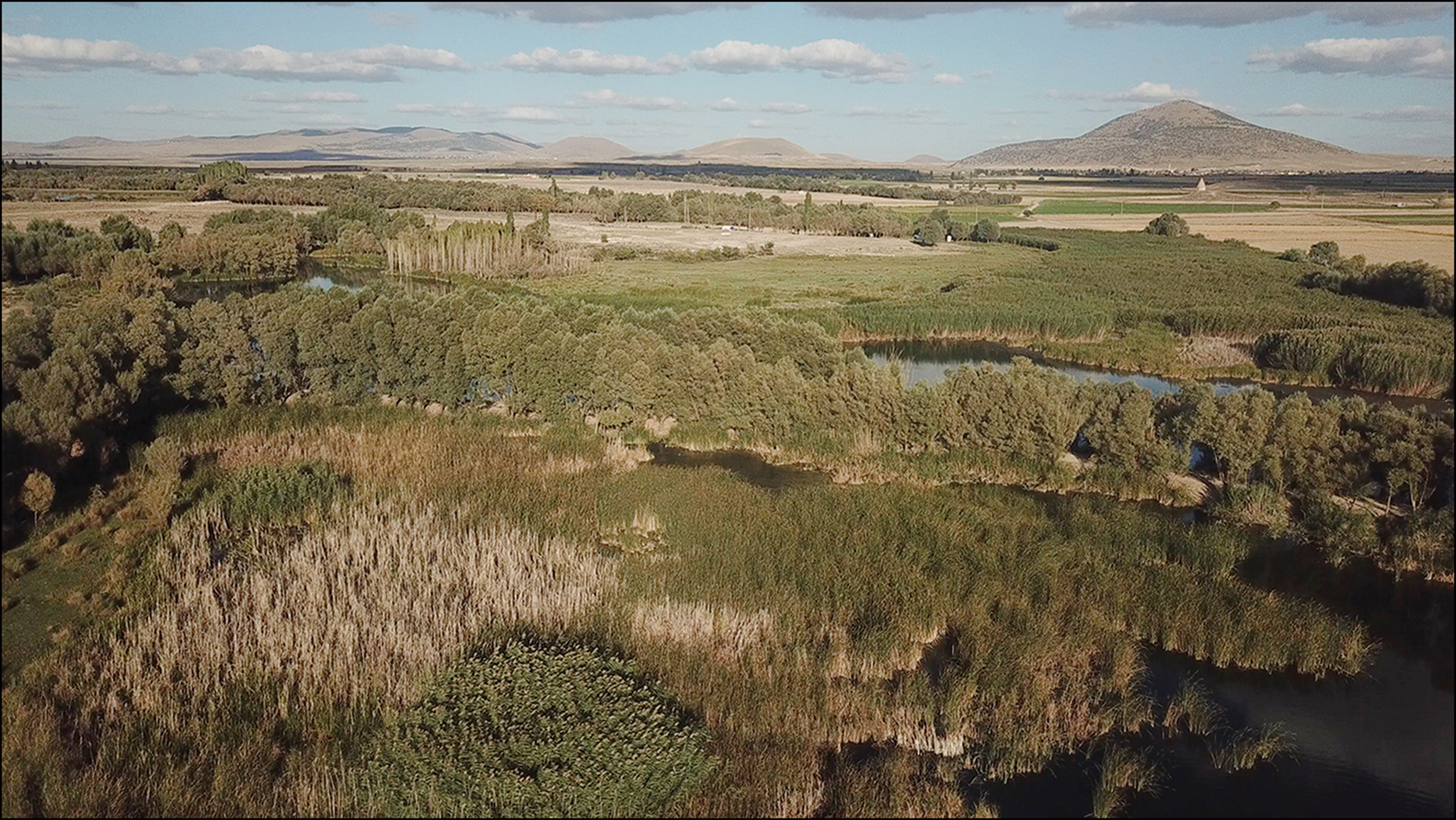
The site lies among wetlands in Cappadocia, about fourteen kilometres northeast of Aşıklı HöyükAşıklı HöyükAn early Neolithic settlement in central Anatolia’s Melendiz valley (c. 8350–7300 BCE), revealing rebuilding, early sheep management, selective subfloor burials, and some genetic kin ties—not a known religious doctrine.Glossary · Click to read the explanation, a neighbouring Neolithic settlement. This is central Anatolian Balıklı, not Balıklıgöl in the city of Urfa. Rescue excavations began in 2019 after illegal bulldozing damaged parts of the site.[1]
The 2025 report dates occupation approximately to 8300–7950 BCE. The 2024 report presents sixteen radiocarbon dates clustering around 8200–7900 BCE. These are approximate ranges reported in different publications, not precisely known foundation and abandonment years.[1][2]
Houses used repeatedly
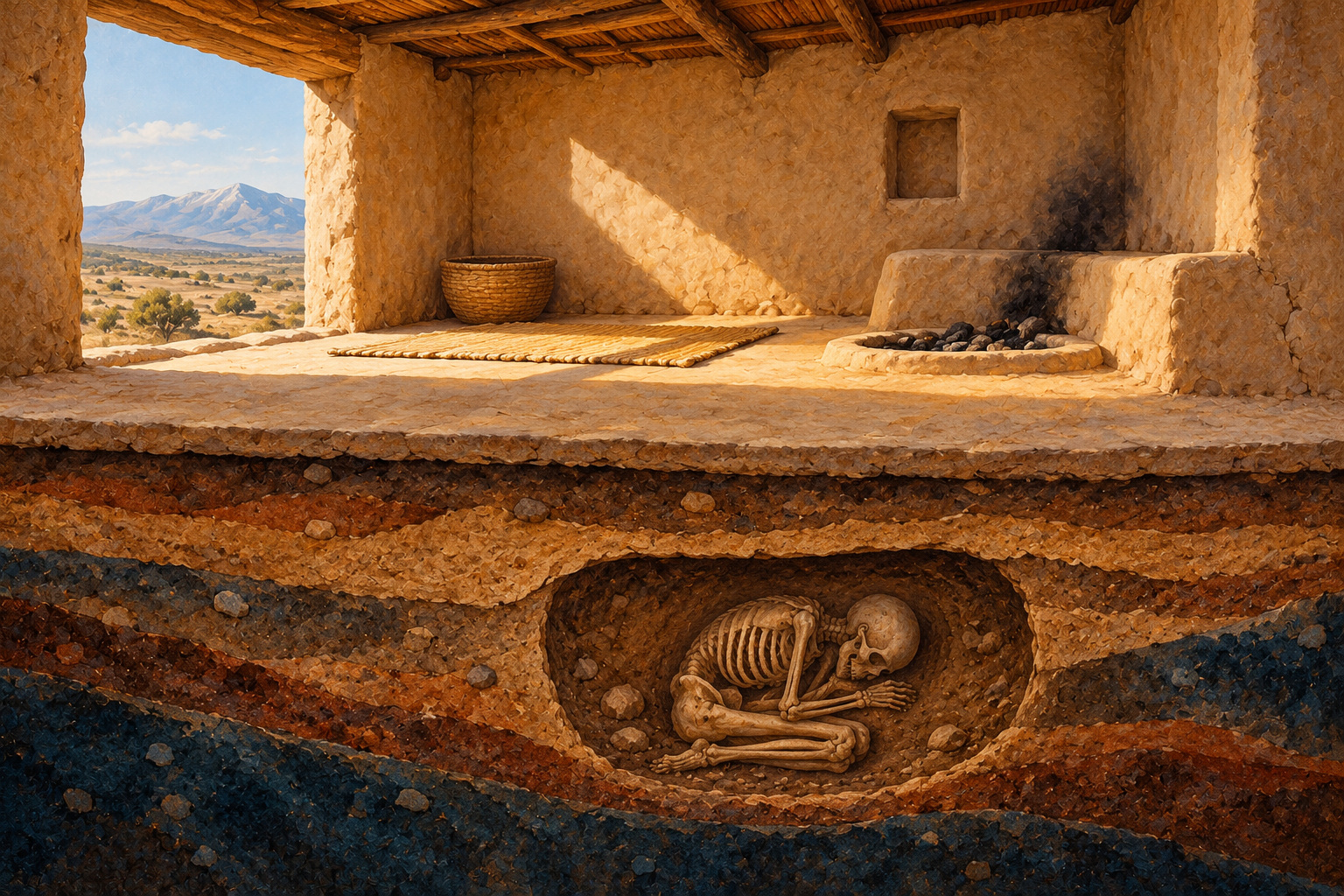
Oval dwellings were partly dug into the ground, with basalt-stone walls and clay-rich building materials. Floors were repeatedly renewed; one building preserves at least five successive floors. Such evidence contributes to studying sedentismSedentismReduced residential mobility and prolonged occupation of a place: a concept distinct from agriculture, assessed through evidence beyond the presence of buildings.Glossary · Click to read the explanation, reduced residential movement and longer occupation of a place, without equating a house form alone with permanent year-round residence.[1]
The 2024 report inferred roof access because no doorways had been identified. In 2025, however, a better-preserved building indicated that an eastern projection served as a stepped entrance. Roof entry should therefore no longer be generalized to every house: the interpretation changed as the evidence improved.[1][2]
Resources and everyday work
The finds reveal a place of work and food acquisition, not only houses and graves. The 2024 report presented six preliminary botanical samples, in which cereal chaff predominated over grains; this favours processing cereals at the settlement. Poor preservation and the small sample do not settle the scale of cultivation or the domestication status of all plants. Fish, turtles, birds and large-animal remains indicate diverse exploited resources, while teeth of newborn equids establish occupation at least in late spring or summer, not an entire year.[1]
Obsidian, a volcanic glass used for sharp tools, occurs as cores, flakes and products from several stages of knapping. This production sequence favours manufacture within the settlement rather than arrival of all tools in finished form. Bone tools and grinding and pounding stones complete the picture. Evidence for work, hunting and plant use thus combines to explain longer stays, while the community’s differing reliance on cultivation and herding compared with neighbouring sites remains a research question.[1]
Death within inhabited space
The 2024 report counted twenty-three burials from the main occupation; the 2025 report described more than sixty individuals. These figures are neither a population census nor evidence of population growth. They record excavation results at different dates, and a burial and an individual are not identical counting units.[1][2]
Two contexts can be distinguished rather than merging all burials into one picture. In buildings 8 and 9, the 2024 report describes horizontal burial cavities in the walls; Figure 6 locates them in building 8. For building 1, the 2024 report describes a primary burial beneath its earliest floor, with three additional pigmented skulls in pits directly below the skeleton and an artefact cache.[1] Figure 5 in the 2025 report illustrates this lower context and the adjacent cache, not a sequence of wall burials.[1][2]
The 2025 report favours temporary placement of some wall-burial individuals elsewhere, followed by reburial during building renovation, citing missing bones from several individuals. The architectural relationship and skeletal incompleteness give this explanation a material basis, but absence of bones alone does not prove transfer: preservation and later disturbance must also be weighed. Transfer remains the researcher’s preferred interpretation, not a complete observed sequence for every burial.[2]
These finds show varied treatment of the dead within inhabited space, but do not name the inhabitants’ beliefs. Ancestor worship requires an additional argument rather than being an automatic description of every burial beneath a house. Neolithic burials must also be distinguished from later graves cut into the site.[1][2]
References and notes (2)
- A. Nigel Goring-Morris et al. (2024). Variation in the development of Neolithic societies atop the Central Anatolian Plateau: recent results from Balıklı. Antiquity 98(401), 1163–1180. DOI: 10.15184/aqy.2024.100. Chronology, architecture, graves, tools, plants and animals; Figure 6 for building 8 wall burials and Figure 2 for the cover. Supplementary tables were not read separately. Return to the text ↑
- Güneş Duru (2025). Balıklı: On the Edge of Time and Everything. Anatolian Research 32, 1–18. DOI: 10.26650/anar.32.1701248. Published 25 July 2025. Pp. 5–8: dating, entrance and burial; p. 7 for missing bones and the reburial hypothesis, Figure 5 on p. 8 for the building 1 subfloor context and cache. Unpublished preliminary genetic results are not relied upon. Return to the text ↑
Suggest a correction · Suggest a source for this record
Cite this record
IL Archive, «Balıklı», https://ilarchive.com/en/sites/balikli
Continue reading