Entity · Concept
Secondary burial
A reference page linking a name, group, or concept to the materials that discuss it.
Redeposition of remains after earlier mortuary treatment or deposition, established from context.
Text
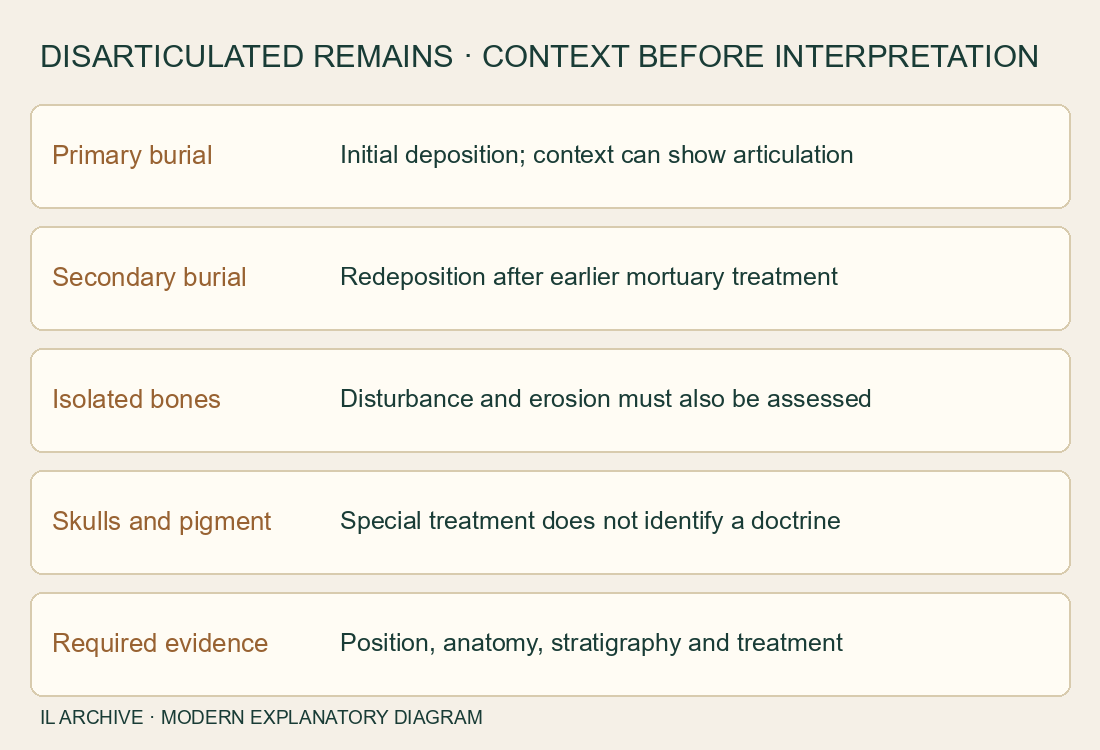
It differs from primary burial, the initial deposition of a body. Bones may be moved after decomposition or redeposited in another location; interpretation uses articulation, distribution, stratigraphy and treatment. BalıklıBalıklıA central Anatolian Neolithic site with floor and wall burials and special skull treatment.Glossary · Click to read the explanation’s report documents primary and secondary deposits; BoncukluBoncuklu HöyükA Konya Plain Neolithic settlement with oval houses and burials associated with continued building use.Glossary · Click to read the explanation’s background in the DNA study records disarticulated remains and skulls in open areas.[1][2]
An isolated bone does not establish secondary burial or an intentional rite: disturbance and erosion may also separate bones, as discussed at Göbekli TepeGöbekli TepeA Neolithic site in southeastern Turkey, known for communal buildings and T-shaped pillars; the excavation team describes a settlement with a pronounced ritual component.Glossary · Click to read the explanation. Redeposition alone identifies neither ritualRitualAn organised or distinguished practice meaningful to a community; it may leave traces, but its form alone does not reveal an associated doctrine.Glossary · Click to read the explanation meaning nor ancestor beliefs. The modern drawing explains distinctions, not a particular historical event.[3]
References and notes
- Güneş Duru (2025). Balıklı: On the Edge of Time and Everything. Anatolian Research 32, 1–18. DOI: 10.26650/anar.32.1701248. Published 25 July 2025. PDF pp. 5–9 and 12–15, plus abstract: c.8300–7950 BCE, over 60 individuals, primary/secondary burials and an entrance in one better-preserved building. Aşıklı comparisons concern contemporary phases and excavated areas, not the whole site. Return to the text ↑
- Reyhan Yaka et al. (2021). Variable kinship patterns in Neolithic Anatolia revealed by ancient genomes. Current Biology 31(11), 2455–2468.e1–e18. DOI: 10.1016/j.cub.2021.03.050. Aşıklı and Boncuklu results, discussion and STAR Methods site backgrounds read in the full text through Europe PMC. Counts belong to the 2021 report; sampled DNA and proposed relationships do not form a complete population register. Return to the text ↑
- Julia Gresky & Lee Clare (2026). First burials give insights into mortuary rites at Göbeklitepe, Early Neolithic Türkiye. PLOS ONE 21(9), e0358979. DOI: 10.1371/journal.pone.0358979. Published 22 September 2026. Abstract, introduction, collective-burial results and erosion discussion read. First two intact burials, not first known human bones. The collective grave cut a plaster floor; dispersed bones may have multiple causes. Return to the text ↑
Research history
Substantive changes are retained here. Minor copy edits remain in the internal operational log.
-
Substantive record update
Suggest a correction · Suggest a source for this record
Cite this record
IL Archive, «Secondary burial», Edition 2, https://ilarchive.com/en/entities/secondary-burial