Entity · Concept
Cranial modification
A reference page linking a name, group, or concept to the materials that discuss it.
Alteration of head shape through bodily practices in early childhood, documented in multiple communities. It may relate to affiliation, status or beauty, but an elongated figurine head alone does not prove the subject underwent it.
Text
Practice and representation
Bioarchaeology examines bone shape and context to identify modification; linking it to artistic images requires separate comparison. Lorentz discusses variation in practices and meanings and limited Near Eastern samples. Neither one motive nor universal population coverage should be assumed.[1]
Comparative example
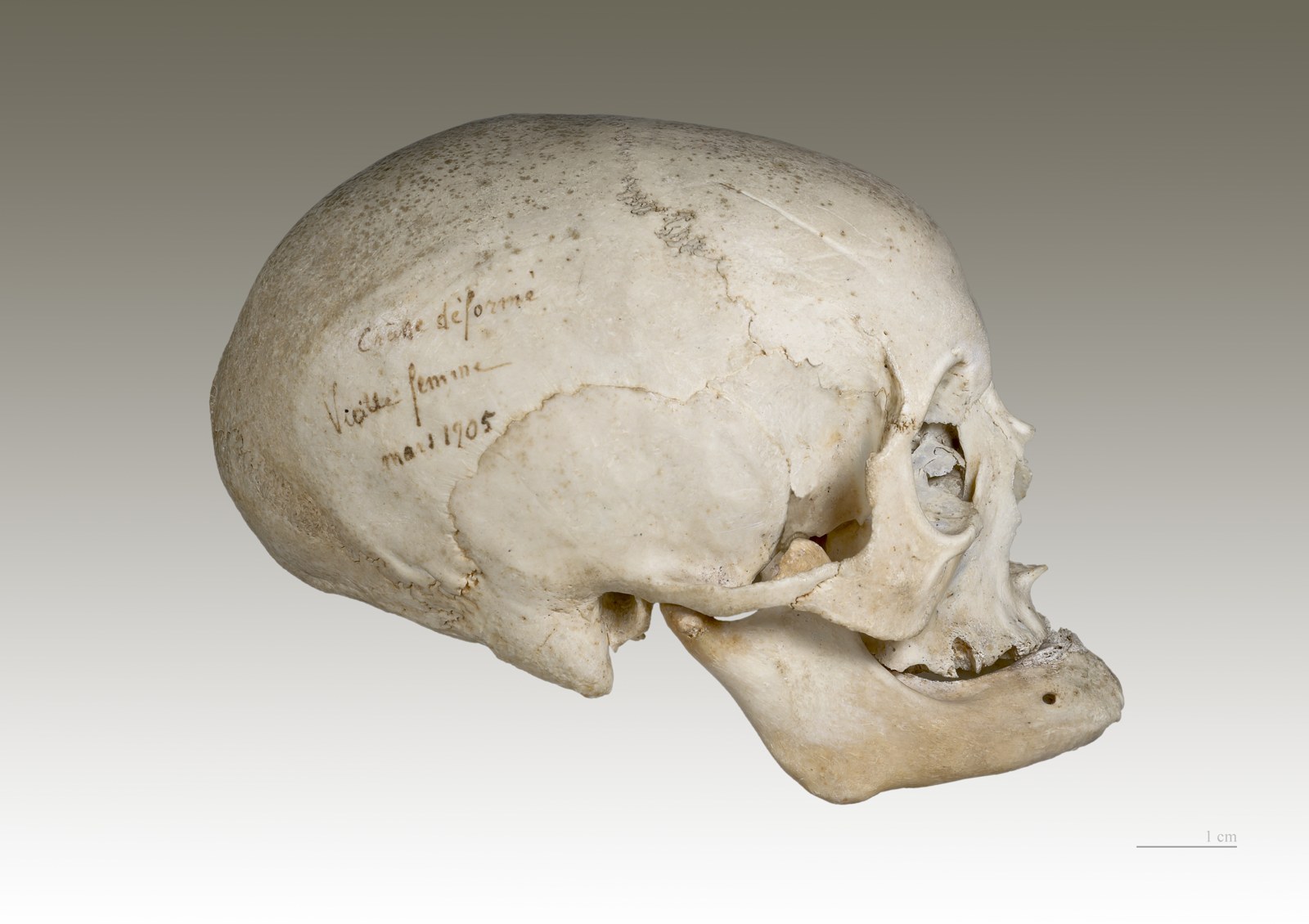
The photograph shows a Toulouse-type modified skull at the Muséum de Toulouse, France, MHNT.ANT.2003.85. It comes from another time and place, not the UbaidUbaid cultureAn archaeological designation for material traditions originating in southern Mesopotamia with regional diffusion. Broad southern frame c. 6500–3800 BCE; not a known linguistic people, with limits varying by region and phase.Glossary · Click to read the explanation, and does not identify Ubaid figurinesFigurineSmall three-dimensional representations of people, animals or other beings. Size and appearance alone do not establish a toy, portrait, ritual object or deity; manufacture, discovery context and use require study.Glossary · Click to read the explanation.
References and notes
- Kirsi O. Lorentz (2010). Ubaid Headshaping: Negotiations of Identity through Physical Appearance? In Beyond the Ubaid, SAOC 63, pp. 125–148. Selected discussion and conclusion, pp. 138–142: variation, identity and sample limits. Does not make headshaping a proven explanation for every represented head, a universal population trait, or a single universal motive. Return to the text ↑
Research history
Substantive changes are retained here. Minor copy edits remain in the internal operational log.
-
Substantive record update
Suggest a correction · Suggest a source for this record
Cite this record
IL Archive, «Cranial modification», Edition 2, https://ilarchive.com/en/entities/cranial-modification