Study
The Warka Vase and Head: When the Sacred Became Recognizable
An extended study of a topic, with evidence and references.
- Timeline
- From 3300 BCE to 2900 BCE
- Region
- Southern Mesopotamia — Uruk
Offerings, Inanna’s emblems and authority at Uruk, alongside a female face probably from a composite statue: what the objects establish and how far goddess, priestess and ruler can be identified.
Estimated reading time: 17 min Published Last reviewed:
Share article
Text
Introduction
How can sacred space be recognized in an image whose figures are unnamed? This study compares the WarkaUrukAncient city at Warka in southern Iraq, a major urban centre around 3200 BCE that preserved early writing and accounting tablets.Glossary · Click to read the explanation Vase and Head from UrukUrukAncient city at Warka in southern Iraq, a major urban centre around 3200 BCE that preserved early writing and accounting tablets.Glossary · Click to read the explanation in southern IraqIraqIraq is a modern country encompassing much of ancient MesopotamiaGlossary · Click to read the explanation around the end of the fourth millennium BCE. It examines offerings, emblems and traces of the head’s construction, distinguishing surviving evidence from interpretations involving InannaInanna / IshtarA prominent Mesopotamian goddess whose Sumerian name Inanna became associated with Akkadian Ishtar across diverse traditions. She was associated with desire, war, royal authority and Venus, while local forms and genealogies varied among texts.Glossary · Click to read the explanation, authority and ritualRitualAn organised or distinguished practice meaningful to a community; it may leave traces, but its form alone does not reveal an associated doctrine.Glossary · Click to read the explanation. The question is not when religion began, but how images and their contexts enable recognition—and where that recognition remains uncertain.
Uruk and the recognizable sacred
In southern Iraq, towards the end of the fourth millennium BCE, images made the relationship between city, authority and the sacred visible in ways for which we now have stronger interpretive clues. Religious art did not begin at Uruk, whose inhabitants were neither the first to fashion a human face nor the first to make meaningful symbols. What matters here is the association of recurring imagery with urban institutions and signs linked to a particular goddess.
Two objects bring this development into view: the Warka Vase, with its rows of plants, animals and offering bearers, and the Warka Head, a carved female face approaching life size. Both belong to Uruk and the archaeological world of the Eanna precinctEanna at UrukAn archaeological precinct and institutional centre at Uruk associated with Inanna; its name does not fix every early building’s function.Glossary · Click to read the explanation. Yet neither has a surviving inscription identifying its female figure as Inanna. The image becomes clearer while the final identification remains open.[1][2][3]
UrukUrukAncient city at Warka in southern Iraq, a major urban centre around 3200 BCE that preserved early writing and accounting tablets.Glossary · Click to read the explanation was a major urban centre where monumental buildings, production, accounts, seals and practices of presentation coexisted. This context helps us understand the vase as more than attractive decoration: it orders a relationship between resources, people and a centre of special standing.
Eanna is known for its strong later connection with Inanna. But neither a building’s size nor the precinct’s name warrants identifying every monumental fourth-millennium structure as her temple. Distinguishing a building and its context from an interpretation of its function remains essential. Recognizing an important religious institution also does not establish that one institution owned the city’s entire economy.
A stone vessel, not a clay tablet
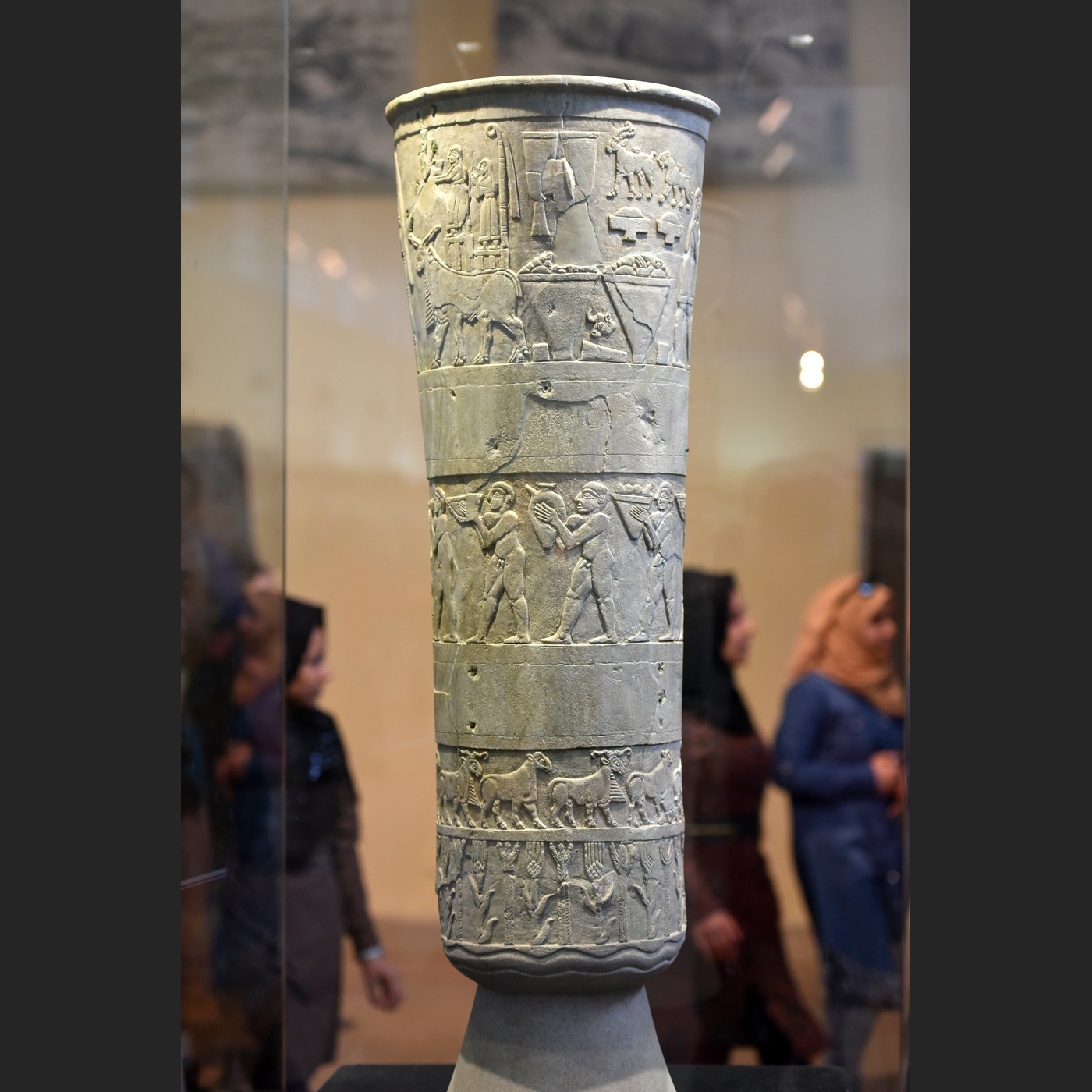
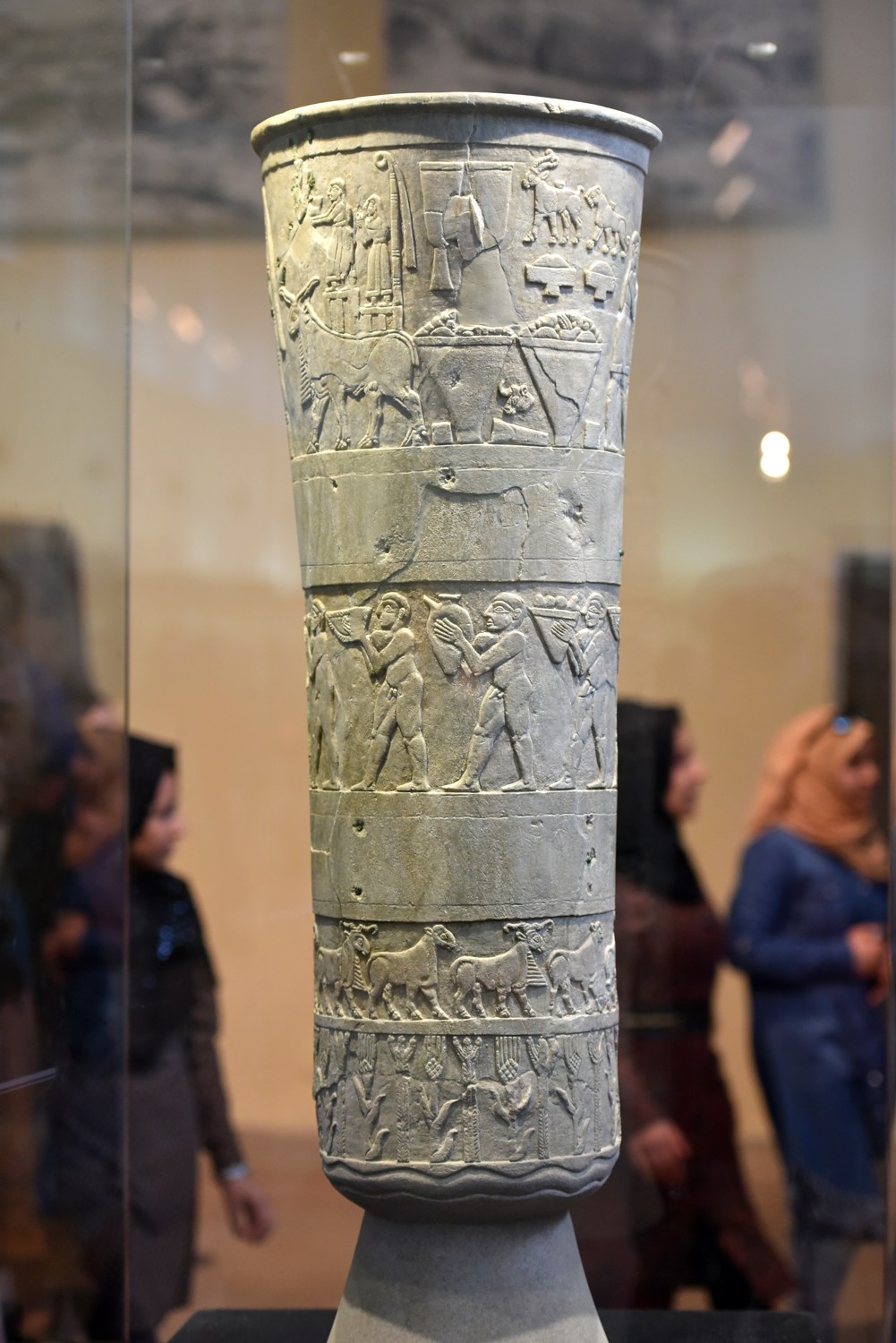
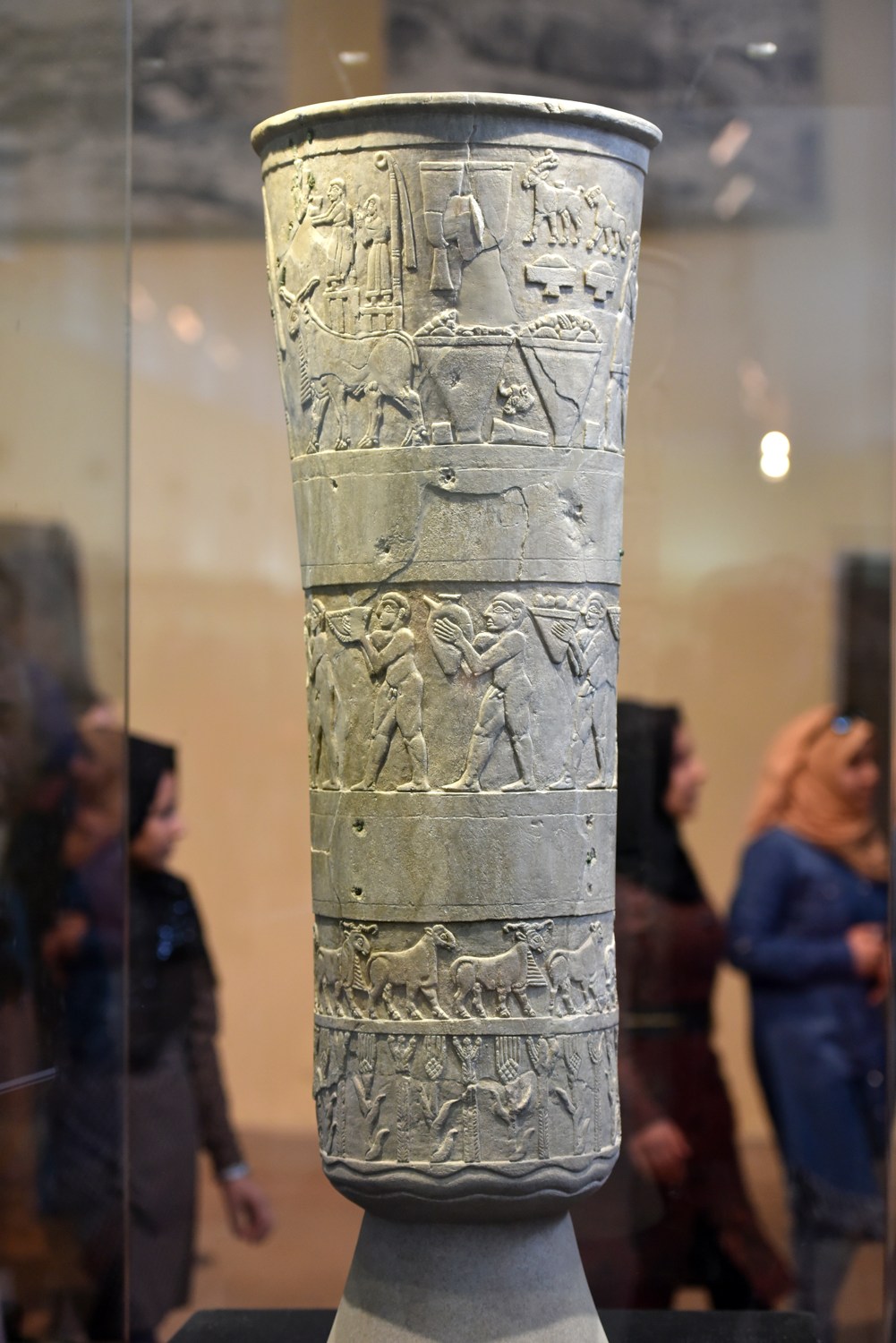
CDLI records the Warka Vase as museum number IM19606 and excavation number W14873, assigning it to Uruk III, approximately 3200–3000 BCE. Its material is stone described as alabaster, with recorded dimensions of 105 cm in height and 36 cm in width. Differing chronological ranges in publications cannot supply an exact year of manufacture.[1]
The height must be understood alongside the displayed object’s condition. The vase has been reassembled and has a reconstructed base; the present photograph does not show one uninterrupted block of surviving ancient stone. Museum documentation also identifies an ancient repair in the upper part and damage during the 2003 looting. Ancient breakage and modern restoration have distinct histories.[4]
Object, depicted action and discovery: different dates
- End of the fourth millennium BCE: the broad context of manufacture; CDLI assigns the vase to Uruk III, approximately 3200–3000 BCE. This is an approximate range, not the date of the depicted ceremony.[1]
- Ancient deposition: Müller records the vase in the level IIIa “treasure house” and the head in a Jemdet Nasr-period debris pit. A deposit does not necessarily date an object’s manufacture or every occasion of its use.[7]
- 1933/1934 and 1939 CE: respectively the vase’s excavation season and the head’s discovery year in Müller’s documentation. They were not found together as one group in a single location.[7]
- 2003 CE and the 2019 photographs: both objects were looted and subsequently recovered. The photographs used here document their modern museum condition, including losses and restoration, not their complete ancient appearance.[4]
The action represented on the vase has no independently established date: it may organize an ideal image or recurring practice rather than record an event assignable to one year.
Reading the registers
The images occupy pictorial registersPictorial registerA horizontal zone or band grouping related images in an artwork; the count can depend on how rows are grouped, and their order alone does not establish chronology.Glossary · Click to read the explanation: horizontal bands that organize a scene. The vase can be described as having three principal registers when plants and animals are grouped into one lower level, or four decorated bands when the plant and animal rows are counted separately. This is not disagreement about which images exist.[2][4]
At the bottom appear wavy lines and plants, followed by animals, men carrying vessels and baskets, and an upper scene of reception and presentation. Blank spaces separate some levels. Moving upwards helps the reading, but the vase also wraps around itself: a photograph from one angle does not reveal every detail.
Water, plants and animals: picturing abundance
The wavy lines are usually read as water, associated with rows of plants. In the environment of southern MesopotamiaMesopotamiaHistorical region associated with the Tigris and Euphrates: Uruk, Ur, Eridu, cuneiform, Sumer, Akkad, Babylon and Assyria, their languages and cults, and the limits of archaeological evidence.Glossary · Click to read the explanation, water and growth provide a visual foundation for the goods appearing further up. This is a reading consistent with the imagery, not a surviving text explaining every line.
The vase alone does not tell how water or earth was created. Its arrangement may connect nature with offerings without constituting a complete map of the cosmos. Describing it as an image of order or abundance interprets relationships between images; it does not translate a myth written on its surface.
Plant identification itself remains debated. Miller, Jones and Pittman (2016) favour a date-palm offshoot over grain for the cross-hatched form, comparing leaf structure, seal images and early signs; they support flax for the other, branching plant. These comparisons strengthen an orchard reading over an impressionistic identification of “ears of grain”, without settling the ceremony’s identity.[11]
Rows of livestock follow the plants, with animals differentiated by horns and form. Their placement brings them into the world of resources on which society depends. Plant resources and herds are more than an attractive background: they help make food, offerings and the city’s continued existence possible.[2]
The imagery can prompt questions about husbandry, wool and organized labour, but provides no independent account of herd sizes or ownership. It cannot quantify temple production or establish that every animal in Uruk belonged to the same institution. The scene selects what matters to its ritual message rather than enumerating all of society.
From offering bearers to the reception scene
In the next level, nude men carry loaded vessels and baskets. Their direction and burdens support interpreting an offering procession. Roughly contemporary seals provide comparisons, including one described by the Metropolitan Museum as a procession before a temple façade involving three nude figures.[2][5]
Nudity alone establishes neither occupation nor legal status. It may relate to ritual action or conventions for portraying performers, but we have no identification for each man. Making them all slaves, priests or members of one social class goes beyond what the carving shows.
In the upper part, a vessel bearer stands before a female figure in a long garment. Behind her are two distinctive looped standards; nearby appear vessels, equipment and smaller images. Presentation and the conjunction of these elements make a ritual interpretation strong, while the participants’ names remain unwritten.[2][3]
The transition matters: resources represented as plants and animals become goods carried by people towards a sacred centre. In this reading, abundance connects with work, and work with presentation. The scene does not reveal the ceremony’s frequency, name or audience.
The scene is particularly revealing where it pictures vessels on the vessel itself. Perkins describes tall chalices resembling it and animal-shaped containers, identifying the latter as vessels from the small cups on their backs. Not every animal shape here represents a living animal. This detail strengthens the reading of displayed equipment and offerings; whether the vase itself participated in a comparable presentation remains an interpretation of its use, not a photographic record of an event.[2][9]
Inanna’s emblems identify the setting
The two emblems are known as ring-posts with streamers. They are commonly interpreted as reed bundles folded at the top, although the form’s origin and material remain debated. Renate Marian van Dijk-CoombesRenate Marian van Dijk-CoombesResearcher in ancient West Asian material and visual culture who has studied standards and symbols in Mesopotamian art.Glossary · Click to read the explanation, a researcher in ancient West Asian material and visual culture, compares them with the early written sign MUŠ3, associated with Inanna; their recurrence on seals and in architectural imagery strengthens the connection with the goddess’s domain.[3]
In this comparative reading they are not neutral ornaments. They help associate the setting with InannaInanna / IshtarA prominent Mesopotamian goddess whose Sumerian name Inanna became associated with Akkadian Ishtar across diverse traditions. She was associated with desire, war, royal authority and Venus, while local forms and genealogies varied among texts.Glossary · Click to read the explanation. In some images an emblem indicates sacred space even without a complete building being depicted. This strong association does not mean that every post or reed bundle in art represents the goddess herself.
The woman: Inanna or her priestess?
Identifying the woman is a different question from identifying the setting. She may be Inanna or a priestess or human representative associated with her. Clothing and position distinguish her, but the area connected with her headdress is incomplete; the iconographic study notes that the break occurred in antiquity.[3]
We cannot restore two horns to the missing area and then treat them as decisive evidence of divinity. Nor should conventions for horned crowns in later Mesopotamian art be imposed on every earlier image. The vase strongly supports her connection with Inanna’s sacred centre; her being the goddess herself remains a possibility.
The missing man and authority as mediation
The important male figure in the upper scene is damaged, leaving portions of dress and ornament and an attendant carrying a fringed end. Comparisons suggest a ruler or someone with political and ritual authority. A reconstructed complete body must not be presented as though it survives on the vase.[2][3]
Researchers call this visual type the “priest-king” or “man in a net kilt”; some connect it with the title EN. These expressions are not all established synonyms. A descriptive label separates visible appearance from a proposed office. Matching the visual type to a particular title remains a research question, not the reading of an inscribed name.
If the important figure is a ruler, the scene places his authority within an act of presentation. He approaches the sacred domain alongside people bringing goods. This can be understood as an image of authority mediating between a community and its deity, rather than displaying military strength alone.
This interpretation concerns the image’s function. It establishes neither that every ruler performed the same rite nor that priest and ruler were identical roles throughout Uruk’s history. Its value lies in making human authority part of the organization of resources and sacred relationships within a shared visual language.
Does the vase show a sacred marriage?
The scene has sometimes been connected with sacred-marriage traditions known from later texts involving Inanna, Dumuzi and kingship. A woman associated with Inanna, an important male and the earth’s goods make comparison understandable. Their presence does not establish that the vase depicts a marriage agreement or sexual union.
Its surface names no Dumuzi and preserves neither ritual speech nor a ceremonial sequence. A later resemblance is insufficient to carry an entire text back into the fourth millennium. Sacred marriage can remain a comparative hypothesis; presentation within Inanna’s domain stays closer to the direct evidence. Archaeologist Ömür Harmanşah warns against projecting later ritual texts onto the vase, suggesting attention to the role of both image and vessel in collective performance.[9]
The Warka Head: a face on another scale
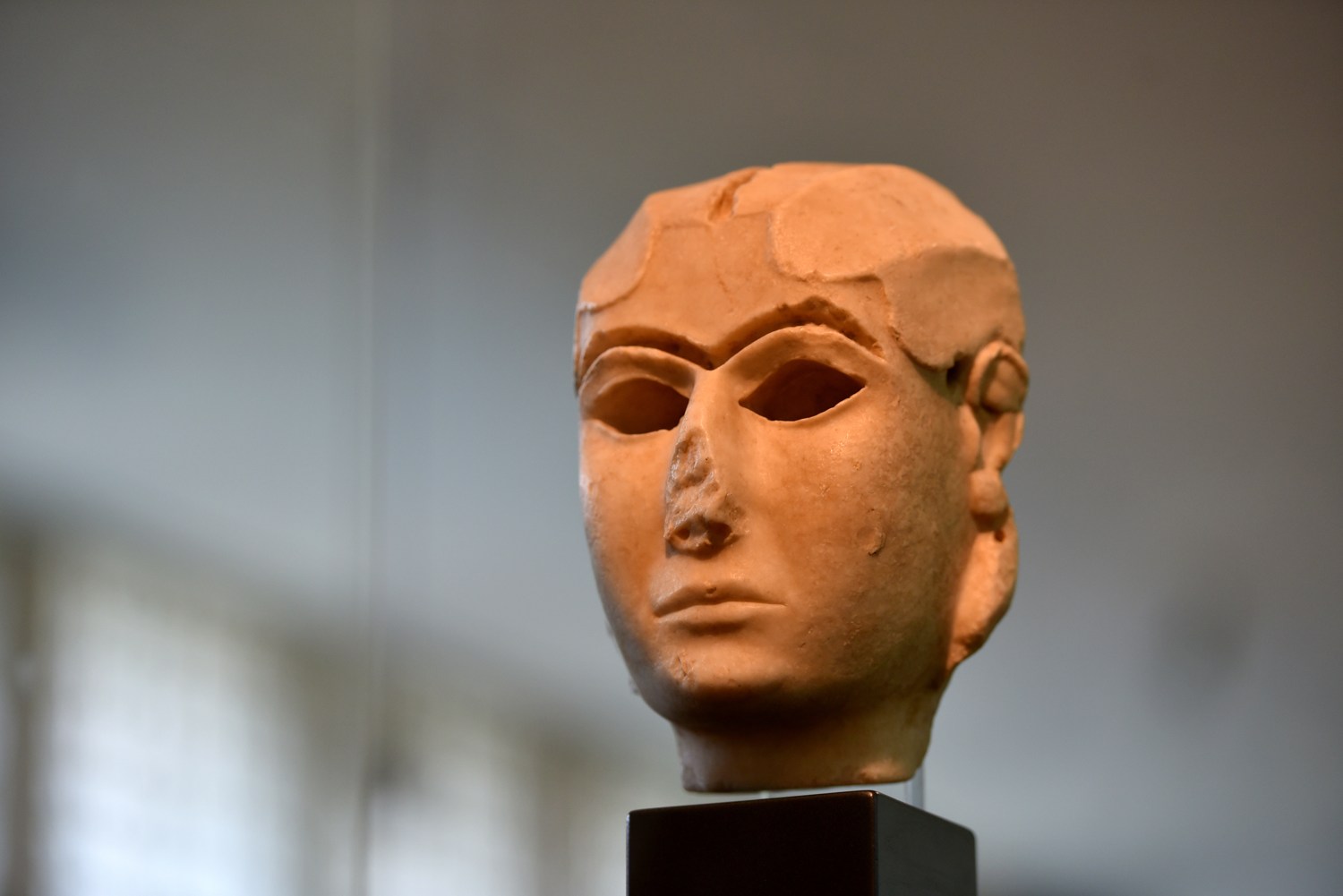
The second object is a female face known as the Warka Head or Warka Mask. Its stone is described as white marble, and its height is about 20–21 cm, approaching the scale of a human head. It belongs to the late fourth millennium or around 3000 BCE; the familiar date “about 3100” is approximate, not a specific year.[2][4]
The head bears museum number IM45434 and excavation number W17878. In her archaeological study, Maya Müller records its discovery in 1939 in a Jemdet Nasr-period debris pit within Eanna. The find context dates deposition, not necessarily carving: an image could remain in use before being discarded. Depositional context and proposed artistic date therefore need to be distinguished.[7] Calling the separated object a “mask” does not establish that a person wore it. What survives is a stone component, while the full body and original display arrangement are not preserved sufficiently to resolve their details.
A composite statue with a lost appearance
The head was probably part of a composite statueComposite statueA statue assembled from separate parts in one or several materials. Evidence from Nippur and the Warka Head explains assembly and the limits of reconstructing missing elements.Glossary · Click to read the explanation assembled from different materials. Eye sockets and eyebrow grooves indicate lost inlays. Cuts and holes also support the suggestion that a separate wig or headdress was attached.[2][4]
The stone ends in a flat surface behind the ears, with a recess at the crown. These are construction traces, not a surviving complete body. In his study of Mesopotamian sculpture, Henri Frankfort suggested that rivet holes near the ears could relate to gold or copper sheets; this is an inference from the traces, not identification of preserved metal. A museum account also considers attachment to a wall. The support or body and the original display arrangement therefore remain open questions.[7][8][10]
The body may have used another material, with additional ornament lending colour and brilliance now missing. Identifying every component specifically as gold, wood or lapis lazuli requires its own evidence. Today’s museum image shows an incomplete ancient appearance; even the warm colour in a photograph can result from lighting without changing the recorded stone description.
Realism is not a ladder from primitive to advanced
The cheeks, mouth and chin display delicate modelling unlike many images emphasizing geometry and lines. This draws attention to an artistic choice responsive to bodily form. It does not turn every earlier work into a failed attempt to portray a face in the same way.[2]
Human images were known millennia before Uruk, including the statues from ‘Ain GhazalAin GhazalNeolithic settlement near Wadi Zarqa and Amman, known for plaster-floored houses, burials and large human sculptures made from lime plaster and reeds. Its pre-pottery and pottery phases are documented; the identities and exact functions of its figures are unknown.Glossary · Click to read the explanation. They need not share this naturalistic style to demonstrate recognition of faces and their expressive possibilities. A community can use abstraction, imitation and symbolism together; skill does not invariably move towards increasing realism.
Is the head Inanna?
Identifying the head as Inanna is common and plausible because of its find context and possible connection with an important ritual image. Yet no surviving inscription names her, and no complete body carries an attribute settling the matter. Proximity to the goddess’s domain does not automatically make every female face an image of her.
An interpretation as a deity or a high-status human figure remains possible, with differing strengths. Treating “Inanna” as an established museum name and then using that name to prove the theory would be circular. “Female head, possibly representing Inanna” keeps description separate from proposed identification.
The clues do not carry equal weight: find context and costly workmanship support an image of special standing more directly than the name Inanna. The LWL museum presentation favours a goddess, whereas Müller’s study establishes construction details without supplying a decisive attribute. We therefore favour the head’s importance as a high-status representation while leaving its divine identity open; an elite woman remains an alternative, not a historical individual established by lifelike features.[7][10]
The head would remain significant if it did not represent the goddess. Creating an image at this scale with multiple materials and inlays indicates investment in visual presence. A human image could participate in ritual relationships or elite representation without itself being the object of worship.
These alternatives are not established identities either. Facial form cannot supply a woman’s name or office. How the image was used and displayed matters alongside resemblance to a living face. Size, materials and context are clues rather than a biography.
Comparing Ubaid figurines
Comparison with small figurinesFigurineA small shaped object depicting a human, animal or abbreviated form, in clay, stone or another medium. Its form alone does not establish its use; manufacture, handling traces and find context matter.Glossary · Click to read the explanation of the Ubaid tradition highlights differences of scale, materials and bodily form. But “Ubaid” embraces diverse sites and contexts. We cannot describe all its figurines as domestic or as equally uncertain in function.
Nor can we draw a sequence in which an enigmatic small being gradually becomes a recognizable naturalistic head. Uruk offers clearer connections between certain signs and Inanna’s domain, together with art associated with urban centres. Continuity of one particular figure from an Ubaid figurine to the Warka Head requires an evidentiary sequence that formal similarity or difference alone cannot provide.
Seals: small images with institutional effects
A cylinder sealCylinder sealSmall engraved cylinder rolled over soft clay to leave an extended image. Used to secure, document and identify administrative actions; its pictures do not automatically constitute writing.Glossary · Click to read the explanation repeats a scene on clay when rolled. Images can therefore travel with closures on containers and doors or with administrative documents. This supplies a practical medium for circulating signs and imagery alongside vessels and sculpture.[5]
The example shown here, Met 1983.314.1, depicts a procession towards a structure the museum interprets as a temple. The impression is modern and reveals the ancient design; it is not an ancient tablet preserved beside the cylinder. This seal names no Inanna. Its comparative value concerns presentation and architectural form rather than the identity of every scene.
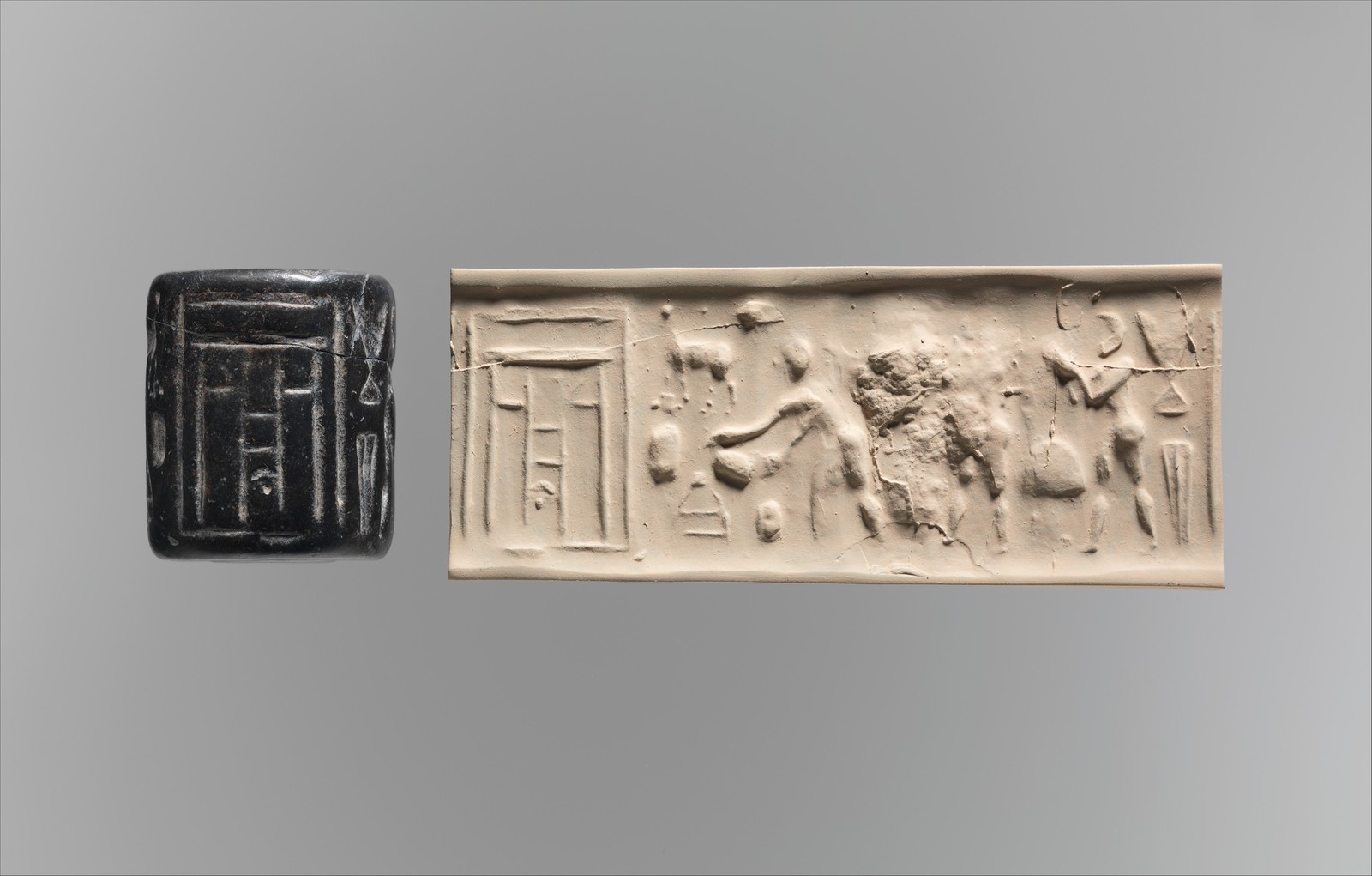
When Inanna’s emblem recurs across media, connections between images become stronger. We can distinguish a religious domain without identifying the woman portrayed within it. Recognizing a symbol differs from identifying the owner of a face.[3]
This proves no universal rule whereby every deity began as a symbol and later acquired a body. It describes what these witnesses allow us to infer. The divine image and its stories may have had older oral histories. Our evidence preserves some means of recognition rather than everything their ancient audience knew.
Inanna, abundance and authority
Water, vegetation, livestock and offerings allow the vase to be read in relation to the city’s prosperity and resources. They cannot reduce Inanna to a “fertility goddess” or extract all her later functions from the carved rows.
Historical traditions assign Inanna wider domains, including love, war and kingship. What the vase more directly shows is a ritual relationship bringing the earth’s resources and human participants into her domain. The difference between this and a comprehensive fertility theology concerns how much we ask an image to establish.
The recurrence of a ruling figure across media allows comparison of dress, standing and actions. Imagery thus does more than organize sacred identity: it makes human authority recognizable without preserving its bearer’s name.[3]
The type may represent an office or an ideal of authority rather than a portrait of one individual. The vase supplies no king list and records no identifiable historical event. Clothing associated with presentation gives us a language of authority while leaving individual history incomplete.
Writing belongs to this same world
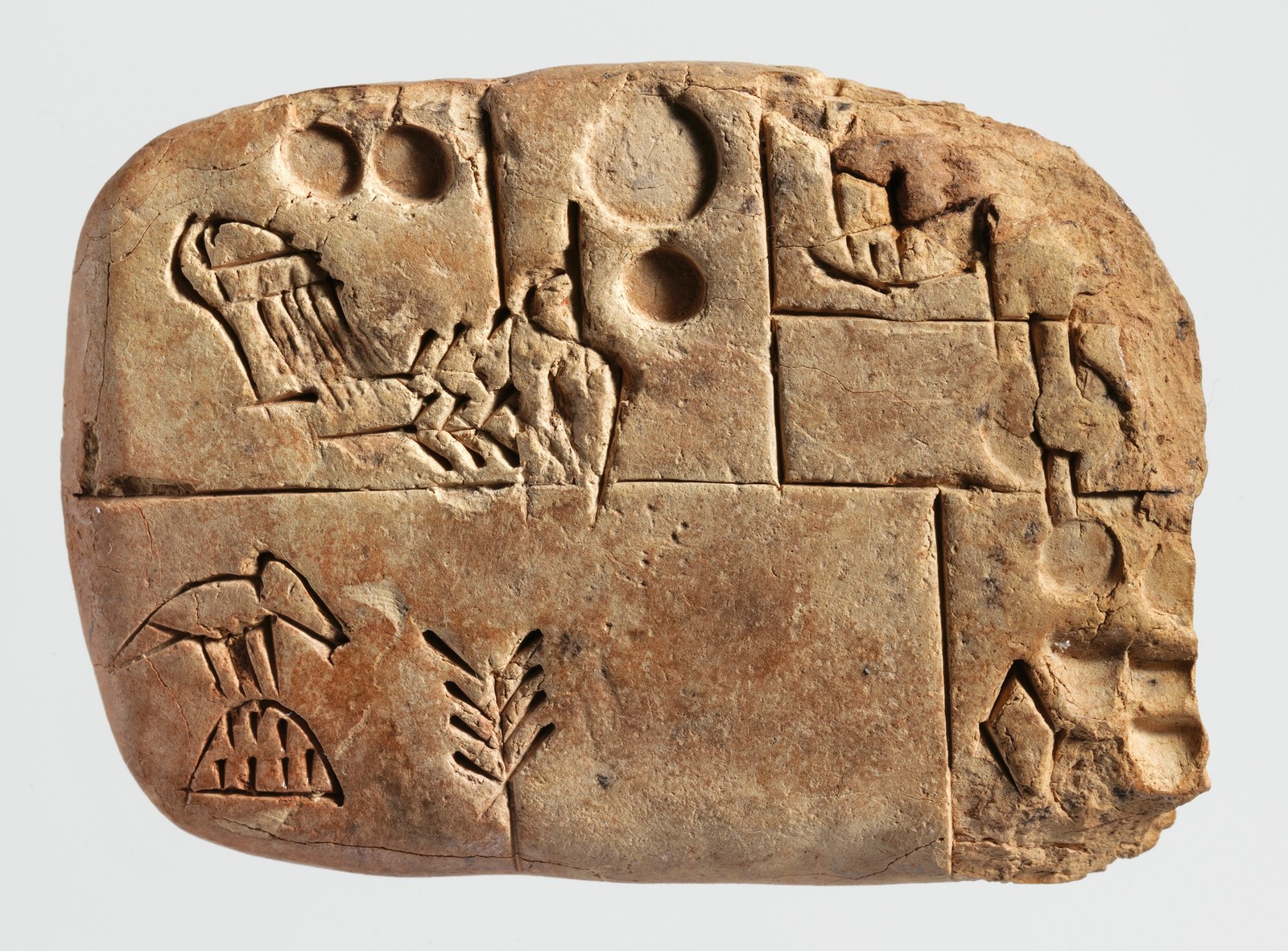
Proto-cuneiform writingProto-cuneiformEarly southern Mesopotamian script (c. 3350–3000 BCE): clay tablets with counting systems and signs for commodities, people and offices, as well as lexical lists; not yet a full rendering of speech.Glossary · Click to read the explanation appeared in the late fourth millennium, the same broad period as the two objects. The story should therefore not end by announcing writing “a little later” as though the vase and head necessarily preceded it. Images and writing remained distinct, overlapping media.[6]
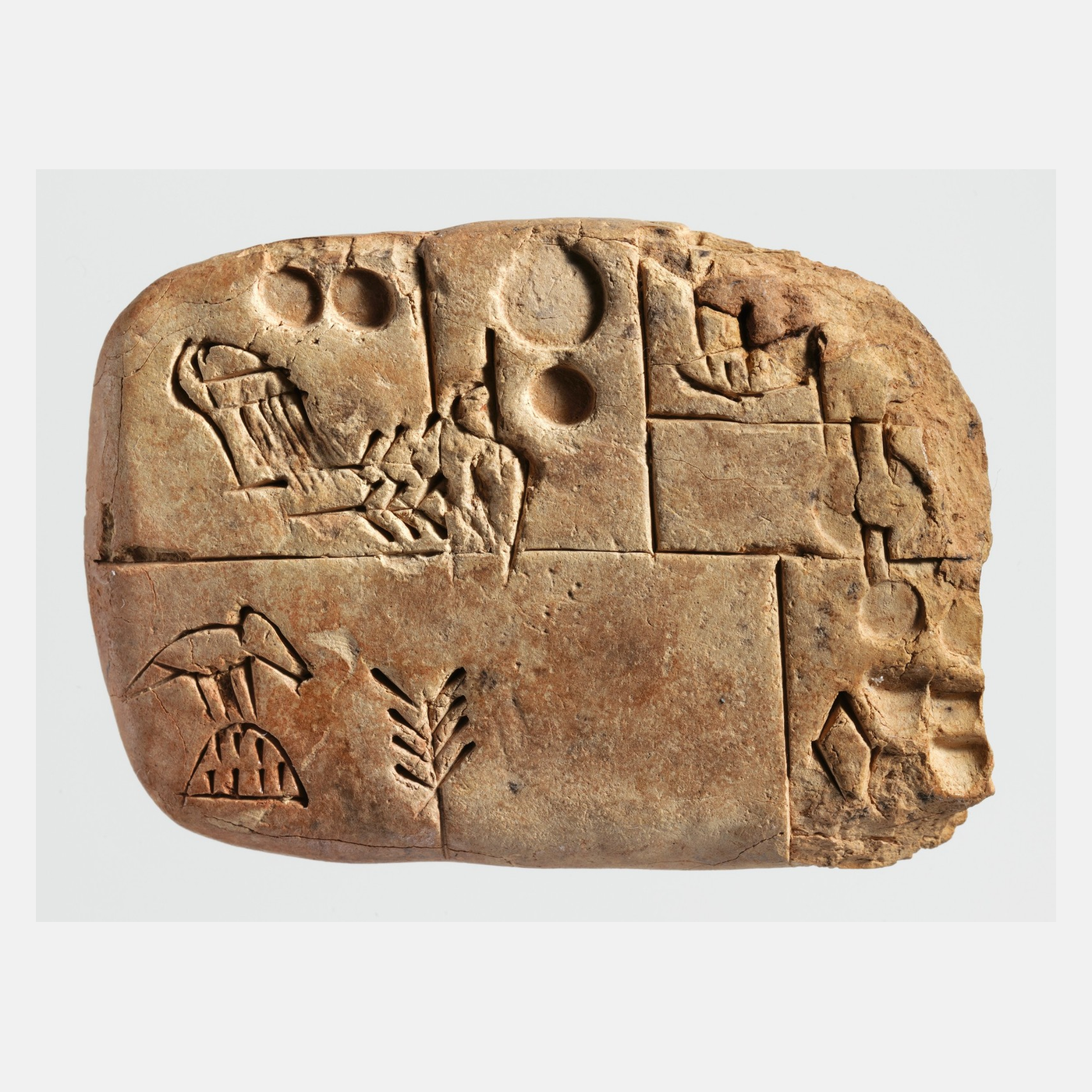
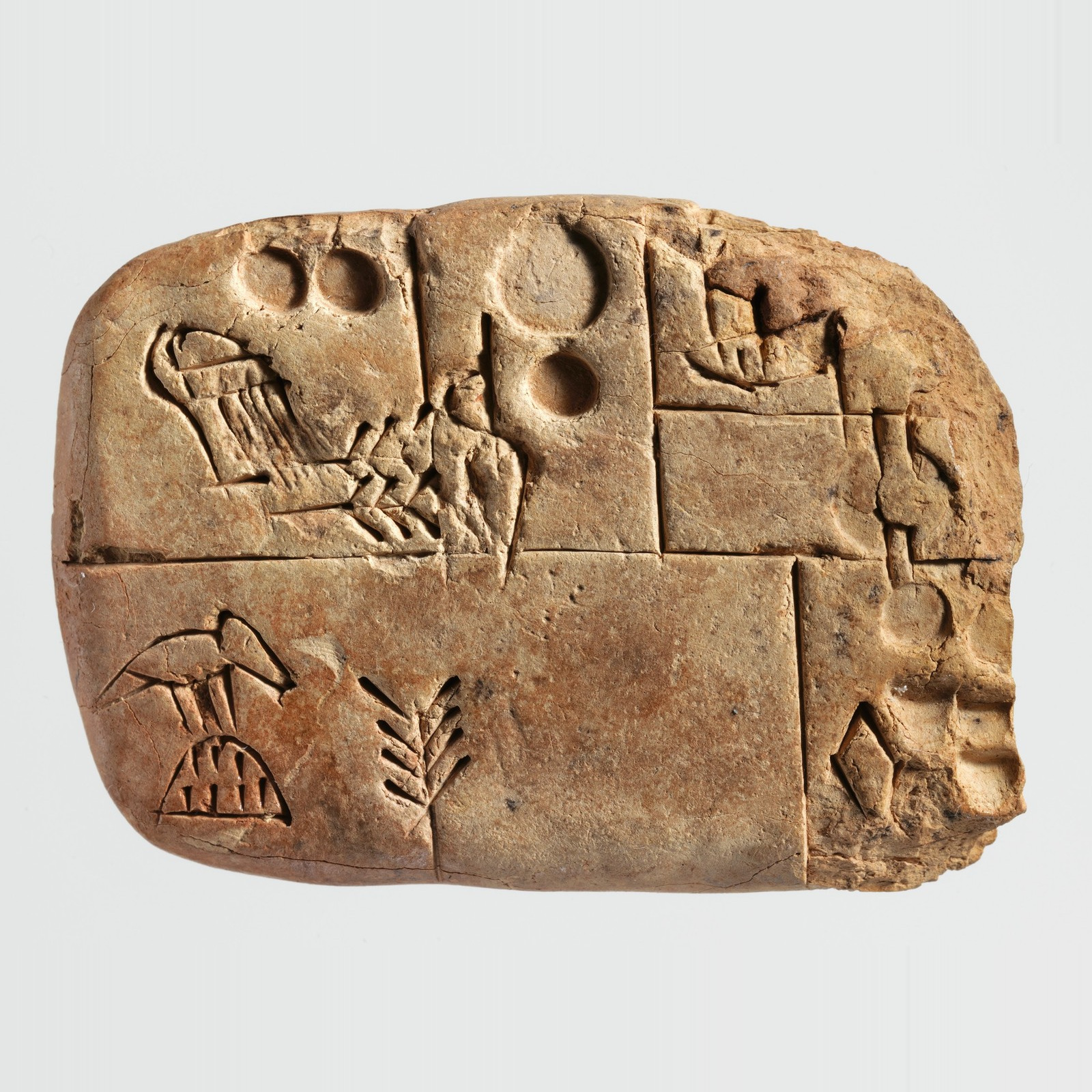
Early texts are largely administrative accounts, not invariably labels below images or explanations of rituals. The illustrated grain tablet exemplifies such recording rather than directly deciphering the vase. Even the “signs” in the vase’s CDLI entry are explicitly reminders of possible correspondences with upper-register images, not an actual cuneiformCuneiformWriting with wedge-shaped signs, developed from Mesopotamian recording traditions and used for several languages from the third millennium BCE.Glossary · Click to read the explanation inscription on the object.[1][6]
Degrees of identification and certainty
Established evidence includes the stone vase with its arranged imagery, the female head with missing inlays, and their association with late Uruk contexts. The looped emblems’ connection with Inanna is strong; interpreting the vase as offerings presented in a sacred domain is strongly supported.[1][2][3][4]
Whether the woman is Inanna or her priestess remains unsettled. Comparative identification of the male as a ruler is probable, but no title is legible on the vase. The head probably belonged to a composite image; identifying it as Inanna is possible, while its precise function and full body remain unknown. Sacred marriage is a comparative possibility rather than a documented event on this vessel.
The sacred had been visible long before Uruk, but some Uruk evidence gives us a stronger ability to recognize its setting. Water, vegetation, animals, people and presentation connect within one visual programme. A female face approaching life size testifies to the presence an image can create.
Neither object closes the distance between sign and person. We know more securely that a domain belongs to Inanna than that a particular face is hers. That distance gives the two witnesses their value: they reveal the sacred entering the language of the city and its institutions, and also what remains beyond our ability to name.
Quick answers
What is the Warka Vase and how old is it?
It is a stone vessel, described as alabaster and 105 cm tall, carved with rows of plants, animals and offering bearers. It is assigned to Uruk III, about 3200–3000 BCE, an approximate range rather than an exact year. [1]
What does the scene on the vase show?
Water and plants, then animals, then nude men carrying vessels and baskets, and at the top a presentation before a woman. This strongly supports reading it as offerings brought to a sacred centre, though nobody is named. [2][3]
Is the woman on the vase the goddess Inanna?
Not certain. The looped emblems behind her strongly link the setting to Inanna, but the woman may be Inanna or a priestess or human representative. Part of her headdress area broke in antiquity. [3]
What is the Warka Head and how was it made?
It is a female face in white marble, about 20–21 cm high, from the late fourth millennium BCE or around 3000 BCE. It was probably part of a statue assembled from different materials, with lost inlays in the eyes and brows. [2][4]
Do the vase and head have an inscription naming who they show?
No. Neither has a surviving inscription identifying its female figure as Inanna, so the identification stays open even though the imagery makes the setting clearer. [1][2][3]
References and notes (11)
- Cuneiform Digital Library Initiative. Warka Vase, P423593; IM019606 / IM19606, W14873. Object entry: Uruk III, 3200–3000 BCE, alabaster, 1050 × 360 mm, museum and excavation identity. The “text” reminds readers of possible sign correspondences in the upper frieze; it is not an inscription on the vessel. Return to the text ↑
- Ann Louise Perkins (1949). The Comparative Archeology of Early Mesopotamia. Studies in Ancient Oriental Civilization 25. University of Chicago. Pp. 135–136: vase, ruler and priestess possibilities; pp. 150–151: marble head, inlays, wig/headdress fastenings and modelling. Return to the text ↑
- Renate Marian van Dijk-Coombes (2018). The Architectural Origin of Mesopotamian Standards in Late Uruk/Jemdet Nasr Period Iconography. Antiguo Oriente 16, 117–146. Pp. 117–126, especially pp. 123–124 and notes 19–20: Inanna’s emblems, priest-king/EN terminology, female identity and ancient damage to the headdress. Return to the text ↑
- Clemens Reichel (2008). Cataloging the Losses: The Oriental Institute’s Iraq Museum Database Project. In G. Emberling & K. Hanson (eds), Catastrophe! The Looting and Destruction of Iraq’s Past, OIMP 28; with D. George & M. Gibson, The Looting of the Iraq Museum Complex. Pp. 22–25: looting and reconstructed vase base; p. 57, Figure 3: head entry; p. 59, Figure 5: four bands and ancient repair. Return to the text ↑
- The Metropolitan Museum of Art. Cylinder seal and modern impression: ritual scene before a temple facade. 1983.314.1. Description and metadata: ca. 3500–3100 BCE; three nude figures, procession and structure interpreted as a temple. Mesopotamian provenance; no deity identified. Modern impression. This case cannot fix the meaning of all nudity or seals. Return to the text ↑
- The Metropolitan Museum of Art. Cuneiform tablet: administrative account concerning the distribution of barley and emmer. 1988.433.2. Description of economic recording, proto-cuneiform and tablet metadata: ca. 3100–2900 BCE, probably Uruk. Does not explain the vase or its figures; late-fourth-millennium writing is a broad context, not an exact date for either sculpture. Return to the text ↑
- Maya Müller, Frühgeschichtlicher Fürst aus dem Iraq, Zürcher Archäologische Hefte 1, 1976. Pp. 18–19; notes 23 and 29 on pp. 29–30: head, deposition versus manufacture, and vase data. Return to the text ↑
- Henri Frankfort, More Sculpture from the Diyala Region, OIP 60, 1943. Pp. 1–2, especially note 4: missing inlays and proposed gold or copper sheets. Return to the text ↑
- Ömür Harmanşah, Performativity of the Uruk Vase: Foregrounded scripts and collective representations, Brown University course commentary, 22 October 2006. Discussion of imagery, collective performance, sacred marriage and Bahrani’s interpretation. Return to the text ↑
- LWL Museum of Archaeology, “5.000 Jahre Megacity,” exhibition release, 31 October 2013. Paragraph on the Lady of Warka: possible goddess and proposed temple-wall attachment. Return to the text ↑
- Naomi F. Miller, Philip Jones and Holly Pittman, “Sign and Image: Representations of Plants on the Warka Vase of Early Mesopotamia,” Origini 39 (2016), pp. 53–73. Pp. 57–61, 63–65, 69: plant identification through leaves, signs and images, and limits of inference about ritual; these passages read, not the whole paper. Return to the text ↑
Suggest a correction · Suggest a source for this record
Cite this record
IL Archive, «The Warka Vase and Head: When the Sacred Became Recognizable», https://ilarchive.com/en/studies/warka-vase-and-head
Continue reading