Entity · Concept
Pictorial register
A reference page linking a name, group, or concept to the materials that discuss it.
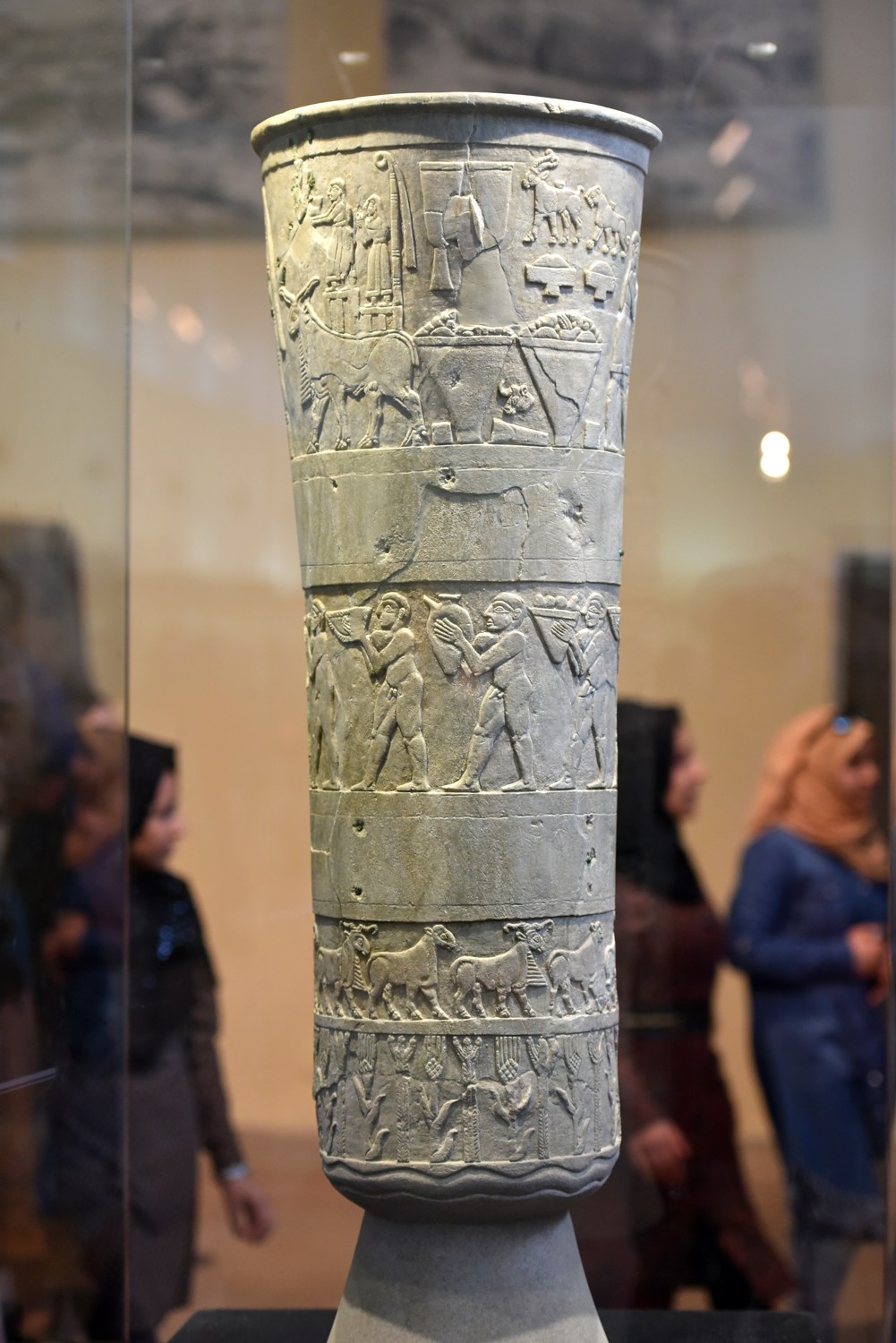
A visual band or field grouping imagery within an ancient composition. The Warka Vase illustrates why three broad registers or four carved rows may be counted—and why interpretation exceeds what survives.
Estimated reading time: 6 min Published Last reviewed:
Share article
Text
Introduction
How did ancient artists organize people, animals, and plants within a limited pictorial space? A “pictorial register” names a way of dividing a composition into visible bands or fields. This entry uses the WarkaUrukAncient city at Warka in southern Iraq, a major urban centre around 3200 BCE that preserved early writing and accounting tablets.Glossary · Click to read the explanation Vase, preserved in the IraqIraqIraq is a modern country encompassing much of ancient MesopotamiaGlossary · Click to read the explanation Museum, to distinguish observable carving from hypotheses about the depicted ritualRitualAn organised or distinguished practice meaningful to a community; it may leave traces, but its form alone does not reveal an associated doctrine.Glossary · Click to read the explanation and society.
What is a pictorial register?
A pictorial register is an organized zone within an artwork in which forms or actions are grouped together. It is usually horizontal; carved rules or undecorated spaces may set it apart from neighbouring zones. Registers can run across a wall, a slab, or the curved surface of a vessel. The word here refers to visual organization, not to a written administrative register or the name of an independent artistic school.
Repeated figures, their orientation, scale, and spacing help the viewer perceive relationships within and between bands. Yet moving upwards through the image does not by itself prove that the bands represent successive moments or a fixed map of the cosmos. Those interpretations must be tested against the imagery, archaeological setting, and related works.
The Warka Vase: object and context
The Warka Vase is a tall carved stone vessel, about one metre high, dated broadly to the late fourth millennium BCE. It was excavated around 1934 from the EannaEanna at UrukAn archaeological precinct and institutional centre at Uruk associated with Inanna; its name does not fix every early building’s function.Glossary · Click to read the explanation precinct at UrukUrukAncient city at Warka in southern Iraq, a major urban centre around 3200 BCE that preserved early writing and accounting tablets.Glossary · Click to read the explanation, the ancient city at modern Warka in southern Iraq. The precinct is historically associated with InannaInanna / IshtarA prominent Mesopotamian goddess whose Sumerian name Inanna became associated with Akkadian Ishtar across diverse traditions. She was associated with desire, war, royal authority and Venus, while local forms and genealogies varied among texts.Glossary · Click to read the explanation, a major Mesopotamian goddess, although findspot alone does not identify every action in the relief as a documented cult ceremony.[3]
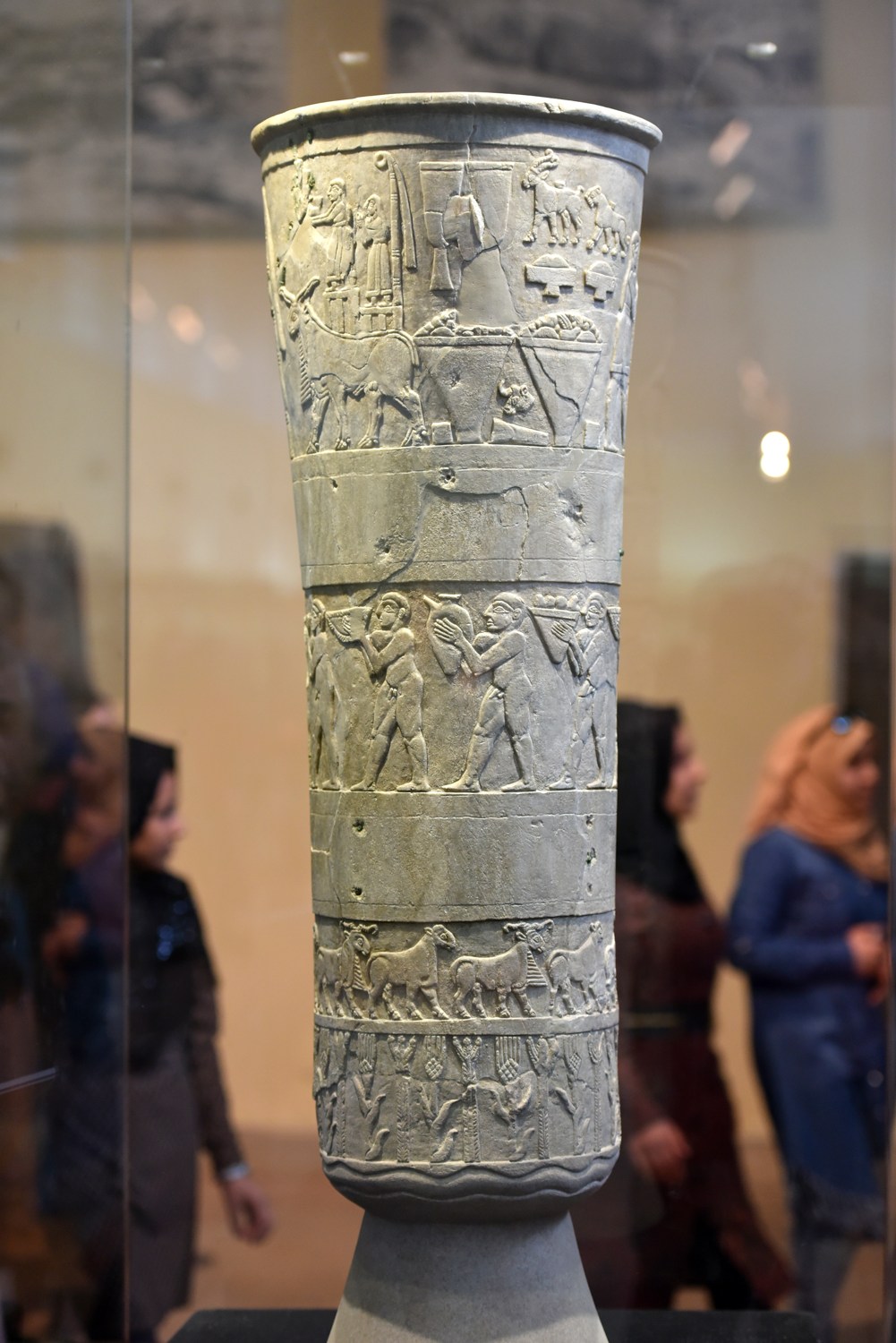
The decorated surface curves around the vessel: a single frontal photograph cannot show every figure at once. Parts of the object were damaged and repaired, both in antiquity and much later. The original carved remains must therefore be distinguished from drawings that supply lost parts by reconstruction.
Three registers or four bands?
Archaeologist Ann Louise Perkins describes three principal registers, dividing the lowest into two sections, with vegetation below and animals above. Clemens Reichel, by contrast, describes four bands of relief decoration. This is a difference in grouping and descriptive scale, not evidence of an otherwise unknown additional scene. Counting a combined lower unit produces a different total from counting each decorated row separately.[1][2]
Undecorated strips also separate parts of the design. Observing divisions, figure alignment, and directions is more precise than imposing a single universal count. When describing a particular object, it is therefore useful to specify whether “registers” means all carved bands or broader visual units.
Water and plants: a revised identification
At the bottom, two wavy lines are conventionally read as water, above which two alternating plant forms appear. A widespread art-historical reading calls them grain and reeds or related plants. In 2016, Naomi F. Miller, Philip Jones, and Holly Pittman compared the carved motifs with botanical morphology, early signs, and other images. They argued that the form previously read as an ear of grain is better identified as a date-palm offshoot, and that its companion represents flax. This is a published, evidenced identification, rather than a definitive botanical label established by the stone alone.[4]
The distinction matters: the visible evidence consists of particular carved forms, while naming the plants involves botanical and iconographic inference. Changing the proposed species alters how resources and abundance might be interpreted, without changing the position of the images on the vase.
Animals and human procession
A band above the plants contains a rhythmic row of ruminants, generally identified as sheep, although earlier descriptions make some different distinctions. Higher up, nude male figures carry vessels, baskets, or containers that are commonly interpreted as offerings or transported produce. Their repetition and coordinated movement are visible; the exact contents of every vessel and the social status of every bearer are matters of interpretation.[1][3]
These bands illustrate how the register works: the repetition of forms in separate zones can create a relationship between resources and their movement. An economic or ritual visual programme is not thereby transformed into an administrative document. Nor does it reveal the participants' personal names or a precise date of performance.
The upper band and Inanna's emblems
The uppermost band is more complex, showing gifts, vessels, and figures rendered at different scales. A female figure stands near reed-bundle standards commonly associated with Inanna. Comparisons with contemporary seals support the suggestion that the largely broken figure of a prominent man represented authority or a priestly role. But much of the figure is missing, and the identity of the woman remains open: goddess, ritual representative, or another symbolic presence are possibilities rather than secure labels.[3]
A common interpretation treats the procession as the delivery of abundance to Inanna, or as part of a rite with political implications. This reading relates water, vegetation, livestock, people, and ceremonial focus; it is not a translation of an ancient written caption. Vessels represented within the scene may even recall the object that carries the scene, suggesting a relationship between its making, use, and imagery.
Does this sequence tell a story?
The composition might be read as an ascent from resources to gifts and their recipient, a visual hierarchy of rank, or a ritual arrangement whose elements did not all happen at the same instant. Miller and colleagues offer an ecological and political interpretation of the lowest motifs and their relationship to the whole, while leaving aspects of the ritual unresolved.[4]
The sound procedure is to describe what survives first, compare relevant parallels second, and attribute more ambitious reconstructions to their proponents. Alignment, directional movement, and emblems are evidence. Naming a particular king, specifying a single “sacred marriage” ceremony, or asserting a fixed cosmology demands additional support.
Comparisons and conceptual limits
The vase is not the only carved object from the world of Uruk. The British Museum holds a limestone trough from Warka, approximately dated to 3300–3000 BCE, in which sheep approach a reed hut while lambs emerge from it. This continuous frieze relates animals, architecture, and religious emblems, but it need not be divided into registers like those of the vase. The museum presents its possible connection with Inanna as an interpretation rather than an established function.[5]
Reliefs on vessels, repeating designs on cylinder sealsCylinder sealSmall engraved cylinder rolled over soft clay to leave an extended image. Used to secure, document and identify administrative actions; its pictures do not automatically constitute writing.Glossary · Click to read the explanation, and the earliest written signs may share visual conventions. Resemblance, however, does not make every picture a readable text or every register an encoded sentence.
Preservation and the photograph
The Warka Vase was looted and broken during the assault on the Iraq Museum in 2003 and was subsequently returned. A University of Chicago publication documents damage to the vessel's reconstructed display base, alongside older repairs to its carved upper part. A current museum photograph therefore records an ancient artefact with a history of repair and display, not its untouched state at excavation.[2][7]
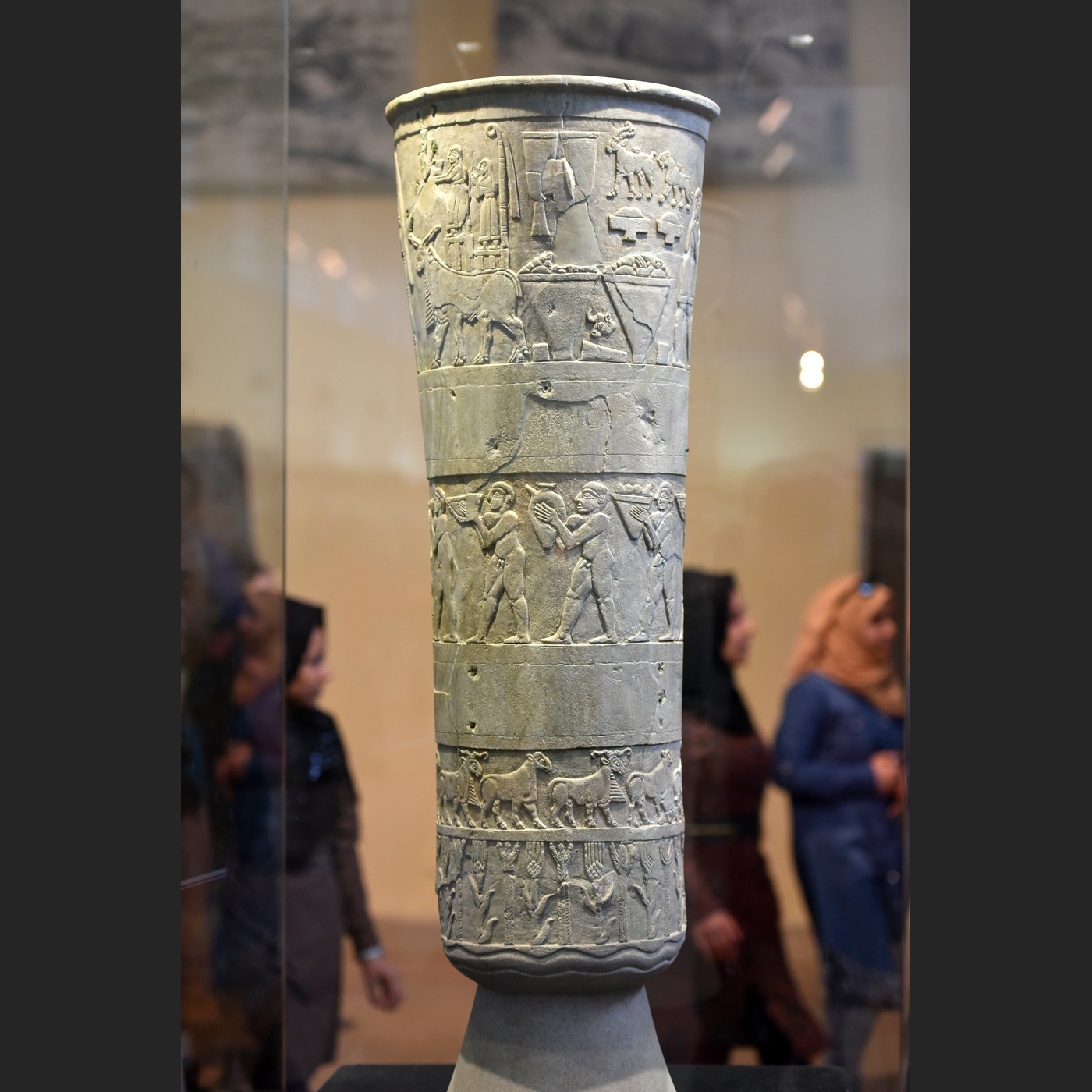
The image accompanying this entry was taken by Osama Shukir Muhammed Amin in the Iraq Museum in 2019 and released under CC BY-SA 4.0. It shows actual surviving reliefs without drawing in missing figures. The square cover merely reframes the same photograph without reconstructing the carving. The concept of a pictorial register is most useful when the viewer can keep the difference between what is visible and what is inferred in view.[6]
References and notes (7)
- Ann Louise Perkins, The Comparative Archeology of Early Mesopotamia, Chicago, Oriental Institute, SAOC 25 (1949). Printed pp. 135–136, vessel description, “three registers” and its two-part lower zone; extracted text of this passage, not the whole book. Return to the text ↑
- Clemens Reichel, “Cataloging the Losses: The Oriental Institute’s Iraq Museum Database Project,” in Geoff Emberling and Katharyn Hanson (eds.), Catastrophe! The Looting and Destruction of Iraq’s Past, OIMP 28 (2008). Printed pp. 58–60: four decorated bands and p. 59, fig. 5, restored vase and ancient repair; selected PDF text, not the full volume. Return to the text ↑
- Senta German, “Warka Vase,” Smarthistory (28 September 2017), account of the relief bands and qualified reconstructions of the upper scene. “Picturing the ruler” and the passages on the top and bottom bands, date and medium; web essay, without printed pagination. Return to the text ↑
- Naomi F. Miller, Philip Jones and Holly Pittman, “Sign and Image: Representations of Plants on the Warka Vase of Early Mesopotamia,” Origini 39 (2016), pp. 53–73. Selected reading: abstract/introduction p. 53, lower register and fig. 2 p. 57, comparative discussion pp. 58–59, conclusion p. 69; rendered PDF pages 53, 57 and 69 inspected; not the whole paper. Return to the text ↑
- British Museum, collection record, “The Uruk Trough,” registration 1928,0714.1; museum number 120000. Object description, 3300–3000 BCE date, provenance and qualified interpretation; online collection record only. Return to the text ↑
- Wikimedia Commons, file “Warka Vase, Iraq Museum.jpg,” photograph by Osama Shukir Muhammed Amin, taken 14 March 2019, CC BY-SA 4.0. Specific file page: photographer, capture date, original dimensions and licence; square cover reframed from the same image, without redrawing; file metadata/licensing page read. Return to the text ↑
- Donny George and McGuire Gibson, “The Looting of the Iraq Museum Complex,” in Geoff Emberling and Katharyn Hanson (eds.), Catastrophe! The Looting and Destruction of Iraq’s Past, OIMP 28 (2008). Printed pp. 22–26, especially figures 4a–b on the reconstructed display base and the passage on the vase’s return; selected passages only. Return to the text ↑
Suggest a correction · Suggest a source for this record
Cite this record
IL Archive, «Pictorial register», https://ilarchive.com/en/entities/pictorial-register
Continue reading