Artifact · Inscription
The Victory Stele of Naram-Sin (Louvre SB 4)
An object record bringing together its image, metadata, rights, and context.
- Timeline
- From 2254 BCE to 2218 BCE
- Region
- Mesopotamia
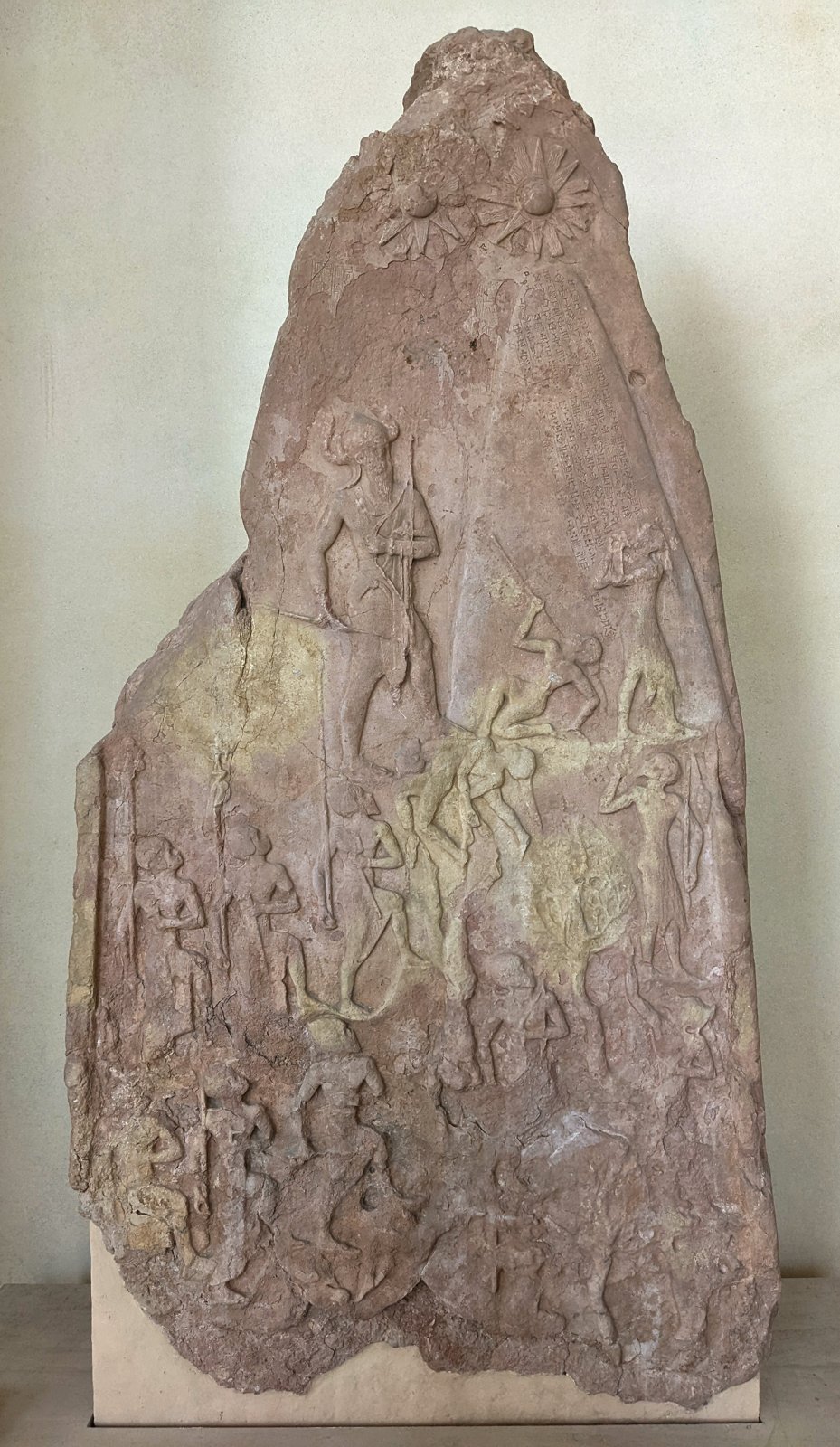
On a two-metre limestone stele, the king of Akkad climbs a mountain above his soldiers. A damaged Akkadian text names the people of Lullubum. A later Elamite inscription records how the stone was taken from Sippar to Elam.
Estimated reading time: 4 min Published Last reviewed:
Share article
Photograph
Photograph by Shonagon, via Wikimedia Commons, CC0 1.0.
Victory Stele of Naram-Sin, Louvre SB 4. The king stands above his soldiers on the slope. The later Elamite inscription is cut into the mountain
License · Image sourceObject details
- Title
- The Victory Stele of Naram-Sin (Louvre SB 4)
- Timeline
- From 2254 BCE to 2218 BCE
- Region
- Mesopotamia
- Rights
- CC0
Text
Introduction
The Victory Stele of Naram-Sin is a limestone monument in the Louvre, inventory SB 4. Its relief places the king of Akkad on a mountain slope, above his soldiers and the people they have defeated. The Louvre dates it to about 2250 BCE, during Naram-Sin’s reign. Two inscriptions give the stone two historical settings. The broken AkkadianAkkadianAn ancient East Semitic language written in cuneiform from the third millennium BCE; its varieties include Babylonian and Assyrian, and it served in international diplomacy.Glossary · Click to read the explanation text belongs to the victory monument. The Elamite text, added centuries later, records its removal from Sippar. [1][2]
An army climbing a mountain
The surviving stele is 200 cm high, 105 cm wide and 27 cm thick. The Louvre describes the stone as pink and beige limestone carved in low relief. Naram-Sin, larger than the other figures, carries a bow and stands higher on the slope. His soldiers climb behind him. Across the face of the stone, men fall or raise their hands. Trees mark the terrain, and radiating discs appear above the king. The mountain gives these figures a shared setting and sets the direction in which the eye follows the ascent. [1][3]
Barbara Couturaud draws attention to differences among the advancing soldiers. Their equipment and clothing vary, and some wear beards. She compares them with the repeated rows of soldiers on the earlier Stele of the Vultures. For Couturaud, the variety of figures and their placement in a continuous landscape help turn familiar images of victory into the story of a particular encounter. The surviving relief tells that story from the Akkadian king’s side. [1][3]
What the Akkadian signs preserve
The remains of the AkkadianAkkadianAn ancient East Semitic language written in cuneiform from the third millennium BCE; its varieties include Babylonian and Assyrian, and it served in international diplomacy.Glossary · Click to read the explanation inscription lie above the king. In the edition prepared from Douglas Frayne’s work, the opening names Naram-Sin and calls him mighty. After a break, the text preserves part of a name read as Sidur-[…], alongside words about the mountain people of Lullubum assembling. Lullubum was in the Zagros region. Couturaud identifies the opposing ruler as Satuni. The reading in Frayne’s edition leaves the fragmentary name unresolved, so the identification of the rival ruler is less secure than the identification of Lullubum. Near the end, a dedication survives in part. The Louvre suggests that the deity receiving it may have been ShamashShamashMesopotamian god of the sun and justice, shown before Hammurabi on an eighteenth-century BCE stele preserved in the Louvre.Glossary · Click to read the explanation. [1][2][3]
The sign before Naram-Sin’s name is a divine determinativeThe divine determinative in cuneiformA cuneiform sign used mostly before a divine name to classify it without being spoken independently; shown as raised d or {d} in transliteration. Usage depends on language and context.Glossary · Click to read the explanation, a cuneiformCuneiformWriting with wedge-shaped signs, developed from Mesopotamian recording traditions and used for several languages from the third millennium BCE.Glossary · Click to read the explanation sign that marks a divine name. The king also wears a horned headpiece, a feature associated with deities in Mesopotamian art. Talah Anderson discusses how the writing and the figure both express his divine status. A separate inscription from Bassetki gives another form of the claim. It says that the inhabitants of Akkad asked the gods to make Naram-Sin the god of their city and built him a temple there. The Bassetki inscription recounts that decision in connection with a series of victories. [2][4][5]
From Sippar to Susa
The later inscription occupies part of the carved mountain. Written in Middle Elamite, it names Shutruk-Nahhunte as king of Anshan and Susa and credits his god Inshushinak with helping him conquer Sippar. Shutruk-Nahhunte says he took the stele of Naram-Sin, sent it to Elam and set it before Inshushinak. His account makes the object itself a spoil of conquest and gives its movement a religious purpose. The text supplies Sippar as the place from which he took it. The Louvre dates the transfer to the twelfth century BCE. [1][2]
The Louvre records the discovery on 6 April 1898, on the acropolis of SusaSusa, ancient ShushSusa is an archaeological city at Shush in southwestern present-day IranGlossary · Click to read the explanation, by the French mission led by Jacques de Morgan. The findspot is the archaeological trace of the later part of the stele’s journey. The two inscriptions each tell of a victory, and the second one describes what happened to the very stone that bore the first. [1][2]
Quick answers
What is the Victory Stele of Naram-Sin?
It is a limestone relief commemorating the Akkadian king’s victory over the people of Lullubum. The Louvre dates it to about 2250 BCE. [1][2]
Why does Naram-Sin wear horns?
The horned headpiece draws on a visual convention for deities. A sign marking a divine name also precedes his name in the Akkadian inscription. [2][4]
Why are there two inscriptions on the stele?
The damaged Akkadian inscription belongs to Naram-Sin’s victory monument. Shutruk-Nahhunte’s later Elamite inscription records taking the stele from Sippar and setting it before Inshushinak. [1][2]
Where was the stele found, and where is it now?
It was found at Susa in 1898 and is held in the Louvre as SB 4. [1]
References and notes
- Musée du Louvre, “Stèle de Naram-Sin,” SB 4 / AS 6065 Description, Inscriptions, Physical characteristics, Places and dates, and History. Relief, catalogued dimensions and approximate date, acquisition from the Susa excavations. Return to the text ↑
- Cuneiform Digital Library Initiative, SB 4 witness P215544 and composite P462029, based on Douglas Frayne, Sargonic and Gutian Periods (2334–2113 BC), RIME 2, University of Toronto Press, 1993, E2.1.4.31 Witness P215544, Akkadian columns 1–3 and added Elamite inscription, especially lines 3 and 5–7. Composite P462029, Akkadian reading and translation of lines 1–2 and 3′–16′. Return to the text ↑
- Barbara Couturaud, “Soldiers and Prisoners in Motion in Mesopotamian Iconography during the Early Bronze Age,” Arts 13, no. 4 (2024), article 132 Section 5 and figure 15. Individual features of soldiers, landscape, the account of the combat and the identification of the opposing ruler as Satuni. Return to the text ↑
- Talah Anderson, Divine Kinship at the Sargonid Royal Court, doctoral thesis, University of Oxford, 2026 Introduction, pp. 4–5 and notes 7–12. The divine determinative and the horned headpiece on the Naram-Sin stele. Return to the text ↑
- Cuneiform Digital Library Initiative, Bassetki statue inscription, witness P216558 and composite P461986, based on Douglas Frayne, RIME 2, 1993, E2.1.4.10 Composite Q005210, lines 1–56, especially 13–23 and 24–56. Victories, petition to make Naram-Sin the god of his city and building of a temple. Return to the text ↑
Archive records may be reviewed and refined as better evidence or sources become available. Suggest a correction
Suggest a correction · Suggest a source for this record
Cite this record
IL Archive, «The Victory Stele of Naram-Sin (Louvre SB 4)», https://ilarchive.com/en/artifacts/naram-sin-victory-stele-sb4
Continue reading