Artifact
The Victory Stele of Esarhaddon from Zincirli (VA 2708)
An object record bringing together its image, metadata, rights, and context.
- Timeline
- From 671 BCE to 669 BCE
- Region
- Anatolia and the eastern Mediterranean
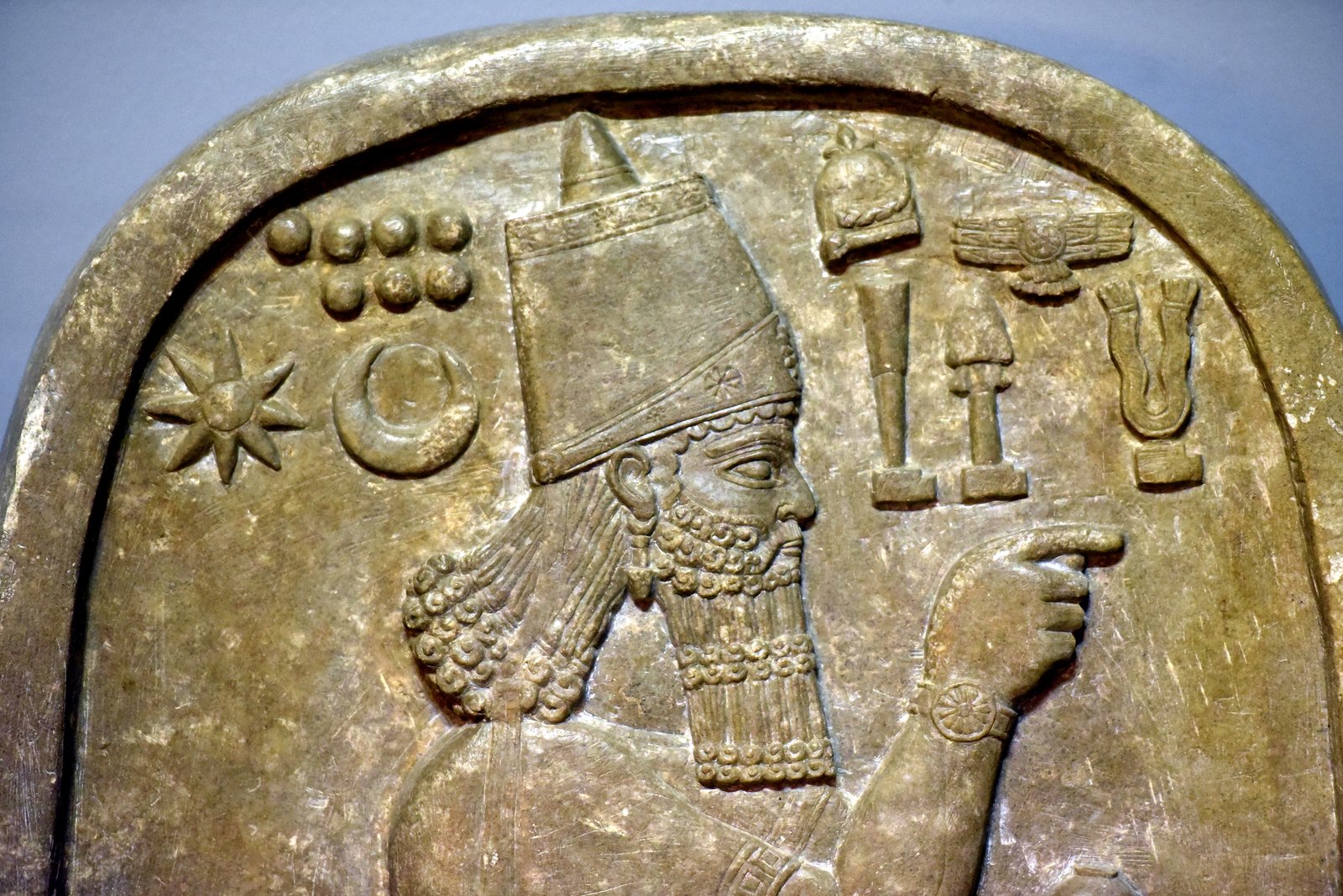
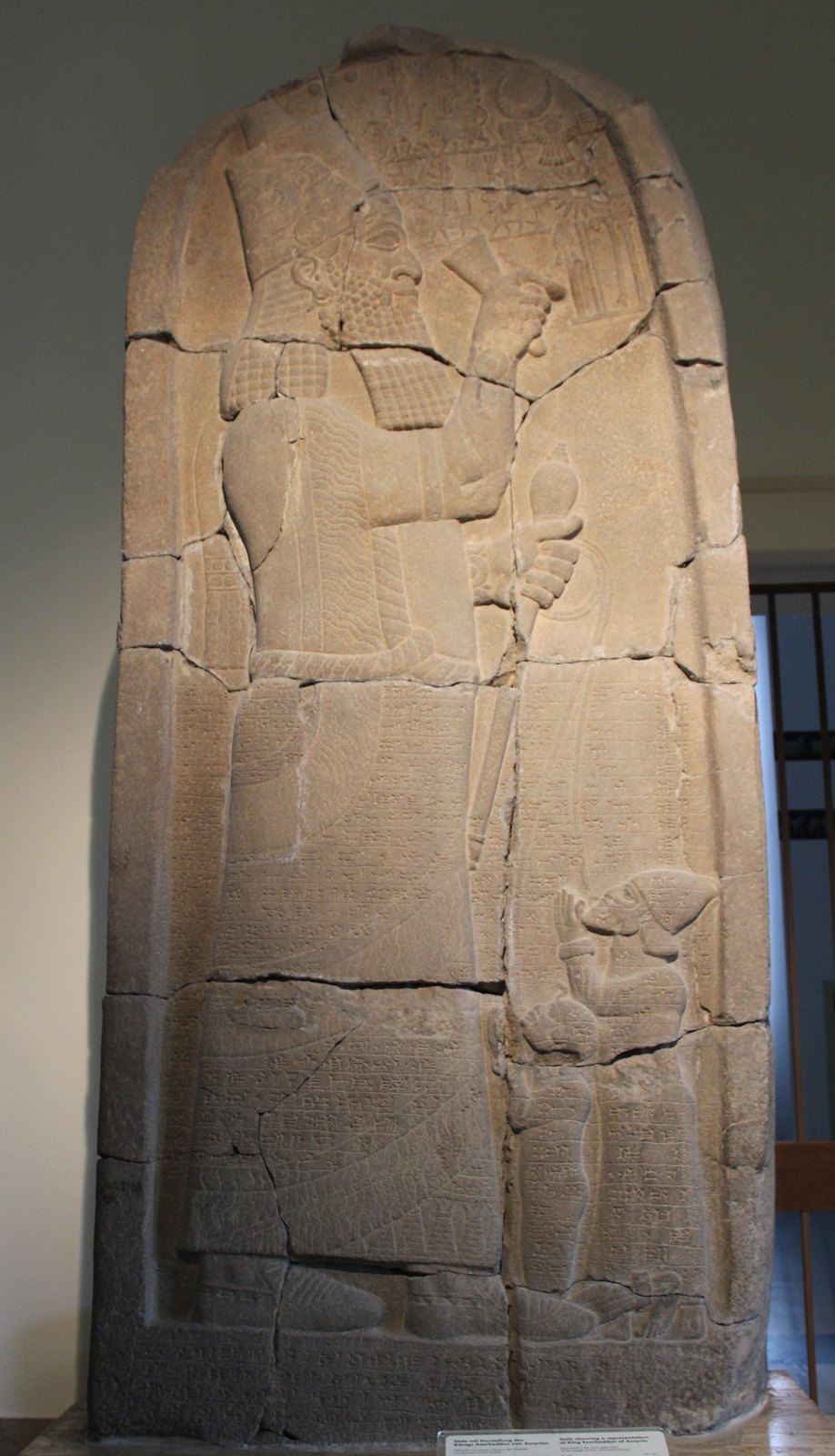
An Assyrian king towers over two captives on a basalt stele from Zincirli. Seven dots appear above his crown, and the inscription names the Seven among the gods who support him. The text recounts the capture of Memphis.
Estimated reading time: 5 min Published Last reviewed:
Share article
Photograph
Gary Todd, Wikimedia Commons. CC0 1.0. Cropped and resized for this entry.
Front of the basalt victory stele from Zincirli, Vorderasiatisches Museum, Berlin, VA 2708. Esarhaddon raises his hand toward divine emblems. The two captives appear lower on the same face
License · Image sourceObject details
- Title
- The Victory Stele of Esarhaddon from Zincirli (VA 2708)
- Timeline
- From 671 BCE to 669 BCE
- Region
- Anatolia and the eastern Mediterranean
- Rights
- CC0
Text
Introduction
Above the crown of EsarhaddonEsarhaddon, king of AssyriaSennacherib’s son and successor, Assyrian king in 680–669 BCE, named in Ahiqar and Tobit.Glossary · Click to read the explanation, seven small circles occupy a corner of the relief on the stele from Zincirli. The inscription names the Seven among the gods to whom the king credits his success. Farther down the stone, two captives face the king. The same monument records the Assyrian campaign in Egypt in 671 BCE, including the capture of Memphis and the deportation of members of Taharqa’s household. [1][2][4]
A monument in the citadel gate
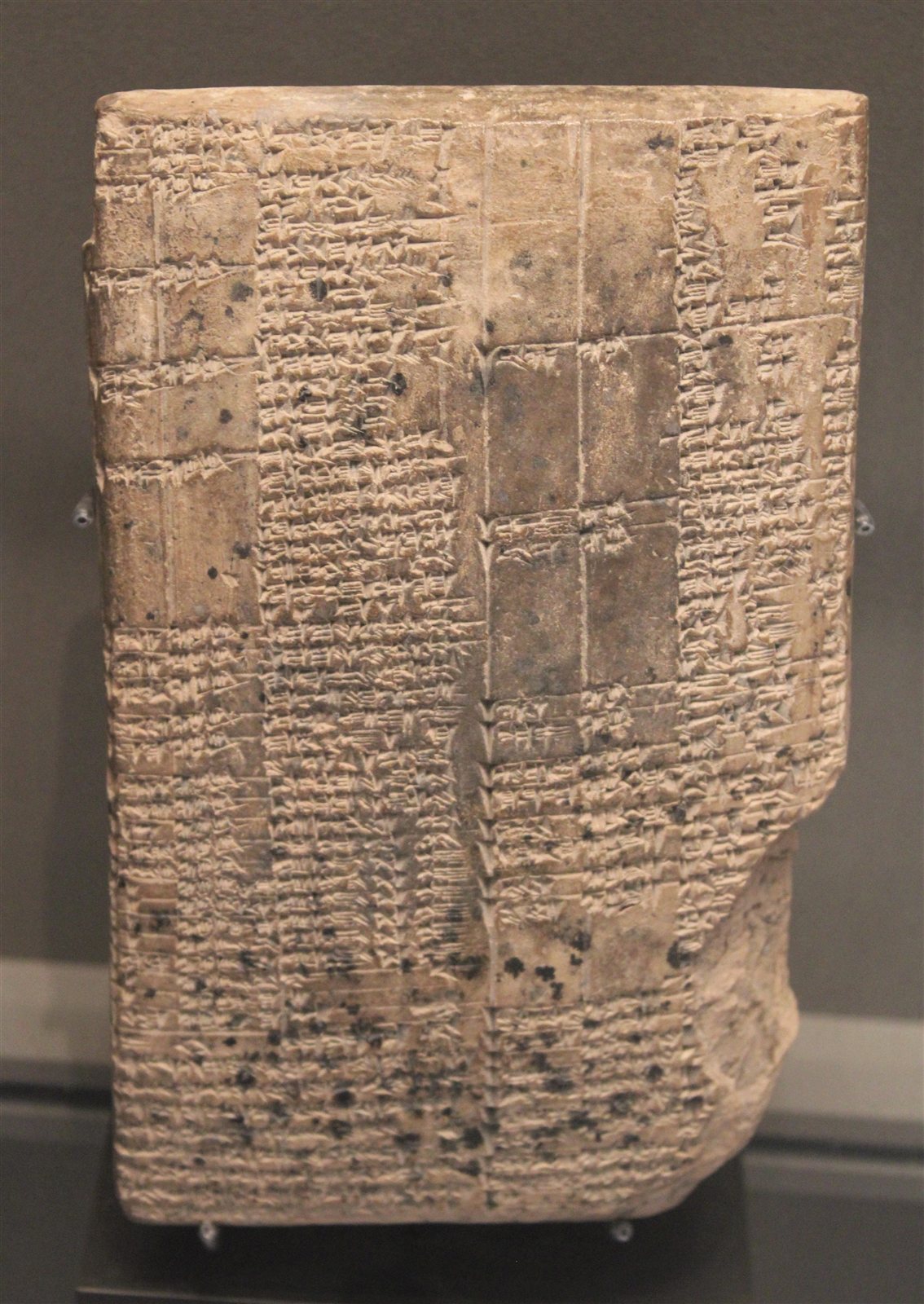
The Vorderasiatisches Museum in Berlin catalogues the stele as VA 02708. The museum records a height of 322 cm, a width of 135 cm, a depth of 62 cm and a weight of 6,146 kg. Its catalogue calls the stone basalt. In the excavation report, Felix von Luschan calls it dolerite and gives the full height as 346 cm when the projecting foot that fitted into the base is included. The findspot is ancient Sam’al, now Zincirli in southeastern TürkiyeTurkeyTurkey is a modern country including Anatolia and territory in southeastern EuropeGlossary · Click to read the explanation. Von Luschan places the base against the west wall of the courtyard in the outer citadel gate. A person passing through the gate could encounter the relief and its accompanying inscription, which starts on the front and continues on the back. The text is in AkkadianAkkadianAn ancient East Semitic language written in cuneiform from the third millennium BCE; its varieties include Babylonian and Assyrian, and it served in international diplomacy.Glossary · Click to read the explanation, written in cuneiformCuneiformWriting with wedge-shaped signs, developed from Mesopotamian recording traditions and used for several languages from the third millennium BCE.Glossary · Click to read the explanation. The digital edition dates it to about 671–669 BCE. The Chicago-Tübingen expedition places the stele in 670 BCE and identifies the citadel gate as its probable original setting. [1][2][7][10]
The Berlin catalogue dates the discovery to 1888 and links the survival of the relief and inscription to a fire that probably destroyed the princely residence in the seventh century BCE. Von Luschan records six large fragments and several smaller ones lying face down in the courtyard amid mudbrick debris. Oğuz Satır and Ali Çifçi report that Carl Humann sent a letter and a reconstruction drawing to Osman Hamdi Bey, director of the Ottoman Imperial Museum. They trace the agreement under which the stele was allotted to Berlin. The Prussian Cultural Heritage Foundation dates the division of finds to 1889. The reassembled stele stood in the Pergamonmuseum from 1930 to 2023. Conservators separated it along the original breaks in 2023 for transport. [1][6][9][10]
The king and the captives
The relief gives Esarhaddon most of the front face. He faces right, raising one hand toward the emblems. He holds royal insignia and the lines attached to the two captives, who are represented at a much smaller scale. In the published drawings, one is upright and the other kneels close to the king’s feet. Each narrow side bears a standing male figure. The Berlin catalogue identifies these as the king’s sons AshurbanipalAshurbanipalAshurbanipal was an Assyrian king of the seventh century BCE, reigning about 668–631 BCEGlossary · Click to read the explanation and Shamash-shuma-ukin, the heirs to Assyria and Babylonia respectively. The drawing published by Frame shows that the two side figures stand on a higher ground line than the figures on the front. [1][3][5][6][8]
The inscription names Taharqa as king of Egypt and Kush. It also names his crown prince Uš-Anaḫuru among those taken to Assyria. Von Luschan identified the kneeling figure as Taharqa. Mattias Karlsson has made the same identification. The Berlin catalogue proposes the crown prince. For the standing figure, Berlin gives Baal of TyreTyreTyre is a city on the coast of present-day southern Lebanon and an important ancient Phoenician centerGlossary · Click to read the explanation and Abdi-Milkutti of Sidon as possibilities. Scholars propose identifications by comparing the carved figures with written accounts, including the campaign account on the stone. [1][2][5][10]
Seven circles above the crown
The circles are grouped near the stele’s rounded top above the king’s headdress. In the excavation report, von Luschan notes that four circles were fully preserved and three were damaged and difficult to make out. His drawing shows two slanting rows, one of four circles and one of three. Lorenzo Verderame singles them out in the drawing of the relief he reproduces and interprets them as a protective emblem associated with the Seven and their celestial counterpart, the Pleiades. Elsewhere among the emblems are a crescent and a winged disk. The motif is part of the group of divine symbols to which the king raises his hand. [1][3][4][10]
On the front, line 10 names the Sebitti, the group called the Seven, just after IshtarInanna / IshtarA prominent Mesopotamian goddess whose Sumerian name Inanna became associated with Akkadian Ishtar across diverse traditions. She was associated with desire, war, royal authority and Venus, while local forms and genealogies varied among texts.Glossary · Click to read the explanation and before a collective invocation of the great gods. The text calls them valiant gods who overcome the king’s enemies. Verderame’s reading of the motif draws on comparisons. A much later tablet from UrukUrukAncient city at Warka in southern Iraq, a major urban centre around 3200 BCE that preserved early writing and accounting tablets.Glossary · Click to read the explanation, for example, puts the written name of the Pleiades within a group of seven stars. On the Zincirli stele the circles appear among the carved emblems, and the name of the Seven appears separately in the inscription. [2][4]
The campaign and the future of the stone
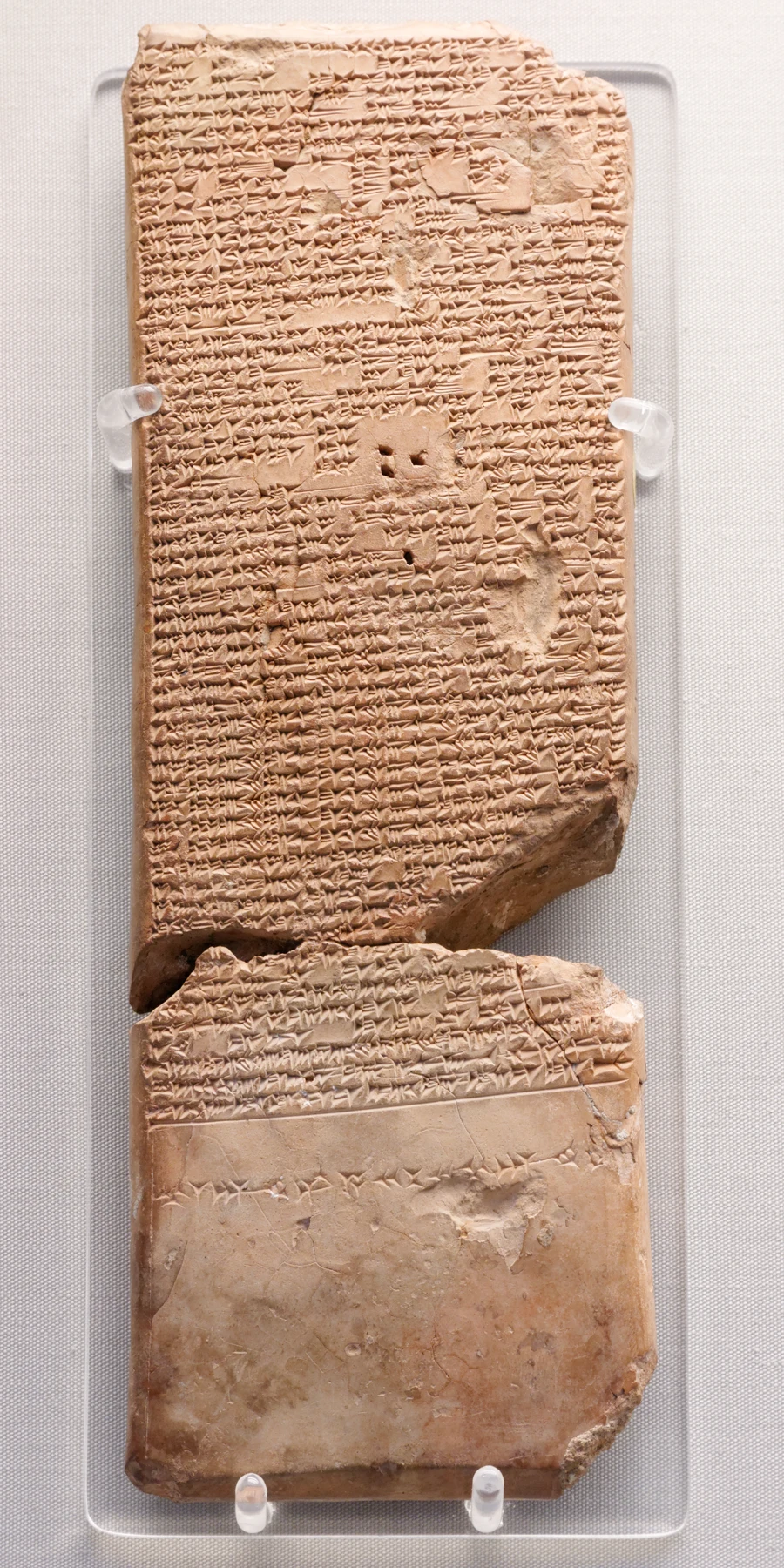
In the account on the reverse, Esarhaddon says he defeated Taharqa’s forces on the way to Memphis and took the city. He lists Taharqa’s wife, women of the court, the crown prince and other children among those he deported to Assyria. He also claims to have installed new rulers and officials in Egypt and imposed yearly tribute. The episodes are preserved in a text the king had carved to advertise his victory. Its claims about the fighting and administration are those of the Assyrian court. [1][2][5]
The closing lines say the king commissioned the stele to commemorate his victories and the support of the god Ashur. They ask a future ruler to look at the monument, read it aloud before it, anoint it with oil and make an offering. A curse invokes Ishtar against anyone who moves or hides the stele or substitutes a different name. At the gate in Sam’al the monument presented a victory in Egypt. Its inscription also set out how a later ruler should preserve and honor the stone. [2][3]
References and notes
- Nadja Cholidis, “Siegesstele des Königs Asarhaddon von Assyrien über Ägypten,” Vorderasiatisches Museum, Staatliche Museen zu Berlin, VA 02708 Expert details and object description. Museum number, material, dimensions, weight, date, findspot, discovery circumstances and identification of the figures. Return to the text ↑
- Erle Leichty, Jamie Novotny and the RINAP Project, “Esarhaddon 098,” Royal Inscriptions of the Neo-Assyrian Period 4, Oracc, digital edition, 2011 and 2017 Entry dating and exemplar VA 02708. Obv. 1–12 names the gods, including the Sebitti at line 10. Rev. 37b–50 gives the campaign and deportations. Rev. 50b–57 gives the commission, curse and requests to a later ruler. Return to the text ↑
- Grant Frame, “The Tell Acharneh Stela of Sargon II of Assyria,” in Tell ‘Acharneh 1998–2004, ed. Michel Fortin, Subartu XVIII, Turnhout, Brepols, 2006, pp. 49–68 Pp. 60–63 and fig. 10. Commission and declared purpose of the stele, pedestal in the gatehouse, drawing of the front and both sides, and differing ground lines. Return to the text ↑
- Lorenzo Verderame, “Pleiades in Ancient Mesopotamia,” Mediterranean Archaeology and Archaeometry 16, no. 4, 2016, pp. 109–117 P. 110, fig. 2 and section 2, for the labeled Pleiades on the later Uruk tablet. Pp. 114–115, fig. 4 and sections 4.2.3 and 5, for the seven dots on the stele, protective motifs and the astral association. Return to the text ↑
- Mattias Karlsson, “Taharqa, not Ushanahuru: Reconsidering the Identity of the African Individual on the Victory Stele of Esarhaddon,” Ash-sharq 7, no. 1, 2023, pp. 14–22 Publisher’s title and open abstract. Identifies Karlsson’s proposed reading of the figure as Taharqa and describes the two captives, the lead ropes and the campaign of 671 BCE. Return to the text ↑
- Helen Gries, “Leben an Euphrat und Tigris,” Vorderasiatisches Museum and Stiftung Preußischer Kulturbesitz, information sheet for the Schlütersaal interim exhibition, 2025 P. 2, section on moving the Esarhaddon stele and fig. 4. Records the 1889 division of finds, display from 1930 to 2023, disassembly and the two crown princes. Return to the text ↑
- Chicago-Tübingen Expedition to Zincirli, “Inscriptions,” section “Stele of Esarhaddon (670 BCE)” Opening of “Stele of Esarhaddon (670 BCE).” The date, location of the broken stele within the citadel gate, proposed original setting and relation to the campaign of 671 BCE. Return to the text ↑
- Koray Toptaş, “Assyria-Egypt Relations from the Assyrian Perspective,” Archivum Anatolicum 18, no. 2, 2024, pp. 453–498 Pp. 474–475 and fig. 2. Description and drawing of the upright captive and the kneeling figure on the Zincirli relief. Return to the text ↑
- Oğuz Satır and Ali Çifçi, “The ‘Worthless Stones’ of Zincirli: Osman Hamdi Bey and the German Excavations of 1888–1902,” Anadolu Araştırmaları–Anatolian Research 31, 2024, pp. 213–244 P. 228 and n. 13, Humann’s letter and enclosed drawing after the discovery. Pp. 230–231, the negotiations and the allocation of the stele to Berlin. Return to the text ↑
- Felix von Luschan, “Monolith des Asarhaddon,” in Ausgrabungen in Sendschirli I. Einleitung und Inschriften, Mittheilungen aus den Orientalischen Sammlungen XI, Berlin, W. Spemann, 1893, pp. 11–29 Pp. 11–14, fig. 3 and fig. 10 on p. 29 show the outer citadel gate, in-place pedestal and fallen fragments. P. 14 gives the dolerite and the height with and without its tenon. Pp. 16–19, fig. 4 and plates I–III give early identifications, the four complete circles and three damaged ones, and photographs of all faces. Return to the text ↑
Archive records may be reviewed and refined as better evidence or sources become available. Suggest a correction
Suggest a correction · Suggest a source for this record
Cite this record
IL Archive, «The Victory Stele of Esarhaddon from Zincirli (VA 2708)», https://ilarchive.com/en/artifacts/esarhaddon-victory-stele-zincirli
Continue reading