Artifact
The Louvre Syllabary (AO 7661)
An object record bringing together its image, metadata, rights, and context.
- Timeline
- From 604 BCE to 539 BCE
- Region
- Mesopotamia
A clay tablet sets Sumerian readings and Akkadian equivalents side by side. Its last eight lines record how an apprentice copied the list for a scholar, who dedicated it to Ishtar for the temple library at Uruk.
Estimated reading time: 4 min Published Last reviewed:
Share article
Photograph
Zunkir, Wikimedia Commons. CC BY-SA 4.0. Resized for this entry.
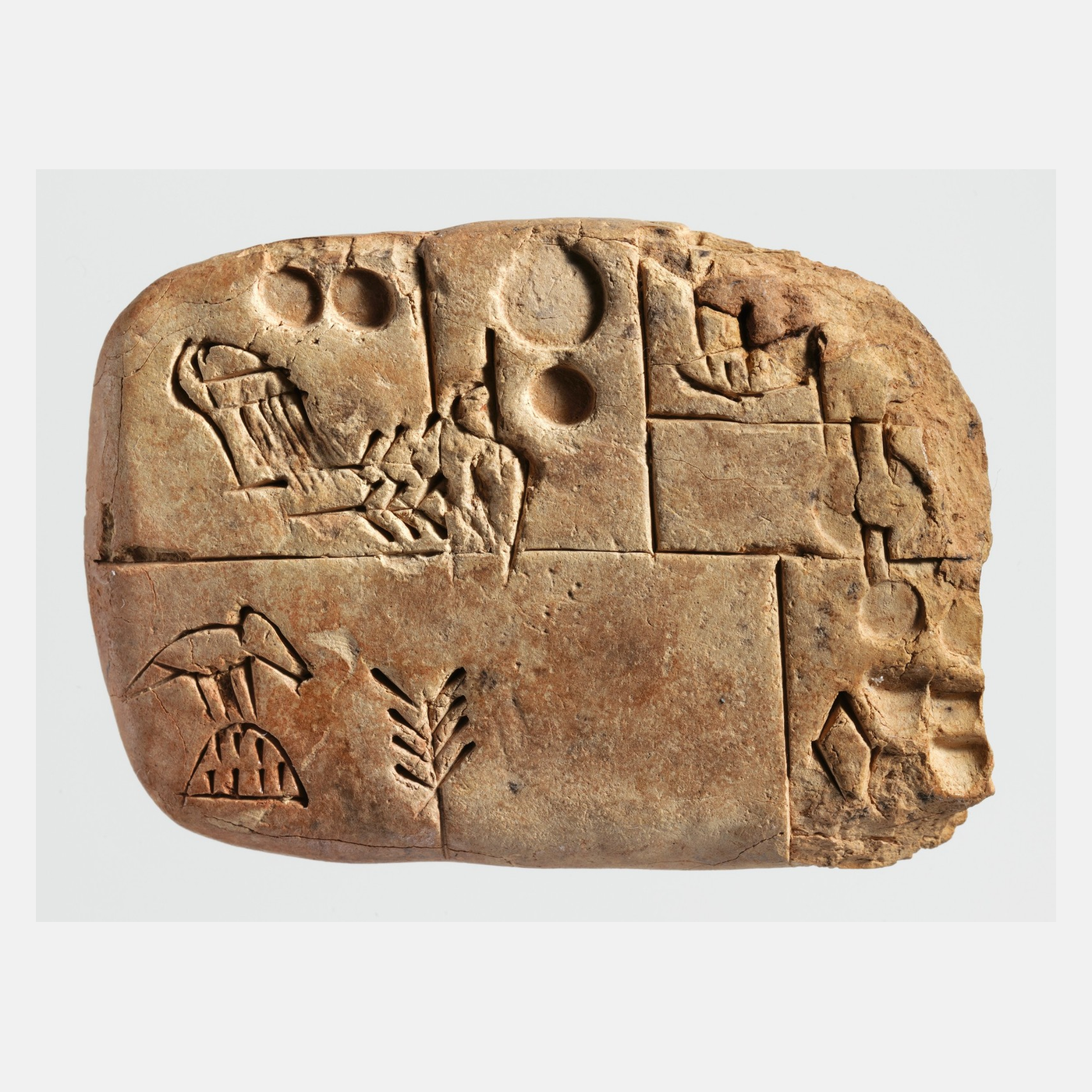
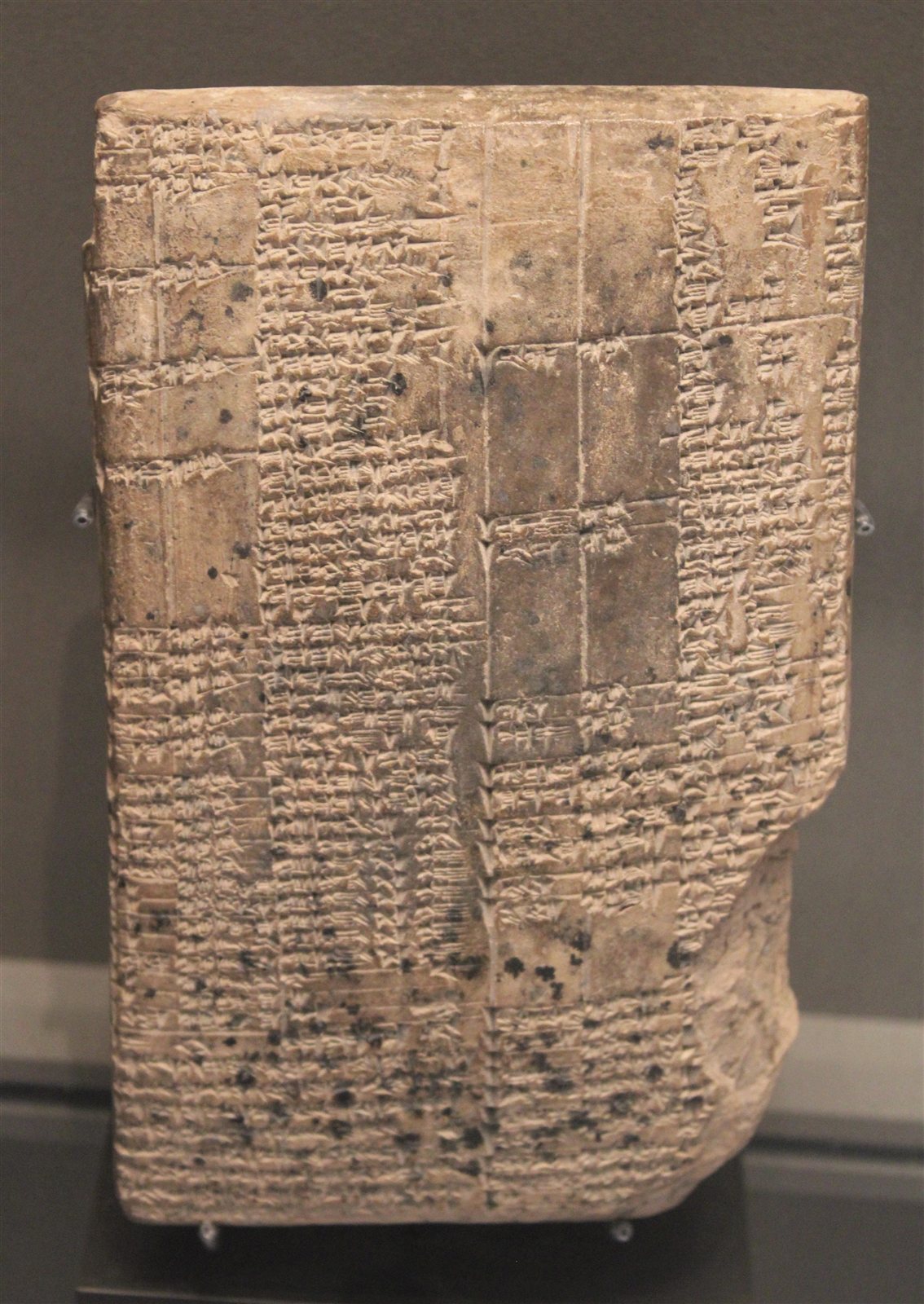
Clay tablet AO 7661 in the Louvre. Ruled lines divide the cuneiform entries on the photographed face
License · Image sourceObject details
- Title
- The Louvre Syllabary (AO 7661)
- Timeline
- From 604 BCE to 539 BCE
- Region
- Mesopotamia
- Rights
- CC BY-SA
Text
Introduction
Louvre AO 7661 begins with a single cuneiformCuneiformWriting with wedge-shaped signs, developed from Mesopotamian recording traditions and used for several languages from the third millennium BCE.Glossary · Click to read the explanation sign and a long series of AkkadianAkkadianAn ancient East Semitic language written in cuneiform from the third millennium BCE; its varieties include Babylonian and Assyrian, and it served in international diplomacy.Glossary · Click to read the explanation equivalents for one of its Sumerian readings. Ruled lines divide the clay into narrow compartments so that a reader can locate the sign, its reading and its equivalents at a glance. The last eight lines name the apprentice who copied the tablet and the scholar who commissioned it, and record its dedication to IshtarInanna / IshtarA prominent Mesopotamian goddess whose Sumerian name Inanna became associated with Akkadian Ishtar across diverse traditions. She was associated with desire, war, royal authority and Venus, while local forms and genealogies varied among texts.Glossary · Click to read the explanation at UrukUrukAncient city at Warka in southern Iraq, a major urban centre around 3200 BCE that preserved early writing and accounting tablets.Glossary · Click to read the explanation. [1][2][3]
The object and its date
The Louvre records the tablet as AO 7661 and as TCL 6,37, the number assigned to it in François Thureau-Dangin’s edition. The shaped and incised clay measures 14.5 × 9.5 × 2.8 cm. Richard T. Hallock describes most of the surface as well preserved, with more serious damage on the upper right edge of the obverse and the lower right edge of the reverse. Thureau-Dangin’s 1922 edition reproduces the two faces in drawings. Its preface records the acquisition in December 1920, and the museum catalogue gives 23 December as the date of the purchase committee. [1][2][5]
The Louvre dates the tablet to 604–539 BCE and assigns it to Uruk, modern Warka, on stylistic grounds. Szilvia Sövegjártó places it in the seventh or sixth century BCE and reports Uruk as its findspot. Hallock identified Neo-Babylonian handwriting in the outer subcolumns. He proposed a Seleucid date from the use of the word šamallû for the copyist in the colophon. The safest link to Uruk is the colophon’s own statement that the tablet was deposited at EannaEanna at UrukAn archaeological precinct and institutional centre at Uruk associated with Inanna; its name does not fix every early building’s function.Glossary · Click to read the explanation, the temple there. [1][2][3]
How the list works
Two columns on each face hold 207 lines of entries in Hallock’s count. His total excludes the catchline, which points forward to the following part of the series, and the eight-line colophon. The scribe divided each column into three. The left-hand subcolumn spells out the Sumerian reading with syllabic signs, the middle gives the sign for that reading, and the right-hand subcolumn supplies the Akkadian equivalents. Some rows leave the two left spaces blank and continue the equivalents on the right. Horizontal rules mark the start of new groups, and a heavier rule sets off the catchline. [1][2]
The opening group shows how much the layout can hold. In the first line, the Sumerian reading conventionally transcribed hum accompanies the sign LUM and is paired with Akkadian hamāšu, which Hallock glosses as “to break, crush, grind.” Hallock counts 28 equivalents for this reading across the first 23 lines. He treats the first pairing as standard and suggests some of the others may have come from specialized vocabularies or different forms of speech. Several meanings remain uncertain in his edition. The placement of these words under the same reading shows how the ancient list grouped them. It gives limited evidence for how any one group of speakers used the word. [2][3]
A section of a longer series
Modern editions identify AO 7661 as Aa V/1. The longer series Aa comprised 42 tablets and ran in parallel with the eight tablets of the shorter EaEnkiMesopotamian deity also known as Ea, linked with Eridu and the Abzu (deep fresh waters), wisdom, incantations, and narratives of creation and cosmic order. Later written attestations do not identify the deity of Eridu’s earliest layers.Glossary · Click to read the explanation. Ivan Hrůša and Frauke Weiershäuser explain that late Babylonian colophons could identify a tablet of the longer series as a section of a particular tablet of Ea. In this numbering, V/1 means the first section corresponding to Ea V. Hallock also showed that the first entry on AO 7661 matches the catchline at the end of the Chicago Syllabary, which he identified as Ea IV. The repeated entry connects two parts of the sign sequence across different versions of the list. [2][3][4]
A copy for the library at Eanna
On the reverse, the colophon calls the tablet a copy from BabylonBabylonBabylon is an ancient city in central present-day Iraq, south of BaghdadGlossary · Click to read the explanation and records that it was checked against its exemplar. Sövegjártó reads the sponsor’s name as Bēl-ahhē-erība, son of Nabû-ina-tēšî-gimil. She tentatively reads the title that follows as a term for an exorcist, a specialist in ritualRitualAn organised or distinguished practice meaningful to a community; it may leave traces, but its form alone does not reveal an associated doctrine.Glossary · Click to read the explanation. In her translation, the sponsor commissioned his apprentice Nabû-šuma-ibni to write the tablet. The dedication asks Ishtar for the sponsor’s long life, the safety of his descendants and freedom from illness. It places the tablet in the library at EannaEanna at UrukAn archaeological precinct and institutional centre at Uruk associated with Inanna; its name does not fix every early building’s function.Glossary · Click to read the explanation. [3]
The closing lines ask Ishtar to look kindly on the scholar who preserves the lines and places the tablet in the library. They also call down her anger on anyone who takes it out of the temple. The inscription thus records how a particular copy was made, who sponsored it, and the care its deposit was meant to entail. The two names and the instructions for the library survive on the same clay as the entries they were meant to preserve. [3]
References and notes
- Musée du Louvre, Département des Antiquités orientales, “tablette,” AO 7661, TCL 6,37 Inventory, Description, Physical characteristics, Places and dates, and History. Identifies the object and language columns, gives material, measurements and catalogue dates, and specifies the basis of the Uruk attribution and the purchase committee date. Return to the text ↑
- Richard T. Hallock, The Chicago Syllabary and the Louvre Syllabary AO 7661, Assyriological Studies 7, Chicago, University of Chicago Press, 1940 Pp. 4–6 on the layout, line count, condition, dating argument and links between the texts. P. 39, col. i 1–23, and p. 70, notes to col. i 1–23, on LUM and its Akkadian equivalents. P. 79, note to col. iv 43, explains the catchline. Return to the text ↑
- Szilvia Sövegjártó, “Two Dedicatory Colophons from the Late Babylonian Period,” in Literary Snippets: A Colophon Reader, vol. 2, ed. George Anton Kiraz and Sabine Schmidtke, Piscataway, Gorgias Press, 2024, pp. 1–4 Section 2, pp. 3–4, reverse col. iv 44–51. The introductory discussion gives the author's dating and findspot. The edition and commentary give the copy statement, sponsor, tentative title, apprentice, dedication and instructions for the temple library. Return to the text ↑
- Ivan Hrůša and Frauke Weiershäuser, Keilschrifttexte aus Assur literarischen Inhalts 14, Lexikalische Texte, Teil 1: Einleitung, Katalog, Textbearbeitungen, Verzeichnisse, ed. Stefan M. Maul, Wiesbaden, Harrassowitz Verlag, 2023 P. 5 and n. 31. Gives the 42 tablets of Aa, the relation of its sections to Ea in late Babylonian colophons, and AO 7661 as Aa V/1. Return to the text ↑
- François Thureau-Dangin, Tablettes d’Uruk à l’usage des prêtres du Temple d’Anu au temps des Séleucides, Textes cunéiformes du Louvre VI, Paris, Paul Geuthner, 1922 Preface on the acquisition in December 1920. Catalogue no. 37 and plates LXX–LXXI give the identification and drawings of the obverse and reverse. Return to the text ↑
Archive records may be reviewed and refined as better evidence or sources become available. Suggest a correction
Suggest a correction · Suggest a source for this record
Cite this record
IL Archive, «The Louvre Syllabary (AO 7661)», https://ilarchive.com/en/artifacts/louvre-syllabary-ao7661
Continue reading