Artifact · Inscription
The Karatepe Bilingual Inscription (KAI 26)
An object record bringing together its image, metadata, rights, and context.
- Timeline
- From 760 BCE to 720 BCE
- Region
- Anatolia and the eastern Mediterranean
At two gates in Iron Age Cilicia, Azatiwada recorded his deeds in Phoenician and Hieroglyphic Luwian. The parallel texts helped scholars read the Anatolian signs and preserve different divine names.
Estimated reading time: 4 min Published Last reviewed:
Share article
Photograph
Dosseman / Wikimedia Commons, CC BY-SA 4.0.
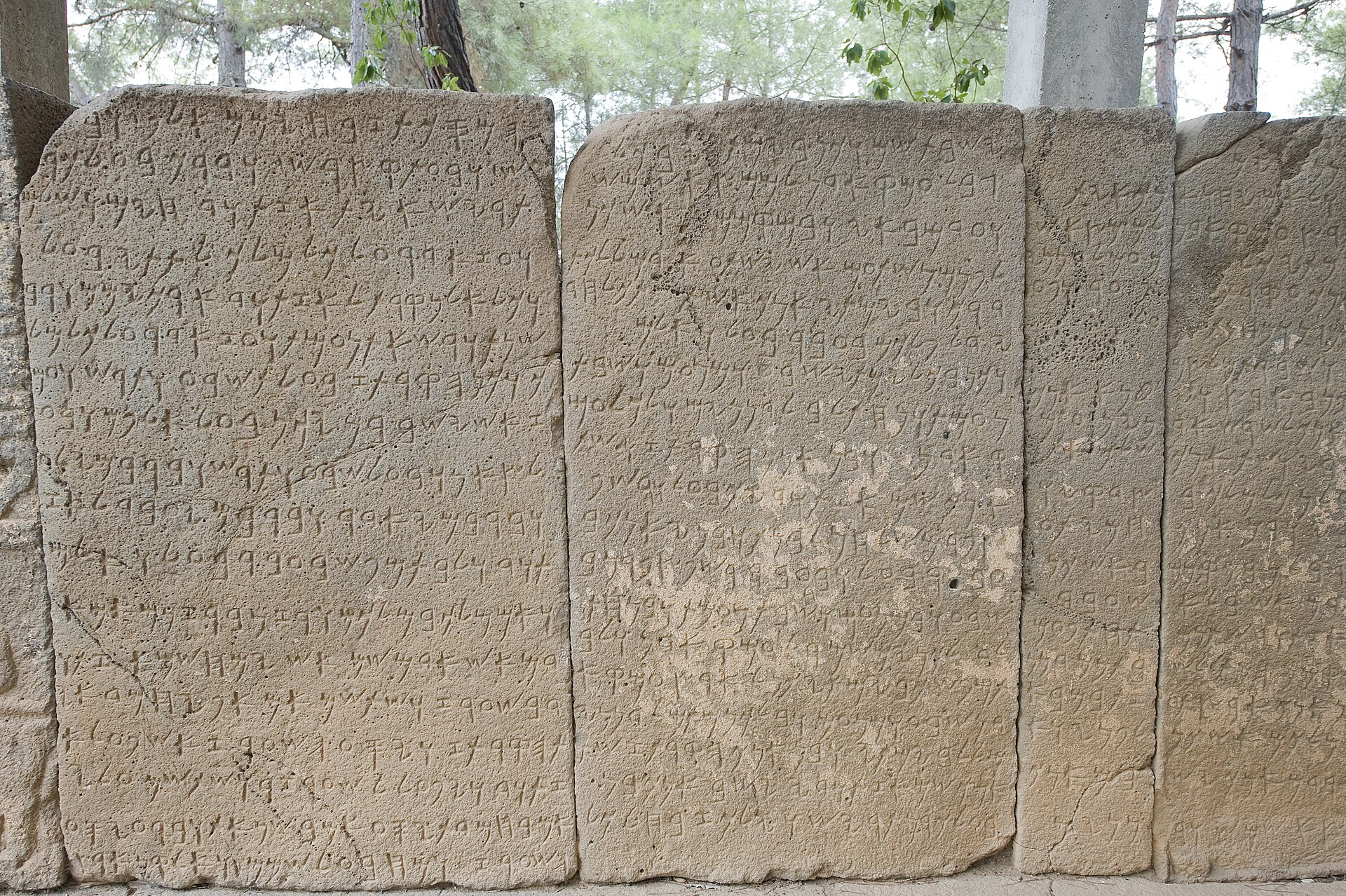
Part of the Phoenician text on the basalt slabs of the north gate at Karatepe-Aslantaş
License · Image sourceObject details
- Title
- The Karatepe Bilingual Inscription (KAI 26)
- Timeline
- From 760 BCE to 720 BCE
- Region
- Anatolia and the eastern Mediterranean
- Rights
- CC BY-SA
Text
Introduction
A visitor entering the hilltop fortress of Karatepe-Aslantaş in CiliciaCiliciaHistorical region on Anatolia’s southern coast in modern Türkiye, with plains and uplands connected to the Levant and Anatolian interior.Glossary · Click to read the explanation could pass the words of Azatiwada cut into the gate walls and their stone guardians. The two monumental gates carried versions of his account in Phoenician alphabetic writing and in Hieroglyphic Luwian. A statue near the south gate bore a third Phoenician version. Together the inscriptions record the building of the fortress, the offerings prescribed for its storm god and a curse on anyone who tried to replace Azatiwada’s name. [1][2][3][5]
The stones at the two gates
The north gate is the lower entrance and the south gate is the upper entrance. The walls of both were faced with upright slabs of basalt. At the north gate, the best-preserved Phoenician version runs across four adjoining slabs. Bahadır Alkım’s first-season report records three columns of 21, 19 and 18 lines on the slabs and a further line that continues across two bases. The text ends on a carved lion. The Luwian text takes up more space. It extends across upright slabs, their bases and sculptures, including a lion and a sphinx. Its physical arrangement does not follow the sequence of the Phoenician text, which editors use to recover the reading order. At the south gate, the two versions are more fragmentary. [1][2][4][5][9]
Ekrem Kuşçu, a teacher from Kadirli who had visited the site, guided Helmuth Theodor Bossert and Halet Çambel there in February 1946. Naci Kum, the director of the Adana Museum, accompanied them. They examined the statue’s Phoenician inscription and fragments in both scripts. Excavation of the gates began in 1947 under Bossert, Bahadır Alkım and Çambel. Çambel describes how conservation continued to turn up missing fragments, some of which could be joined physically to the blocks. The inscribed stones can be seen at the open-air museum. UNESCO added the inscriptions to its Memory of the World Register in 2025. [1][2][4][8][9]
The ruler’s account and its date
Azatiwada names Awariku in the opening and presents himself as a man charged with the welfare of the people of Adana. His claim to have acted as both father and mother introduces an account of prosperity, the strengthening of borders and the building of fortified places. He says that he made formerly dangerous roads safe enough for a woman to walk alone. He gives the new settlement a name formed from his own and says that the gods commissioned its construction. These are claims made in his own account. [1][3][7]
Awariku’s identity affects the date. In his 2000 edition, John David Hawkins considered an early seventh-century BCE placement, based in part on the possible identification of Azatiwada with Sanduarri, a ruler known from Assyrian records. H. Craig Melchert rejects that identification. He favors an early to mid-eighth-century date, citing the archaeological argument of Mirko Novák and the difference between Karatepe, which does not mention Assyria, and the separate bilingual inscription from Çineköy, which celebrates a partnership with it. The Ohio State University edition gives 760–720 BCE. [1][3][7]
Offerings and the protection of a name
The north-gate Phoenician text prescribes an ox each year, a sheep at ploughing and a sheep at harvest. In Hawkins’s reading of the corresponding Luwian passage, the last offering is assigned to the grape harvest, and the term for the previous occasion is less certain. Timothy Hogue links the prescribed offerings and the depictions of processions in the south-gate reliefs to the statue near that entrance. His reconstruction treats the placement of the carved texts and the movement of visitors through the gate as evidence for how the inscriptions may have been used. [1][3][5]
The north-gate version threatens a future ruler or other prominent person who might erase Azatiwada’s name or replace the gate and inscribe his own. Among the powers invoked are Baal of the Heavens, ElElEl is a senior deity in Late Bronze Age Ugaritic texts, portrayed as father of the divine family and a council authority, alongside his consort Athirat. This entry does not cover every linguistic use of El.Glossary · Click to read the explanation with the title Creator of Earth, the Eternal Sun and the sons of the gods. The curse asks them to erase the offender and his kingdom, and ends by comparing the endurance of Azatiwada’s name to that of the Sun and Moon. The corresponding Luwian clause invokes the celestial storm god Tarhunzas, the celestial Sun, EaEnkiMesopotamian deity also known as Ea, linked with Eridu and the Abzu (deep fresh waters), wisdom, incantations, and narratives of creation and cosmic order. Later written attestations do not identify the deity of Eridu’s earliest layers.Glossary · Click to read the explanation and all the gods. In the Phoenician version on the statue, the surviving curse refers to erasing Azatiwada’s name from the divine image itself. [1][3][6]
How the parallel texts helped readers
Before the discovery, scholars had already identified some signs for words and syllables in Anatolian hieroglyphs. The long Phoenician text gave them a way to test earlier readings against a continuous Luwian account and to establish meanings for more words. The two versions could be aligned passage by passage, even when their phrasing or divine names differed. Hawkins notes that scholars still misread certain signs, including one for a negative. Their readings were revised as more evidence about the script became available. [1][2]
References and notes
- John David Hawkins, Corpus of Hieroglyphic Luwian Inscriptions, vol. I, Inscriptions of the Iron Age, part 1 (Walter de Gruyter, 2000) pp. 14–15 on decipherment and remaining sign difficulties, pp. 43–46 on dating, the copies and the discovery, and the edition of KARATEPE 1, especially §§ I–III, XXXIX–XL, XLVIII and LXVI–LXXV. Return to the text ↑
- Halet Çambel, Corpus of Hieroglyphic Luwian Inscriptions, vol. II, Karatepe-Aslantaş: The Inscriptions, Facsimile Edition, with a contribution by Wolfgang Röllig and tables by John David Hawkins (Walter de Gruyter, 1999) Preface on conservation, joins and preparation of the facsimiles. List of plates, nos. 4–19, 20–51 and 52–59, for the north gate, south gate, statue and Luwian slabs. Return to the text ↑
- Digital Editions of Aramaic and Phoenician Sources, Ohio State University, ‘Karatepe Bilingual Luwian-Phoenician Inscription (Cilicia)’, KAI 026 Composition date, General Notes on Phoenician copies A and C, and edition and translation of their opening, offerings and curses. Return to the text ↑
- Türkiye Ministry of Culture and Tourism, ‘Karatepe Aslantaş Müzesi ve Örenyeri’ Site history from the first visit to the open-air museum, and description of the two gates, their stone slabs and the storm-god statue. Return to the text ↑
- Timothy Hogue, ‘Texts, Architecture, and Ritual in the Iron II Levant’, Religions 16, no. 9 (2025), 1178 § 2.1 on Karatepe, especially figs. 1–4 and 6–8 and the comparison of Hu/Ho § 48 with the offerings of Phu (KAI 26 A), II 19–III 2. Return to the text ↑
- Nathaniel B. Levtow, ‘Text Destruction and Iconoclasm in the Hebrew Bible and the Ancient Near East’, in Natalie N. May (ed.), Iconoclasm and Text Destruction in the Ancient Near East and Beyond (Oriental Institute, 2012) p. 319, passage on the Azatiwada inscriptions, for the curse on the north gate (Phu/A III 12–IV 3) and its variant on the statue (PhSt/C IV 13–16). Return to the text ↑
- H. Craig Melchert, ‘Cilicia in the Iron Age’, in Contacts of Languages and Peoples in the Hittite and Post-Hittite World, vol. II (Brill, 2025), pp. 93–108 § 4, pp. 107–108, on the dates of Karatepe and Çineköy, the identification of Sanduarri, and Azatiwada’s role under Awariku. Return to the text ↑
- UNESCO Memory of the World, ‘Karatepe-Aslantaş Inscriptions’ International register entry and year of registration, 2025. Return to the text ↑
- U. Bahadır Alkım, ‘Excavations at Karatepe’, Belleten 12, no. 45 (1948), pp. 249–255 pp. 249–250 on the February 1946 visit and the first excavation season, and p. 254 on the three columns, their line counts and the continuation of the north-gate text across two bases and onto the lion. Return to the text ↑
Archive records may be reviewed and refined as better evidence or sources become available. Suggest a correction
Suggest a correction · Suggest a source for this record
Cite this record
IL Archive, «The Karatepe Bilingual Inscription (KAI 26)», https://ilarchive.com/en/artifacts/karatepe-bilingual-kai26
Continue reading