Ancient text
The Ugaritic Text Associated with Dream Omens (RS 18.041)
A text for line-by-line reading, with transliteration, translation, and resources.
- Timeline
- From 1300 BCE to 1190 BCE
- Region
- The Levant
A damaged text from the royal palace at Ugarit lists animals and other details in short entries. Its opening may refer to dreams, but the surviving lines leave the purpose of the list open to debate.
Estimated reading time: 4 min Published Last reviewed:
Share article
Text
Introduction
RS 18.041 is a fragmentary text in Ugaritic alphabetic cuneiformUgaritic alphabetAlphabetic cuneiform system of Late Bronze Age Ugarit, using thirty chiefly consonantal written signs, distinct from Akkadian syllabic cuneiform.Glossary · Click to read the explanation from the royal palace at UgaritUgaritAncient city and kingdom at Ras Shamra on the Syrian coast, flourishing between the fourteenth and early twelfth centuries BCE and preserving multilingual archives.Glossary · Click to read the explanation. It is usually cited as KTUKTU: Ugaritic Text ReferencesAbbreviation for a modern edition of alphabetic cuneiform texts. Its text references can be cross-identified with find numbers such as RS or RIH; they are not dates.Glossary · Click to read the explanation 1.86. Dennis Pardee reads it as a possible list of things seen in dreams. Some entries may have given the meaning of what the dreamer saw. Gregorio del Olmo Lete understood it as a record concerning domestic animals. The disagreement concerns what the entries were for, as well as how to read the opening words. [1][2][3]
A fragment from the royal palace
The excavation concordance of Pierre Bordreuil and Dennis Pardee records the fragment in the eighteenth campaign, in 1954. The find came from point 1331a in the area originally called Court V. The concordance gives a recorded depth of 2.90 metres and identifies the museum piece as DO 4784 in Damascus. The USC West Semitic Research Project also places the text in the National Archaeological Museum in Damascus. [1][4][5]
The excavation and edition numbers have a complicated history. The concordance assigns the text to number 158 in Le Palais royal d’Ugarit, volume 5, and notes that the earlier publication used the number 18.39. A separate catalogue entry, RS 18.041 A, is listed under number 158 bis and corresponds to KTU 4.351. Pardee reports a separate find-location label for that piece and finds no secure textual connection between the two. The museum number DO 4784 and the reference KTU 1.86 identify the text discussed here. [1][2]
Claude Schaeffer interpreted the concentration of tablets in this part of the palace as the contents of a kiln used to fire them. Jean-Claude Margueron later challenged that interpretation. Robert Hawley, Florence Malbran-Labat and Carole Roche re-examined the group using the excavation records and the contents of the texts. They use locus 153 for the former Court V and point 1331 for the find area previously called the kiln. They count 259 inscribed pieces from point 1331, of which 253 are in Ugaritic alphabetic script. The group includes such different documents as letters and records of property transfers. That setting provides a context for RS 18.041 and helps explain why the excavation label alone gives little guidance about its genre. [6]
How the text is arranged
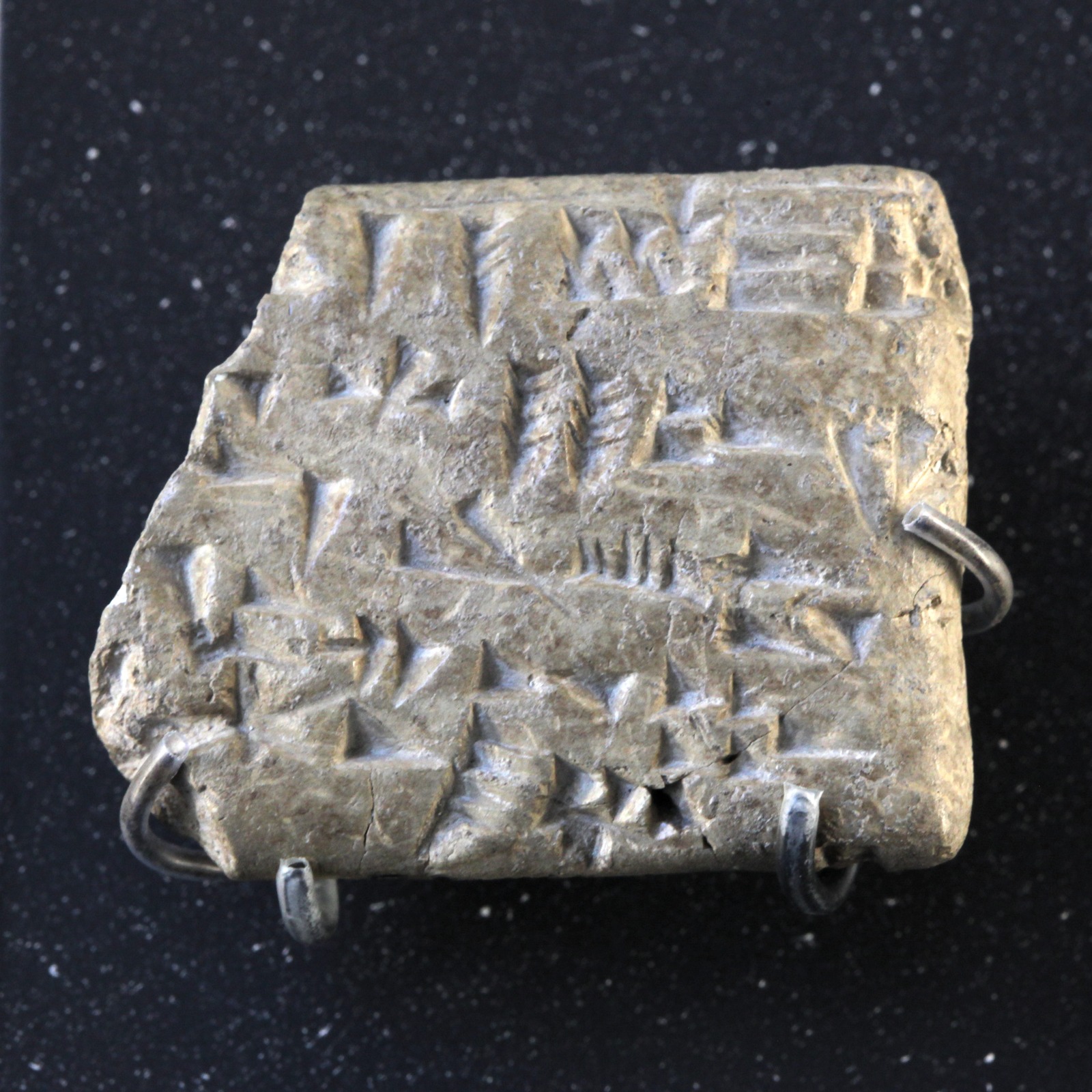
The surviving part measures 103 mm high, 101 mm wide and 23 mm thick. It includes most of the width near the upper edge. Pardee estimates that the original tablet was about 150 mm high and carried about 50 lines. The left side of the obverse is especially legible, while the right side is badly damaged on both faces. The condition of the clay helps explain why readers can often identify what an entry names while its ending is missing. [2]
Pardee reads the damaged opening word as spr, meaning a document or written list. Horizontal lines separate groups of entries. He identifies young cattle in the first group, horses in the next, then donkeys and sheep or goats. One line appears to name Astarte’s horse. On the reverse he identifies a kind of tool and cups, among other entries. The range of subjects on the reverse matters because the first groups on the obverse contain so many animals. [2]
Pardee reads hm as “if” in line 7. He suggests that rgm, meaning “word” or “utterance,” may introduce the interpretation in lines 2 and 7. The clay preserves part of a possible sign and perhaps the beginning of its interpretation in line 7. František Válek stresses that the predictions themselves are lost. The arrangement led Pardee to consider an inventory of things one might see in a dream, with indications of how to interpret some signs. [2][3]
Dreams or a record of animals?
The word after spr is read as ḥlmm. Pardee cautiously favors “dreams” and discusses the alternative reading “healthy or well-fed animals.” He takes the inanimate objects on the reverse into account when judging whether the opening could describe the whole list. Del Olmo Lete’s reading of the text as a record of domestic animals is reported by Válek. The USC catalogue leaves the classification open, suggesting a myth, ritualRitualAn organised or distinguished practice meaningful to a community; it may leave traces, but its form alone does not reveal an associated doctrine.Glossary · Click to read the explanation or incantation with question marks. [2][3][4]
Other writing from Ugarit gives clearer examples of dreams with an interpretation. In the sixth tablet of the Baal CycleBaal CycleA group of Late Bronze Age Ugaritic religious texts recounting Baal’s conflicts, relationships with the gods and the building of his palace.Glossary · Click to read the explanation, El says what he will take as a sign that Baal lives, and the dream then shows him those images. Koowon Kim discusses this episode and points out how little of RS 18.041 survives. The literary episode illustrates a setting where the dream and its meaning can both be read. On RS 18.041, the headings, ruling and surviving names are the evidence on which a reader has to judge whether this document also dealt with dreams. [2][7]
References and notes
- Pierre Bordreuil and Dennis Pardee, La trouvaille épigraphique de l’Ougarit. 1. Concordance, Ras Shamra-Ougarit V, Éditions Recherche sur les Civilisations, 1989 P. 158, eighteenth campaign, entries RS 18.041 and RS 18.041 A. Registers Court V, point 1331a, depth 2.90 m, DO 4784, PRU 5 no. 158 and the older numbers. The next entry separates the piece catalogued as KTU 4.351. Return to the text ↑
- Dennis Pardee, Les textes rituels d’Ougarit, fasc. 1, Ras Shamra-Ougarit XII, Éditions Recherche sur les Civilisations, Paris, 2000 Chapter 30, pp. 457–468. P. 457 and n. 1 describe preservation, findspot and catalogue numbers. Pp. 458–463 present the text and discuss both faces, the opening and possible signs. P. 468 summarizes the proposed interpretation. Return to the text ↑
- František Válek, “Divination and Political Administration at Ugarit,” Axis Mundi 18 (2), 2023, pp. 49–56 P. 50 and n. 3 on the palace find and Del Olmo Lete’s animal-record interpretation. P. 53 and n. 7 on what is missing from the possible dream omens. Return to the text ↑
- West Semitic Research Project, University of Southern California, “Ugaritic Texts,” ISF_TXT_06140 Entry for KTU 1.86 in the literature and religion catalogue. Identifies Damascus National Archaeological Museum and leaves the genre uncertain. Return to the text ↑
- Claude F.-A. Schaeffer, “La 18e campagne de fouilles à Ras Shamra-Ugarit (1954),” Comptes rendus des séances de l’Académie des Inscriptions et Belles-Lettres 99 (2), 1955, pp. 249–263 P. 249, dates of the eighteenth excavation campaign. Return to the text ↑
- Robert Hawley, Florence Malbran-Labat and Carole Roche, “Pour une étude sur les textes de l’« ex-four » dans l’« ex-cour V » du Palais royal d’Ougarit,” in Le mobilier du Palais royal d’Ougarit, Ras Shamra-Ougarit XVII, Maison de l’Orient et de la Méditerranée Jean Pouilloux, 2008, pp. 327–344 Pp. 327–329 on the older kiln interpretation, Margueron’s reassessment and the excavation labels. Pp. 337–338 on the composition of the point 1331 group, with n. 31 for the language totals. Return to the text ↑
- Koowon Kim, “When Even the Gods Do Not Know: El’s Dream Divination in KTU 1.6 iii,” in Perchance to Dream: Dream Divination in the Bible and the Ancient Near East, ed. Esther J. Hamori and Jonathan Stökl, SBL Press, 2018, pp. 43–60 P. 44 n. 2 on the preservation of KTU 1.86. Pp. 47–48 translate the statement of the sign and the dream in the Baal Cycle. Return to the text ↑
Archive records may be reviewed and refined as better evidence or sources become available. Suggest a correction
Suggest a correction · Suggest a source for this record
Cite this record
IL Archive, «The Ugaritic Text Associated with Dream Omens (RS 18.041)», https://ilarchive.com/en/texts/ugaritic-dream-omens-rs18041
Continue reading