Artifact
Tablet Six of the Baal Cycle (Louvre AO 16636)
An object record bringing together its image, metadata, rights, and context.
- Timeline
- From 1400 BCE to 1200 BCE
- Region
- The Levant
The last tablet of the Baal Cycle preserves the return of Baal and the dream in which El sees a sign that he is alive. At the end of the poem, a few lines name the scribe Ilimilku and his teacher.
Estimated reading time: 5 min Published Last reviewed:
Share article
Photograph
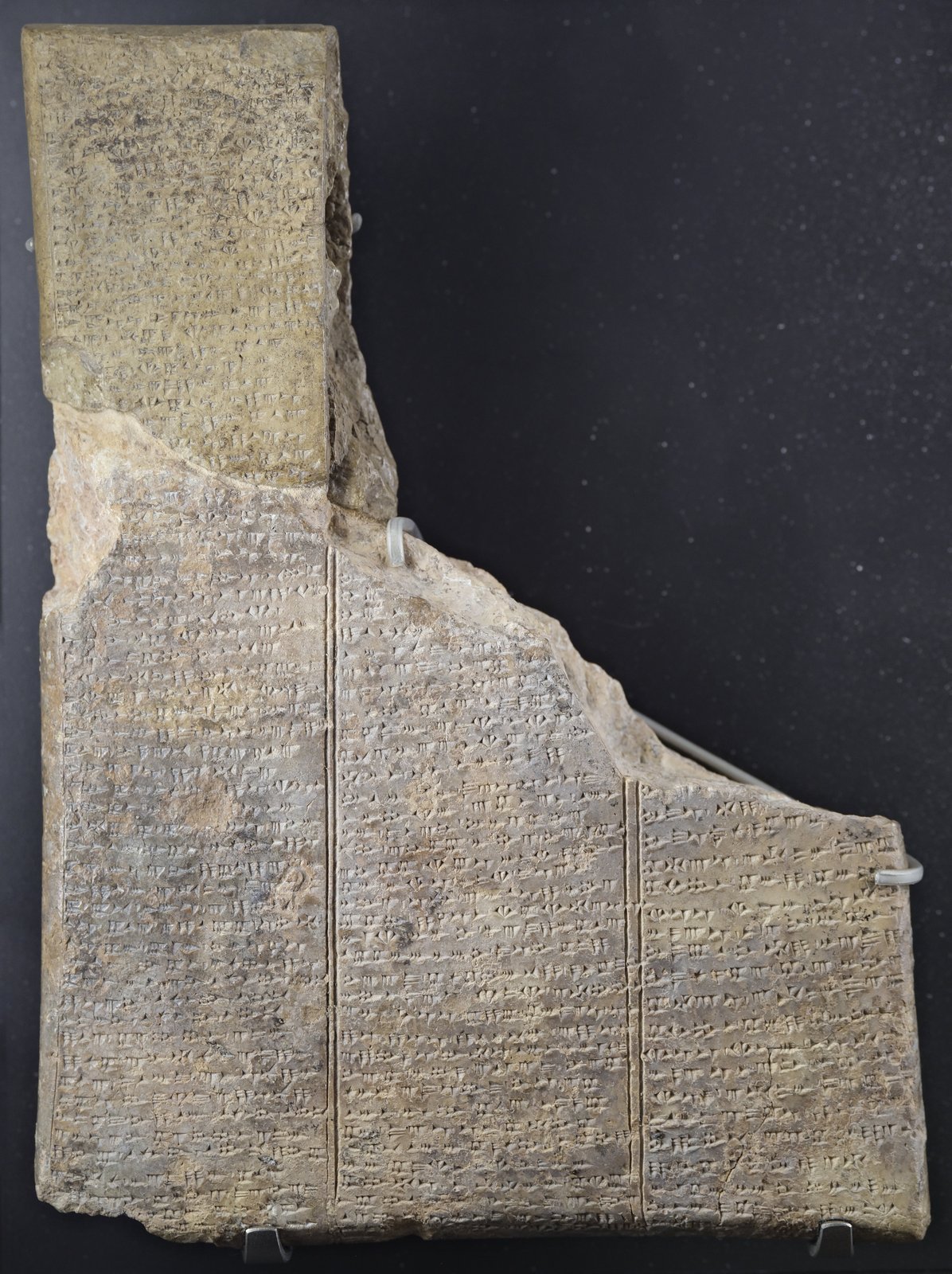
Photograph by Shonagon, via Wikimedia Commons. CC0 1.0. Image resized.
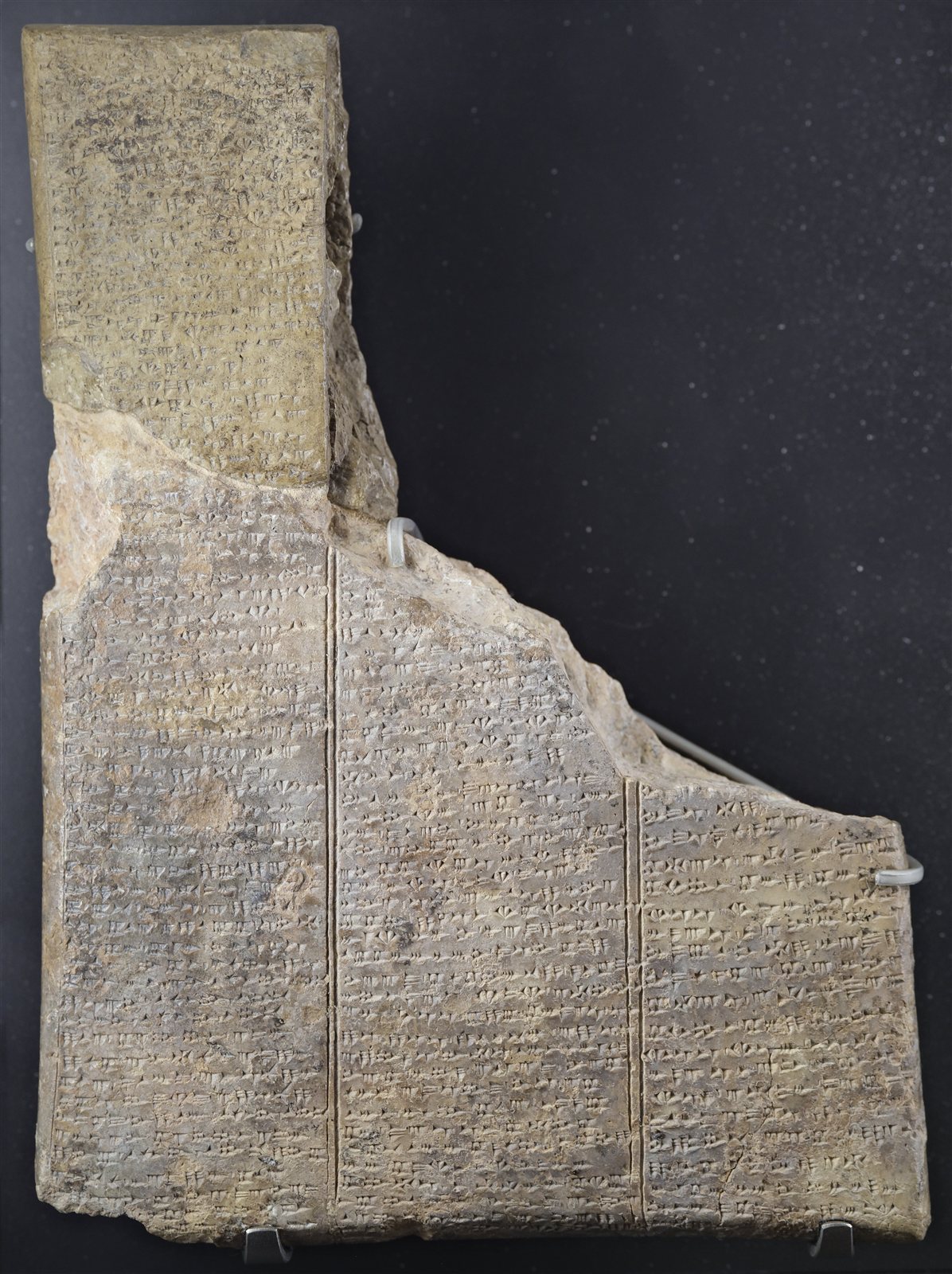
The surviving fired-clay tablet AO 16636 at the Louvre. Three columns of Ugaritic alphabetic cuneiform are visible on this broken face
License · Image sourceObject details
- Title
- Tablet Six of the Baal Cycle (Louvre AO 16636)
- Timeline
- From 1400 BCE to 1200 BCE
- Region
- The Levant
- Rights
- CC0
Text
Introduction
Three columns of wedge-shaped signs remain visible on the photographed face of Louvre tablet AO 16636. The pieces from the acropolis of Ras ShamraUgaritAncient city and kingdom at Ras Shamra on the Syrian coast, flourishing between the fourteenth and early twelfth centuries BCE and preserving multilingual archives.Glossary · Click to read the explanation, ancient Ugarit, make up the sixth tablet in the conventional ordering of the Baal CycleBaal CycleA group of Late Bronze Age Ugaritic religious texts recounting Baal’s conflicts, relationships with the gods and the building of his palace.Glossary · Click to read the explanation. In it AnatAnatAnat is an ancient Near Eastern goddess attested at Mari, Ugarit and in Egypt. In Ugaritic narratives she is a warrior, Baal’s ally and a mourner for him; her roles vary by tradition and context.Glossary · Click to read the explanation confronts MotMotGod of death in the Baal Cycle; an adversary who returns even after a violent attack.Glossary · Click to read the explanation, El dreams that BaalBaalUgaritic storm god and warrior king who defeats Yamm, builds his palace with El’s consent and confronts Mot. References to El and Dagan as fathers do not define a single genealogy.Glossary · Click to read the explanation is alive, and Baal returns to face his rival. A scribal note at the end names IlimilkuIlimilkuUgaritic scribe associated with the Baal Cycle, Kirta and Aqhat; handwriting and colophons aid attribution. His work alone does not date the traditions’ origins.Glossary · Click to read the explanation. [1][2][3][4][5]
The object from Ras Shamra
The Louvre lists two excavation numbers, RS 2.009 and RS 5.155, and gives the House of the High Priest on the Ras Shamra acropolis as the findspot. The Göttingen catalogue records the two fragments as a join and identifies the tablet as KTUKTU: Ugaritic Text ReferencesAbbreviation for a modern edition of alphabetic cuneiform texts. Its text references can be cross-identified with find numbers such as RS or RIH; they are not dates.Glossary · Click to read the explanation 1.6. Charles Virolleaud reports that the fragment found in 1933 preserves the beginning of column I and the end of column VI, including the scribal note. The Louvre describes the material as fired clay, gives a height of 27 cm and dates the tablet to about 1400–1200 BCE. [1][2][6]
The writing is Ugaritic in alphabetic cuneiformUgaritic alphabetAlphabetic cuneiform system of Late Bronze Age Ugarit, using thirty chiefly consonantal written signs, distinct from Akkadian syllabic cuneiform.Glossary · Click to read the explanation. On the photographed face, the long ruled lines across the surviving surface mark the divisions between columns. The edge of the break cuts diagonally through the column layout and leaves much less writing on one side of the image than on the other. In editions of the poem, the numbering of the columns and lines makes it possible to locate a passage even when part of the clay that once carried it is missing. [1][4]
Anat and Mot
At the start of the surviving narrative, the sun goddess ShapshuShapshuShapshu, the Ugaritic sun goddess, helps mourn Baal and warns Mot under El’s authority; her links with the dead and drought remain debated.Glossary · Click to read the explanation helps Anat carry Baal’s body for burial. The poem then presents Anat confronting Mot. Mot is Baal’s rival in the story and is associated with death. Anat overcomes him, and the narrative moves on to the question of whether Baal is alive. Mot returns later and faces Baal again. In his discussion of the poem, Koowon Kim treats Anat’s defeat of Mot and Baal’s return as distinct stages in a sequence that also involves El and Shapshu. [3][4][6]
Kim estimates that about 40 lines are missing at the start of the third column. He considers it possible that Anat told El of Mot’s death in the lost passage. [4]
El’s dream
In the third column, El sets out what he will take as a sign that Baal lives. He says that oil will fall from the sky and honey will flow through the streambeds. The poem repeats both images when El has the dream, then describes his relief. He says that Baal is alive. Soon afterward he asks Anat to take a message to Shapshu. The message speaks of dry furrows and asks where Baal is. The contrast between the abundance in the dream and the dry fields in the message gives the scene much of its force. [4]
Kim reads El’s declaration as a turning point in the narrative. In his interpretation, declaring that Baal lives sets the other characters in motion and helps bring about Baal’s return to his place of rule. The poetic images describe what El sees in a dream. The surviving dialogue shows what he says and does after seeing it. [4]
The scribe’s name
The colophon, a note at the end of the text, names Ilimilku of Shubbanu as scribe and identifies him as a pupil of Attenu. It also names Niqmaddu, king of Ugarit. František Válek discusses how to assign the titles in this passage, including those usually rendered chief priest and chief herdsman. The names can be read with more confidence than the attribution of each office. The note tells us who wrote down the poem in the surviving copy. How much Ilimilku contributed to shaping its wording remains an open question. [2][5]
The final lines shift the reader’s attention from the figures in the story to named people associated with the writing of the tablet. Ilimilku identifies himself by his place of origin and by his teacher. These are details about the transmission of the poem preserved within the same clay object as the story itself. [1][5]
Quick answers
What is this tablet and where was it found?
It is the sixth tablet of the Baal Cycle, written in Ugaritic alphabetic cuneiform on fired clay. It was found in the House of the High Priest on the acropolis of Ras Shamra, ancient Ugarit. [1][2][6]
How old is it?
The Louvre dates the tablet to about 1400–1200 BCE. It is 27 cm high and made of fired clay. [1][2][6]
What happens in the story on this tablet?
Anat confronts Mot, Baal's rival who is linked with death, and overcomes him. The story then turns to whether Baal is alive. [3][4][6]
What is El's dream about?
El says oil will fall from the sky and honey will flow in the streambeds as a sign that Baal lives. After the dream he says Baal is alive. [4]
Who wrote the tablet, and what is still unclear?
A note at the end names Ilimilku of Shubbanu as scribe, a pupil of Attenu. The names are fairly secure, but how much he shaped the poem's wording is an open question. [2][5]
References and notes
- Musée du Louvre, Département des Antiquités orientales, “tablette ; fragment,” AO 16636, RS 5.155, RS 2.[009] Inventory, inscription, material, dimensions, Late Bronze Age date and findspot in the House of the High Priest on the Ras Shamra acropolis. Return to the text ↑
- Edition des ugaritischen poetischen Textkorpus, Georg-August-Universität Göttingen, “Texte, Tafeln, Forschung” Index entry Baˁlu VI (Baal-Zyklus VI), correlating the excavation numbers, Louvre AO 16.636 and the KTU 1.6 and CTA 6 references. Return to the text ↑
- West Semitic Research Project, University of Southern California, “Ugaritic Texts,” ISF_TXT_01246, “Baal Myth Sixth Tablet” Catalogue row on the tablet’s identifiers, present collection and the sequence of Shapshu and Anat, Mot’s defeat and the renewed encounter with Baal. Return to the text ↑
- Koowon Kim, “When Even the Gods Do Not Know: El’s Dream Divination in KTU 1.6 iii,” in Perchance to Dream: Dream Divination in the Bible and the Ancient Near East, ed. Esther J. Hamori and Jonathan Stökl, Ancient Near East Monographs 21, SBL Press, 2018, 43–60 Pp. 46–49, text and translation of KTU 1.6 iii 1–24 and iv 1–5 and the gap at the start of column iii. Pp. 55–57, the declaration that Baal is alive and the episodes that follow. Return to the text ↑
- František Válek, “The Epics of Aqhat and Kirta as Social Myths?,” Aula Orientalis 42 (2), 2024, 253–280 Section 4.2, “Authorship,” pp. 261–262, the transliteration and translation of KTU 1.6 vi 54–58, the identity of the scribe and the uncertain allocation of the titles. Return to the text ↑
- Charles Virolleaud, ‘Fragment nouveau du poème de Môt et d’Aleyn-Baal’, Syria 15 (3), 1934, pp. 226–243 P. 226 on the fragment discovered in 1933 and the portions it preserves. Pp. 234–235 on column I, Shapshu’s help in carrying Baal’s body and Anat’s burial of him. Return to the text ↑
Archive records may be reviewed and refined as better evidence or sources become available. Suggest a correction
Suggest a correction · Suggest a source for this record
Cite this record
IL Archive, «Tablet Six of the Baal Cycle (Louvre AO 16636)», https://ilarchive.com/en/artifacts/baal-cycle-tablet-six
Continue reading