Artifact
Tablet III of Enuma Elish (British Museum K.3473+)
An object record bringing together its image, metadata, rights, and context.
- Timeline
- From 911 BCE to 612 BCE
- Region
- Mesopotamia
This clay manuscript from Nineveh preserves the gods’ preparations for Marduk’s confrontation with Tiamat. Its last line repeats the opening of Tablet IV, when the gods set out a dais for Marduk.
Estimated reading time: 4 min Published Last reviewed:
Share article
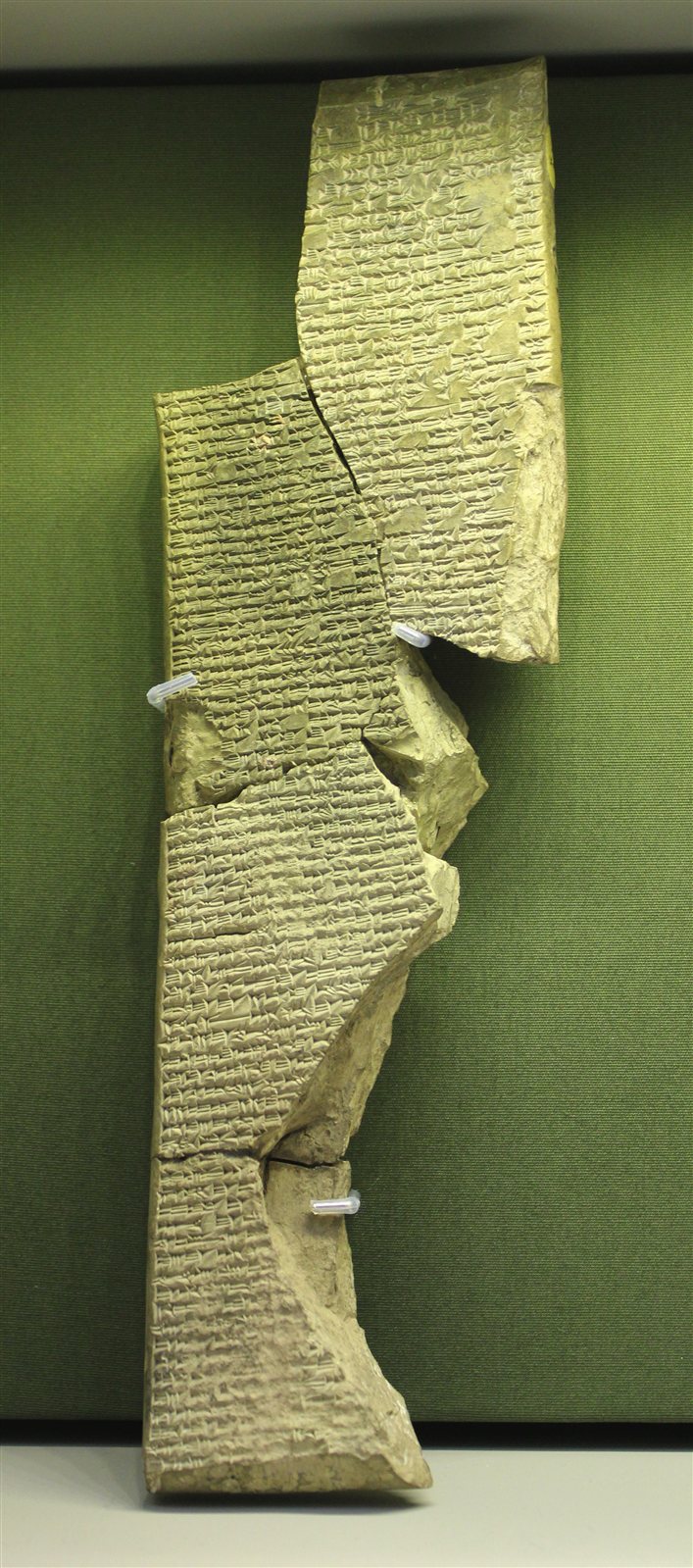
Photograph
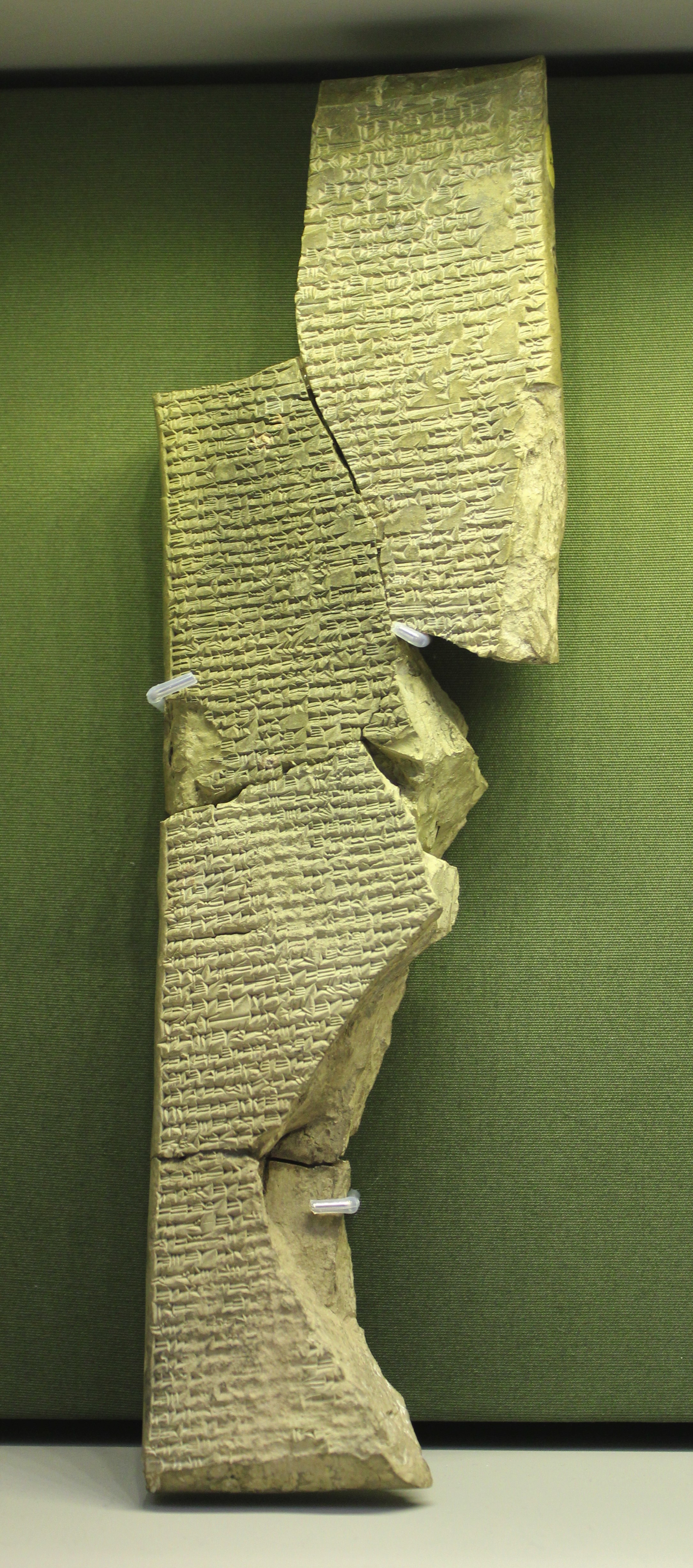
Photograph by Zunkir, via Wikimedia Commons. CC BY-SA 4.0. Image resized.
Surviving clay from a Nineveh manuscript of Enuma Elish, Tablet III, in the British Museum display group associated with K.3473. Lines of cuneiform are visible between the breaks
License · Image sourceVideo
Enuma Elish: The first waters, the storm and the fifty names
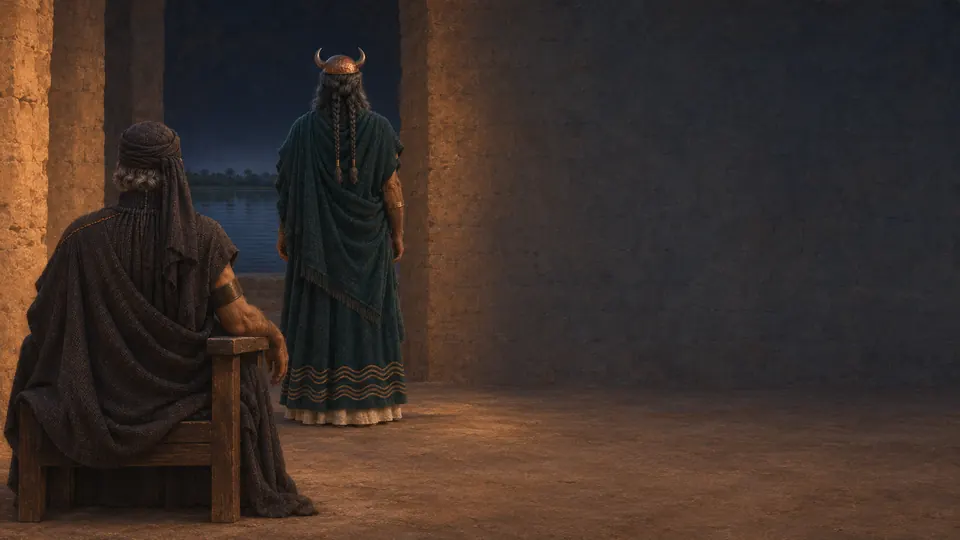
The first waters, the storm and the fifty names. The whole story in four illustrated chapters, told from the ancient clay tablets; where the tablets are broken, the narration says so. Illustrations, narration voice and visual effects were created with AI tools by IL Archive; the text is a faithful retelling based on the ancient tablets.
The YouTube player loads only when you press play. Watch on YouTube
Object details
- Title
- Tablet III of Enuma Elish (British Museum K.3473+)
- Timeline
- From 911 BCE to 612 BCE
- Region
- Mesopotamia
- Rights
- CC BY-SA
Text
Introduction
The long, broken clay tablet in the British Museum preserves part of Enuma ElishEnuma ElishA seven-tablet Babylonian creation poem in Akkadian, recounting Marduk’s rise, victory over Tiamat, cosmic ordering and human creation, and culminating in praise through fifty names. Its composition date is debated; later manuscripts and recitation traditions preserve it.Glossary · Click to read the explanation, the Babylonian creation poem. It comes from NinevehNineveh and KuyunjikNineveh is an ancient Assyrian city near Mosul in northern Iraq; Kuyunjik is one of its archaeological moundsGlossary · Click to read the explanation and is catalogued under several fragment numbers, including K.3473. The electronic Babylonian Library identifies it as a witness to Tablet III. The surviving text includes the dispatch of a messenger to the gods. A line at the end also anticipates the beginning of Tablet IV. The object preserves an episode and a device for connecting it to the next part of the poem. [1][2][3][4][5]
A manuscript from Nineveh
The British Museum records K.3473 as a clay tablet fragment from Kuyunjik, the mound of ancient Nineveh. It dates the fragment to the Neo-Assyrian period and counts 38 + 4 lines on K.3473 itself. The electronic Babylonian Library records two joins, Rm.615 and 1879,0708.296. The accession list for CDLI record P365283 also includes K.4832. In the electronic Babylonian Library, K.4832 is catalogued separately as a witness to Tablet II. [1][2][3][7]
The photograph shows the narrow surviving portion of the manuscript, with rows of cuneiformCuneiformWriting with wedge-shaped signs, developed from Mesopotamian recording traditions and used for several languages from the third millennium BCE.Glossary · Click to read the explanation and several breaks visible. Babette Schnitzlein and Jon Taylor include K.3473 in their survey of tablets in the Library of AshurbanipalAshurbanipalAshurbanipal was an Assyrian king of the seventh century BCE, reigning about 668–631 BCEGlossary · Click to read the explanation and list it as a manuscript with one column. Their comparison finds that most of the Enuma Elish sources in their survey were in a tall format with one column and notes a two-column example from Ashur. The shape and layout of the surviving manuscript are therefore part of the evidence for how the poem was copied. [2][6]
Anshar’s message
Tablet III opens with the god Anshar preparing to speak. He sends his vizier Kakka to Lahmu and Lahamu to summon the gods. The message describes TiamatTiamatTiamat is a primeval divine mother and watery figure in Enūma eliš who later opposes Marduk; he divides her body in making the cosmos. No Babylonian portrait of her is securely identified.Glossary · Click to read the explanation’s anger, the forces gathered around her, and MardukMardukBabylon’s leading god, worshipped at Esagil and elevated in the Akkadian Enūma eliš. His symbols include a spade and mušḫuššu dragon. His earliest origins remain obscure; Nibiru is no evidence of a planetary homeland.Glossary · Click to read the explanation’s decision to confront her. Marduk asks the gods to assemble and give him the power to determine destinies in their place. The text devotes much of this tablet to the arrangements leading up to the encounter. [4]
Much of what Kakka is told to say appears again when he delivers the message. In the digital edition, these speeches are presented as part of a continuous text, with the readings of individual manuscripts available beneath the lines. This makes it possible to follow the repetition and also to ask which words a particular piece of clay preserves. Near the end of Tablet III the gods go before Anshar and gather in assembly. The next tablet opens with the setting out of a dais for Marduk. [2][4][5]
The line that leads to Tablet IV
The electronic Babylonian Library records this same witness twice in the poem. In Tablet III it appears under the label NinNA1. In Tablet IV it appears under the label NinNAQuo1 for the opening line. The comparison of copies shows that the latter line occurs on the reverse of the Tablet III witness. It gives the words about setting out a dais for Marduk. The line serves as a catchline, a repetition of the opening of the next tablet at the end of the one being read. [2][4][5]
That placement gives one line two functions. It belongs to the opening of Tablet IV as part of the story, while on this clay manuscript it helps mark the connection between installments. The digital edition gives the position on the reverse as line 54. This is a line number on the physical tablet. In the continuous text of the poem the same words are numbered as line 1 of Tablet IV. Keeping those references together explains why the electronic Babylonian Library’s fragment record points to both parts of the edition. [2][4][5]
The museum and object catalogues identify the pieces, while the digital edition compares their lines with those on other copies. Its continuous translation draws on that wider evidence. By moving between the fragment record and the line comparison, a reader can see which copy supplies a particular reading and where the ancient scribe marked the passage from one tablet to the next. [1][2][3][4][5]
References and notes
- The British Museum, Collection Online, “tablet,” K.3473 Description, production period, excavated findspot and the catalogue’s count of 38 + 4 lines for K.3473. Return to the text ↑
- electronic Babylonian Library, “K.3473: eBL fragment edition” Fragment record, joins, provenance, Neo-Assyrian script, and links under Edited in Corpus to the Tablet III witness NinNA1 and the Tablet IV quotation NinNAQuo1. Return to the text ↑
- Cuneiform Digital Library Initiative, “CDLI Literary 002718.03, ex. 001 (P365283)” Text content, chronology, provenance and collections. The accession field includes K.04832 as well as the three pieces linked by eBL. Return to the text ↑
- A. C. Heinrich, “Poem of Creation (Enūma eliš) Chapter III,” electronic Babylonian Library, 2021, translated by Benjamin R. Foster Edition, opening, the instructions to Kaka and their repetition in his report, and the closing assembly. Line 1 comparison shows witness NinNA1. Return to the text ↑
- A. C. Heinrich, “Poem of Creation (Enūma eliš) Chapter IV,” electronic Babylonian Library, 2021, translated by Benjamin R. Foster Edition, line 1 and its expanded score. NinNAQuo1 gives reverse line 54 and marks the rest of the side as blank. Return to the text ↑
- Babette Schnitzlein and Jon Taylor, “Typological Aspects of Scholarly Tablets in the Library of Ashurbanipal,” KASKAL 21, 2024 Section 6 on literary tablets, the Enūma Eliš comparison, figure 13 and the Appendix entry for K.3473. Return to the text ↑
- electronic Babylonian Library, ‘K.4832: eBL fragment edition’ Fragment K.4832. Under Edited in Corpus, the entry links this fragment to Tablet II as witness NinNA3. Return to the text ↑
Archive records may be reviewed and refined as better evidence or sources become available. Suggest a correction
Suggest a correction · Suggest a source for this record
Cite this record
IL Archive, «Tablet III of Enuma Elish (British Museum K.3473+)», https://ilarchive.com/en/artifacts/enuma-elish-tablet-three-k3473
Continue reading