Artifact
Baal and Yam on a Tablet from Ugarit (Louvre AO 16640)
An object record bringing together its image, metadata, rights, and context.
- Timeline
- From 1400 BCE to 1200 BCE
- Region
- The Levant
A clay fragment from Ugarit preserves part of the struggle between Baal and Yam. The poem moves from a demand for Baal’s surrender before the assembly of the gods to a battle in which the craftsman Kothar names two weapons.
Estimated reading time: 4 min Published Last reviewed:
Share article
Photograph
Shonagon, Wikimedia Commons. CC0 1.0. Image resized.
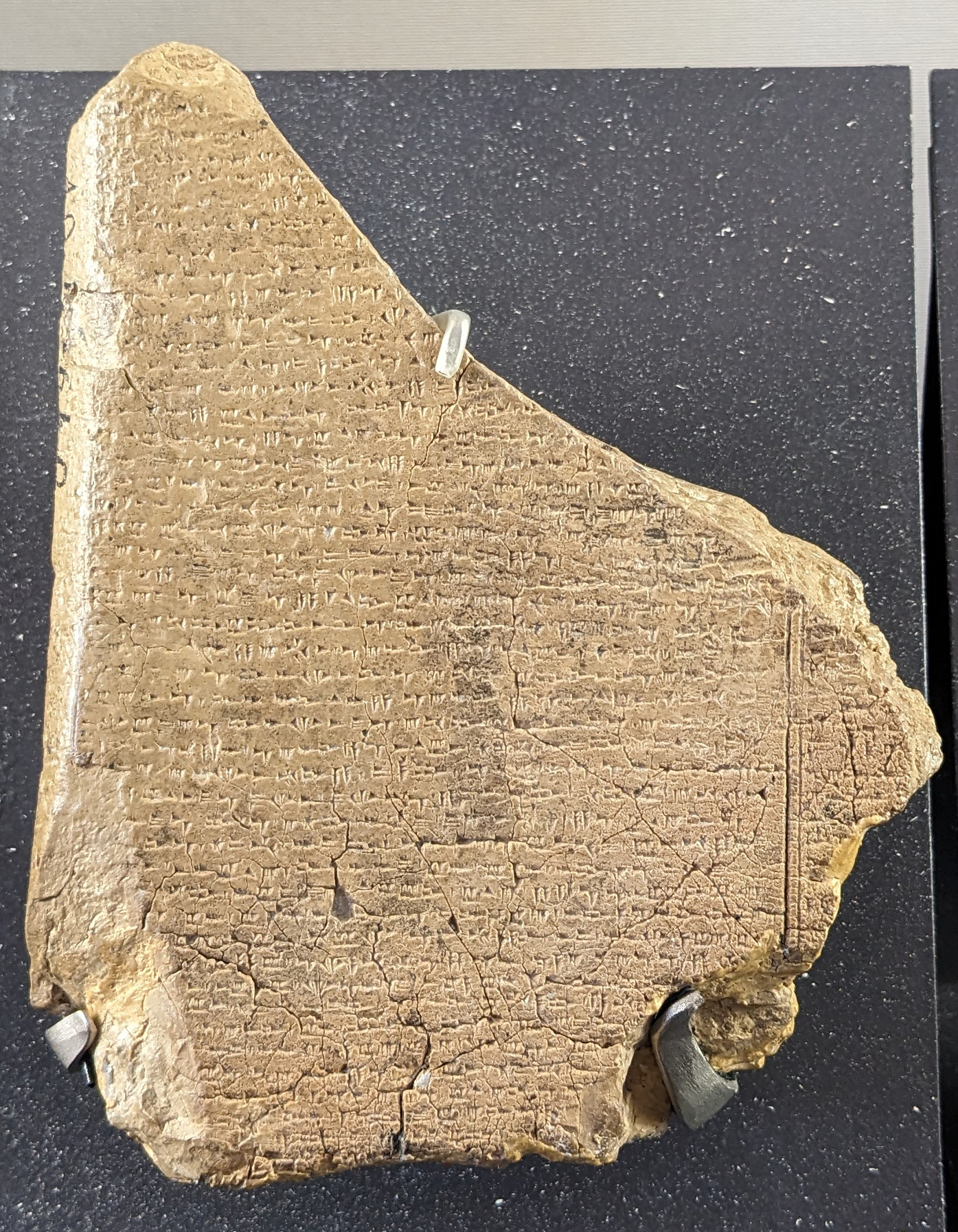
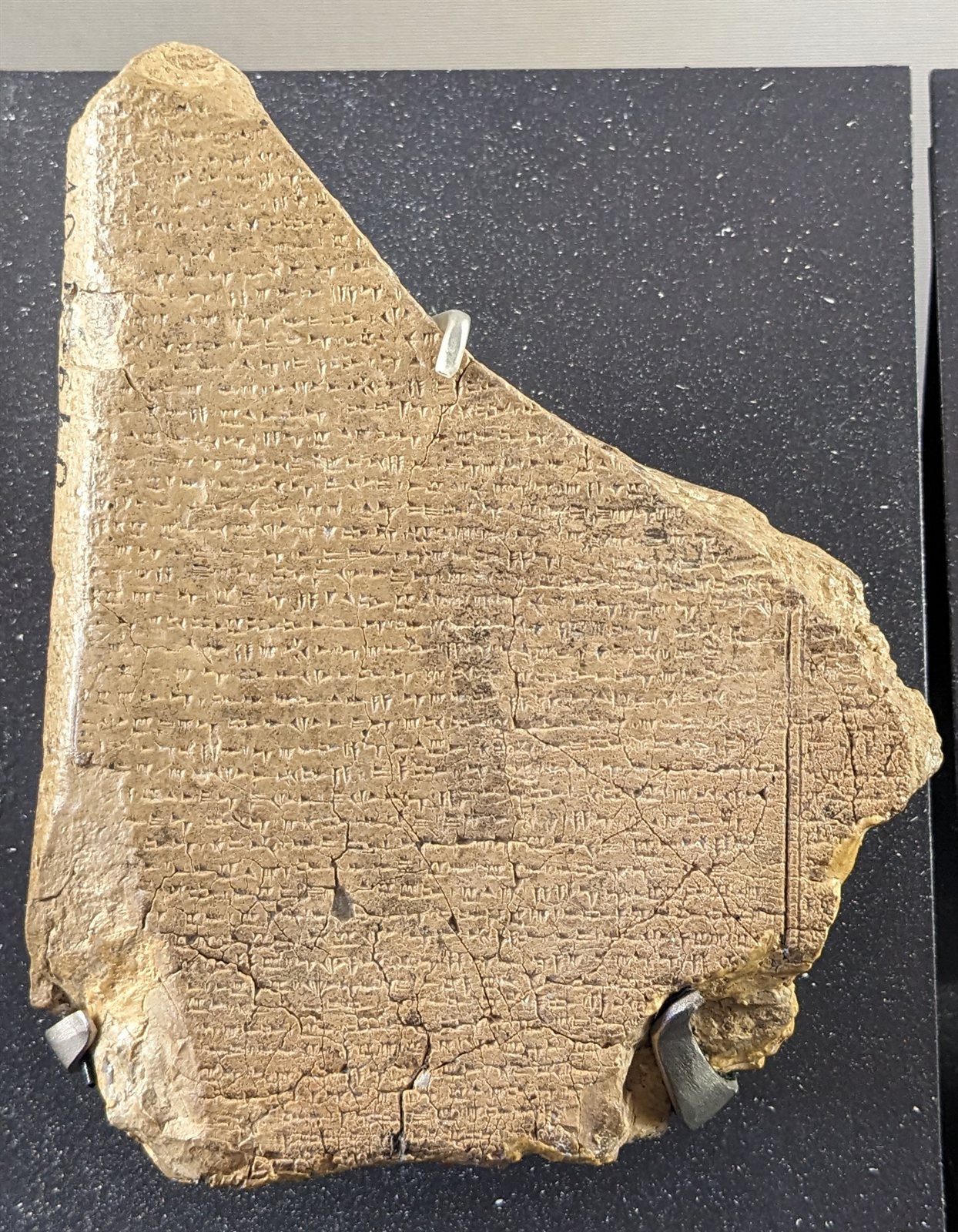
The inscribed clay fragment AO 16640 from Ras Shamra. The sloping break cuts across the lines of Ugaritic alphabetic cuneiform
License · Image sourceObject details
- Title
- Baal and Yam on a Tablet from Ugarit (Louvre AO 16640)
- Timeline
- From 1400 BCE to 1200 BCE
- Region
- The Levant
- Rights
- CC0
Text
Introduction
The Louvre fragment AO 16640 comes from a clay tablet of the Baal CycleBaal CycleA group of Late Bronze Age Ugaritic religious texts recounting Baal’s conflicts, relationships with the gods and the building of his palace.Glossary · Click to read the explanation found at UgaritUgaritAncient city and kingdom at Ras Shamra on the Syrian coast, flourishing between the fourteenth and early twelfth centuries BCE and preserving multilingual archives.Glossary · Click to read the explanation. The text to which it belongs is conventionally called the second tablet and is cited as KTUKTU: Ugaritic Text ReferencesAbbreviation for a modern edition of alphabetic cuneiform texts. Its text references can be cross-identified with find numbers such as RS or RIH; they are not dates.Glossary · Click to read the explanation 1.2. It carries part of the story of BaalBaalUgaritic storm god and warrior king who defeats Yamm, builds his palace with El’s consent and confronts Mot. References to El and Dagan as fathers do not define a single genealogy.Glossary · Click to read the explanation and his rival YamYam / NaharSea god in Ugaritic texts, associated with the name Nahar and portrayed in the Baal Cycle as Baal’s rival for authority among the gods.Glossary · Click to read the explanation, the god of the sea. The surviving lines include a demand that the gods surrender Baal and a battle in which the craftsman Kothar equips him with two named weapons. Editors also associate a smaller fragment with the text. Its physical attachment to the larger piece remains in doubt. [1][2][3][5][6][7]
The fragment from Ras Shamra
The Louvre catalogues AO 16640 as fired clay and records its dimensions as 12.5 cm high, 9.9 cm wide and 2.9 cm thick. The museum dates it to about 1400–1200 BCE, in the Late Bronze AgeLate Bronze AgeAn archaeological period around 1600–1200 BCE in much of the Near East, with international diplomacy, exchange and religious diversity; its endpoints vary by region.Glossary · Click to read the explanation. The excavators found it in 1931 in the building known as the House of the High Priest on the acropolis of Ras Shamra. Claude Schaeffer’s report dates that third excavation campaign from late March to mid-July. The Louvre records that the piece entered its collection through the division of finds after excavation. [1][4]
On the photographed face, the lines of alphabetic cuneiformUgaritic alphabetAlphabetic cuneiform system of Late Bronze Age Ugarit, using thirty chiefly consonantal written signs, distinct from Akkadian syllabic cuneiform.Glossary · Click to read the explanation stretch across a broad lower portion of the fragment and narrow as they approach the sloping break above. The break interrupts the writing. Where the lines survive only in part, editions may restore words from repeated passages or leave gaps. The inscription is in Ugaritic, and modern editions index its lines by column so readers can locate the surviving passages. [1][3][5][7]
The larger fragment carries the excavation number RS 3.367. The smaller Louvre fragment, AO 16640 BIS, carries RS 3.346 and has a separate catalogue entry. The Göttingen concordance groups both fragments under KTU 1.2, also known as CTA 2. The Louvre describes the physical join with AO 16640 BIS as probably erroneous. The shared reference identifies the text as editors have grouped it, while the inventory numbers identify the two pieces of clay. [1][2][3]
Yam’s demand before the gods
In Aaron TugendhaftAaron TugendhaftScholar of the ancient Near East and the relationship between religion, politics and the arts.Glossary · Click to read the explanation’s translation of the first column, Yam sends envoys to the assembly. Their orders tell them to stand while delivering his demand for Baal and to withhold the gestures of deference normally expected before El and the assembled gods. The assembly is seated at a feast as Yam’s envoys approach Mount Lalu. They appear like flames, and the poem compares their speech to a sharpened sword. The gods lower their heads when they see the envoys. Baal tells them to raise their heads and offers to answer the messengers himself. The poem gives Yam’s demand first as an instruction to the envoys and then as the speech they deliver. It calls him by name and by a second designation, Nahar, or River. [5]
El replies that Baal will serve Yam and bring him tribute. Baal reacts in anger. In Tugendhaft’s rendering, AnatAnatAnat is an ancient Near Eastern goddess attested at Mari, Ugarit and in Egypt. In Ugaritic narratives she is a warrior, Baal’s ally and a mourner for him; her roles vary by tradition and context.Glossary · Click to read the explanation and Astarte seize his hands as he turns on the envoys. Tugendhaft draws attention to the changes in posture as part of the dispute over authority. The messengers follow Yam’s order to stand while speaking, and Baal speaks after urging the assembly to lift its heads. [5]
The weapons Kothar names
In the fourth column, Kothar-wa-HasisKothar-wa-HasisUgaritic divine craftsman who makes Baal’s weapons, builds his palace and proposes its window; also associated with Aqhat’s bow. No securely identified ancient portrait.Glossary · Click to read the explanation names two maces. Scott Noegel gives the names ygrš and ʾaymr the senses of “Driver” and “Expeller.” The names echo the verbs Kothar uses to address the weapons. Each name is immediately turned into a command to drive Yam from his throne. Noegel reads the naming and the command as part of what gives the weapons their power in the story. The language connects each blow to the loss of Yam’s seat of rule. [6][7]
Translators differ over the verb that introduces Kothar’s action. Noegel takes it to mean that he fashions the maces. William Justin Reed reads it as bringing them down and notes that the name of the second weapon appears earlier in a damaged passage. In Reed’s translation of the battle, the first mace strikes Yam’s shoulder and he stays upright. The second strikes his head and he falls. The two episodes follow the same pattern of naming, command and blow, with a different outcome each time. [6][7]
References and notes
- Musée du Louvre, Département des Antiquités orientales, “tablette,” AO 16640, RS 3.367 Inventory, Description, Physical characteristics, Places and dates, and History. These sections record the object, the suspected problem with the join, dimensions, material, dating, findspot and entry into the collection. Return to the text ↑
- Musée du Louvre, Département des Antiquités orientales, “tablette,” AO 16640 BIS, RS 3.346 Inventory and Description. The catalogue lists the separate inventory number and refers to AO 16640. Return to the text ↑
- Edition des ugaritischen poetischen Textkorpus, Georg-August-Universität Göttingen, “Texte, Tafeln, Forschung” Tafelkonkordanz, Baˁlu II entry. Matches RS 3.367 and RS 3.346 with AO 16.640 and AO 16.640 bis, KTU 1.2 and CTA 2. Return to the text ↑
- Claude F.-A. Schaeffer, “Les fouilles de Minet-el-Beida et de Ras-Shamra. Troisième campagne (printemps 1931). Rapport sommaire,” Syria 13 (1), 1932, pp. 1–27 P. 1, dates of the third excavation campaign. Return to the text ↑
- Aaron Tugendhaft, “Unsettling Sovereignty: Politics and Poetics in the Baal Cycle,” Journal of the American Oriental Society 132 (3), 2012, pp. 367–384 Author’s copy. Pp. 382–383 on posture and authority and Appendix, pp. 383–384, translation of KTU 1.2 I 11–46. Return to the text ↑
- Scott B. Noegel, “‘Literary’ Craft and Performative Power in the Ancient Near East: The Hebrew Bible in Context,” in Approaches to Literary Readings of Ancient Jewish Writings, ed. Klaas Smelik and Karolien Vermeulen, Brill, 2014, pp. 19–38 Pp. 23–24, translation and discussion of Kothar’s words in KTU 1.2 IV 11–13 and 19–20. Return to the text ↑
- William Justin Reed, Yahweh’s “Cruel Sword”: The Manifestation of Punishment and the Trauma of Exile, doctoral dissertation, Johns Hopkins University, 2018 Pp. 106–107, text and translation of the two blows in KTU 1.2 IV 11–26. Pp. 108–110 discuss the disputed verb and the earlier appearance of the second weapon’s name. Return to the text ↑
Archive records may be reviewed and refined as better evidence or sources become available. Suggest a correction
Suggest a correction · Suggest a source for this record
Cite this record
IL Archive, «Baal and Yam on a Tablet from Ugarit (Louvre AO 16640)», https://ilarchive.com/en/artifacts/baal-cycle-tablet-two
Continue reading