Entity · Deity
Yam / Nahar
A reference page linking a name, group, or concept to the materials that discuss it.
Yam / Nahar, the sea god of Ugaritic texts and Baal’s rival for authority: the narrative, its witnesses, and the limits of interpretation and imagery.
Estimated reading time: 6 min Published Last reviewed:
Share article
Video
The Baal Cycle: The Sea, a palace and the meeting with Death
The Sea, a palace and the meeting with Death. The whole story in three illustrated chapters, told from the ancient clay tablets; where the tablets are broken, the narration says so. Illustrations, narration voice and visual effects were created with AI tools by IL Archive; the text is a faithful retelling based on the ancient tablets.
The YouTube player loads only when you press play. Watch on YouTube
Text
Introduction
Yam, paired with the name Nahar, is the sea god in texts from UgaritUgaritAncient city and kingdom at Ras Shamra on the Syrian coast, flourishing between the fourteenth and early twelfth centuries BCE and preserving multilingual archives.Glossary · Click to read the explanation, the ancient city on the Syrian coast. The Baal CycleBaal CycleA group of Late Bronze Age Ugaritic religious texts recounting Baal’s conflicts, relationships with the gods and the building of his palace.Glossary · Click to read the explanation makes him a rival of BaalBaalUgaritic storm god and warrior king who defeats Yamm, builds his palace with El’s consent and confronts Mot. References to El and Dagan as fathers do not define a single genealogy.Glossary · Click to read the explanation, the storm god, in a struggle for authority among the gods. Understanding his role requires distinguishing the surviving narrative, scholarly interpretations of the conflict, and what can be established about his imagery.[1]
Name and written evidence
The Ugaritic name Yam means Sea, and Nahar means River; Yam is associated with the title Judge River. Here the sea acts as a character who speaks, makes demands and fights. Not every ordinary use of the word sea names this deity.[2]
The formulas “zbl ym” and “ṯpṭ nhr,” Prince Yam and Judge River, repeatedly describe the same opponent. In KTU 1.2 IV 24–25 the club strikes Yam’s head and the space between Nahar’s eyes in a single action. This parallelism supports reading the names as one character in the scene, not two successive opponents. By itself, however, it cannot reconstruct a historical merger of originally separate gods.[8]
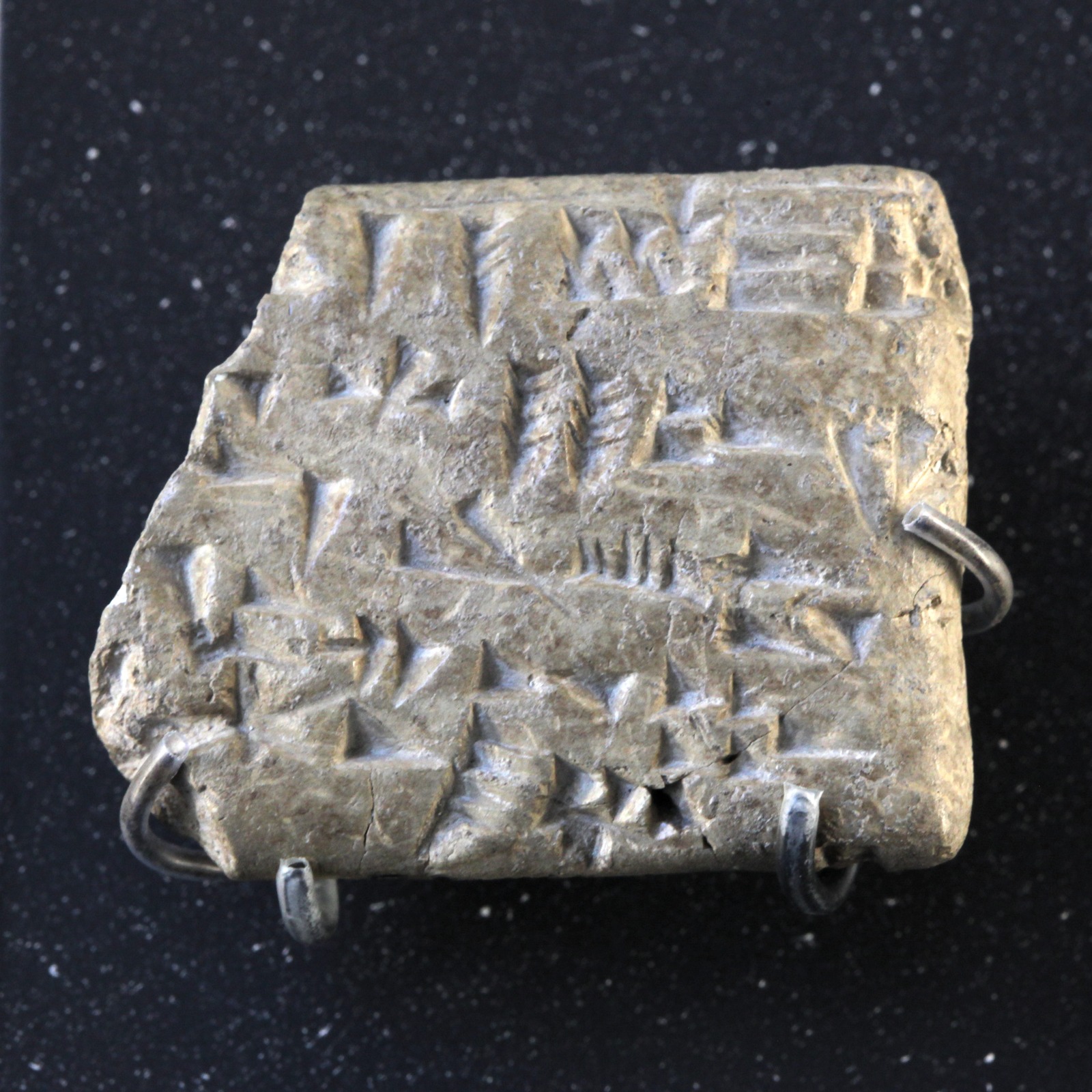
The Baal Cycle survives on six Late Bronze AgeLate Bronze AgeAn archaeological period around 1600–1200 BCE in much of the Near East, with international diplomacy, exchange and religious diversity; its endpoints vary by region.Glossary · Click to read the explanation tablets, not as an uninterrupted modern book. The battle passage is cited as KTUKTU: Ugaritic Text ReferencesAbbreviation for a modern edition of alphabetic cuneiform texts. Its text references can be cross-identified with find numbers such as RS or RIH; they are not dates.Glossary · Click to read the explanation 1.2 IV: the number identifies the text in a catalogue of Ugaritic texts, and the Roman numeral identifies the column. Such references direct readers to a particular witness rather than merging separate passages into a single story.[3]
Three different times
- Narrative time: a struggle in the divine world, without a human calendar date; council and throne already exist before the battle.
- Composition: these tablets do not supply a single date for the formation and wording of all the traditions. Older material is possible, but that does not date each passage or establish stages of compilation.
- Surviving copies: the Late Bronze Age. The Göttingen project places the scribe IlimilkuIlimilkuUgaritic scribe associated with the Baal Cycle, Kirta and Aqhat; handwriting and colophons aid attribution. His work alone does not date the traditions’ origins.Glossary · Click to read the explanation’s recording of the major epics in the late thirteenth century BCE, whereas the Louvre gives the photographed object the broader museum range of about 1400–1200 BCE. Identifying the scribe and dating the object are different operations; neither dates the mythological battle.[3][7]
The demand for Baal and the battle
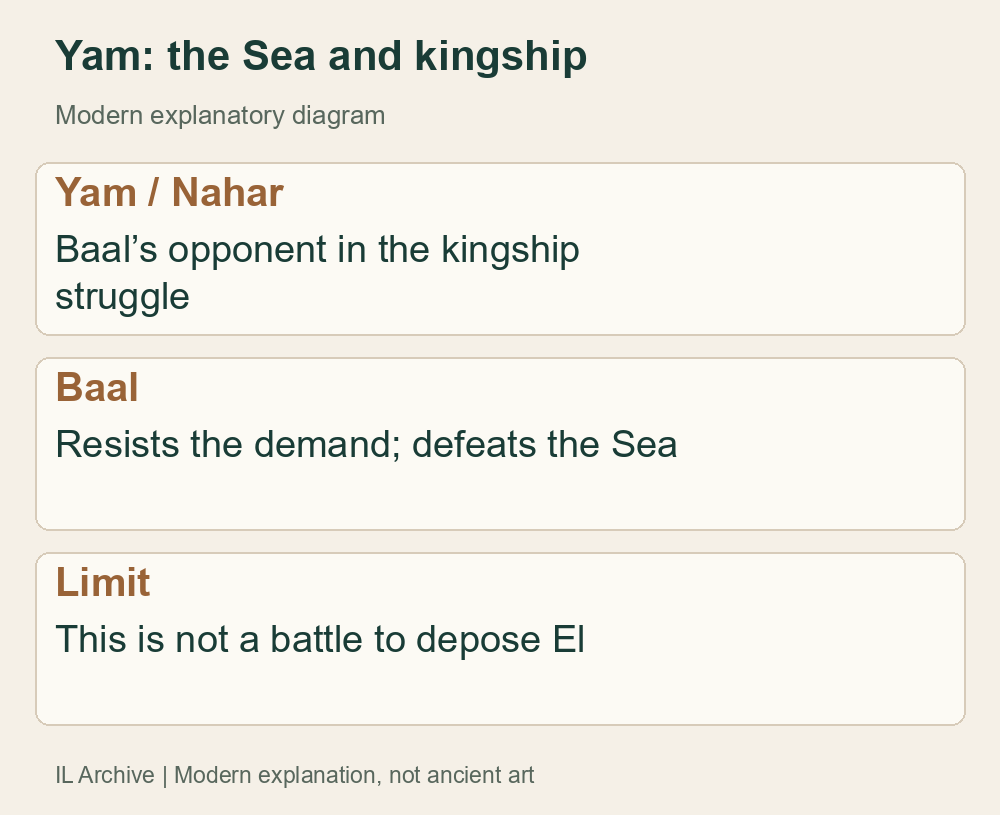
Yam sends envoys to the divine councilDivine councilA divine council is a religious and literary scene in which divine beings gather before a superior authority for discussion, commissioning or judgment; it is not identical to a pantheon list.Glossary · Click to read the explanation demanding Baal’s surrender. ElElEl is a senior deity in Late Bronze Age Ugaritic texts, portrayed as father of the divine family and a council authority, alongside his consort Athirat. This entry does not cover every linguistic use of El.Glossary · Click to read the explanation, the senior god, accepts the demand, but Baal resists. Baal wins the confrontation with help from Kothar-wa-HasisKothar-wa-HasisUgaritic divine craftsman who makes Baal’s weapons, builds his palace and proposes its window; also associated with Aqhat’s bow. No securely identified ancient portrait.Glossary · Click to read the explanation, the craftsman god who supplies his weapons. The opponent defeated here is Yam; this episode does not narrate a battle to depose El.[1]
The messenger passages show authority operating within the story: the gods lower their heads, Baal objects to their response, and the demands are delivered. These actions make the conflict more than a description of sea and weather; it also concerns submission, resistance and each god’s standing in the council.[4]
The beginning of the sequence is damaged, however. Elsewhere, in KTU 1.3 III, the goddess AnatAnatAnat is an ancient Near Eastern goddess attested at Mari, Ugarit and in Egypt. In Ugaritic narratives she is a warrior, Baal’s ally and a mourner for him; her roles vary by tradition and context.Glossary · Click to read the explanation’s speech is read as a claim to victories over Yam and others. The speaker and the relationship to Baal’s battle involve grammatical and interpretive debate. The gap should therefore not be filled with a detailed joint battle that the surviving narrative does not supply.[5] Jeffery B. Lloyd, author of a study of Anat, favors her claiming the actions herself, since first-person forms in the surrounding speech make that reading more consistent. Combining the two victories into one event requires a further interpretive step.[5]
What the battle lines actually say
KTU 1.2 IV 12–13, in the naming of Kothar’s first weapon, includes this Ugaritic excerpt in Latin transliteration:[8]
The slash separates poetic clauses; it does not mark a break in the tablet. This is an excerpt from two longer lines, and the selected wording requires no restored letters in the transcription used here. The translation renders the phrase directly rather than retelling the whole battle. Throne and dominion identify what the opponent must lose: a position of rule, not merely a body of water. The parallel Yam and Nahar also supports their identity within this scene.[8]
Victory unfolds in two stages. The first weapon, whose name is connected with driving away, strikes Yam’s shoulder without bringing him down; the second strikes his head and he falls to the ground (KTU 1.2 IV 11–26). The repetition contrasts resistance to the first blow with the success of the second. Kothar’s craftsmanship and naming of the weapons thus act alongside Baal’s strength.[8]
The ending means more than “the sea disappeared.” Mark S. SmithMark S. SmithScholar of the Hebrew Bible and Ugaritic religion whose work examines the divine family and biblical monotheism.Glossary · Click to read the explanation, the cycle’s specialist commentator, discusses disputed verbs in line 27 and the goddess Athtart’s speech in lines 28–31: does she restrain Baal or urge him to scatter his opponent? He favors scattering because the object pronoun in line 31 suits a transitive verb. Defeat is clearer than every action in the ending, and does not require the god’s disappearance from the wider tradition.[10]
Narrative opponent and recipient of offerings
Yam’s evidence extends beyond combat. Herbert Niehr’s specialist entry assembles attestations in god listsGod ListsTexts collecting divine names for preservation, teaching and classification, with varying theological organization.Glossary · Click to read the explanation and offering ritualsRitualAn organised or distinguished practice meaningful to a community; it may leave traces, but its form alone does not reveal an associated doctrine.Glossary · Click to read the explanation, including KTU 1.47:30 and 1.39:13. These make cosmic evil an inadequate definition: opposing Baal does not remove Yam from worship. Niehr interprets the River title as dominion over fresh water, not proof of a river ordeal unattested at Ugarit.[9]
Interpreting the conflict
Baal’s storm character and Yam’s marine name invite discussion of natural forces, but do not exhaust the narrative’s meaning. A scholarly reading emphasizes how combat stories establish divine hierarchy and kingship. It also questions descriptions of the defeated opponent as chaos or cosmic evil rather than accepting these as neutral, self-evident definitions.[6]
The royal reading is therefore stronger here: throne and the seat of rule occur in the witness itself, rather than being inferred solely from the names Sea and Storm. Natural imagery remains part of the characters, without turning the sequence of scenes into a securely established annual calendar. This weighs different kinds of evidence; it does not deny seasonal elements elsewhere in the cycle.[8][9]
Describing a story is not the same as reconstructing history: Baal’s victory in the text does not by itself demonstrate a political coup or the replacement of one cult by another. Resemblance to another story likewise does not make Yam identical to its sea figure. One important distinction is that Lotan, the serpentine monster of the texts, is not directly and unproblematically equated with Yam.[2]
What does the photograph show?
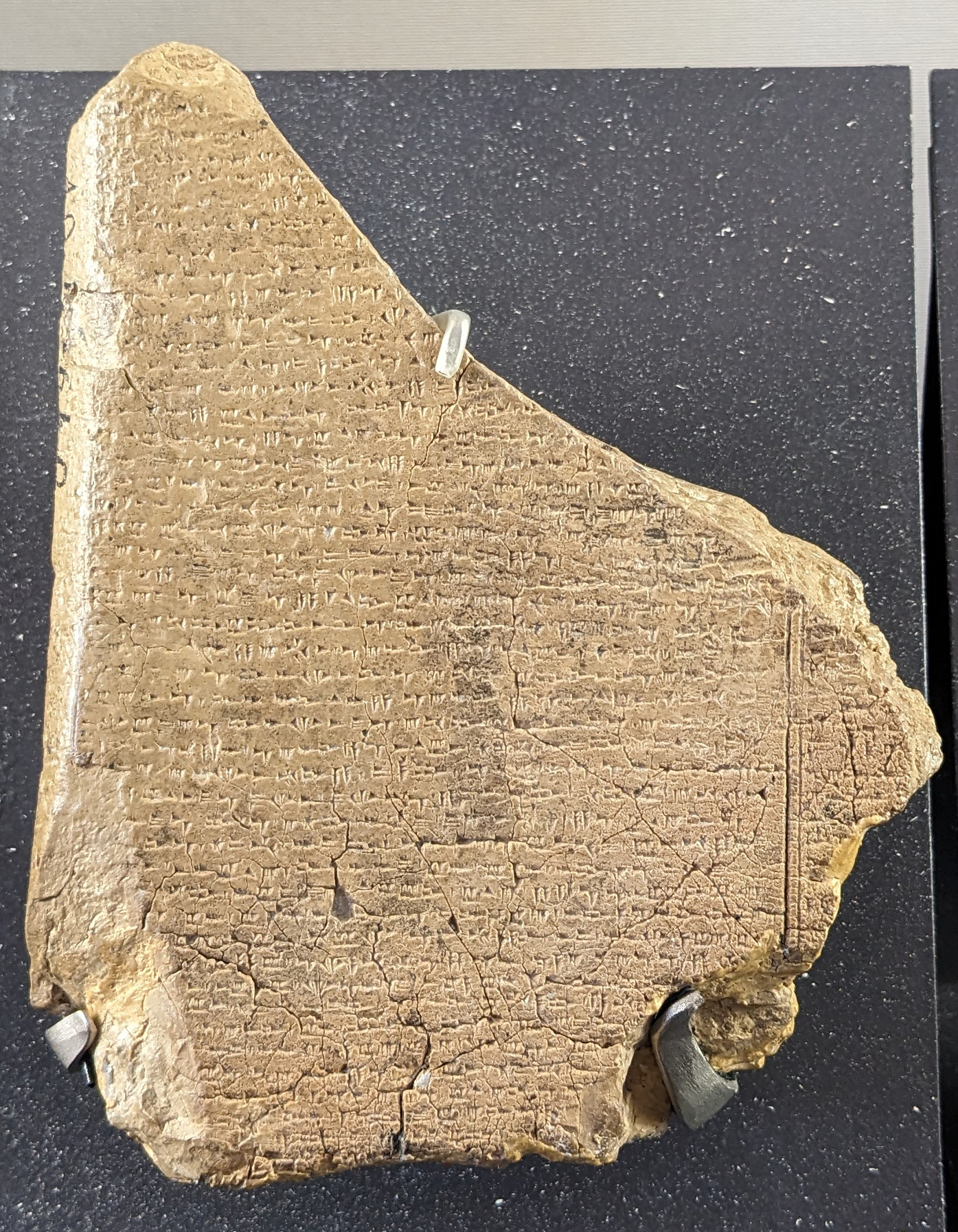
Louvre AO 16640 is a written witness from Ugarit associated with KTU 1.2. The museum dates it to about 1400–1200 BCE. It is incomplete; the catalogue warns that its proposed join with AO 16640 BIS is probably mistaken. The object’s date is not the date of the story’s events, and its photograph does not show Yam’s appearance.[7]
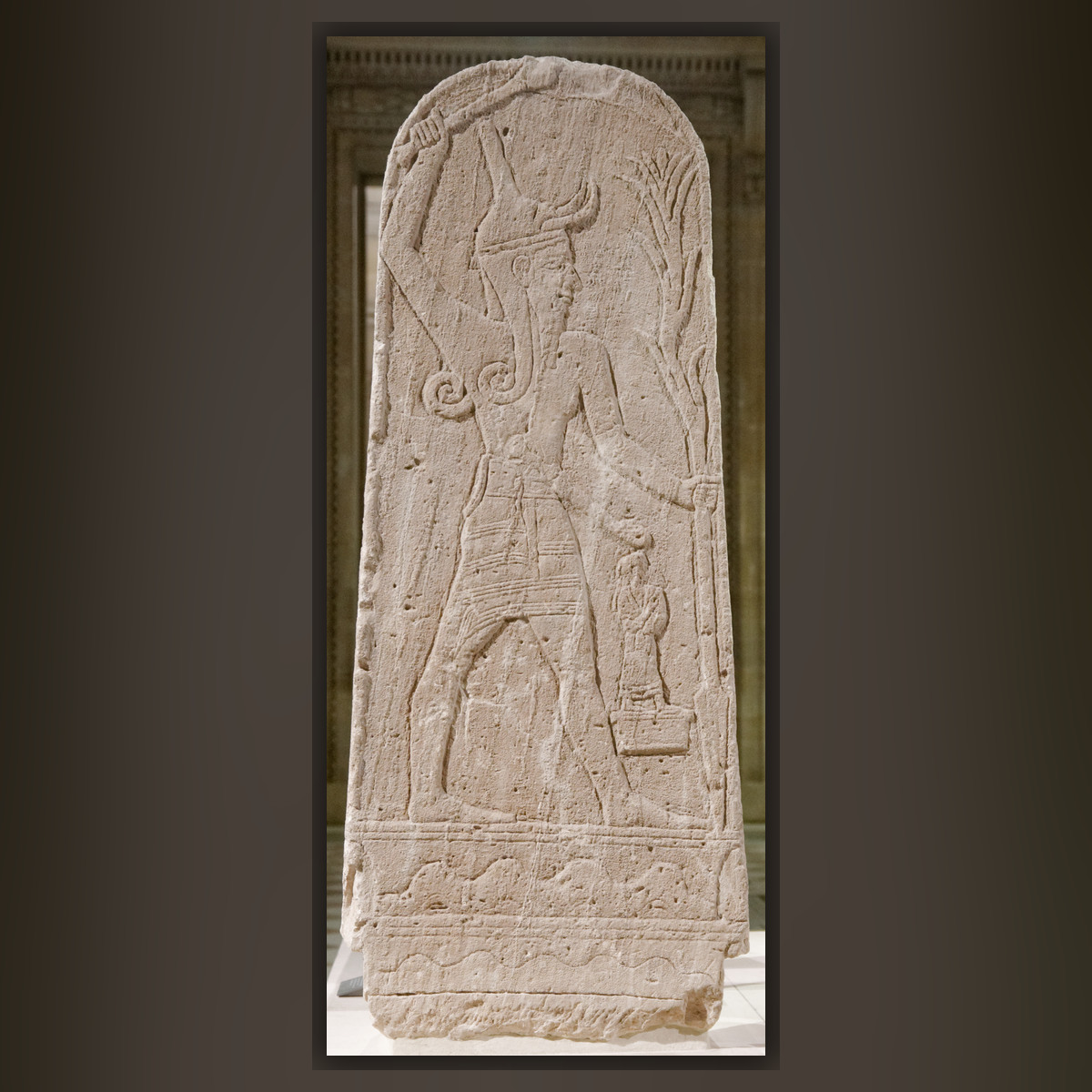
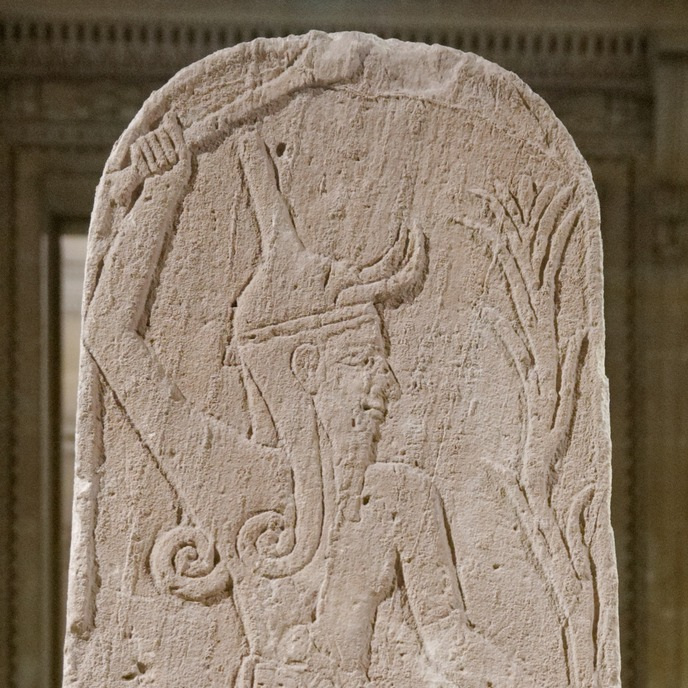
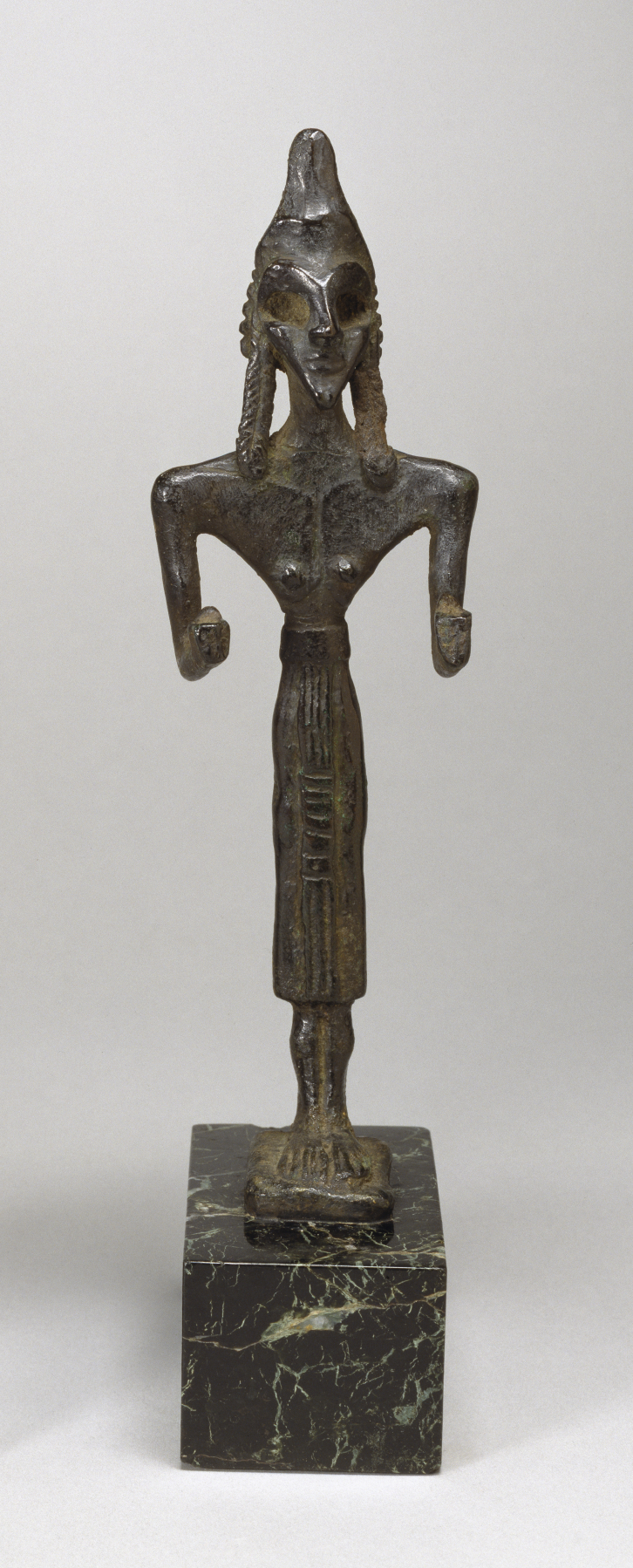
Identifying this god in seal scenes or water symbols requires an argument specific to each object; a serpent or wavy lines alone cannot establish identity. Choosing a written witness here distinguishes material survival from an imagined mythological scene.[2]
References and notes (10)
- Ira Spar, “The Gods and Goddesses of Canaan,” Metropolitan Museum of Art, 1 April 2009. Complete museum essay; especially Yam’s envoys, El’s acceptance, Baal’s resistance and Kothar’s assistance. Its seasonal explanation and identification of visual symbols are not adopted as consensus. Return to the text ↑
- Jürg Eggler, “Yam,” Iconography of Deities and Demons, electronic pre-publication, revised 9 June 2008. All three pages; p. 1 on the name, Nahar title and lack of direct equation with Lotan; pp. 1–2 on cautions concerning seals and wavy symbols. Return to the text ↑
- Edition des ugaritischen poetischen Textkorpus, Göttingen, corpus overview and tablet concordance. Baal Cycle overview and KTU 1.1–1.4 concordance, especially KTU 1.2; not a reading of the critical edition announced for future publication. For the battle in column IV, see also note 5. The page opening dating Ilimilku’s recording to the late thirteenth century BCE was also checked. Return to the text ↑
- Sang Youl Cho, Pro-angelology in the Ugaritic Texts and the Hebrew Bible: A Comparative Study of the Nature and Roles of Lesser Deities, PhD thesis, University of Edinburgh, 2007. Printed pp. 171–173 and opening of 174; translation and discussion of KTU 1.2 I 23–26 and 31–33. Selected passages, not the whole thesis. The author’s coronation premise is not treated as established by these lines alone. Return to the text ↑
- Jeffery B. Lloyd, The Goddess Anat: An Examination of the Textual and Iconographic Evidence from the Second Millennium B.C., PhD thesis, University of Edinburgh, 1994. Printed pp. 156–157, translation of KTU 1.3 III 38–40, pp. 174–176 and opening of 177. Lloyd favors Anat speaking of her victories and discusses the grammar and relation to Baal’s combat in KTU 1.2 IV. Not the entire thesis or an independent collation of Ugaritic. Return to the text ↑
- Debra Scoggins Ballentine, The Conflict Myth and the Biblical Tradition, Oxford University Press, 2015. Publisher abstracts of chapter II (chapter range pp. 22–72) and conclusion (pp. 186–198) only; restricted chapters not read. Kingship and the critique of chaos/evil labels are attributed to this scholarly interpretation. Return to the text ↑
- Musée du Louvre, Collections catalogue, tablet AO 16640, excavation number RS 3.367, Ras Shamra; updated 24 March 2026. Object record: dating 1400–1200 BCE, material, dimensions, incomplete condition and warning about the join with AO 16640 BIS; bibliography identifies KTU³ 1.2. This record does not supply the photograph’s license. Return to the text ↑
- William M. Schniedewind and Joel H. Hunt, A Primer on Ugaritic: Language, Culture, and Literature, Cambridge University Press, 2007. Gary A. Rendsburg, “UT 68 and the Tell Asmar Seal,” Orientalia 53 (1984), 448–452, pp. 449–450. Pp. 137–138, §6.5: complete transcription of KTU 1.2 IV; p. 137 visually checked (PDF page 155). Excerpt from lines 12–13, with words separated. Brief archive translations follow this transcription, checked against Rendsburg (1984), pp. 449–450; not an independent tablet collation. Return to the text ↑
- Herbert Niehr, “Yammu,” Reallexikon der Assyriologie und Vorderasiatischen Archäologie 15, 2016, pp. 142–144. Complete entry; particularly §1, p. 143 (PDF page 193), on god lists, offerings and the River title. Ritual references follow Niehr’s survey, not a new reading of the ritual tablets. Return to the text ↑
- Mark S. Smith, The Ugaritic Baal Cycle, Volume I: Introduction with Text, Translation and Commentary of KTU 1.1–1.2, Brill, 1994. Pp. 351–358: verbs in KTU 1.2 IV 27, Athtart’s speech and the ending. Electronic extracted commentary read, not the whole book or tablet photographs; line transcription checked with Schniedewind and Hunt. Interpretive disagreement does not negate Yam’s defeat. Return to the text ↑
Suggest a correction · Suggest a source for this record
Cite this record
IL Archive, «Yam / Nahar», https://ilarchive.com/en/entities/yam
Continue reading
Related readings