Artifact
The Memorial Inscription of Panamuwa II (VA 3012)
An object record bringing together its image, metadata, rights, and context.
- Timeline
- From 732 BCE to 730 BCE
- Region
- Anatolia and the eastern Mediterranean
On the surviving lower half of a statue near Zincirli, Barrākib recalls his father’s service to Assyria and death on campaign. The inscription ends with an appeal to the gods of Sam’al, naming Hadad, El, Rākib-El and Šamš.
Estimated reading time: 4 min Published Last reviewed:
Share article
Photograph
Ausgrabungen in Sendschirli I (1893), fig. 16, via Wikimedia Commons · Public domain
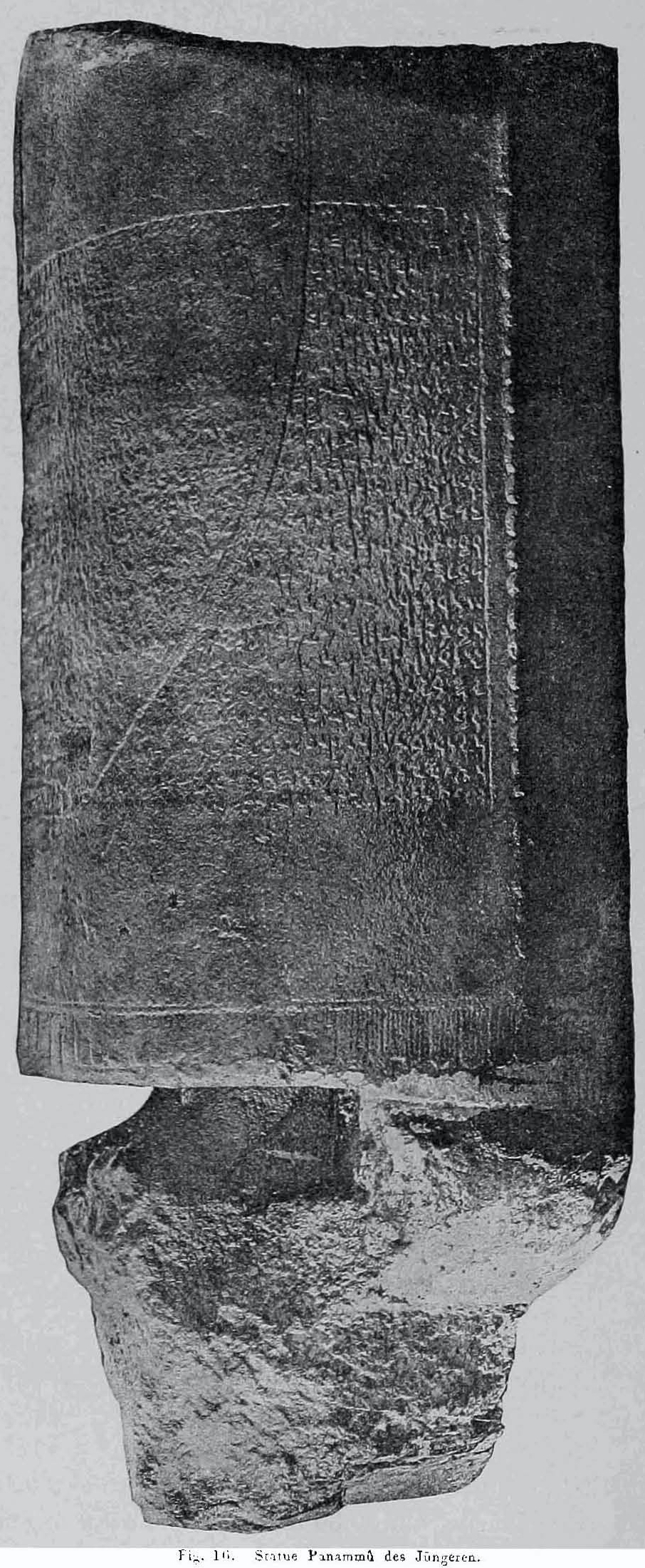
The surviving lower half of the statue of Panamuwa II (VA 3012). The inscription is carved in relief on the front of the garment
License · Image sourceObject details
- Title
- The Memorial Inscription of Panamuwa II (VA 3012)
- Timeline
- From 732 BCE to 730 BCE
- Region
- Anatolia and the eastern Mediterranean
- Rights
- Public domain
Text
Introduction
A fringe runs down the front of the surviving lower half of a statue of Panamuwa II, king of Sam’al. Across the garment, raised alphabetic letters preserve a memorial that his son and successor Barrākib commissioned. The stone came to light near a spring at Tahtalı Pınarı, north of Zincirli. Today it belongs to the Vorderasiatisches Museum in Berlin as VA 3012. The inscription, catalogued as KAI 215, recounts Panamuwa’s service to the Assyrian king and ends with Barrākib’s appeal to the gods. [1][2][3][4][10]
A statue found at Tahtalı Pınarı
Felix von Luschan reports that a local man told him about a large stone at an abandoned cemetery by the spring in 1888. What had looked like cartridges to the informant resembled the fringe of a garment to von Luschan. He records returning the following day with F. Winter and workmen to expose the stone. The excavator interpreted its position as evidence that it had been reused upside down as a grave marker. He first thought it had come from Zincirli, which he put 1.9 km away. After finding comparable sculptures at Gerçin, he proposed Gerçin as its original setting. The more recent survey report by Timur Demir and Özgür Çomak retains that possibility. [1][2][8][9]
Von Luschan describes the stone as dolerite and gives the fragment’s height as 1.93 m including the tenon that secured it to a base. He provisionally estimated the original statue at about 3.50 m tall. He measured the field of the inscription at 1.00 m high and 1.50 m long, with 23 lines in raised relief. Eduard Sachau found extensive losses at the ends of the lines and damage from a round hole affecting lines 19–21. He began studying the text from photographs and paper impressions, then examined the original in Berlin from the summer of 1889. The plaster cast catalogued by the University of Chicago is 1.90 m high and 0.88 m wide. [1][2][4][9]
A son’s account of Assyrian service
The opening identifies Barrākib as the person who set up the statue and Panamuwa as the son of Barṣūr. In the damaged opening section, the inscription recounts the killing of Barṣūr and of seventy of his kin, according to K. Lawson Younger’s translation published by the Zincirli expedition. Jan Dušek reads line 6 as a description of high prices for basic goods during the reign of Panamuwa’s predecessor. Farther on, the text says that Panamuwa brought the Assyrian king a gift and that the king installed him over his ancestral house. An Assyrian summary inscription of Tiglath-pileser III lists Panammû of Sam’al among the rulers who made payments. The two inscriptions record that relationship in the voices of different courts. [2][3][7][11]
Barrākib associates his father’s service with campaigns across the Assyrian realm and with the grant of cities from Gurgum. Younger’s translation pictures Panamuwa running at the wheel of his Assyrian lord. Federico Giusfredi and Valerio Pisaniello explain that the proposed verb in KAI 215 is restored with help from a similar passage in KAI 216, another inscription of Barrākib, and that its exact form is uncertain. They classify the memorial as Sam’alian, the local variety used in the older royal texts, and classify KAI 216 as Old Aramaic. [2][3][6]
Mourning and a prayer for the successor
Lines 16–19 recount Panamuwa’s death while following Tiglath-pileser III on campaign, the mourning in the Assyrian camp, an image set up along the route, and provisions for the deceased king’s spirit. The Zincirli expedition places the death at Damascus and dates the memorial to 732 BCE. The Chicago exhibition catalogue dates the statue to about 730 BCE and puts the death in 733/732 BCE. The destination in line 18 is read differently. Younger’s translation has the king brought from Damascus to Assyria, while Herbert Niehr renders the destination as “this place.” Niehr interprets the passage as evidence that Tiglath-pileser arranged rites for the dead king while the royal funeral had to wait. He treats the damaged text as evidence of an offering rite, with the details of the ritualRitualAn organised or distinguished practice meaningful to a community; it may leave traces, but its form alone does not reveal an associated doctrine.Glossary · Click to read the explanation uncertain. [3][4][5]
As the text turns to his own succession, Barrākib attributes his throne to Tiglath-pileser and to the loyalty he and his father showed. In line 22 Sachau’s early rendering tentatively treats the memorial as the possession of the gods he lists. Younger understands the same line as a request for their favour. Both identify HadadAdad: storm godAdad is the storm god in Mesopotamian traditions, associated with rain, thunder and powers of fertility or destruction.Glossary · Click to read the explanation, El, Rākib-El, Šamš and the gods of the kingdom, whose name is written Y’DY in the inscription. Rākib-El bears the title translated as lord of the house or dynasty. The line records El as a name in its own right alongside Rākib-El. In Younger’s reading, the new king, who has just credited Assyria for his accession, asks for the favour of the gods at his father’s memorial. [2][3][6]
References and notes
- Felix von Luschan, “Fünf Bildwerke aus Gerdschin,” in Ausgrabungen in Sendschirli I. Einleitung und Inschriften, Berlin, W. Spemann, 1893, pp. 44–54 P. 48, discovery, distance from Zincirli, reuse and the proposed original site. Pp. 53–54, § E, measurements, dolerite, raised inscription and fig. 16. Return to the text ↑
- Eduard Sachau, “Die Inschrift des Königs Panammû von Šam’al,” in Ausgrabungen in Sendschirli I. Einleitung und Inschriften, Berlin, W. Spemann, 1893, pp. 55–84 P. 55, early study and access to the original. P. 67, losses and the hole. Pp. 79–81, translation, including the rendering of line 22. Return to the text ↑
- Chicago–Tübingen Expedition to Zincirli, “Inscriptions,” section “Inscriptions of Barrākib (732 and ca. 720 BCE),” translation of KAI 215 by K. Lawson Younger First translation in the section, opening, service and death, line 18 on movement from Damascus to Assyria, succession and list of gods. The introduction dates the memorial to 732 BCE. Return to the text ↑
- J. David Schloen, “Statue of Panamuwa II of Samʾal (Cast),” in Virginia Rimmer Herrmann and J. David Schloen (eds.), In Remembrance of Me: Feasting with the Dead in the Ancient Middle East, OIMP 37, Chicago, Oriental Institute, 2014 Catalogue no. 12, pp. 120–121, dates, findspot, inscription, clothing, ancient original VA 3012 and plaster cast OIM C5676. Return to the text ↑
- Herbert Niehr, “The Katumuwa Stele in the Context of Royal Mortuary Cult at Samʾal,” in Virginia Rimmer Herrmann and J. David Schloen (eds.), In Remembrance of Me: Feasting with the Dead in the Ancient Middle East, OIMP 37, Chicago, Oriental Institute, 2014 P. 59, translation of KAI 215 lines 16–19, proposed original setting, and interpretation of the funerary offering and the temporary image. Return to the text ↑
- Federico Giusfredi and Valerio Pisaniello, “The Population, the Language and the History of Yadiya/Samʾal,” in Annick Payne, Šárka Velhartická and Jorit Wintjes (eds.), Beyond All Boundaries: Anatolia in the First Millennium BC, OBO 295, Leuven, Peeters, 2021, pp. 189–223 Pp. 191, 198, 204 and 213, local kingdom name, the two varieties used in Barrākib’s inscriptions and the verb restored in KAI 215 from KAI 216. Return to the text ↑
- Hayim Tadmor and Shigeo Yamada, The Royal Inscriptions of Tiglath-pileser III (744–727 BC) and Shalmaneser V (726–722 BC), Kings of Assyria, RINAP 1, Winona Lake, Eisenbrauns, 2011 Tiglath-pileser III 47, p. 122, reverse lines 7′–9′, list of western rulers including Panammu of Samʾal. Return to the text ↑
- Timur Demir and Özgür Çomak, “Gaziantep Gerçin Höyük’ten Savaş Arabası Şeklinde Bir Kaide,” Seleucia XV, 2025, pp. 121–138 Pp. 122 and 129, find at the Tahtalıpınar cemetery and proposed movement of the statue from Gerçin Höyük. Return to the text ↑
- Institute for the Study of Ancient Cultures, “Statue (Cast),” OIM C5676, University of Chicago Object record, plaster, height and width in millimetres and the description of reuse of the original sculpture. Return to the text ↑
- Regine Hunziker-Rodewald, “[HadadDigital]: Zwischenbilanz und ein Forschungsvorhaben,” Freie Universität Berlin P. 3 n. 6, correspondence of epigraphic number KAI 215 and Berlin inventory VA 3012. P. 1 n. 2 identifies KAI 214 separately. Return to the text ↑
- Jan Dušek, “High Prices in Samʾal/Yʾdy before Panamuwa II’s Reign,” Aramaic Studies 23, no. 2, 2025, pp. 131–153 Abstract published by Charles University. Interpretation of line 6 as describing high prices for basic goods before the accession of Panamuwa II. Return to the text ↑
Archive records may be reviewed and refined as better evidence or sources become available. Suggest a correction
Suggest a correction · Suggest a source for this record
Cite this record
IL Archive, «The Memorial Inscription of Panamuwa II (VA 3012)», https://ilarchive.com/en/artifacts/panamuwa-ii-inscription
Continue reading