Artifact
The Funerary Stele of Katumuwa from Zincirli
An object record bringing together its image, metadata, rights, and context.
- Timeline
- From 743 BCE to 732 BCE
- Region
- Anatolia and the eastern Mediterranean
Katumuwa commissioned a stone monument while he was alive. Its relief shows him at a banquet. The inscription asks whoever takes possession of the room to renew an offering in his memory each year.
Estimated reading time: 4 min Published Last reviewed:
Share article
Photograph
Photograph by Dosseman, via Wikimedia Commons. Image resized. CC BY-SA 4.0.
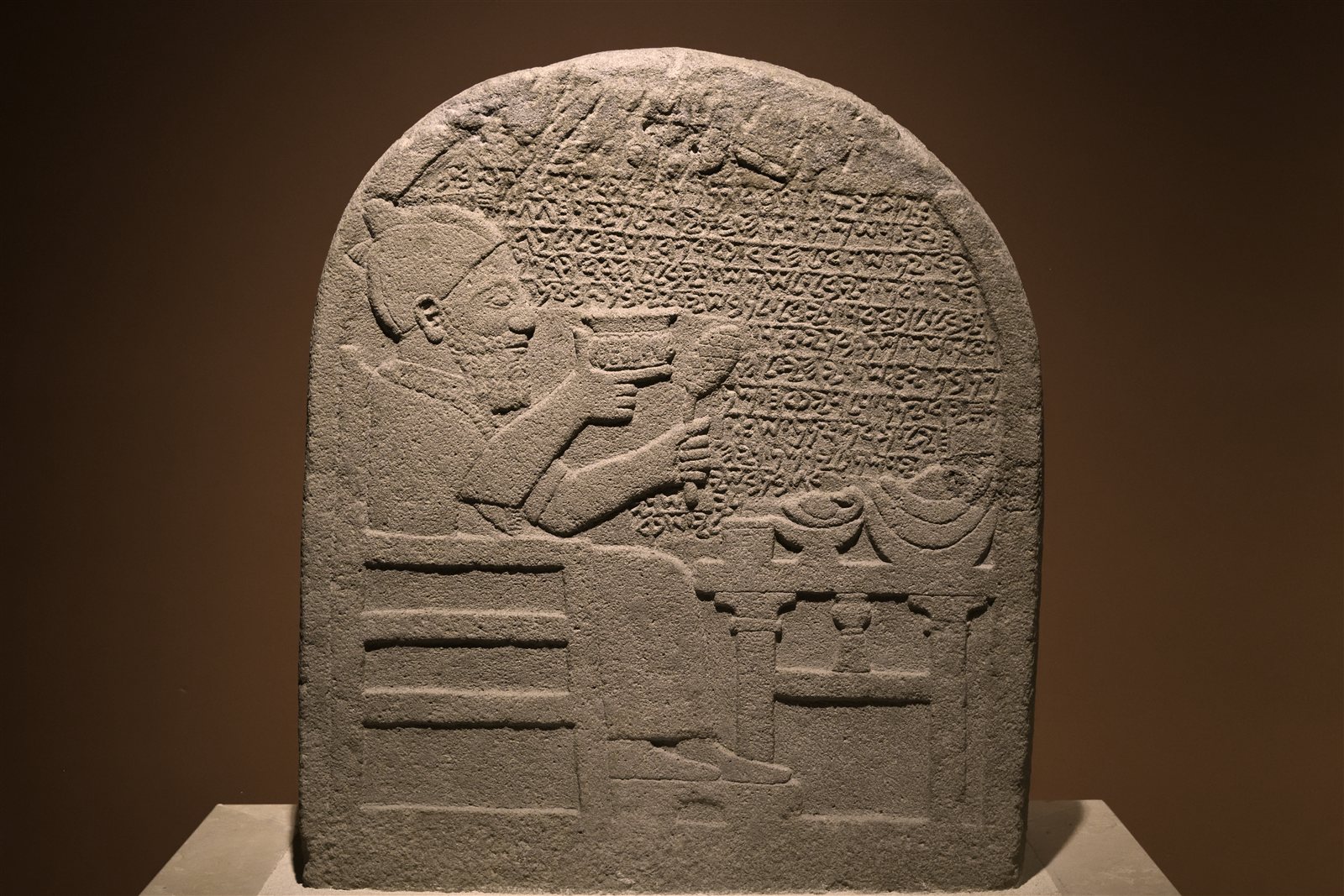
Katumuwa’s basalt stele in the Gaziantep Archaeology Museum. He raises a cup while seated in front of a table. The inscription runs above it and alongside him
License · Image sourceObject details
- Title
- The Funerary Stele of Katumuwa from Zincirli
- Timeline
- From 743 BCE to 732 BCE
- Region
- Anatolia and the eastern Mediterranean
- Rights
- CC BY-SA
Text
Introduction
A basalt stele from ancient Sam’al shows a seated man facing a table of food. Its thirteen lines identify him as Katumuwa, a servant of Panamuwa, and say he had the monument made during his lifetime. The inscription sets out offerings for several gods and for a part of himself that he calls his nbš. Excavators found the stone still standing in a room of the lower town at Zincirli. The image, the wording and the room give different evidence for the commemoration he planned. [1][2][3][4]
A room in the lower town
The expedition discovered the stele on 21 July 2008 in Building A/II, in the northern lower town. It stood in a corner of the innermost room. The room had previously contained two clay bread ovens. Virginia Rimmer Herrmann describes how it was remodeled and how a small paved area, a low stone bench and a stone pedestal framed the stele. The features could have supported the ritualsRitualAn organised or distinguished practice meaningful to a community; it may leave traces, but its form alone does not reveal an associated doctrine.Glossary · Click to read the explanation described in the inscription. The original monument is held at the Gaziantep Archaeology Museum. [2][4][5]
Below the curved top, the relief shows Katumuwa seated with a cup raised in one hand, facing a table. The alphabetic letters occupy the space above the table and continue beside the figure. A visitor standing in front of the stele saw an image of eating and drinking in the same field as instructions about offerings. The excavators found no human remains beneath the room’s floor. The find establishes where this commemoration took place, while Katumuwa’s burial place remains unknown. [1][2][5]
The feast and its renewal
The inscription begins in the first person. The consonants of the name are KTMW, conventionally read Katumuwa, though the exact ancient vowels are uncertain. The name contains Luwian elements, while the wording is in the local variety of Aramaic. This combination is evidence for the use of different linguistic traditions in Sam’al. The inscription itself gives no birthplace for the official. Dennis Pardee identifies Panamuwa probably as the later of two kings of Sam’al by that name. In Pardee’s reading, Katumuwa installed the stele in a chamber he calls eternal and established a feast there. Steiner reads the phrase about the feast as an introduction to the chamber’s list of offerings. An approximate date around 735 BCE places the monument in the late 8th century BCE. [1][2][3][4]
The opening list specifies a bull for HadadAdad: storm godAdad is the storm god in Mesopotamian traditions, associated with rain, thunder and powers of fertility or destruction.Glossary · Click to read the explanation Qarpatalli and rams for other divine recipients, including Šamš, Hadad of the Vineyards and Kubaba. Another ram is for Katumuwa’s nbš in the stele. The instructions then address whoever comes to possess the room, whether a son or someone from another family. They connect a yearly offering to the yield of a vineyard and reserve a portion of meat for Katumuwa. The wording makes use of the room relevant to the duty of maintaining his commemoration. [1][3]
What nbš means here
Both Pardee and Richard C. Steiner render nbš as “soul” in this passage. The inscription places it in the stele and later locates the offering beside it. Those details give the word a particular role in this text. The stone provides a place at which the living can address Katumuwa and set aside food for him after his death. How an ancient speaker understood the relation between the carved likeness, the physical stone and the deceased person remains a matter of interpretation. [1][2][3]
The wording of the yearly instructions is also open to more than one reading. Pardee reads the lines as an instruction to offer some of the vineyard’s best produce. Steiner reads them as an instruction to use the vineyard’s yield to buy a sheep each year. This difference affects how one reconstructs the annual provision. Both readings connect the room to a continuing obligation that could pass beyond Katumuwa’s own descendants. [1][3]
Reading the monument in place
Herrmann interprets the converted room as a mortuary chapel and proposes that the neighboring building may have been a small temple. The suggested relationship gives context to a text in which named gods and the deceased are both recipients of offerings. The inscription specifies the feast Katumuwa wanted future occupants to maintain. The archaeology shows how a room was adapted to house the monument. Together they help explain how someone entering the room could connect the carved banquet with the prescribed offering. [1][2]
References and notes
- Dennis Pardee, “The Katumuwa Inscription,” In Remembrance of Me: Feasting with the Dead in the Ancient Middle East, Virginia Rimmer Herrmann and J. David Schloen, eds., OIMP 37, Oriental Institute of the University of Chicago, 2014 pp. 45–48. Translation of lines 1–13, naming and language, the location of the nbš, and the provisions relating to the vineyard. Return to the text ↑
- Virginia R. Herrmann, “The Katumuwa Stele in Archaeological Context,” In Remembrance of Me: Feasting with the Dead in the Ancient Middle East, Virginia Rimmer Herrmann and J. David Schloen, eds., OIMP 37, Oriental Institute of the University of Chicago, 2014 pp. 49–54. Discovery, alterations to the room, excavation below the floor, the neighboring building and the proposed ritual use. Return to the text ↑
- Richard C. Steiner, Disembodied Souls: The Nefesh in Israel and Kindred Spirits in the Ancient Near East, with an Appendix on the Katumuwa Inscription, Ancient Near East Monographs 11, SBL Press, 2015 Appendix, pp. 128–130. Translation, the interpretation of nbš, and the reading of the vineyard provision in the closing lines. Return to the text ↑
- J. David Schloen and Amir S. Fink, “New Excavations at Zincirli Höyük in Turkey (Ancient Samʾal) and the Discovery of an Inscribed Mortuary Stele,” Bulletin of the American Schools of Oriental Research 356, 2009 Publisher’s open abstract, on the discovery in the lower town, the late 8th-century date and the official with a Luwian name. Return to the text ↑
- University of Chicago News, “Exhibit at Oriental Institute to show how ancient cultures commemorated the dead” Opening account of the stele, its banquet scene and the location of the original in the Gaziantep Archaeology Museum. Return to the text ↑
Archive records may be reviewed and refined as better evidence or sources become available. Suggest a correction
Suggest a correction · Suggest a source for this record
Cite this record
IL Archive, «The Funerary Stele of Katumuwa from Zincirli», https://ilarchive.com/en/artifacts/katumuwa-stele
Continue reading