Artifact
The Sumerian Flood Tablet from Nippur (CBS 10673)
An object record bringing together its image, metadata, rights, and context.
- Timeline
- 1650 BCE
- Region
- Mesopotamia
Only the lower part of this tablet from Nippur survives. It names five cities, describes a flood that rocks a boat for seven days and nights, and tells what the gods grant the survivor Ziusudra.
Estimated reading time: 4 min Published Last reviewed:
Share article
Photograph
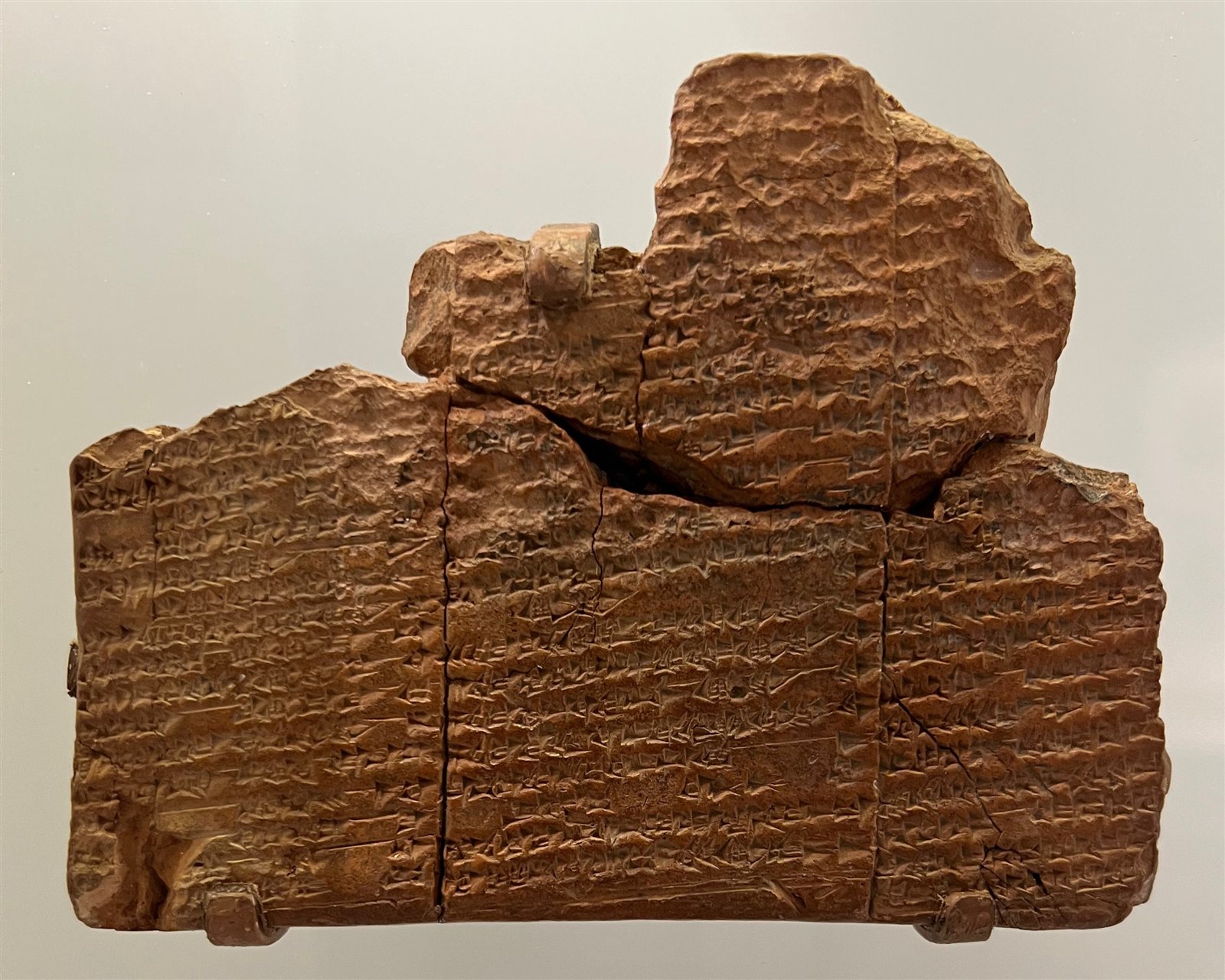
Photograph by Onceinawhile, via Wikimedia Commons. Image resized. CC BY-SA 4.0.
The surviving part of the Sumerian Flood Tablet, Penn Museum CBS 10673, with cuneiform columns below the broken upper edge
License · Image sourceVideo
The Flood Before Noah: What the Clay Tablets Say
Our third documentary reads the oldest flood stories on clay: Ziusudra, Atrahasis and Gilgamesh, then sets them beside Noah in the Abrahamic scriptures. Some scenes are AI-generated illustrations.
The YouTube player loads only when you press play. Watch on YouTube
Object details
- Title
- The Sumerian Flood Tablet from Nippur (CBS 10673)
- Timeline
- 1650 BCE
- Region
- Mesopotamia
- Rights
- CC BY-SA
Text
Introduction
The broken clay tablet CBS 10673 preserves part of a Sumerian story about early cities, a destructive flood and the king ZiusudraZiusudraA literary king-priest in the fragmentary Sumerian Flood Story (ETCSL 1.7.4). He survives by boat, sacrifices, and receives divine life from An and Enlil in Dilmun. The surviving copy is Old Babylonian; his historicity is unproven.Glossary · Click to read the explanation. It was excavated at NippurNippur / NuffarAncient Nippur (modern Nuffar, Iraq), major cult centre of Enlil and Ekur; excavations revealed sanctuaries, houses and thousands of cuneiform tablets across many periods.Glossary · Click to read the explanation and is held by the Penn Museum. The text is often called the Sumerian Flood Story or the EriduEriduEridu (Abu Shahrain), a multi-mound site in southern Iraq occupied since the Ubaid, later home to a religious precinct associated with Enki. Its eighteen sounding levels are not proof that every early building was a temple.Glossary · Click to read the explanation Genesis. The broken edges visible in the photograph help explain the gaps in every translation, including the gap just before the story announces that humanity is to be destroyed. [1][2][3][4]
The tablet and the missing lines
The Penn Museum describes the surviving piece as the lower third of a baked clay tablet. The catalogue measures it at 13.3 cm long, 10.16 cm wide and 1.9 cm thick. The writing ran in six columns, three on each face. Much of each column lay on the missing upper portion. When an edition moves from one surviving block to the next, several dozen lines can fall between them. The museum also records a joining piece, CBS 10867. CDLI catalogs the joined manuscript as P265876. [1][2][3]
The Penn Museum dates the tablet to about 1650 BCE from its script. This is an estimate for the surviving copy. Jeremiah Peterson notes that the earlier editor Miguel Civil placed it in the late Old Babylonian period or shortly afterward. The date when the narrative first took the form represented here is a separate question. Samuel Kramer records that Arno Poebel published and edited the Nippur tablet in 1914. Thorkild Jacobsen later called the composition the Eridu Genesis in an edition published in 1981. That title describes a modern reading of the composition’s scope. [1][4][5]
Cities before the Flood
An early passage describes gods fashioning human beings and making animals multiply. Kingship later descends from heaven, and five cities are named and assigned to deities. The first is EriduEriduEridu (Abu Shahrain), a multi-mound site in southern Iraq occupied since the Ubaid, later home to a religious precinct associated with Enki. Its eighteen sounding levels are not proof that every early building was a temple.Glossary · Click to read the explanation, allotted to NudimmudEnkiMesopotamian deity also known as Ea, linked with Eridu and the Abzu (deep fresh waters), wisdom, incantations, and narratives of creation and cosmic order. Later written attestations do not identify the deity of Eridu’s earliest layers.Glossary · Click to read the explanation, a name of EnkiEnkiMesopotamian deity also known as Ea, linked with Eridu and the Abzu (deep fresh waters), wisdom, incantations, and narratives of creation and cosmic order. Later written attestations do not identify the deity of Eridu’s earliest layers.Glossary · Click to read the explanation. Bad-tibira, Larag, Sippar and Shuruppak follow. The passage also mentions waterways. Nippur is the findspot of this copy, while Eridu appears within the story as the first city in its sequence. [1][3]
At the end of the city passage the text breaks off. In the next surviving portion, the divine assembly has already decided to send a flood. Ziusudra, identified as a king and a priest, hears a warning addressed to a wall while he stands beside it. The surviving passage says the decision cannot be revoked. It leaves the reasons for the decision unclear. Kramer identifies the events leading to the decision as one of the text’s unresolved problems. [3][5]
Seven days in the boat
Another break separates the warning from the storm passage. When the narrative resumes, winds and waves rock a large boat for seven days and seven nights. Utu, the sun god, appears, and Ziusudra makes an opening through which sunlight enters. The king bows to Utu and offers cattle and sheep. The break before this episode is large enough that the surviving lines leave the construction of the boat and the preparations for the flood undescribed. [3]
The last substantial passage describes animals disembarking. Ziusudra bows before An and EnlilEnlilEnlil/Ellil: a major Mesopotamian god associated with destinies, kingship, and Ekur at Nippur, already prominent in third-millennium god lists. His name’s origin and cult beginnings remain debated.Glossary · Click to read the explanation, who grant him enduring life and settle him in DilmunDilmun: Ancient Gulf Land and Literary SettingDilmun was an ancient Gulf trading land with a major archaeological centre in Bahrain and connections to eastern Arabia and Failaka. This entry separates boats, burials and kings from the literary purity and fresh water of Enki and Ninhursaga, and tests the limits of comparison with Eden.Glossary · Click to read the explanation, described as a land across the sea where the sun rises. In the story this honours his preservation of animals and humanity. The text breaks again after a fragment of speech. The edition gives readers a surviving ending scene, with uncertainty about what followed it. Across the surviving columns, the story moves from organizing life in cities to preserving it through disaster. [3]
A fragment that might fill a gap
A separate clay fragment, N 3514, describes rulers before the Flood and preserves part of a difficult passage. Peterson suggests a possible place for it in the gap between the assignment of the cities and the warning, if it belongs to the same composition. The fragment does not physically join the Nippur tablet. Differences in the shapes of some signs also leave room for another manuscript or a different composition. For now, the two fragments published as CBS 10673 and CBS 10867 represent a joined manuscript, while N 3514 remains a proposed parallel. That distinction matters whenever a reconstruction is used to explain why the gods sent the flood. [2][3][4]
References and notes
- Penn Museum, “Flood Tablet / Deluge Tablet,” CBS10673, Collections Collection record: dimensions, material, provenance, date estimate, six columns, joining fragment and surviving episodes. Return to the text ↑
- Cuneiform Digital Library Initiative, “CDLI Literary 000357, ex. 001” (P265876, CBS 10673 + CBS 10867) Artifact metadata and composite links, including the museum numbers, language, period and designation as a manuscript witness. Return to the text ↑
- Electronic Text Corpus of Sumerian Literature (University of Oxford), “The Flood story: translation,” composition 1.7.4 Segments A–E and their lacunae, especially the cities in B, the warning in C, the storm and offering in D, and the landing and Dilmun in E. The companion bibliography identifies the Nippur witness. Return to the text ↑
- Jeremiah Peterson, “A New Sumerian Fragment Preserving an Account of the Mesopotamian Antediluvian Dynasties,” Aula Orientalis 26, 2008, 257–262 Pp. 257–258, introduction and comparison of N 3514 with the joined Nippur tablet, including the alternative identification and Civil’s dating. Return to the text ↑
- Samuel Noah Kramer, “The Sumerian Deluge Myth Reviewed and Revised,” Anatolian Studies 33, 1983, 115–121 Publisher’s open extract and first note on the editorship, naming of the composition and unresolved problems before the flood. Return to the text ↑
Archive records may be reviewed and refined as better evidence or sources become available. Suggest a correction
Suggest a correction · Suggest a source for this record
Cite this record
IL Archive, «The Sumerian Flood Tablet from Nippur (CBS 10673)», https://ilarchive.com/en/artifacts/sumerian-flood-tablet-cbs-10673
Continue reading