Artifact
The Tell al-Rimah Stele of Adad-nirari III
An object record bringing together its image, metadata, rights, and context.
- Timeline
- From 810 BCE to 783 BCE
- Region
- Mesopotamia
The stele shows an Assyrian king with his right forefinger extended. The text below the relief names tribute from Damascus, Samaria, Tyre and Sidon. Nine lines about a provincial governor’s building work were deliberately erased in antiquity.
Estimated reading time: 4 min Published Last reviewed:
Share article
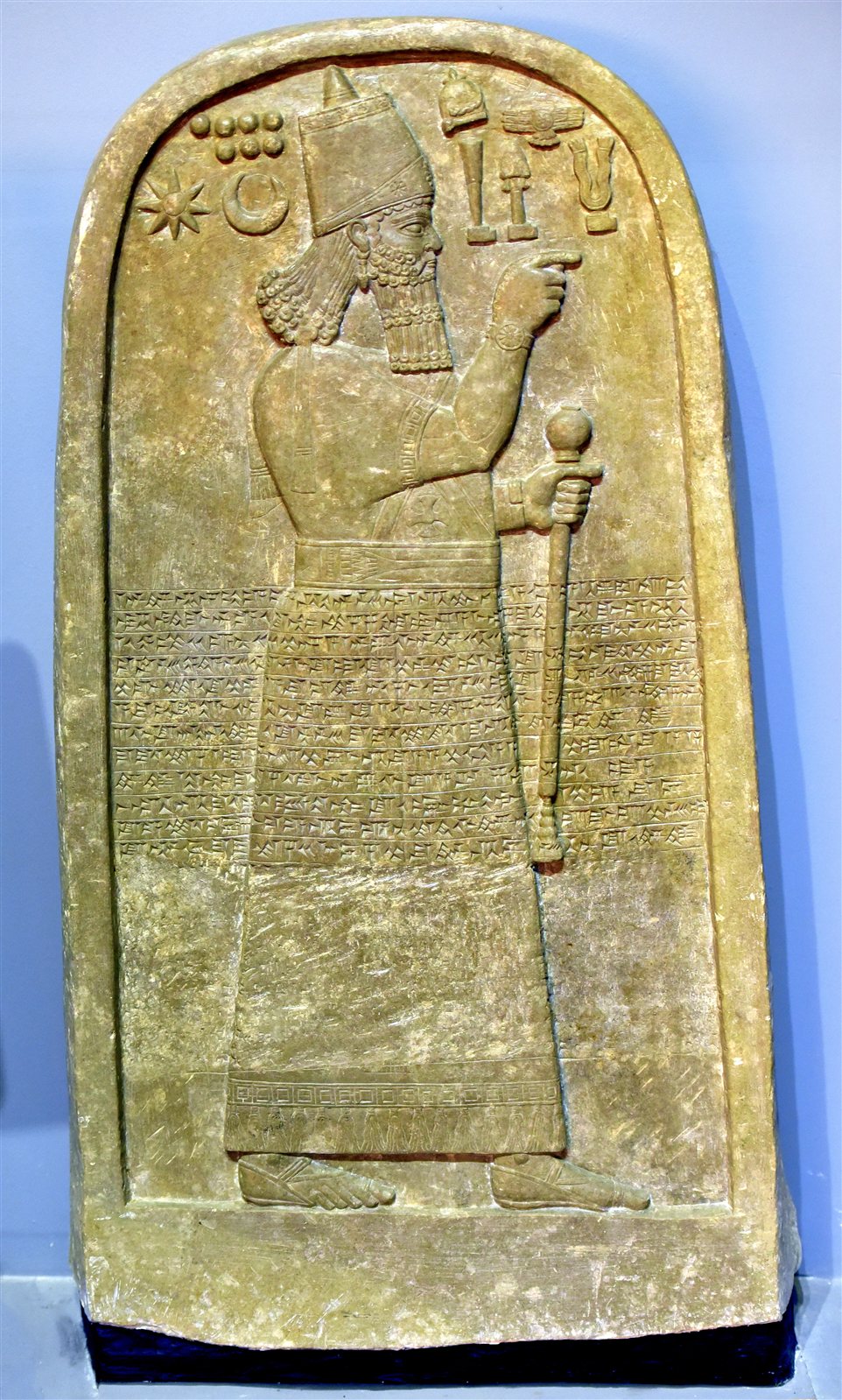
Photograph
Photograph by Osama Shukir Muhammed Amin, via Wikimedia Commons. Image resized. CC BY-SA 4.0.
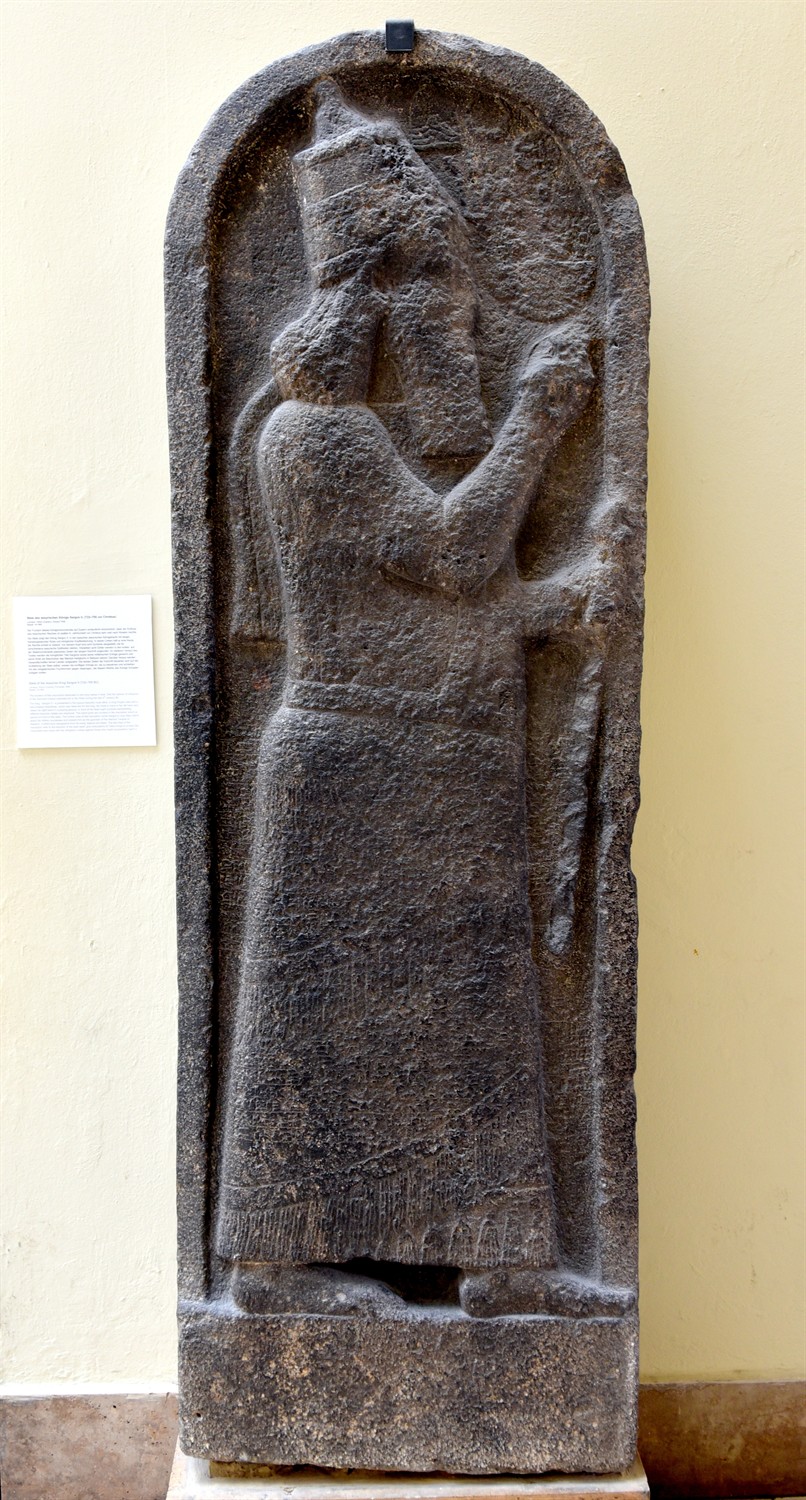
Full view of the Tell al-Rimah stele at the Iraq Museum, Baghdad. The king’s raised hand and divine emblems appear above the surviving lines. The scraped surface below marks the erased lines
License · Image sourceObject details
- Title
- The Tell al-Rimah Stele of Adad-nirari III
- Timeline
- From 810 BCE to 783 BCE
- Region
- Mesopotamia
- Rights
- CC BY-SA
Text
Introduction
The stele from Tell al-Rimah in northern IraqIraqIraq is a modern country encompassing much of ancient MesopotamiaGlossary · Click to read the explanation shows the Assyrian king Adad-nirari III, who reigned from 810 to 783 BCE. His right hand is raised and divine emblems surround his head. Below his belt an inscription records tribute from several western places, including SamariaSamaria: city and regionAncient city and administrative region; the city’s site is at Sebastia, northwest of Nablus in the West Bank.Glossary · Click to read the explanation. In 1967 the excavators found the stone standing next to a podium inside a shrine. The image, the inscription and that position give different evidence about what the stele was made to do. [1][2][3]
A royal image beside a podium
Stephanie Page’s publication describes a single slab of hard, grey stone called Mosul marble. It measures 130 cm in height and 69 cm at the base. The rounded frame encloses a standing figure, shown in profile and slightly smaller than life. The inscription crosses the figure’s skirt and the field around it. Page records that no traces of paint were visible when the stone was uncovered. The present colour of the surface therefore tells us little about how it was originally finished. [2]
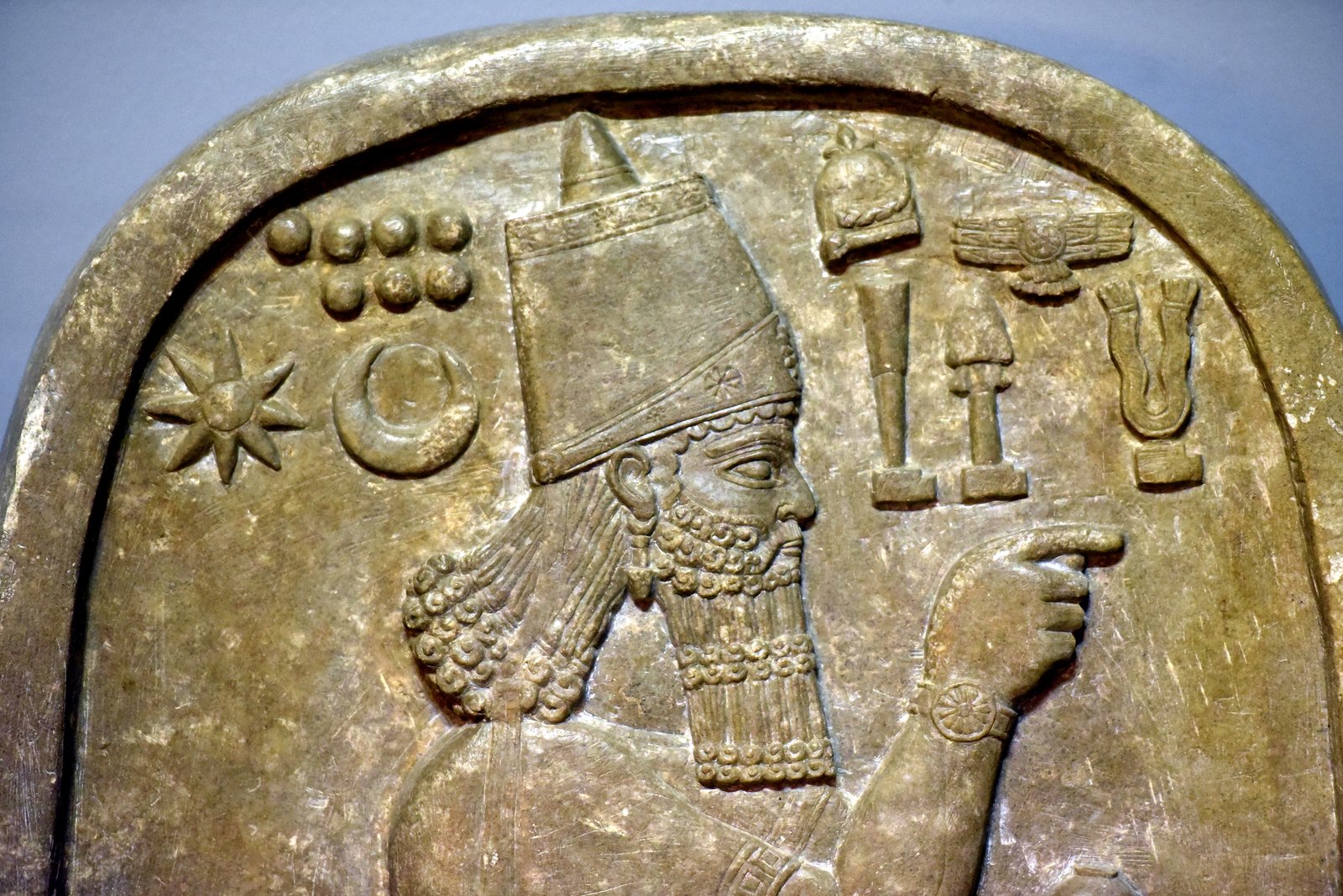
The king points with the forefinger of his right hand. Ludovico Portuese observes that the finger points out of the carved scene towards the adjoining podium, where a cult statue may once have stood. The text begins with a dedication to the storm god AdadAdad: storm godAdad is the storm god in Mesopotamian traditions, associated with rain, thunder and powers of fertility or destruction.Glossary · Click to read the explanation, and Portuese identifies the forked lightning emblem above the finger as the same god’s symbol. A statue of Adad is a plausible target if the stele was found in its original position. The excavation evidence leaves that condition open. [1][3]
Tribute in the king’s account
After the dedication the inscription gives the king’s titles and ancestry. The narrative presents the submission of Amurru and Hatti within a single year and lists a substantial payment from the ruler of Damascus, including metals and linen garments. Line 8 also names Joash of Samaria and payments from the people of TyreTyreTyre is a city on the coast of present-day southern Lebanon and an important ancient Phoenician centerGlossary · Click to read the explanation and Sidon. It supplies no separate amount for these payments. The wording is an Assyrian account of tribute. The line gives no account of how, where or through whom these payments were delivered. [1]
The next passage moves to the Mediterranean, mentions a royal statue on the island of Arwad and describes cedar taken from Mount Lebanon for the king’s palace and temples. The monument thus relates events in distant places to the person of the king shown above the text. The compressed account records what the royal inscription claims. It gives no dated itinerary for the separate episodes. [1]
The missing lines
The inscription originally contained 21 lines. The last nine were deliberately erased. Enough traces survived for editors to read much of the passage. It names the governor usually called Nergal-ereš, read as Pālil-ēreš in the online edition, and credits him with undertaking to rebuild 331 settlements at the king’s command. One entry includes 126 villages in the Mount Singara area, an example of how the inscription groups the settlements. The final line calls on the great gods against anyone who would erase one of the names. The prominent scraped area in the lower part of the relief is a physical trace of what later happened to that record. [1][2][4]
Karen Radner compares the erasure with damage to a related monument from Dūr-Katlimmu. Some other inscriptions naming the governor were left intact. Radner suggests that a later division of his province may explain the selective removal of his titles and claims. The erasures themselves establish what was targeted more clearly than who ordered the work or why. [4]
Seven dots beside the crown
The photograph shows seven rounded dots behind the king’s crown, four above three, beside a star and a crescent. Lorenzo Verderame discusses the widespread seven-dot emblem and its link to the Pleiades and the Seven gods in Mesopotamian scholarship. A later tablet from UrukUrukAncient city at Warka in southern Iraq, a major urban centre around 3200 BCE that preserved early writing and accounting tablets.Glossary · Click to read the explanation supplies a particularly clear comparison because the written name of the Pleiades appears among seven stars. The Tell al-Rimah carving carries no such label beside the dots. Its inscription names Adad, while the carved emblems invite comparison with other monuments and texts. The stone preserves both kinds of evidence, as well as the traces of a decision to erase part of what it once said. [1][3][5]
References and notes
- A. Kirk Grayson, Assyrian Rulers of the Early First Millennium BC II (858–745 BC), RIMA 3, 1996, 209–212, A.0.104.7, “Adad-nerari III 07,” Royal Inscriptions of Assyria online, Q004755 Online edition, especially lines 1–3 (dedication and royal ancestry), 4–12 (tribute and the western journey), and 13–21 (governor, settlements and closing curse). Return to the text ↑
- Stephanie Page, “A Stela of Adad-Nirari III and Nergal-Ereš from Tell al Rimah,” Iraq 30 (2), 1968, 139–153 Publisher’s open extract from the first page, on the spring 1967 discovery, shrine position, stone, measurements, layout, lack of visible paint and the erased lines. Return to the text ↑
- Ludovico Portuese, “Text, Context, and Image: Taking Another Look at the Ubāna Tarāṣu Gesture,” Iraq 86, 2024, 357–378 Opening abstract and “Contextual Target,” especially the account of the stele, the hypothesis about the cult statue, and figure 5 and its caption. Return to the text ↑
- Karen Radner, “The Stele of Adad-nērārī III and Nergal-ēreš from Dūr-Katlimmu (Tell Šaiḫ Ḥamad),” Altorientalische Forschungen 39 (2), 2012, 265–277 Introduction and pp. 275–276 on the comparison with the Dūr-Katlimmu stele, targeted erasures, surviving inscriptions and the possibility of provincial reorganization. Return to the text ↑
- Lorenzo Verderame, “Pleiades in Ancient Mesopotamia,” Mediterranean Archaeology and Archaeometry 16 (4), 2016, 109–117 Sections 1–2, especially VAT 7851, figure 2, and the discussion of the seven dots and groups of seven gods. Return to the text ↑
Archive records may be reviewed and refined as better evidence or sources become available. Suggest a correction
Suggest a correction · Suggest a source for this record
Cite this record
IL Archive, «The Tell al-Rimah Stele of Adad-nirari III», https://ilarchive.com/en/artifacts/tell-al-rimah-stele
Continue reading