Study
Judgment Scales: Egypt and the Worlds of Late Antiquity
An extended study of a topic, with evidence and references.
- Timeline
- From 950 BCE to 1506 CE
Heart, destiny and deeds: Egyptian, Greek, Hebrew, Iranian and Quranic witnesses compared through roles, dates and the limits of transmission hypotheses.
Share article
Text
One balance, different questions
In an ancient Egyptian scene, the dead person stands before a divine court and a heart is placed in a balance. In an Iranian text, RashnRashnu: justice in Iranian reckoningIranian figure associated with just reckoning; the Menog i Khrad describes a balance favouring neither king nor pauper.Glossary · Click to read the explanation judges without favouring king or pauper. In the Testament of AbrahamTestament of AbrahamNarrative of Abraham’s death and journey; its long recension distinguishes Abel the judge, Dokiel the weigher and Michael the guide.Glossary · Click to read the explanation, one angel weighs, another tests by fire, and deeds are recorded. The QuranQuranCentral text of Islam, used here as evidence of its religious discourse.Glossary · Click to read the explanation then describes just balances established for the Day of ResurrectionResurrection of the deadThe dead returning to life, distinguished from soul immortality, with differing scope and form among texts.Glossary · Click to read the explanation, when nobody is wronged. The resemblance is evident, but the things weighed and the narratives surrounding them differ. [1][8][11][17]
Comparison therefore begins with questions rather than a verdict that everyone copied an Egyptian template. Who weighs? What is weighed? When does it happen? How does the result relate to innocence, punishment and mercy? We compare selected witnesses, not everything these religions teach about judgment. The purpose is to understand the image’s history and uses, without deciding religious truth or ranking beliefs.
The heart before Maat
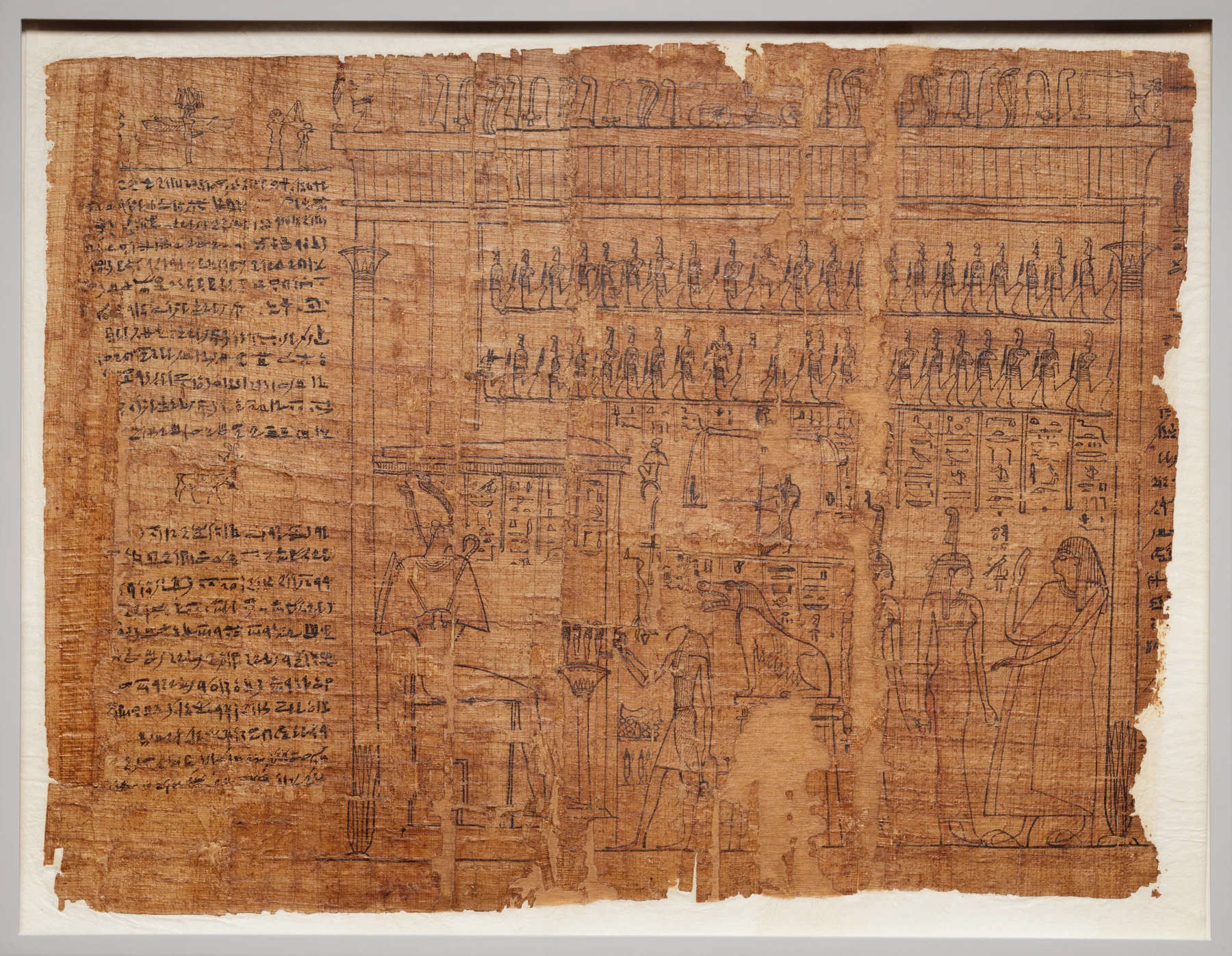
The British Museum dates Nestanebetisheru’s papyrus to approximately 950–930 BCE. Its balance sets the heart against MaatMaatAncient Egyptian right order, truth and rectitude, also divinely personified; represented in heart-weighing by a feather or a goddess’s figure.Glossary · Click to read the explanation as a small goddess. Anubis and Thoth participate; Ammit and a lake of fire appear. A feather is therefore not the Egyptian standard’s only possible representation. [1]
Texts associated with weighing Ani’s heart make this more than a picture. Thoth declares that the heart has been tested and its owner vindicated; the divine company grants acceptance and offerings. This is not a historian’s external account of someone’s life. The document helps equip the dead for safe passage, and declaring innocence serves a religious purpose. [2]
The heart should not immediately be translated into an arithmetical list of deeds. Here it bears testimony concerning its owner and the truth of his life. One possible comparison is that human existence remains subject to evaluation after death. The details of that evaluation, however, belong to an Egyptian world of gods, formulas and offerings.
Ethics and ritual in the same document
Declarations of innocence in the translation of Ani’s papyrus deny theft, killing, lying and taking cultivated land. They also involve knowledge of divine names and places. The address to the heart asks it not to oppose its owner at judgment. One heart formula comes with directions involving a green-stone scarab. [2]
These features belong together. Removing ritualRitualAn organised or distinguished practice meaningful to a community; it may leave traces, but its form alone does not reveal an associated doctrine.Glossary · Click to read the explanation and protective formulas makes the scene resemble a modern court of ethics; removing conduct reduces it to an attempt to deceive the gods. The funerary document combines protection, knowledge, testimony and behaviour, aiming at a particular person’s successful passage.
The edition must also be identified. We use Budge’s historical translation published in 1913, which presents Ani’s text together with additions from other papyri, including Nu’s. Not every sentence in its appendices belongs to Ani’s papyrus. Nor does this edition replace a modern critical Egyptian text. The references specify the passages read. [2]
Homer weighs a destiny
In IliadIliadGreek epic attributed to Homer, narrating a phase of the Trojan War.Glossary · Click to read the explanation 22, ZeusZeusZeus is the sky god and leading deity in many Greek traditions. In the Iliad he presides over divine gatherings while others can still speak and object.Glossary · Click to read the explanation raises his golden balance and places AchillesAchillesImportant hero of the Iliad, whose anger and participation shape the poem’s warfare.Glossary · Click to read the explanation’ and Hector’s death-lots in it. Hector’s side sinks towards death, and ApolloApolloGod of music and prophecy in Greek traditions, also participating in the Iliad’s events.Glossary · Click to read the explanation leaves him. Book 8 contains a comparable image involving the opposing armies. [3]
Zeus is not examining Hector’s accumulated virtues and sins or judging a deceased person against Maat. The scene gives the battle’s destiny a tangible form. This matters because the same instrument can convey divine decision without being an afterlife balance of deeds.
Two pans in two texts therefore do not establish one shared belief. Even the term “weighing souls” can obscure differences when applied without explanation. What this passage of the Iliad weighs is a death-lot, not a heart or an aggregate of moral actions. [3]
The Hebrew balance before death
In Job 31:6, Job asks to be weighed in just balances so that his integrity can be known. Surrounding oaths enumerate what he has not done and accept consequences should his claims prove false. Job pleads as a living person: these verses do not describe his soul travelling to a court for the dead. [4]
Proverbs 16:2 and 21:2 contrast human self-approval with YHWHYahwehThe divine proper name written YHWH in the Hebrew Bible.Glossary · Click to read the explanation’s appraisal of spirits or hearts. The HebrewHebrewA Northwest Semitic language in the Canaanite group, with ancient and modern forms.Glossary · Click to read the explanation vocabulary involves assessment and measurement; these passages describe neither a detailed apparatus nor an angel carrying scales. [5][6]
Daniel 5:25–28 makes weighing part of interpreting the writing addressed to the king. He has been weighed and found deficient; his kingdom is about to be divided. This concerns the king and his rule, not the distribution of every human soul after resurrection. [7]
Nili Shupak argues for an Egyptian background to some weighing imagery in Hebrew wisdom. She also acknowledges linguistic objections and the conjectural reconstruction of adaptation stages. This is a scholarly transmission model, not a conclusion demanded by the word “balance” alone. [14]
Rashn and impartial justice
In the Menog i Khrad, the Judgments of the Spirit of Wisdom, a person reaches the Chinvat BridgeChinvat BridgeAvestan image of moral destiny after death, with passage elaborated in later traditions.Glossary · Click to read the explanation after death. Chapter 2:110–122 describes the soul staying near the body for three nights, movement at dawn on the fourth day, and Mihr, Srosh and RashnRashnu: justice in Iranian reckoningIranian figure associated with just reckoning; the Menog i Khrad describes a balance favouring neither king nor pauper.Glossary · Click to read the explanation participating in the reckoning. It insists that the balance favours neither king nor ruler, and does not privilege rank over the least of people. [8]
This detail gives the image a powerful social meaning. A ruler cannot purchase from the afterlife court what power might secure in life. Perfect justice is described as a balance that does not depart a hair’s breadth from the right decision. This is a textual account of incorruptible judgment, not surviving evidence of a physical machine.
Chapter 12:11–15 assigns those whose good deeds exceed sins to heaven, those with more sins to hell, and those with equal totals to an intermediate place, Hamistagan. Chapter 7:18–19 describes its position and the cold and heat experienced there. Equality does not have an identical outcome in every comparable narrative. [8]
Iranian texts do not have one date
Ahmad Tafazzoli proposes a late Sasanian compilation for the Menog i Khrad, possibly under Khosrow I, 531–579 CE, while acknowledging dating difficulties. The lateness of surviving manuscripts does not independently date each paragraph. [9]
Leon Goldman distinguishes Rashnu’s presence in Younger Avestan texts from his role in Middle Persian literature; he is absent from the Older Avestan sections. An earlier name alone does not establish an equally early detailed balance scene. [10]
The Book of Arda Wiraz illustrates the same caution. Philippe Gignoux places its final form in the ninth–tenth centuries CE, after earlier redactions. The setting claimed within a narrative does not date every detail of its journey. [21]
Iranian and later reckoning traditions can therefore be compared. Comparison does not automatically establish transmission from a late Persian text to an earlier Jewish work, or make every detail Achaemenid. We must identify which witness actually precedes the other.
Abraham visits the court
The Testament of AbrahamTestament of AbrahamNarrative of Abraham’s death and journey; its long recension distinguishes Abel the judge, Dokiel the weigher and Michael the guide.Glossary · Click to read the explanation is not part of Genesis, nor independently verified as a document written by the historical Abraham. It narrates the biblical hero’s death and journey with MichaelMichael / MīkālTheophoric name asking who is like God; borne by humans and a heavenly figure in Daniel. It establishes no former Canaanite deity.Glossary · Click to read the explanation. E. P. Sanders identifies a Jewish work, probably Egyptian and generally dated to the late first century CE, with two major recensions whose relationship remains disputed. [12]
In the long recension, displayed in our source as Version 1, Abraham is no complacent spectator. Seeing wrongdoing on earth, he asks for the offenders’ destruction. A divine voice stops the tour: Abraham’s haste to punish does not express the mercy the narrative requires. He is then taken to heaven’s gate to witness judgment and recompense. [11]
This movement is essential to understanding the balance. The court teaches Abraham how to see sinners, placing his anger alongside the possibility of repentance and mercy. It does more than display an account.
Who weighs in the Testament of Abraham?
In chapters 11–14 of the long recension, Abraham sees two gates and Adam rejoicing over those entering life and mourning those heading for destruction. A court then appears, with a throne, a book and two angels recording righteousness and sins. Another angel carries a balance, while a further angel tests works through fire. [11]
The narrative allocates the roles: Abel sits in judgment; Dokiel holds the balance; Puruel, as named in the historical translation used here, performs the fiery test. Michael guides Abraham and answers his questions. Saying that Michael weighs in this recension confuses the guide with the figure specifically appointed to weigh. [11]
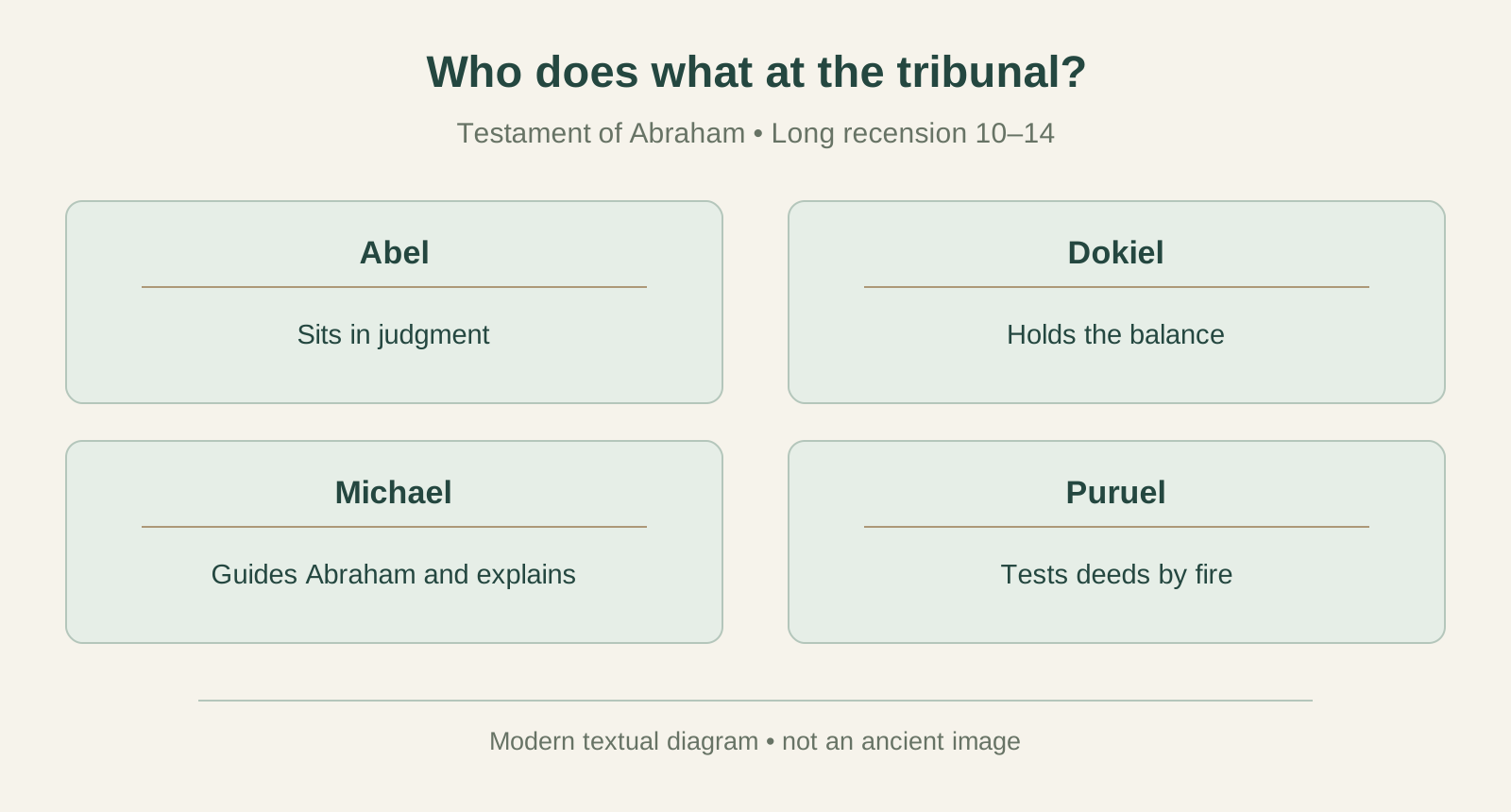
The short recension, displayed as Version 2, also has reckoning, equally balanced deeds and records. Enoch is identified as the scribe rather than the source of the final judgment. Scene order and details differ. We should not combine them into an unmarked third text called “the Testament.” Our explanation of Dokiel and fire uses the long recension; comparison with the short one remains separately identified. [11]
This court is more elaborate than Proverbs’ brief language of evaluating hearts. Its elaboration does not make it an official account shared by all Jews or Christians.
Equality and mercy
In the long recension, Abraham sees a soul whose sins and righteous actions balance equally, leaving it between the two destinies. Abraham and Michael pray for it, and its fate changes to salvation. Abraham then seeks mercy for those whose destruction he had requested. [11]
Reckoning does not exclude mercy in this story. Nor is its equal balance automatically identical to Iranian Hamistagan: the predicament resembles it, but resolution, actors and narrative placement differ.
Malka Simkovich proposes that traditions of these testaments continued in later Christian and rabbinic writings, with changes in religious outlook. This is a proposal about literary circulation; by itself it does not establish a route from ancient Egypt to every subsequent balance image. [13]
Michael in a later image
In Revelation 20:11–15, the dead stand before the throne, books and the book of life are opened, and judgment follows their deeds. No balance appears in this passage. Reckoning and records do not require two scales, and a later image of Michael need not literally illustrate this scene. [15]
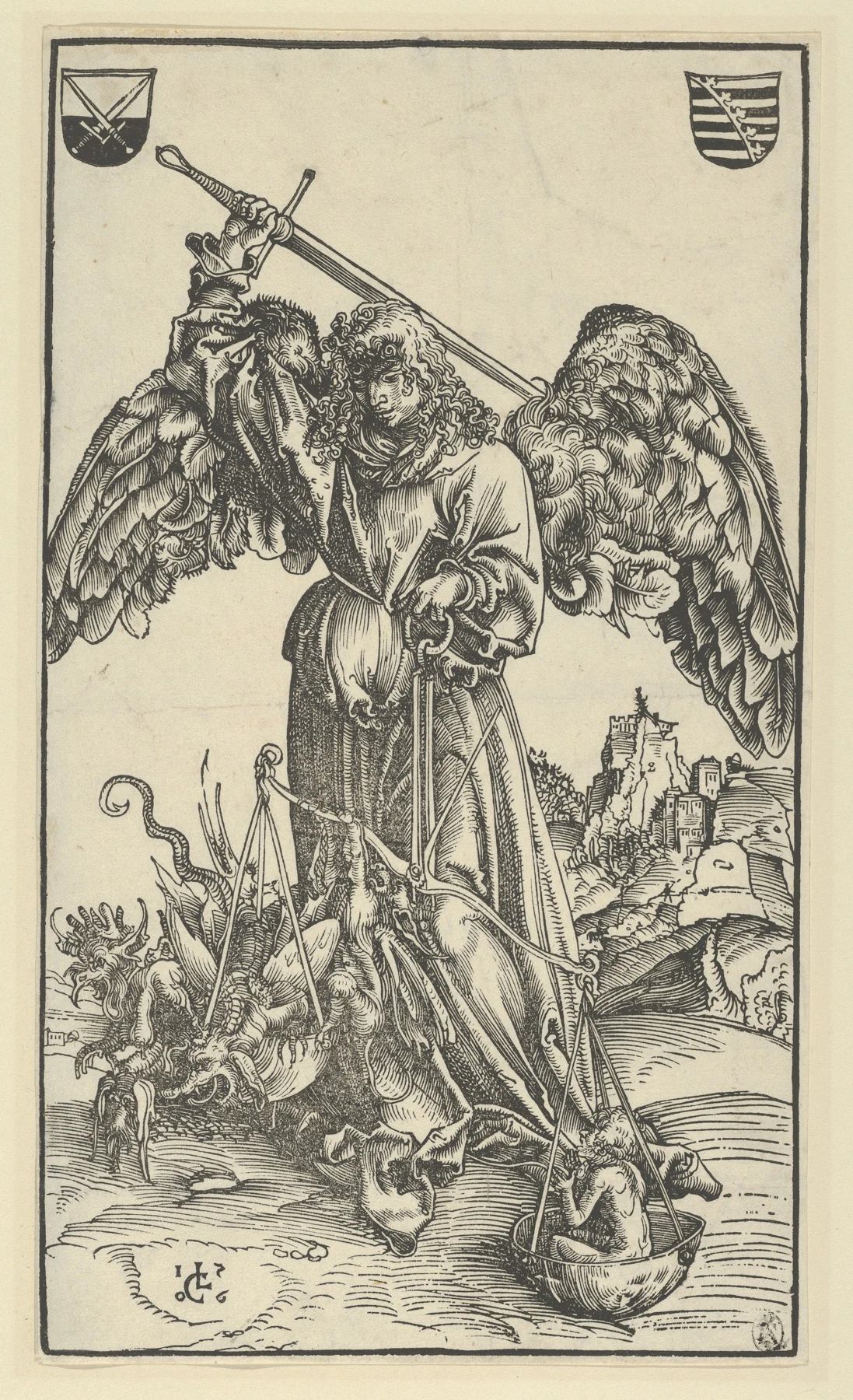
Our cover is Lucas Cranach the Elder’s 1506 woodcut, catalogued by the Metropolitan Museum as The Archangel Michael Weighing a Soul. The angel carries a sword and balance; small figures and demonic forces appear near the pans. It witnesses later Christian representation, not Roman-period imagery or an original illustration of the Testament of Abraham. [20]
The contrast is useful: a later artwork shows Michael with scales, while an earlier text assigns them to Dokiel. General resemblance does not permit replacing one name with another inside a source.
Neither does the picture make Michael Anubis under a new name. Demonstrating the transfer of a role or artistic arrangement requires intervening witnesses. This artwork, by itself, establishes that Cranach depicted Michael in this role in 1506.
The Quran’s just balances
Quran 7:8–9 links heavy balances with success and light ones with loss. Verses 23:102–103 repeat the contrast while naming JahannamGehenna: a place-name and language of punishmentTerm related to the valley of Hinnom; usage changes across Jewish, Christian and Islamic texts and does not equate every afterlife term.Glossary · Click to read the explanation. In 101:6–11, heavy balances accompany a pleasing life, whereas light ones lead to the abyss and fire. These passages explicitly connect weighing with an eschatological outcome. [16][19][18]
Verse 21:47 adds that the balances are just, nobody is wronged, and even a mustard seed’s weight is brought into account. The image centres on exact justice and comprehensive knowledge, without social privilege or concealment of conduct. [17]
The selected passages do not name Michael or Rashnu as the weigher, place a heart opposite Maat’s feather, or supply the Testament of Abraham’s courtroom detail. Inserting a later commentary or report into a verse and then treating the combined account as evidence of borrowing would confuse distinct witnesses.
Questions of metaphor and the mechanics of weighing must also be separated from identifying the wording. These verses affirm weighing, justice and recompense. Establishing what becomes tangible in the pans and how a balance operates requires separate research into commentaries and reports, rather than mechanically translating the Egyptian image.
Resemblance and routes of contact
We have an ancient Egyptian afterlife balance, Hebrew appraisal of hearts and integrity, a Jewish text with a proposed Egyptian setting, Iranian and Quranic witnesses, and later Christian art. Transmission is therefore a legitimate question. The history need not be a single unbranched route.
The proposed Egyptian setting for the Testament of Abraham gives comparison a contact context to examine. A shared setting, however, does not identify an Egyptian papyrus lying before its author. Similarities in scribes, court and balance support discussion; intermediaries, borrowed expressions and the recension carrying them require further investigation. [12][11][2]
Comparing Quranic and Iranian texts likewise requires attention to chronology. A compilation potentially preceding Islam can inform a possible setting, while another book’s final form is later. An ancient name does not settle the date of every description attached to it. [9][10][21]
What strengthens a transmission claim?
A claim becomes stronger when defensible chronological priority combines with specific social or linguistic contact, an unusual cluster of shared details, and intervening witnesses explaining changing roles. Alternatives must then be tested. Could commercial and judicial scales produce similar metaphors? Did a general model circulate and change? Or is there more specific literary dependenceLiterary dependenceA relationship explaining a text’s composition through another text.Glossary · Click to read the explanation?
Differences are evidence, not obstacles to conceal. The Iliad’s death-lot, the Egyptian document’s heart and the Iranian text’s deeds are not interchangeable labels. A difference might itself reflect reinterpretation, but that needs an argument; “development” cannot replace evidence.
Our conclusion is bounded accordingly. We establish witnesses and their functions in the passages read, while distinguishing proposed connections. We have no continuous manuscript chain carrying the balance from OsirisOsirisEgyptian deity associated with the dead and continued life, presiding over judgment in funerary papyri such as 66.99.142.Glossary · Click to read the explanation’ court to the Quran or Cranach.
Degrees of evidence
- Textually confirmed: the Egyptian witness weighs a heart; HomerHomerThe name to which Greek tradition attributes the Iliad and Odyssey.Glossary · Click to read the explanation’s selected passages determine a military destiny. [1][2][3]
- Textually confirmed: the passages read in Job, Proverbs and Daniel do not present the Testament’s same afterlife court. [4][5][6][7]
- Textually confirmed: Rashn reckons impartially in the Menog i Khrad; Dokiel holds the scales in the long Testament of Abraham. [8][11]
- Textually confirmed: Quranic balances relate to justice and eschatological outcomes, without naming a weigher in these verses. [16][17][18][19]
- Probable within the cited scholarly readings: an Egyptian context for the Testament and a late Sasanian Menog i Khrad compilation, not individual dating of every sentence. [12][9]
- Open to discussion: Egyptian contributions to Hebrew wisdom imagery and circulation of testament traditions in later literature. [14][13]
- Not established here: that every scene copies one original; that Michael is a renamed Anubis or Rashnu; or that the Quran directly borrowed from a specific papyrus or Iranian book.
What survived within the balance?
The balance gives justice a form people can imagine. Something impressive in human life may prove deficient; something despised may carry weight. Yet the image’s history changes the thing weighed, the judge, the moment of reckoning and the relationship between result and mercy.
Possible inheritance does not erase each narrative’s meaning. Difference does not exclude historical contact. Research begins with both: resemblance requiring explanation and distinctions preventing every heavenly court from becoming a copy of another.
References and notes
- Catalogue description and metadata; not full page. British Museum, Greenfield papyrus, EA10554,80; c. 950–930 BCE Return to the text ↑
- Selected passages; Nu appendices distinguished from Ani. E. A. Wallis Budge, The Papyrus of Ani (1913); weighing scene, heart formula 30B and selected opening declarations Return to the text ↑
- Two selected scenes; not the complete Iliad. Homer, Iliad 8.69–74; 22.209–213; Lang, Leaf and Myers historical translation Return to the text ↑
- Selected Hebrew passages. Job 31:1–8, 13–19; Hebrew primary text Return to the text ↑
- All four Hebrew verses. Proverbs 16:1–4, especially 16:2; Hebrew primary text Return to the text ↑
- All four Hebrew verses. Proverbs 21:1–4, especially 21:2; Hebrew primary text Return to the text ↑
- All four verses. Daniel 5:25–28; KJV, public domain Return to the text ↑
- Selected passages in a historical translation; not whole book. Menog i Khrad 2:110–132; 7:1–19; 12:1–15; E. W. West (1885), SBE 24 Return to the text ↑
- Entry body, not the books it cites. Aḥmad Tafażżolī, Dādestān ī Mēnōg ī Xrad, Iranica (1993; updated 2013) Return to the text ↑
- Entry body; not the Arda Wiraz primary text. Leon Goldman, Rašn Yašt, Iranica (2012; updated 2013) Return to the text ↑
- Passages from both recensions, kept distinct. Testament of Abraham, long recension 10–14; short recension 8–11; W. A. Craigie (1896) Return to the text ↑
- Publisher summary only, not complete chapter. E. P. Sanders, Testament of Abraham, in Outside the Old Testament (1986), pp. 56–70; publisher summary Return to the text ↑
- Publisher extract only, not complete article. Malka Z. Simkovich, HTR 109/1 (2016), pp. 1–32; DOI 10.1017/S0017816015000462; publisher extract Return to the text ↑
- Selected author-posted passages; not whole volume. Nili Shupak, Weighing in the Scales, in From Author to Copyist (2015), pp. 249–257; selected passages Return to the text ↑
- All five verses. Revelation 20:11–15; KJV, public domain Return to the text ↑
- Both Arabic verses. Quran 7:8–9; Arabic primary text Return to the text ↑
- Full Arabic verse. Quran 21:47; Arabic primary text Return to the text ↑
- All six Arabic verses. Quran 101:6–11; Arabic primary text Return to the text ↑
- Both Arabic verses. Quran 23:102–103; Arabic primary text Return to the text ↑
- Catalogue, original and rights; later Christian depiction. Lucas Cranach the Elder, The Archangel Michael Weighing a Soul (1506); Met 27.54.22 Return to the text ↑
- All three paragraphs, not the books they cite. Philippe Gignoux, Ardā Wīrāz, Iranica (1986; updated 2013) Return to the text ↑
Suggest a correction · Suggest a source for this record
Cite this record
IL Archive, «Judgment Scales: Egypt and the Worlds of Late Antiquity», Edition 1, https://ilarchive.com/en/studies/judgment-scales-egypt-and-late-antiquity
Continue reading