Entity
Rashnu: justice in Iranian reckoning
A reference page linking a name, group, or concept to the materials that discuss it.
Rashn is a Zoroastrian divine being linked to uprightness and discerning truth; the Menog i Khrad presents him as an impartial weigher who favors no ruler.
Estimated reading time: 6 min Published Last reviewed:
Share article

Text
Introduction
Rashn, or Rashnu in the Avestan form, is a Zoroastrian yazata associated with uprightness and justice: a divine being worthy of veneration within Zoroastrian traditionZoroastrianism: Hymns, Rituals and the Changing TraditionA living Iranian religious tradition examined through Avestan hymns, Middle Persian writings and royal inscriptions, separating textual evidence, later interpretation and hypotheses of influence.Glossary · Click to read the explanation. His familiar later literary role involves a balance of deeds that favors neither kings nor the powerful. Reducing him to a “weigher of the dead,” however, obscures his place in hymns and ritualsRitualAn organised or distinguished practice meaningful to a community; it may leave traces, but its form alone does not reveal an associated doctrine.Glossary · Click to read the explanation concerned with discerning truth.
This entry follows two different witnesses: Yasht 12, which invokes Rashn in an extensive ritual setting, and the Menog i Khrad, which describes his justice in the soul’s reckoning. The aim is to understand the relationship between justice in life and judgment after death, distinguishing textual composition from surviving copies and literary description from modern visual interpretation. [1][2]
Name and place in the tradition
William W. MalandraWilliam W. MalandraScholar of ancient Iranian languages and religion and professor emeritus at the University of Minnesota.Glossary · Click to read the explanation, a scholar of ancient Iranian religion, connects Rashn’s name with a root expressing straightness; the epithet razišta means “most just” or “most upright.” Name and epithet introduce his function, but the actions attributed to him also matter. Rashn does not occur in the oldest Avestan portions, appearing instead in the Younger AvestaAvestaThe Zoroastrian sacred corpus in Old and Younger Avestan, containing hymns, liturgy and prayers transmitted orally before later manuscript copying.Glossary · Click to read the explanation and subsequent literature. [1][2]
Passages of Yasht 10, dedicated to Mihr or Mithra, associate Rashn and Srosh with Mihr. Srosh is a divine figure linked to religious listening and protection, while Mihr guards agreements. Their neighboring calendar days, 16, 17, and 18, also place them within the system of veneration. Yasht 12 itself, however, does not name Mihr and Srosh: their grouping elsewhere should not be imposed on every passage of that hymn. [1][2]
Yasht 12: invoking justice, not recording a trial
A Yasht is a hymn within the AvestaAvestaThe Zoroastrian sacred corpus in Old and Younger Avestan, containing hymns, liturgy and prayers transmitted orally before later manuscript copying.Glossary · Click to read the explanation; the twelfth is devoted to Rashn. Section 7 repeats his name with qualities specifying the power being invoked:
The transliteration follows the Avestan text published electronically from Geldner’s edition. “Truthful” points to his association with truth and religious order, not merely avoidance of everyday lying. The passage continues with qualities of knowledge, far sight, and power against thieves. This phrase contains neither a balance nor a fully developed trial of a soul. [3]
Sections 3–6 invoke Rashn in the context of varah, interpreted by scholars as an oath or truth-discerning ordeal, with ritual elements such as fire and barsom, the bundle of twigs used in worship. Sections 9–37 repeatedly summon him from different cosmic locations. This reach makes the justice sought independent of one locality; it need not describe a geographical journey undertaken by the deity. [2][3]
Leon GoldmanLeon Goldman, Iranian-text scholarLeon Goldman is a scholar of Avestan texts and author of Rašn Yašt.Glossary · Click to read the explanation, an Iranian-text specialist and editor of the hymn, rejects treating repetition alone as evidence of literary poverty or late composition: repetition serves oral and ritual performance. He proposes that the opening question was prefixed to an earlier ritual, but this is scholarly reconstruction, not a sequence of separately dated manuscript stages. The interpretation of varah and the procedure’s details remain debated. The connection with justice that reveals truth is persuasive; a complete historical courtroom procedure cannot be reconstructed from this witness. [2][4]
Composition is not the date of a copy
The different chronological levels should remain distinct:
- Yasht 12 belongs to the Younger Avesta. Goldman presents a first-millennium-BCE setting for its material as a broad probability, followed by oral transmissionOral transmissionThe passing-on of words, narratives or knowledge through hearing, performance and learning, sometimes alongside writing; degrees of stability vary with genre, setting and controls.Glossary · Click to read the explanation and later writing; this is not an exact date for every passage.
- The oldest Yasht manuscript described by Goldman, F1, was copied at Navsari in Gujarat, India, in 1591 CE. Yasht 12 occupies folios 170r–175v. It is a late copy of an older tradition, not a document from ZoroasterZoroaster / ZarathustraFoundational figure associated with Zoroastrian tradition and the Old Avestan Gathas. His priestly role, teaching and relationship to the poems are subjects of research; his lifetime and biographical details remain disputed.Glossary · Click to read the explanation’s lifetime. [4]
- The Menog i Khrad, “Judgments of the Spirit of Wisdom,” is a Middle Persian instructional dialogue between a sage and the Spirit of Wisdom. Ahmad Tafazzoli favors a late Sasanian origin, possibly in the sixth century CE, while acknowledging uncertainty. Its Pahlavi manuscript K43 is dated 1589, whereas the Pazand–Sanskrit witness L19 is dated 1520: these preserve different versions. [5]
The balance in the Menog i Khrad
Chapter 2 moves from guidance on conduct to the person’s fate after death. In 2.114–125 the soul remains near the body for three nights, then travels at dawn on the fourth day to the Chinvat BridgeChinvat BridgeThe crossing associated with the soul’s judgment after death in Zoroastrian tradition. Named in the Gathas, it receives fuller descriptions of guardians, weighing and unequal passage in later texts; it is distinct from resurrection and world renovation.Glossary · Click to read the explanation, where protection, struggle, and reckoning intersect. Mihr, Srosh, and Rashn appear in this setting, with impartial weighing assigned to Rashn. [8]
The decisive wording in 2.121, in Middle Persian transliteration, is:
This wording was checked against the TITUS electronic text and West’s translation. It is neither an inscription nor a description of an excavated device. The surrounding passage explains that judgment favors neither righteous nor wicked because of identity, nor lords and rulers because of rank: the greatest and humblest receive the same justice. The point is an impartial standard, not the disappearance of the distinction between good and evil. [6][8]
Sections 2.131–136 give this standard practical content: refraining from harm and theft, honoring people and guests, acquiring wealth honestly, and avoiding bribery and false witness. Good deeds appear to the soul as a beautiful maiden. This literary image differs from the balance but likewise connects a person’s destiny with conduct during life. [8]
Three outcomes and the limits of Rashn’s role
Chapter 12.11–15 contrasts the disturbed distribution of worldly benefits with justice in spiritual reckoning. Predominantly good deeds lead to heaven, predominantly sinful deeds to hell; an equal balance leads to Hamistagan, the abode of those whose deeds are evenly balanced. “Equality” here describes an individual reckoning, not a claim that good and bad always have identical value. [7]
This is an account of individual judgment after death. FrashokeretiFrashokereti: final renovationCreation’s completion or renovation in Iranian tradition, linked to incorruptible life and evil’s retreat.Glossary · Click to read the explanation, final renovation, concerns the resurrection of the dead and the transformation of all creation. Rashn should not automatically be inserted into every eschatological scene: Malandra notes his absence from the Iranian Bundahishn’s chapter 34 on the final body. This limits generalization without canceling his well-attested role in individual reckoning. [1]
What can comparison and imagery establish?
The strongest evidence here combines the uprightness invoked in ritual with the Middle Persian text’s explicit insistence on impartial weighing. It does not establish that every element is historically contemporary, or that a single simple development moved the figure from an earthly court to a heavenly one.
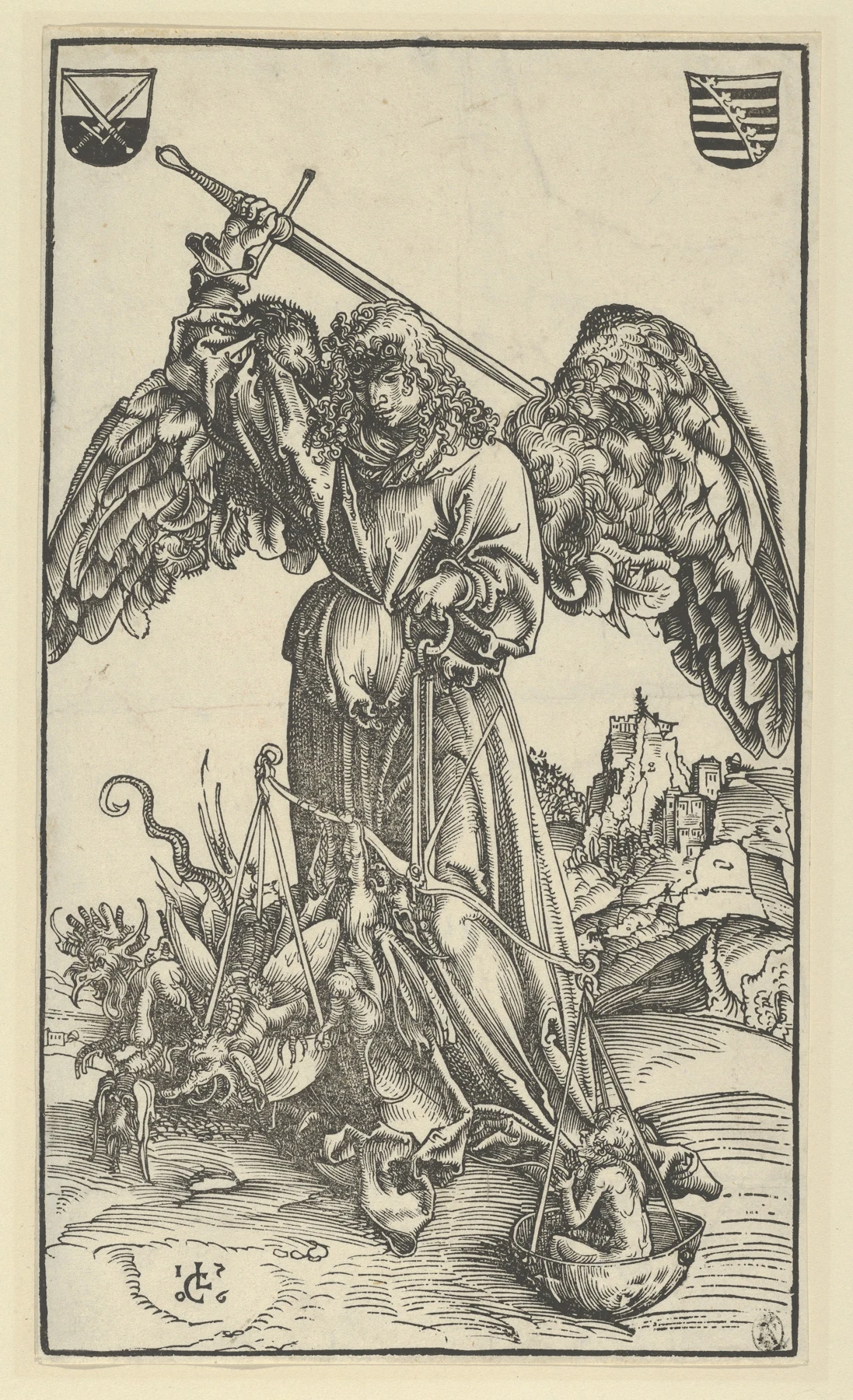
Iranian balances may be compared with Egyptian imagery or traditions involving Michael, but a similar instrument does not make Rashn identical to Anubis or Michael, nor identify a route of borrowing. Such an argument requires dated witnesses, specific shared features, and examinable contact. The cover is a modern AI-assisted interpretation of a level balance. It portrays neither Rashn’s appearance nor an archaeological object. The argument rests on the wording and context, not the illustration.
References and notes (8)
- William W. Malandra, “Rašn, ” Encyclopaedia Iranica (2013). Name and uprightness; Yasht 10.41, 100, 126; calendar days; individual judgment and absence from Iranian Bundahishn 34. Entire entry, not all works cited therein. Return to the text ↑
- Leon Goldman, “Rašn Yašt, ” Encyclopaedia Iranica (2012). Entire entry: absence from Old Avesta, hymn structure and differing interpretations of varah. Pirart and Schwartz are known here through this survey, not independently read. Return to the text ↑
- Yasht 12, electronic Avestan text based on Karl Friedrich Geldner’s edition. Indexed text 0–17, especially 3–7; short quotation from 7. Invocation compared with Darmesteter’s translation and Goldman’s account; no manuscript examination or new critical edition. Return to the text ↑
- Leon Goldman, The Avestan Hymn to Justice (Rašn Yašt), Reichert (2015); publisher sample. Printed pp.1–5, 8–12 read in the sample; pp.6–7 absent. Pp.1–5 cover ritual, structure and proposed chronology; p.10 describes F 1. Full critical text not read. Return to the text ↑
- Ahmad Tafazzoli, “Dādestān ī Mēnōg ī Xrad, ” Encyclopaedia Iranica (1993), pp.554–555. Dialogue genre, proposed Sasanian date; K 43(1589) and L 19(1520), distinguishing Pahlavi from Pazand–Sanskrit. Return to the text ↑
- Menog i Khrad, chapterII, TITUS electronic transliteration, Frankfurt University. Sections 2.114–125, especially 121, compared with West; starred readings elsewhere do not occur in the quotation used. No manuscript collation claimed. Return to the text ↑
- Menog i Khrad 12, West’s historical translation, Pahlavi Texts III, SBE 24 (1885). Entire chapter 12.1–15 and notes read; sections 11–15 distinguish the three outcomes. Return to the text ↑
- Menog i Khrad 2, historical translation by Edward William West, Pahlavi Texts III, SBE 24 (1885). Sections 1–149 read; cited passages 114–125 and 131–136. Original note marker 8 retained, with URL updated to the text read directly; no claim to have read the whole book. Return to the text ↑
Suggest a correction · Suggest a source for this record
Cite this record
IL Archive, «Rashnu: justice in Iranian reckoning», https://ilarchive.com/en/entities/rashnu
Continue reading