Ancient text · Religious corpus
Avesta
A text for line-by-line reading, with transliteration, translation, and resources.
- Names
- Abestāg · Avesta
- Region
- Ancient Iranian world (the composition region of the textual layers is debated); later manuscript transmission in Iran and India
The Avesta is the Zoroastrian corpus in Old and Younger Avestan, including the Gathas, Yasna, Yashts and Videvdad, shaped by oral transmission and later writing; the study separates text, Zand and manuscript age.
Estimated reading time: 8 min Published Last reviewed:
Share article

Text
Introduction
What is the Avesta, and how did texts recited for centuries come down to us in manuscripts? This entry maps the sacred corpus of ZoroastrianismZoroastrianism: Hymns, Rituals and the Changing TraditionA living Iranian religious tradition examined through Avestan hymns, Middle Persian writings and royal inscriptions, separating textual evidence, later interpretation and hypotheses of influence.Glossary · Click to read the explanation, distinguishing its languages, component collections and ritualRitualAn organised or distinguished practice meaningful to a community; it may leave traces, but its form alone does not reveal an associated doctrine.Glossary · Click to read the explanation functions from the dates of composition, writing and surviving copies. It is a critical introduction to a religious corpus, not an edition or complete translation of its texts, nor an endorsement of every historical claim made within the tradition. [1]
The name and the boundaries of the corpus
“Avesta” designates the inherited collection of texts in Avestan, an ancient Iranian language distinct from Middle Persian and modern Persian. It does not mean one book with one author and a fixed sequence of chapters from the beginning. The corpus includes acts of worship, hymns, prayers, prescriptions and narratives transmitted, selected and rearranged at different times. “Zand” is not a synonym for Avesta: in this context it denotes Middle Persian translation and explanation, sometimes paired with the Avestan text under the expression “Avesta and Zand.” [2]
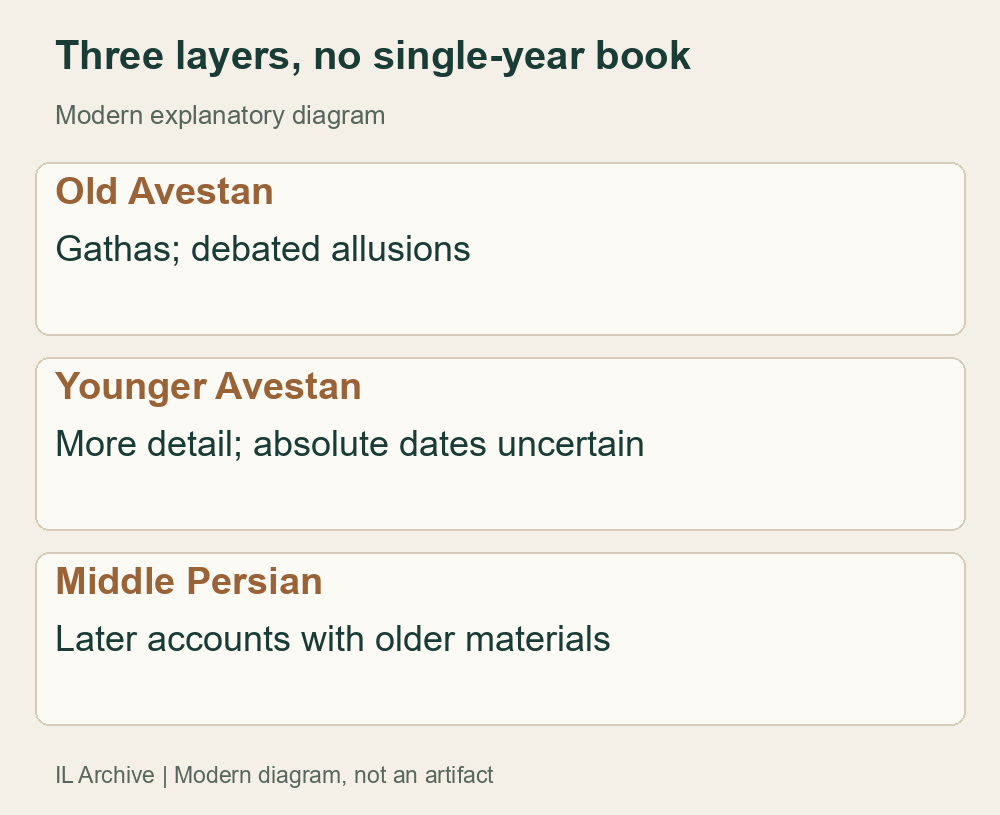
Linguistic comparison suggests two broad strata: Old Avestan and Younger Avestan. These labels register differences in language, style and oral heritage; they do not supply a secure calendar date for every passage. The precise regions of composition, particularly for the older material, remain debated. The whole collection should not therefore be assigned to one king's reign or a single region without independent evidence. [3]
The older texts: Gathas and the seven-chapter Yasna
The Gathas comprise 17 hymns in five metrical groups embedded in the Yasna, in chapters 28–34, 43–46, 47–50, 51 and 53. Zoroastrian tradition attributes them to Zoroaster (Zarathustra)Zoroaster / ZarathustraFoundational figure associated with Zoroastrian tradition and the Old Avestan Gathas. His priestly role, teaching and relationship to the poems are subjects of research; his lifetime and biographical details remain disputed.Glossary · Click to read the explanation, although his time and place, and even questions of historical authorship, remain debated. The hymns address Ahura MazdaAhura MazdaWise Lord in Iranian traditions, associated with truth, goodness and creation; not a Persian name for Yahweh.Glossary · Click to read the explanation and explore truth or right order (aša), reflection, action and choice. Yasna 30:2–5, for example, calls on hearers to examine their choices and presents contrasting spirits and conduct. That observation refers to a passage examined through a modern edition and translation; it is not offered as a newly established literal translation of the Avestan. [4]
Alongside the hymns is the Yasna Haptanghaiti (“Worship in Seven Chapters”), Yasna 35–41. It is in Old Avestan, but it is neither one of the seventeen Gathic hymns nor composed in the same metrical form. Its prayers, praises and ritual formulas have been edited, translated and discussed in a specialist volume by Almut Hintze. Hence “Old Avestan” must not be equated with the Gathas alone, and the antiquity of a passage does not prove that a single historical person authored it. [5]
The Yasna as a performed ritual text
In its received order, the Yasna comprises 72 chapters, bringing together material of different periods and genres, including the Gathas and the seven-chapter Yasna at its centre. Recitation accompanies ritual actions involving implements and offerings, including haoma, water and fire. Reading a printed edition alone cannot disclose every aspect of the performance; nor is it accurate to reduce the entire religion to “fire worship.” SOAS's Multimedia Yasna project studies the relationship between transmitted recitation, ritual practice and variant manuscript readings. [6]
The Visperad is incorporated into the recitation of the Yasna and is normally not recited as a standalone book. Its use has been linked to particular seasonal observances. The names of textual collections must therefore be distinguished from the ways in which they are inserted into changing ritual sequences: being a “part of the Avesta” does not make every collection an independent performance, or establish that it was originally composed in its present form. [7]
Younger hymns and everyday prayers
The twenty-one Yašts are hymns addressed to individual sacred beings or worthy objects of reverence, including Mithra and Tištrya. They preserve narratives, poetic imagery and sometimes older passages beside later material. Membership in the “Younger Avestan” linguistic stratum does not imply that every motif was recently invented. Nor should their variety be mistaken for a final uniform set of beliefs accepted by all adherents in every age. [8]
The Khordeh Avesta (“Little Avesta”) names collections for daily devotion and for use outside the longer priestly ritual. These include prayers for divisions of the day, praises and blessings. Their contents and order vary from manuscript to manuscript; some include selected Yašts while others do not. No single short edition is consequently a word-for-word equivalent of every historical Khordeh Avesta collection. [9]
Vīdēvdād: prescriptions, purity and narrative
The Vīdēvdād, also called Vendidad, is an Avestan composition devoted in large part to ritual purity, pollution, remedies and penalties, and also contains dialogues and accounts concerning the world and humankind. Its name points toward law or regulation directed against the daēvas, rather than simply a modern “book of evil.” The date of the chapter sequence should not be confused with the date of each element it incorporates. William W. Malandra notes that chapter 12 is absent from the older manuscript tradition and that some later material supplied in its place was newly composed. [10]
Some witnesses transmit the Vīdēvdād accompanied by Pahlavi explanation; others embed portions within an extended ceremony involving Yasna and Visperad. These distinct transmission families enable textual comparison, but caution against treating one copy as an entire tradition, or assuming that every prescription represents uniform historical practice throughout ancient IranIranIran is the modern country containing Shush, ancient SusaGlossary · Click to read the explanation.
Ideas and their later reinterpretation
The Avesta contains changing accounts of the relationship between Ahura Mazda and sacred beings such as the Amesha SpentasAmesha SpentasBenevolent beings and concepts in Iranian tradition, approximately “holy/bounteous immortals.”Glossary · Click to read the explanation, of truth (aša) and deceit (druj), and of human responsibility for thought and action. Turning these layers into a single finished theological system obscures distinctions between Old Avestan poetry, later hymns and Pahlavi exegesis. Discussion of the hostile spirit Angra MainyuAngra Mainyu / AhrimanThe hostile spirit in Zoroastrian texts: Gathic wording, Younger Avestan counter-creation and Ahriman in Middle Persian cosmology.Glossary · Click to read the explanation, for instance, must take account of the passage and terminological development before equating it without qualification with the later portrayal of “Ahriman.” [4]
The Avestan heritage also contains images of moral destiny after death, such as the Chinvat BridgeChinvat BridgeThe crossing associated with the soul’s judgment after death in Zoroastrian tradition. Named in the Gathas, it receives fuller descriptions of guardians, weighing and unequal passage in later texts; it is distinct from resurrection and world renovation.Glossary · Click to read the explanation, subsequently elaborated in accounts of judgment and final renewalFrashokereti: final renovationCreation’s completion or renovation in Iranian tradition, linked to incorruptible life and evil’s retreat.Glossary · Click to read the explanation. These are important topics, but a verbal parallel with another religious tradition does not establish its origin or direction of transmission. The specific passage, its linguistic stratum and its witness must be identified first. [1]
From memorised recitation to phonetic writing
Priestly groups transmitted texts through long traditions of instruction and recitation. The Avestan script was then devised with a rich set of signs suited to recording recited sounds, drawing on a Pahlavi scribal background. Neither the precise moment of its invention nor the canonisation of the whole corpus can be fixed with certainty. Writing and organisation are generally associated with the Sasanian period, especially its later phases, though the details remain disputed. Many centuries separate the oldest hymns from the oldest surviving codices, which in general date only from the late thirteenth century onward, not from Zoroaster's lifetime. [11]
Collating manuscripts is essential rather than ornamental. A codex may transmit only Avestan (sāde) or add a Pahlavi translation, while Iranian and Indian lines of copying also differ. The Avestan Digital Archive makes witnesses searchable by passage and manuscript identifier; viewing its catalogue, however, is not the same as inspecting the relevant folios and readings. [12]
Sasanian arrangements and lost books
Later Middle Persian works, notably Book Eight of the Dēnkard, describe a tradition of twenty-one nasks or sacred textual divisions. This is retrospective evidence about an inherited scheme and religious memory, not a surviving complete set of twenty-one manuscripts; nor does it prove that every present collection already had identical scope and order in one particular century. Lost materials are inferred in part from quotations and summaries, but the exact proportion destroyed or missing cannot be established. [13]
Pahlavi accounts also tell of sacred copies destroyed under Alexander and fragments subsequently collected by kings and priests. Such a story must be attributed to later Zoroastrian memory; it is not an independent archaeological report that establishes a destruction and recovery just as narrated. Collecting old material, selecting a canon, devising its written form and translating it are distinct processes, not necessarily a single event. [14]
Zand and the history of interpretation
Some Avestan manuscripts interleave Middle Persian translations with original sentences and glosses that clarify vocabulary, ritual procedure and competing readings. Alberto Cantera shows that the translations developed in more than one phase, and that a word-by-word rendering may still embody an interpretation or shift away from an earlier sense. Zand therefore documents how the Avesta was understood, rather than offering a transparent replica of its original voice. A Middle Persian work such as the Bundahišn does not become part of the Avestan-language corpus simply because it belongs to the same religious heritage. [15]
Reading the Avesta today
Critical reading combines language, metre and ritual structure with collations of actual witnesses, rather than uncritically selecting one digital text. The contemporary Multimedia Yasna platform provides transcriptions and a textual apparatus, identifying uncertainties, gaps and damaged passages; a convenient translation remains useful but cannot replace comparing readings. Yasna 30, for example, may be checked word by word against an academic linguistic analysis and an English translation. The present entry describes its location and themes, rather than reproducing a copyrighted translation. [16]
The date of Zoroaster and the provenance of some compositions remain matters of scholarly argument. Comparisons with other traditions require independent evidence for contact and chronology. The historical importance of the Avesta lies not in assuming an entire intact book from one founding moment, but in following texts performed, preserved, interpreted and copied by communities over a long period. [17]
References and notes (17)
- Jean Kellens (1987), “AVESTA i. Survey of the History and Contents of the Book,” Encyclopaedia Iranica, III/1, pp. 35–44. Online introduction; Avesta–Zand distinction; contents, manuscript transmission and limits of survival; print pages not individually inspected. Return to the text ↑
- Encyclopaedia Iranica (2015), “ZAND,” short reference entry. Entire short online entry; Zand as Middle Persian translation and explanation. Return to the text ↑
- Philip Huyse (2006), “IRAN viii. Persian Literature (1) Pre-Islamic,” Encyclopaedia Iranica, XIII/4, pp. 410–414. Online opening and “The Avesta” paragraphs on orality, linguistic strata and tentative dating; print not consulted. Return to the text ↑
- Scott L. Harvey, Winfred P. Lehmann and Jonathan Slocum, “Old Avestan: Yasna 30,” Early Indo-European Online, University of Texas at Austin. Lesson introduction; Yasna 30.1–5, displayed English rendering and lexical analysis; no verbatim republication. Return to the text ↑
- Almut Hintze (2007), A Zoroastrian Liturgy: The Worship in Seven Chapters (Yasna 35–41), Harrassowitz, 397 pp. Publisher/university abstract and contents list only; the book’s full text was not accessible or read. Return to the text ↑
- SOAS University of London, “The Multimedia Yasna (MUYA),” institutional research overview. Project overview and methods for ritual film/manuscript analysis; full ritual film not viewed. Return to the text ↑
- William W. Malandra (2000), “VISPERAD,” Encyclopaedia Iranica. Online introduction and discussion of its intercalation into Yasna and seasonal use. Return to the text ↑
- Almut Hintze (2014), “YAŠTS,” Encyclopaedia Iranica. Opening account of the 21 hymns, their title, ritual roles and contrast with Yasna. Return to the text ↑
- William W. Malandra (2022), “KHORDEH AVESTA,” Encyclopaedia Iranica. Opening definition, manuscript variability and prayer catalogue; not every subsection read. Return to the text ↑
- William W. Malandra (2000), “VENDĪDĀD i. Survey of the History and Contents of the Text,” Encyclopaedia Iranica. Online introduction, missing chapter 12, manuscript families and selected dating discussion. Return to the text ↑
- Karl Hoffmann (1987), “AVESTAN LANGUAGE i. The Avestan Script,” Encyclopaedia Iranica, III/1, pp. 47–62. Opening online sections on script direction, phonetics, Pahlavi basis and manuscript witnesses; print article not checked in full. Return to the text ↑
- Avestan Digital Archive (ADA), Freie Universität Berlin, online manuscript discovery portal. Landing page and search functions only; manuscript folios were not systematically opened or collated. Return to the text ↑
- Jean Kellens (1987), “AVESTA i,” Encyclopaedia Iranica, Sasanian collection and surviving transmission. Sections on late medieval manuscripts, 21 nasks and indeterminate loss; the “one-quarter” estimate is not a demonstrated count. Return to the text ↑
- Carlo Giovanni Cereti (2009), “MIDDLE PERSIAN i. PAHLAVI LITERATURE,” Encyclopaedia Iranica, Dēnkard discussion. Opening and Dēnkard passages on remembered Sasanian textual arrangements; later evidence, not contemporary proof. Return to the text ↑
- Alberto Cantera (2015), “AVESTA ii. Middle Persian Translations,” Encyclopaedia Iranica. Online sections on manuscript types, translation stages, interlinear glosses and exegetical interpretation. Return to the text ↑
- Multimedia Yasna Project, “Edition and transcriptions of the Yasna,” editorial and collation methods. Editing workflow, manuscript transcription and collation notes, editor-by-chapter list; no complete interactive apparatus review. Return to the text ↑
- Manfred Hutter (2009), “ZOROASTER iii. Zoroaster in the Avesta,” Encyclopaedia Iranica. Introduction and comparison of Old and Younger Avestan portrayals; uncertainty over chronology and attribution. Return to the text ↑
Archive records may be reviewed and refined as better evidence or sources become available. Suggest a correction
Suggest a correction · Suggest a source for this record
Cite this record
IL Archive, «Avesta», https://ilarchive.com/en/texts/avesta
Continue reading
Related readings