Entity · Concept
Frashokereti: final renovation
A reference page linking a name, group, or concept to the materials that discuss it.
Creation’s completion or renovation in Iranian tradition, linked to incorruptible life and evil’s retreat.
Estimated reading time: 6 min Published Last reviewed:
Share article

Text
Introduction
Frashokereti names creation’s final renovation in Zoroastrian traditionZoroastrianism: Hymns, Rituals and the Changing TraditionA living Iranian religious tradition examined through Avestan hymns, Middle Persian writings and royal inscriptions, separating textual evidence, later interpretation and hypotheses of influence.Glossary · Click to read the explanation: a future in which evil can no longer corrupt life, associated in important texts with the resurrection of the dead and freedom from death. Yet “the end of the world” can mislead: in the Bundahishn’s account, the material world is not simply abolished but freed from corruption and brought to completion.
Understanding this idea requires three questions to be distinguished: what happens to people after death, how the dead return to life, and how creation as a whole changes. Reading Avestan witnesses alongside a detailed Middle Persian account reveals both their connections and the differences that a single, uniform doctrinal summary would conceal. [1][2]
The name and the layers of evidence
The Avestan form is frašō.kərəti, with Middle Persian equivalents such as frašegird. The first element’s meaning is not entirely settled; translations therefore include “renovation,” “completion,” and “making existence wonderful.” Its significance depends on the passage, not etymology alone. [1]
The Gathas, Old Avestan hymns within the AvestaAvestaThe Zoroastrian sacred corpus in Old and Younger Avestan, containing hymns, liturgy and prayers transmitted orally before later manuscript copying.Glossary · Click to read the explanation, contain a verbal expression in Yasna 30.9 regularly discussed in the history of the idea:
This is a brief interpretive rendering of the wording cited by Almut HintzeAlmut HintzeAlmut Hintze studies ancient Iranian languages, the Avesta and Zoroastrian traditions.Glossary · Click to read the explanation, a specialist in ancient Iranian languages. It expresses human participation in improving existence; it does not by itself describe resurrection and the molten-metal river in all their later detail. Continuity of vocabulary and themes supports an eschatological reading, but the earlier passage does not state everything found in Middle Persian interpretation. [1][2]
A short chronological guide is more useful than a supposedly certain sequence of doctrinal stages:
- The Old Avestan Gathas are linguistically earlier than the Younger Avestan Yashts. This relative priority does not itself date every passage or the completion of a doctrine.
- Yasht 19.89–96 describes resurrection and the victory of good as future events. Their narrative time is the eschatological future, not the date of composition.
- The Bundahishn is a Middle Persian compilation developed through successive redactions; an important redaction belongs to the late ninth century CE and incorporates older material. Surviving copies are later: an Indian-recension manuscript is dated 1397, while Iranian-recension witnesses include sixteenth- and seventeenth-century manuscripts. A copy’s date is not the idea’s date of origin. [3]
What Yasht 19 adds
Yasht 19.89 connects renovation with SaoshyantSaoshyantSaoshyant is an Avestan term for a benefactor, with an eschatological savior sense in Zoroastrian texts.Glossary · Click to read the explanation, the savior or benefactor in this context, and his helpers. The coming world is free from aging, death, and decay, and the dead rise. Astvat-ereta then appears in 19.92–94, accompanied in the following passage by helpers of good thoughts, words, and deeds; sections 95–96 describe the defeat of falsehood, wrath, hunger, and thirst. [4]
The vision concerns more than one soul’s deliverance: the conditions of life itself change. Nevertheless, this passage is not an abbreviated duplicate of the Bundahishn chapter. The later river of metal and immortality-giving preparation cannot simply be inserted into its wording. Each witness first deserves to be read on its own terms before asking how commentators expanded that horizon.
How does the Bundahishn describe resurrection?
The BundahishnBundahishnThe Bundahishn is a Middle Persian Zoroastrian work on creation, the world and its final renovation.Glossary · Click to read the explanation treats creation, the structure of the world, and its end. It survives in recensions called Indian and Iranian. Resurrection is discussed in chapter 30 of the Indian recension and chapter 34 of the Iranian: the different chapter numbers do not refer to different events. Here we follow the Indian chapter in Edward William West’s historical translation, while attending to disputed readings. [3][5]
The chapter opens with ZoroasterZoroaster / ZarathustraFoundational figure associated with Zoroastrian tradition and the Old Avestan Gathas. His priestly role, teaching and relationship to the poems are subjects of research; his lifetime and biographical details remain disputed.Glossary · Click to read the explanation asking Ahura MazdaAhura MazdaWise Lord in Iranian traditions, associated with truth, goodness and creation; not a Persian name for Yahweh.Glossary · Click to read the explanation, Ohrmazd in Middle Persian, how a body scattered by wind and water can be restored. Sections 30.4–6 compare re-creation with original creation: restoring what previously existed is easier than bringing into being what did not exist. Bones are reclaimed from earth, blood from water, hair from plants, and life from fire. This is the text’s cosmological reasoning, not a medical account of bodily reconstruction.
Humanity rises, righteous and wicked alike, and relatives recognize one another. At a general assembly everyone sees their deeds; even a righteous person experiences shame for failing to teach a friend the good they themselves practiced. Separation and punishment follow, lasting three days and nights in this account. These final three nights are distinct from the soul’s three nights near the body immediately after individual death. [5]
Molten metal: punishment and purification
Iranian Bundahishn 34.18 describes the flowing metal in a phrase transcribed by William W. MalandraWilliam W. MalandraScholar of ancient Iranian languages and religion and professor emeritus at the University of Minnesota.Glossary · Click to read the explanation:
This is an excerpt from the sentence, not a restored line; its context names Fire and Airyaman as agents in melting the metal. It is a parallel Iranian witness, not a quotation from the Indian chapter’s translation. [6]
The decisive distinction appears in Bundahishn 30.20. West’s translation describes all people passing through molten metal and becoming pure: the righteous experience it as warm milk, while the wicked suffer its burning character. The scene does not treat conduct as irrelevant. It combines unequal suffering with a shared purifying outcome, followed by reunion among relatives and friends and collective praise. [5][7]
In 30.25 Saoshyant and his helpers perform a rite involving the ox Hadhayosh and white haoma; a preparation granting immortality is given to humanity. The narrative thus moves beyond an abstract moral reckoning to restored bodies, life, and social relationships.
The chapter ends with evil’s defeat, hell’s purification, and the incorporation of its domain into the renovated world. This does not require claiming that every text teaches Ahriman’s ontological annihilation: the renovation’s secure endpoint is his inability to cause further harm. There are real textual difficulties too. West’s “halo” in 30.19 corresponds to Airyaman in a witness identified in his apparatus, and the dragon’s fate in 30.31 admits different readings. A disputed translated word should not bear the weight of a doctrinal conclusion. [2][5]
Is salvation universal in every source?
The Bundahishn’s passage and purification support a universalist reading for the humanity whose resurrection it describes. Turning this into an unqualified consensus, however, erases variation within the tradition. In discussing the Pahlavi Rivayat, Hintze identifies passages understood as permanent punishment or annihilation alongside accounts of purification. This cites her scholarly survey, not a claim to have collated that work’s manuscripts. [1]
Our judgment is passage-specific: chapter 30’s promise of purification deserves to be taken seriously because it is explicit and reinforced by reunion and praise. It should not become a key that cancels every conflicting formulation. Interpreting one book remains different from reconstructing what all Zoroastrians believed in every period.
Renovation, judgment, and comparison
Judgment at the Chinvat BridgeChinvat BridgeThe crossing associated with the soul’s judgment after death in Zoroastrian tradition. Named in the Gathas, it receives fuller descriptions of guardians, weighing and unequal passage in later texts; it is distinct from resurrection and world renovation.Glossary · Click to read the explanation concerns an individual after death; resurrection concerns the return of embodied life; renovation concerns creation as a whole. They can coexist within one narrative, but distinguishing them prevents every mention of a balance or bridge from being read as final renovation.
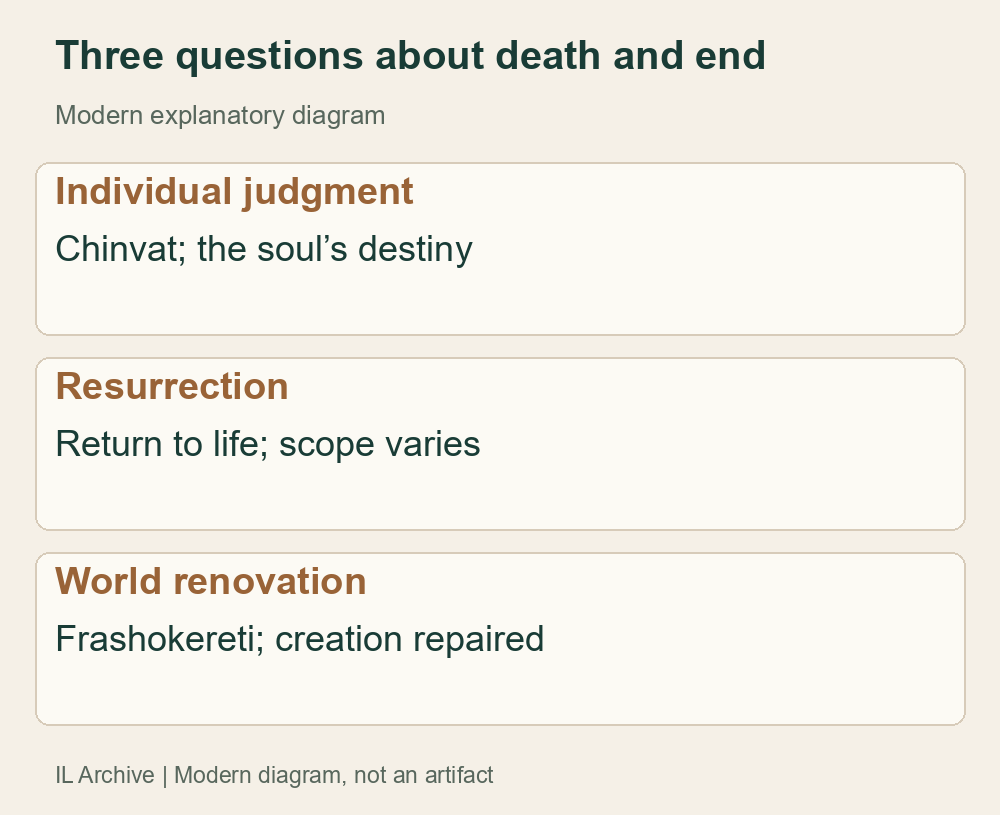
The same distinction matters when comparing Iranian, Jewish, or Christian texts. Shared language about “the rising of the dead” does not settle who rises, the sequence of judgment, the world’s fate, or a route of transmission. A strong comparison depends on specific witnesses, their dates, and historical contact rather than a collection of similar words. The cover is a modern visual interpretation of purification and renewed life, not an archaeological image or literal map of the future world.
References and notes (7)
- Almut Hintze, “Frašō.kərəti, ” Encyclopaedia Iranica (2000), pp.190–192. Etymology; Yasna 30.9 wording; divergent accounts of the wicked. Pahlavi Rivayat interpretations are cited through this survey, not an independent manuscript collation. Return to the text ↑
- Shaul Shaked, “Eschatology i, ” Encyclopaedia Iranica (1998), pp.565–569. Sections General Observations; Eschatology in the Gathas; Universal eschatology. Individual judgment, renovation and disagreement over Ahriman’s ultimate fate. Return to the text ↑
- David Neil MacKenzie, “Bundahišn, ” Encyclopaedia Iranica (1989), pp.547–551. Opening; Manuscripts and editions; Authorship and compilation. Late-ninth-century redaction and witnesses H 6/M 51, TD 1, TD 2, DH; copy dates are not dates of doctrinal origin. Return to the text ↑
- Yasht 19, historical translation by James Darmesteter, Sacred Books of the East, American edition 1898. Sections 89–97 read in the electronically indexed text: resurrection, Astvat-ereta, helpers and evil’s defeat. No unread modern edition is cited as the textual source. Return to the text ↑
- Indian Bundahishn 30, translated by Edward William West, Pahlavi Texts I (1880), pp.120–130. Entire chapter 30.1–33 and its notes read; especially 4–16, 19–25, 29–33. Notes 125:4 and 129:4 record Airyaman and dragon variants. Indian-recension numbering, not Iranian chapter 34. Return to the text ↑
- William W. Malandra, “Šahrewar, ” Encyclopaedia Iranica (2000). Indexed section comparing Pahlavi Rivayat 48.70 and Iranian Bundahishn 34.18, including transliteration and translation. Quotation is the sentence’s closing clause, without supplied or restored words. Return to the text ↑
- Domenico Agostini, “This Earth will be Uncrowned, without Depression, Flat, ” Annali 77 (2017), pp.116–133. Only the abstract and indexed excerpt of printed p.127 read: Iranian Bundahishn 34.19–23, confirming universal passage and purification. Full publisher PDF was unavailable; no claim to have read the whole article or critical apparatus. Return to the text ↑
Suggest a correction · Suggest a source for this record
Cite this record
IL Archive, «Frashokereti: final renovation», https://ilarchive.com/en/entities/frashokereti
Continue reading