Person · Figure
Zoroaster / Zarathustra
Zarathustra between the Gathic voice and later prophetic portraits: disputed dating, ritual authority, truth and choice, and the limits of reconstructing a life from texts.
Estimated reading time: 7 min Published Last reviewed:
Share article
Text
Introduction
Zoroaster, the Greek-derived form of the Avestan name Zarathustra, is the foundational religious figure associated with the worship of Ahura MazdaAhura MazdaWise Lord in Iranian traditions, associated with truth, goodness and creation; not a Persian name for Yahweh.Glossary · Click to read the explanation and with the Gathas, the oldest hymns in the AvestaAvestaThe Zoroastrian sacred corpus in Old and Younger Avestan, containing hymns, liturgy and prayers transmitted orally before later manuscript copying.Glossary · Click to read the explanation. He matters not only as a name attached to a doctrine: the poems bring religious authority, ritualRitualAn organised or distinguished practice meaningful to a community; it may leave traces, but its form alone does not reveal an associated doctrine.Glossary · Click to read the explanation, human choice and the order of existence into a demanding relationship. Yet neither a secure birth date nor a continuous contemporary biography survives. Understanding him requires distinguishing the voices of the earliest poems, later representations of the prophet, and the history of the texts that preserve them.
The evidence: poems before biography
The Gathas comprise seventeen songs in five metrical groups, now embedded in the Yasna ritual collection: Yasna 28–34, 43–46, 47–50, 51 and 53. Their Old Avestan language is closely comparable to the archaic language of the Vedic hymns. They are difficult religious poetry, not a chronological life or a systematic handbook. Names, appeals, disputes and hopes occur within ritual speech; extracting a biography from them requires interpretation. The Old Avestan Yasna Haptanghaiti, chapters 35–41, belongs to the surrounding liturgical setting but should not simply be counted as another Gatha. [1][2]
In later Avestan texts, Zarathustra often becomes the person who questions Ahura Mazda and receives authoritative instruction. Middle Persian works elaborate his life and the history of revelation still further. These are important witnesses to how communities understood their founder, but their narrative detail cannot automatically be projected into the earliest poems. In particular, a later dialogue set in the prophet’s lifetime is not evidence that its wording was composed during that lifetime. [3][4]
When and where might he have lived?
There is no uncontested synchronism fixing Zarathustra to a securely dated ruler or event. Two broad approaches explain why proposed dates diverge. A traditional reckoning places him 258 years before Alexander; linguistic approaches compare Old Avestan with Vedic and place the earliest religious poetry substantially earlier. The former relies on later chronological constructions, sometimes intertwined with cosmic periods and regnal schemes. The latter establishes relative linguistic antiquity more securely than an exact calendar date: an archaic sacred language can be preserved and transmitted. [1][2][4]
William Malandra’s 2009 survey proposed approximately 1000 BCE, allowing a century either way, as a possible scholarly convergence at that time. This is neither a dated inscription nor a permanent consensus. Prods Oktor Skjærvø’s account suggests that Old Avestan was probably spoken in the second millennium BCE, in a Central Asian setting. This dates a linguistic stage, not directly the composition of every surviving poem. These positions should not be averaged into a supposedly precise birth year. The defensible conclusion is an early Iranian linguistic and religious environment; the narrower chronology remains contested. [1][4]
Eastern Iranian or Central Asian settings are commonly argued from linguistic and cultural evidence. “Iranian” here denotes a historical linguistic-cultural field, not necessarily the borders of the modern Iranian state. The Gathas do not identify a birthplace that can confidently be pinned to a modern city. Nor does identifying the patron Vishtaspa with the father of the Achaemenid Darius provide a reliable shortcut to a sixth-century date. [1]
A compact chronology of different things
- Lifetime represented in tradition: religious teaching, opponents and patronage are associated with Zarathustra; exact birth and death years remain unsecured.
- Early textual layer: proposals based on the language and early poetry range across the second millennium and the beginning of the first millennium BCE. A language’s period of use need not coincide with the composition of every transmitted text; relative linguistic antiquity is stronger evidence than a single numerical date. Younger Avestan texts represent later language and religious formulations, not one book written at one moment. [1][4]
- Writing and transmission: a long oral and ritual transmission precedes the surviving codices. The Avestan writing system and textual recording are associated with the Sasanian period; the precise stages and dates are reconstructed, not an extant autograph by Zarathustra. [4]
- Physical copies: the Yasna manuscript K 5 with Pahlavi translation was copied in 1323 CE; the Vendidad manuscript K 1 in 1324. These date particular witnesses, not the composition of the Gathas. [5]
- Later life narratives: the ninth-century Middle Persian Denkard preserves developed traditions about revelation and the founder’s life. Such accounts can transmit older material without every episode becoming independently verified biography. [1]
Priest, questioner and authoritative speaker
Almut Hintze emphasizes that priestly and prophetic authority are not opposites in this corpus. Yasna 33.6 uses the priestly designation zaotar, while poems also present speech directed to Ahura Mazda and knowledge received through an encounter with the divine. “Prophet” therefore describes a mode of religious authority; it need not imply that every detail of a later prophetic life story is already present. [3]
The line is given without reconstructed words, following the text printed in Arish Dastur’s 2025 study. The repeated questioning in Yasna 44 concerns the ordering of existence and the right religious orientation. Its literary form combines inquiry with an appeal to divine authority; it is neither a modern scientific questionnaire nor a stenographic record of an externally dated conversation. In this context, a priest’s ritual competence and the claim to truth-giving knowledge reinforce one another. [2][3][6]
Truth, choice and the problem of evil
Asha concerns truth and right order; Druj marks its contrary, the Lie or deception. These terms organize more than private honesty: they connect speech, action, worship and the condition of existence. Good Thought is likewise not merely a passing agreeable thought. The poems situate human allegiance and conduct within a religious order in which Ahura Mazda has central authority. [1][3][6]
Yasna 30.3–6 juxtaposes two spirits and their differing choices. This supports a fundamental contrast of good and evil, but it does not by itself establish every feature of later systems involving Ohrmazd and Ahriman. Whether particular expressions describe independent beings, divine attributes or interacting modes of religious action is a philological question, not something settled simply by applying “monotheismMonotheismBelief that only one God possesses divinity in its fullest sense. Historically distinct from exclusively worshipping one deity without denying others; its theological forms vary.Glossary · Click to read the explanation” or “dualism”. Ahura Mazda’s creative supremacy and the activity of other named powers must both remain visible. [1][2]
Accordingly, the useful question is not whether Zarathustra fits a modern binary label, but how a given passage relates divine agency, human choice and evil. Fire participates in this religious and ritual world; reducing it to “fire worship” obscures its role, while treating the poems as purely ethical philosophy strips away their ritual setting. [3]
How much of a life can be recovered?
The poems name Zarathustra and the Spitama family, as well as patrons and associates. Malandra treats them as evidence for a priest-poet’s historical setting; Humbach defends personal authorship against readings emphasizing collective ritual production. A significant objection is that a name in a liturgical text does not automatically identify the author of every utterance. The counterargument is that shifts between first- and third-person reference occur in ancient poetry and do not by themselves disprove personal authorship. Neither pronoun counting nor a later attribution resolves the entire problem. [1][2]
Yasna 46.1 shows the practical consequence. It has been read as a lament over exclusion and a search for refuge; Humbach instead understands the speaker as unable to gain admission to a community he hopes to convert. The difference depends on construing difficult poetic language, not on two independently documented journeys. The poem can illuminate conflict and dependence on support without supplying a certain itinerary. Similarly, later traditions naming parents, specifying an age at death or narrating miracles should be identified as traditions, not inserted into gaps as established facts. [1][2]
From the earliest voice to a living tradition
The Gathas already connect conduct with an after-death destiny, including the Chinvat BridgeChinvat BridgeThe crossing associated with the soul’s judgment after death in Zoroastrian tradition. Named in the Gathas, it receives fuller descriptions of guardians, weighing and unequal passage in later texts; it is distinct from resurrection and world renovation.Glossary · Click to read the explanation. Younger Avestan and Middle Persian texts offer fuller accounts of judgment, resurrection and frashokeretiFrashokereti: final renovationCreation’s completion or renovation in Iranian tradition, linked to incorruptible life and evil’s retreat.Glossary · Click to read the explanation, the renovation of creation. Their continuity is a research question to be traced passage by passage, not a warrant to attribute every later doctrinal detail to one datable founder. The Gathic wish to improve existence and the developed final-renovation narratives are related without being interchangeable texts. [6][7]
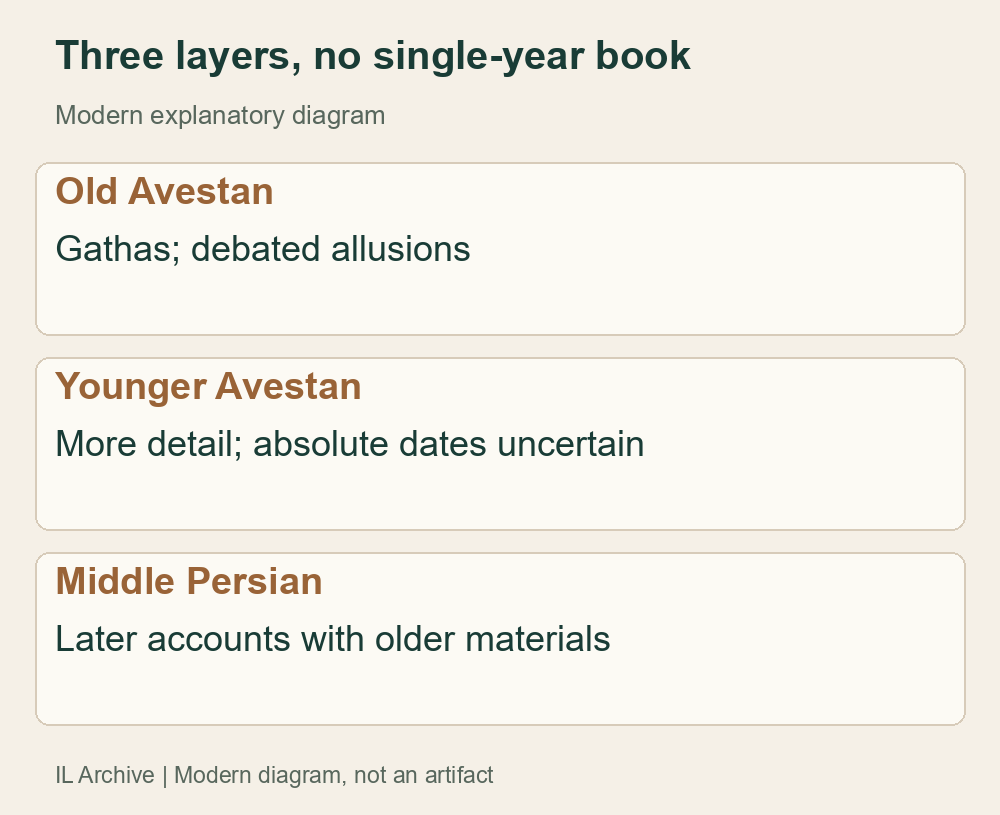
The strongest portrait is therefore neither a fully documented modern biography nor a contentless legendary name. It is a foundational figure encountered through early ritual poetry, whose relation to that poetry must be argued, and whose later authority developed through transmission and interpretation. The accompanying modern diagram distinguishes textual layers; it is not an ancient portrait of Zarathustra or a facsimile of his handwriting.
References and notes (7)
- William W. Malandra, “Zoroaster ii. General Survey,” Encyclopaedia Iranica (2009). Full entry read, including date, homeland, biography and doctrine. The approximate 1000 BCE proposal is attributed to this 2009 survey, not presented as a current consensus or verified birth date; its entire bibliography was not read firsthand. Return to the text ↑
- Helmut Humbach, “Gathas i. Texts,” Encyclopaedia Iranica (2000). Read the sections on the Gathas’ composition, transmission, readings, authorship, chronology and ritual interpretation, through the discussion of Yasna 46.1. No claim to have read the complete editions of Humbach or Kellens and Pirart; their positions are discussed through this entry. Return to the text ↑
- Almut Hintze, “On the Prophetic and Priestly Authority of Zarathustra,” in Gifts to a Magus, edited by Jamshed Choksy and Jennifer Dubeansky (Peter Lang, 2012), pp. 43–58. Author-version text read directly, pp. 43–53, particularly Yasna 33.6, 43.7–8 and 45.3, and prophetic/priestly authority. Remaining pages not fully read. Publication year 2012 verified from the SOAS record; the 2013 deposit date is not its publication date. Return to the text ↑
- Prods Oktor Skjærvø, “Iran vi.2. Documentation,” Encyclopaedia Iranica 13 (2006), pp. 348–366. The “Avestan” section read directly, with preceding context and the opening Middle Persian section, not the entire long article. Separates linguistic layers, oral composition, Sasanian recording and extant manuscripts; the second-millennium proposal is attributed to the author. Return to the text ↑
- Jes P. Asmussen, “Codices Hafnienses,” Encyclopaedia Iranica 5 (1992), pp. 886–893. Collection history and manuscript descriptions through K 31 read; the dating examples use entries K 5 and K 1, not inspection of their manuscript images or a claim that they are authorial copies. Return to the text ↑
- Arish Dastur, “Imbued with the essence of the Gods,” Bulletin of SOAS 88/2 (2025), pp. 267–300. Introduction, sections 3.2–3.3, conclusion, note 110 and adjacent paragraphs read directly, including the quoted Yasna 44.1 and Yasna 46.10–11. Translation and exposition prepared for IL Archive; study licensed CC BY 4.0. No claim to have read every section or adopted all its specific morphological interpretations. Return to the text ↑
- Almut Hintze, “Frašō.kərəti,” Encyclopaedia Iranica 10 (2000), pp. 190–192. Full displayed entry read, including Yasna 30.9 and Younger Avestan and Pahlavi witnesses. Used to distinguish Gathic allusion from later renovation formulations, not to attribute every later doctrine to Zarathustra. Return to the text ↑
Suggest a correction · Suggest a source for this record
Cite this record
IL Archive, «Zoroaster / Zarathustra», https://ilarchive.com/en/people/zoroaster
Continue reading