Entity · Concept
Chinvat Bridge
A reference page linking a name, group, or concept to the materials that discuss it.
The Zoroastrian bridge of judgment: its Gathic attestations, later accounts of crossing and weighing, and the distinction between the soul’s destiny, resurrection and world renovation.
Estimated reading time: 6 min Published Last reviewed:
Share article
Text
Introduction
The Chinvat Bridge is the crossing associated with judgment in Zoroastrian accounts of the human destiny after death. It is already named in the Old Avestan Gathas, but the familiar scene—scales, guardians, and a bridge that widens or contracts—is not fully described there. Understanding it requires following the evidence through its different textual layers and distinguishing individual judgment from resurrection and the renovation of the world, rather than attributing a single composite narrative to ZoroasterZoroaster / ZarathustraFoundational figure associated with Zoroastrian tradition and the Old Avestan Gathas. His priestly role, teaching and relationship to the poems are subjects of research; his lifetime and biographical details remain disputed.Glossary · Click to read the explanation.
A crossing that distinguishes and reckons
Avestan Chinvat corresponds to Middle Persian Chinwad; puhl in Chinwad Puhl means “bridge”. The first element has variously been interpreted as “separator”, “account keeper”, or “collector”. These do not denote different bridges: they reflect debate about the word and the crossing’s function. Ahmad Tafazzoli reviews the traditional derivation and an interpretation associated with gathering; in a 2025 study, Arish Dastur proposes “Bridge of Summation”, relating it to the accumulation of deeds in determining their agent’s destiny. This is a contextual linguistic interpretation, not an uncontested English equivalent. Here “bridge of judgment” describes its function, while Chinvat remains its name. [1][2]
What do the Gathas actually say?
The principal passages are Yasna 46.10–11 and 51.13. Yasna names a collection of ritualRitualAn organised or distinguished practice meaningful to a community; it may leave traces, but its form alone does not reveal an associated doctrine.Glossary · Click to read the explanation texts within the AvestaAvestaThe Zoroastrian sacred corpus in Old and Younger Avestan, containing hymns, liturgy and prayers transmitted orally before later manuscript copying.Glossary · Click to read the explanation, not an author or a date. In 46.10 the invitation encompasses a man or woman who supports action aligned with Truth and Good Thought, and the speaker declares that he will cross with them. In the following stanza the outcome changes when the karapans and kavis appear, opponents accused of damaging existence through their actions. [1][2]
The bracketed “they shall be” supplies an English verb, not missing Avestan letters. The extract follows the text printed by Dastur. The House of Deceit is an ethical and religious designation, not merely a place for everyday lying. The context associates distress with the agents’ own soul and daēnā, a word whose meanings encompass religious vision and awareness: automatically translating it as modern “conscience” is insufficient. Yasna 51.13 connects this destiny with actions, the tongue, and deviation from the path of Truth. [2][3]
There is therefore an early basis for crossing, accountability, and differentiated outcomes. But these two verse lines do not describe RashnRashnu: justice in Iranian reckoningRashn is a Zoroastrian divine being linked to uprightness and discerning truth; the Menog i Khrad presents him as an impartial weigher who favors no ruler.Glossary · Click to read the explanation’s scales, measured bridge widths, or beautiful and ugly women. Reading those details back into the Gathas confuses the witness with later interpretations. Conversely, calling the bridge an entirely late invention ignores the name actually present in the early text.
Younger Avestan texts: an expanded scene
Vendidad, or Videvdad, 19.27–32 presents Zoroaster asking Ahura MazdaAhura MazdaWise Lord in Iranian traditions, associated with truth, goodness and creation; not a Persian name for Yahweh.Glossary · Click to read the explanation where recompense occurs, followed by an answer concerning the soul’s destiny as the nights after death pass. In 19.29 the bridge is made by Mazda and the path is shared by the righteous and wicked; in 19.30 a maiden accompanied by two dogs conducts the righteous soul towards the heavenly world. These belong to a Younger Avestan text, not to the Gathic description itself. [1][4]
The ancient text must also be separated from its translator’s notes. James Darmesteter’s early translation appends to 19.29 an explanation involving nine javelins and a narrow thread. That explanation draws on other works: citing it there does not make it part of the translated verse. Darmesteter likewise interprets the maiden through the Hadokht Nask and subsequent tradition. His accessible translation is useful evidence, but its older interreligious comparisons and linguistic proposals are not automatically adopted here. [4]
Middle Persian accounts: confronting one’s deeds
In chapter 2 of the Menog i Khrad, the “Spirit of Wisdom”, the soul remains near the body for three days and nights, then approaches the bridge at dawn on the fourth day. Sections 2.114–122 name Srosh, Mihr, and Rashn; Rashn has scales that grant the powerful no preference over the least privileged. The bridge then becomes broad for the righteous person, whose good deeds approach in the form of a maiden. Asked who she is, she identifies herself in 2.130 and 2.136 with that person’s deeds, thoughts, and words. [5]
The scene matters for more than its dramatic crossing: what a person has done becomes something they must confront, rather than displace onto ancestry or wealth. The text enumerates truthfulness, resisting oppression, hospitality, and generosity, alongside the religious observance it approves. “Good” here is not a secular category detached from ritual and belief. The continuation presents a contrasting destiny for the wicked. Details of a sharp bridge, its location, and its dimensions differ among works; they should not be turned into a universally agreed engineering diagram. [1][5]
Three different chronologies
- Time within the narrative: death, three nights, judgment, and crossing. This is the internal order of a religious account, not a date for the emergence of the belief.
- Textual chronology: the Gathas are linguistically older than the Younger Avesta, but their absolute dating remains disputed. Middle Persian formulations subsequently interpret and expand older material. A later written exposition does not mean that all its components originated when it was recorded. [1][2][7]
- Dates of surviving copies: for example, K 5, containing the Yasna and its Pahlavi translation, dates to 1323 CE; the Vendidad manuscript K 1 dates to 1324. K 23, a Pazand version of the Menog i Khrad with a Gujarati translation, dates to 1662. These are dates of particular physical copies, not of the composition of the Gathas or the invention of the bridge. [7]
Judgment, resurrection, and renovation
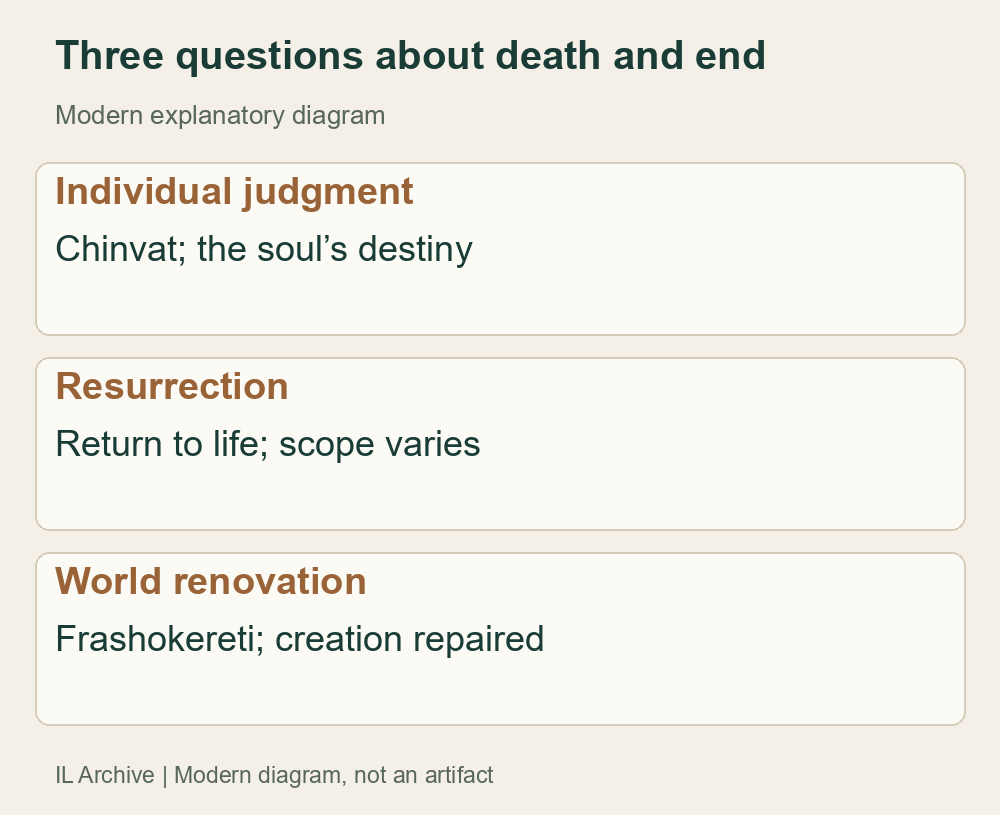
The bridge addresses an individual’s destiny after death. Resurrection concerns the return of the dead to life; frashokeretiFrashokereti: final renovationCreation’s completion or renovation in Iranian tradition, linked to incorruptible life and evil’s retreat.Glossary · Click to read the explanation, the renovation of creation, concerns the removal of evil and restoration of existence. These themes are connected in Zoroastrian tradition but are not synonyms. Later texts, including Yasht 19, describe resurrection and comprehensive transformation more explicitly than the Gathic allusions, while Pahlavi works differ on details of the ultimate destiny of the wicked. The Gathic phrase “for all time” cannot therefore automatically summarize every later view of punishment’s permanence or eventual end. [3][6]
The strongest textual conclusion is an early core of crossing and accountability, followed by elaboration whose every stage cannot be dated or placed on a single straight line of development. Similarity to afterlife crossings in other religions is likewise insufficient to establish direct borrowing: an intermediary text, its chronology, and the particular content transmitted must be identified.
The accompanying modern diagram distinguishes these three questions. It is neither an ancient image nor a geographical location of the bridge; the argument and its evidence are supplied in the text, not confined to an illustration.
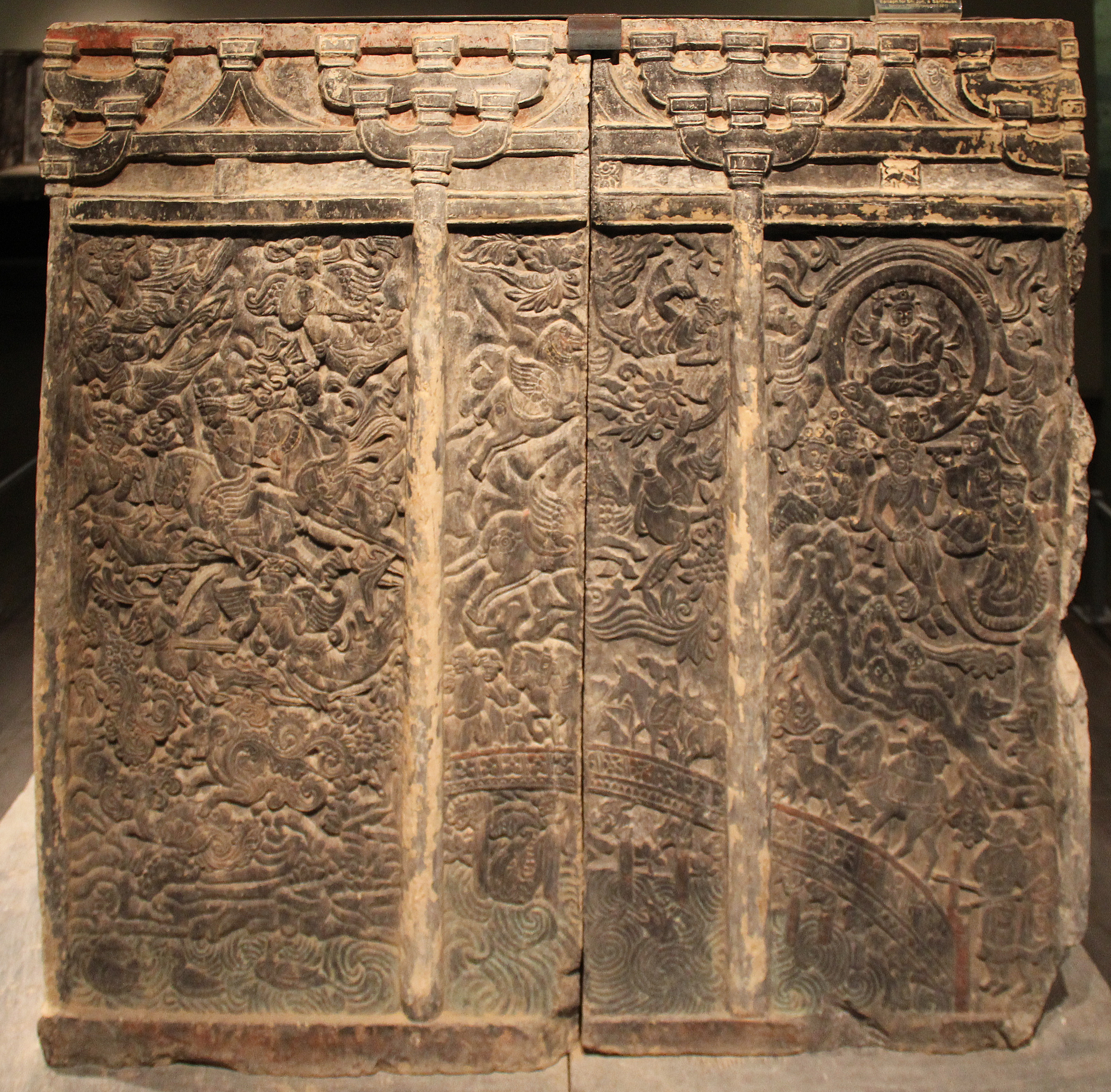
The cover supplies a witness to reception in a different setting: the east panels of the sarcophagus of Wirkak, or Shi Jun, and his wife at Xi’an, dated approximately 579–580 CE. Jin Xu interprets the lower crossing scene as Chinvat within an afterlife journey combining Zoroastrian and Buddhist elements. This is an iconographic identification in later funerary art, not a Gathic-period diagram or proof that every textual detail coincides. [8]
References and notes (8)
- Aḥmad Tafażżolī, “Činwad Puhl,” Encyclopaedia Iranica 5 (1991), pp. 594–595. Full entry read: etymology, Yasna 46.10–11 and 51.13, and later Avestan and Pahlavi passages. Its bibliography is not represented as entirely read firsthand. Return to the text ↑
- Arish Dastur, “Imbued with the essence of the Gods,” Bulletin of SOAS 88/2 (2025), pp. 267–300. Direct reading of sections 3.2–3.3, conclusion and note 110, with the introduction and adjacent paragraphs; especially 3.2.4 for Yasna 46.10–11. The short extract’s translation and accompanying exposition are adapted for IL Archive. Article licensed CC BY 4.0; not every section or referenced edition was read. Return to the text ↑
- Philippe Gignoux, “Hell i. In Zoroastrianism,” Encyclopaedia Iranica 12 (2003), pp. 154–156. Full entry read, especially Yasna 46.11 and 51.13, developments in the portrayal of daēnā, and Pahlavi variation over punishment’s end. Gathic ethical language is distinguished from elaborate afterlife descriptions. Return to the text ↑
- Vendidad 19.27–32, translated by James Darmesteter, The Zend-Avesta, Part I, Sacred Books of the East 4 (1880), original edition 1880; digital transcription of the American edition (1898) at Avesta.org. Complete passage and notes 47–59 read in the search-index text; direct page opening failed. Used as an older translation, not an independent collation of an Avestan manuscript; bridge-width commentary is separated from 19.29 itself. Return to the text ↑
- Menog i Khrad 2.114–163, translated by Edward William West, Pahlavi Texts, Part III, Sacred Books of the East 24 (1885), digital transcription at Avesta.org. Translation read directly in indexed results: 2.114–122 for timing and scales, 2.123–139 for the maiden and deeds, 2.140–163 for the onward journey and beginning of the wicked soul’s fate. Neither manuscripts nor Pahlavi text were collated; this translation is not attributed to Zoroaster. Return to the text ↑
- Almut Hintze, “Frašō.kərəti,” Encyclopaedia Iranica 10 (2000), pp. 190–192. Full displayed entry read, including Gathic, Younger Avestan and Pahlavi sections; particularly Yasht 19.11–12 and 19.89–96, and variation in the wicked’s final fate. Not every Pahlavi work was independently consulted. Return to the text ↑
- Jes P. Asmussen, “Codices Hafnienses,” Encyclopaedia Iranica 5 (1992), pp. 886–893. Collection history and descriptions through K 31 read; dates used here derive from entries K 1, K 5, K 23. This is not a claim to have inspected their manuscript images or to regard them as authorial copies. Return to the text ↑
- Jin Xu, “The Wirkak (Shi Jun) Sarcophagus,” Smarthistory, April 7, 2021. Article text displayed in search results read, especially “Ascent to Paradise and Awakening (E1–3),” dating and mixed religious setting; direct opening failed. The selected image is Gary Todd’s photograph, not the article’s schematic drawing. Return to the text ↑
Suggest a correction · Suggest a source for this record
Cite this record
IL Archive, «Chinvat Bridge», https://ilarchive.com/en/entities/chinvat-bridge
Continue reading