Entity · Deity
Ahura Mazda
A reference page linking a name, group, or concept to the materials that discuss it.
Wise Lord in Iranian traditions, associated with truth, goodness and creation; not a Persian name for Yahweh.
Estimated reading time: 7 min Published Last reviewed:
Share article
Text
Introduction
Ahura Mazda, conventionally rendered “Wise Lord”, is the central divine figure of ZoroastrianismZoroastrianism: Hymns, Rituals and the Changing TraditionA living Iranian religious tradition examined through Avestan hymns, Middle Persian writings and royal inscriptions, separating textual evidence, later interpretation and hypotheses of influence.Glossary · Click to read the explanation, an Iranian religious tradition still practised today. Hymns, royal inscriptions and later theological books describe him in different settings. This entry asks how those witnesses connect wisdom, creation and resistance to evil, without treating their several accounts as a single timeless system.
Names and textual settings
The Avestan name Ahura Mazdā, Old Persian Ahuramazda and Middle Persian Ohrmazd belong to a connected history of worship, not to three unrelated gods. The AvestaAvestaThe Zoroastrian sacred corpus in Old and Younger Avestan, containing hymns, liturgy and prayers transmitted orally before later manuscript copying.Glossary · Click to read the explanation, the Zoroastrian sacred corpus, contains both Old Avestan and Younger Avestan compositions. Its Gathas are hymns traditionally associated with ZarathustraZoroaster / ZarathustraFoundational figure associated with Zoroastrian tradition and the Old Avestan Gathas. His priestly role, teaching and relationship to the poems are subjects of research; his lifetime and biographical details remain disputed.Glossary · Click to read the explanation, whose lifetime cannot be securely fixed. Their linguistic antiquity must be distinguished from the much later manuscripts that preserve them. [1][3]
In Yasna 44.3–7, a sequence of questions addresses Mazda about the ordering of sun and stars, earth and sky, waters and plants, and light and darkness. The speaker seeks knowledge from the deity rather than offering a continuous creation narrative. This matters especially for darkness: the hymn's question cannot simply be replaced by the later picture in which Ohrmazd occupies light and his enemy darkness. Aša, often translated “truth” or “right order”, concerns the proper ordering of life as well as truthful conduct. [4]
Worship and the good creation
Mazda is not only a name in speculation about evil or royal authority. The Yasna Haptanghaiti, “Worship in Seven Chapters” (Yasna 35–41), is an Old Avestan liturgical text. Its repeated first-person plural places a worshipping community before the deity. It joins veneration with care for cattle and with the commitment to good thought, speech and action (35.2–7). The rites concern the conditions of a good life, not an escape from a supposedly evil material world. [15]
In Yasna 37.1, Mazda is praised for both truth and material creation; 37.4–5 also praise beneficent powers, including truth, good thought and good rule. These belong to the history of the Amesha SpentasAmesha SpentasBenevolent beings and concepts in Iranian tradition, approximately “holy/bounteous immortals.”Glossary · Click to read the explanation, “Beneficent Immortals”. The result is a pattern of worship organized around Mazda without restricting every invocation to his name alone. This liturgical evidence helps explain why counting divine names is insufficient to describe the religious system. [15]
Mazda and the two spirits
Yasna 30.3–5 contrasts two spirits through thought, speech, action and choice; Yasna 45.2 emphasizes their incompatibility. These passages underlie the familiar opposition between Spenta Mainyu, the beneficent spirit, and Angra MainyuAngra Mainyu / AhrimanThe hostile spirit in Zoroastrian texts: Gathic wording, Younger Avestan counter-creation and Ahriman in Middle Persian cosmology.Glossary · Click to read the explanation, the hostile spirit. Yet the wording and the relation of the beneficent spirit to Mazda remain disputed. Yasna 47 also speaks of Mazda acting through this spirit. Translating such language does not by itself settle whether the relation is an aspect of divine activity, a distinct agency, or a relationship expressed through parenthood. [5][6]
The Iranian-religion specialist Mary BoyceMary BoyceScholar of Zoroastrianism and Iranian languages, 1920–2006, and SOAS professor of Iranian studies.Glossary · Click to read the explanation stresses an uncreated good deity opposed by an independently existing hostile spirit. Other readings understand the twin spirits in relation to Mazda as their common source and give their divergent choices a decisive role. These are competing reconstructions, not a genealogy stated unambiguously by every hymn. “MonotheismMonotheismBelief that only one God possesses divinity in its fullest sense. Historically distinct from exclusively worshipping one deity without denying others; its theological forms vary.Glossary · Click to read the explanation” and “dualism” therefore need explanation rather than functioning as mutually exclusive labels that decide the evidence in advance. [1][6]
A short original-language anchor is Yasna 30.3b, transcribed from the Geldner-based TITUS text:
“In thought and speech and action: better and bad” (editorial rendering). This excerpt retains the base reading manahicā, not the apparatus’s proposed removal of its final conjunction. It establishes a qualitative opposition; the line does not itself name Mazda as the father of both spirits. [14]
The difficulty is partly textual. In Yasna 47.3, the transmitted tā is interpreted as “father” by Almut HintzeAlmut HintzeAlmut Hintze studies ancient Iranian languages, the Avesta and Zoroastrian traditions.Glossary · Click to read the explanation, supported by 47.2 and phonology; an alternative analysis treats it as a pronoun. [11] “Father” is therefore an argued reading, not a missing word silently restored here. Even accepting Mazda’s parenthood of the beneficent spirit does not by itself settle the hostile spirit’s origin: that further conclusion depends on how twinship is understood.
For this entry, the stronger conclusion is narrower than either complete genealogy: Mazda is associated with beneficent creative activity, while the paired spirits articulate incompatible orientations. The choice language cannot be removed from the hymns; their compressed kinship imagery also cannot bear the entire later cosmic system without additional premises. This reading preserves what the passages directly support while leaving the disputed origin of the hostile spirit open. [5][6]
Royal worship and its limits
Darius IDarius IPersian king of the late sixth and early fifth centuries BCE, responsible for the Behistun inscription.Glossary · Click to read the explanation, Achaemenid king from 522 to 486 BCE, invokes Ahuramazda in his DNa tomb inscription. Its opening credits the god with earth, sky, humanity, happiness and the king's authority; lines 30–36 connect divine favour with Darius's restoration of order. This is royal self-presentation, not a census of his subjects' beliefs. [7]
The opening itself reads, in scholarly Latin transcription of Old Persian:
“Ahuramazda is a great god, who created this earth” (DNa 1–2; editorial translation). No restoration is inserted in this excerpt. The relative clause connects divine identity with creation; the continuation connects it with the making of a king. Its evidential strength is the datable royal monument, rather than a reconstruction from medieval copies. Its limit is equally concrete: these lines neither name Zarathustra nor explain the two spirits. [7]
Boyce argues that the Achaemenid kings were Zoroastrians, while recording objections based on their terminology and practices. Invocation of Ahuramazda is secure evidence of royal devotion; whether it establishes all the doctrines known from later Zoroastrian books is a separate question. Imperial support for local cults also cautions against imagining a religiously uniform empire. [2]
Ohrmazd in later cosmology
The BundahishnBundahishnThe Bundahishn is a Middle Persian Zoroastrian work on creation, the world and its final renovation.Glossary · Click to read the explanation, a Middle Persian compilation on the world's origin and structure, preserves older traditions in a work with successive redactions, including an important ninth-century CE stage. Its opening places Ohrmazd in light, knowing the coming conflict, and Ahriman in darkness with limited knowledge. Ohrmazd proposes a bounded contest and reveals his eventual victory through a sacred formula. [8][9]
This story gives good creation a purpose within the defeat of evil. Its asymmetry is important: the adversaries do not have equal knowledge or an eternally undecided outcome. It should not be reduced to “two equal gods”, nor should its developed chronology be put into the mouth of the Gathic speaker. The creation story, its medieval compilation and its surviving manuscripts belong to different times. [8][9]
Chronology of the evidence
- Old Avestan hymns and liturgy: their language is older than that of the Younger Avesta; a late second-millennium BCE setting is one scholarly proposal, not a securely dated composition. Their cultural background is usually sought in eastern Iranian or southern Central Asian regions, not simply at the later Persian court. [12]
- Younger Avestan works: a later linguistic layer with its own internal history; relative sequence does not provide a single calendar date for every passage. [3]
- Middle Persian theological books: older materials were collected and reworked after the Sasanian period; the Bundahishn includes ninth-century CE redaction. Its beginning-of-the-world narrative is not a report composed at that beginning. [9]
- Surviving copies: the Yasna manuscripts J2 and K5 date to 1323 CE, whereas the Videvdad witnesses L4 and K1 were copied in 1323 and 1324. They preserve older texts through transmission, not contemporary manuscripts of Zarathustra. [13]
Reading the images
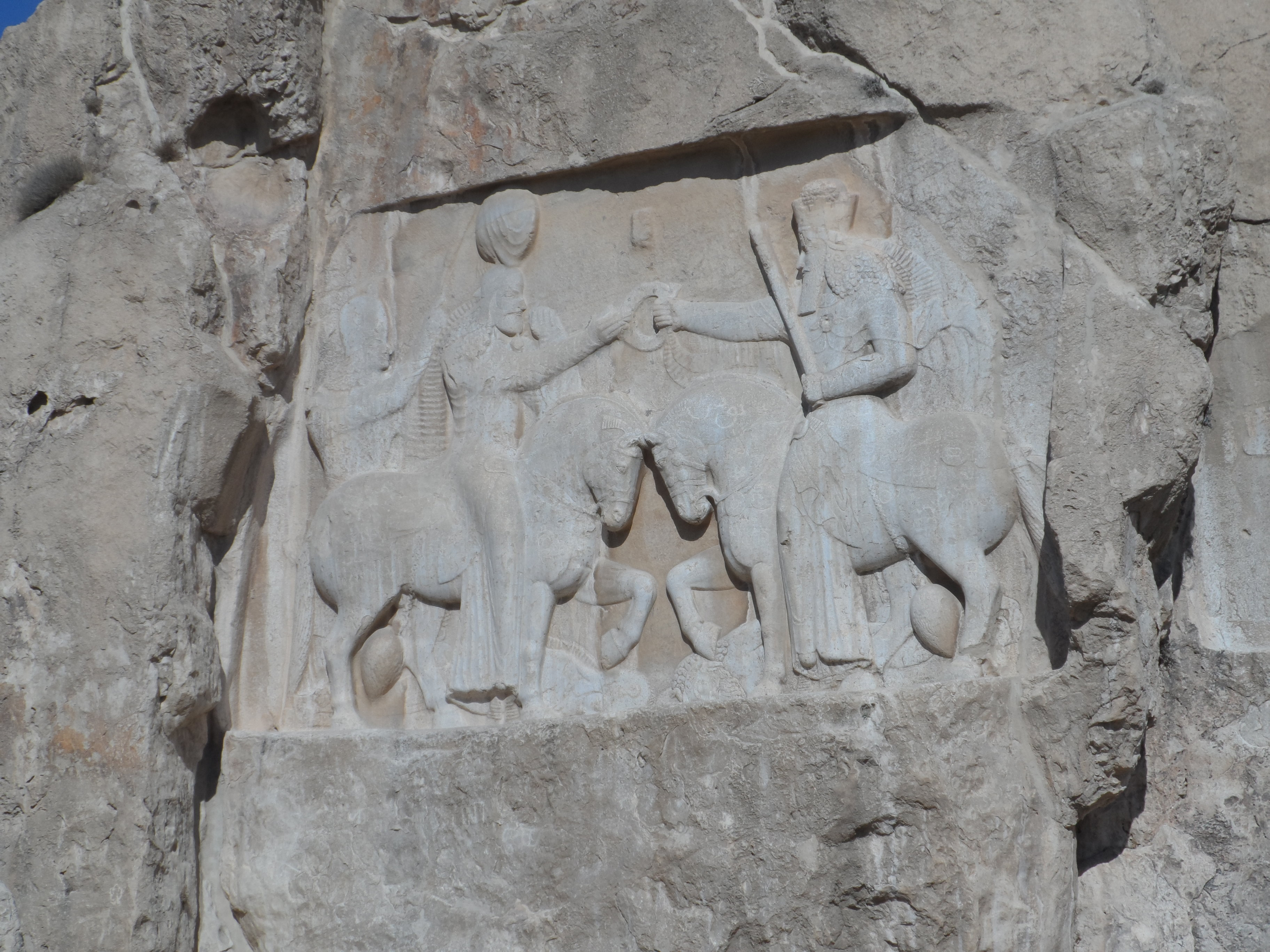
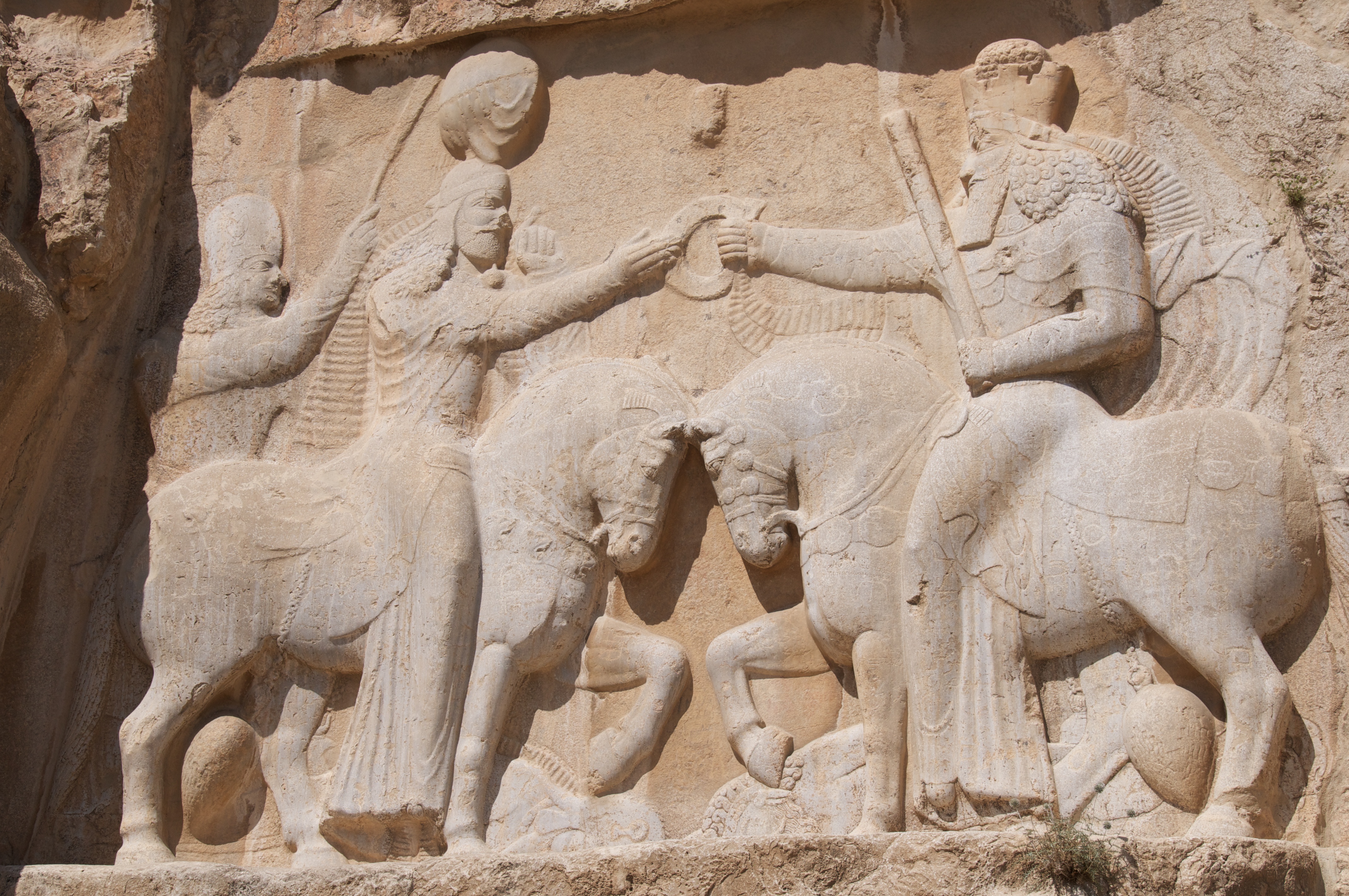
The cover shows a third-century CE Sasanian investiture relief at Naqsh-e Rustam in southern IranIranIran is the modern country containing Shush, ancient SusaGlossary · Click to read the explanation, photographed in 2010. Its inscription identifies the mounted figures as Ardashir I and Ahura Mazda. It is evidence for a historical representation of divine kingship, not a portrait from Zarathustra's lifetime. The interpretation and sequence of Sasanian investiture imagery remain subjects of research. [10]
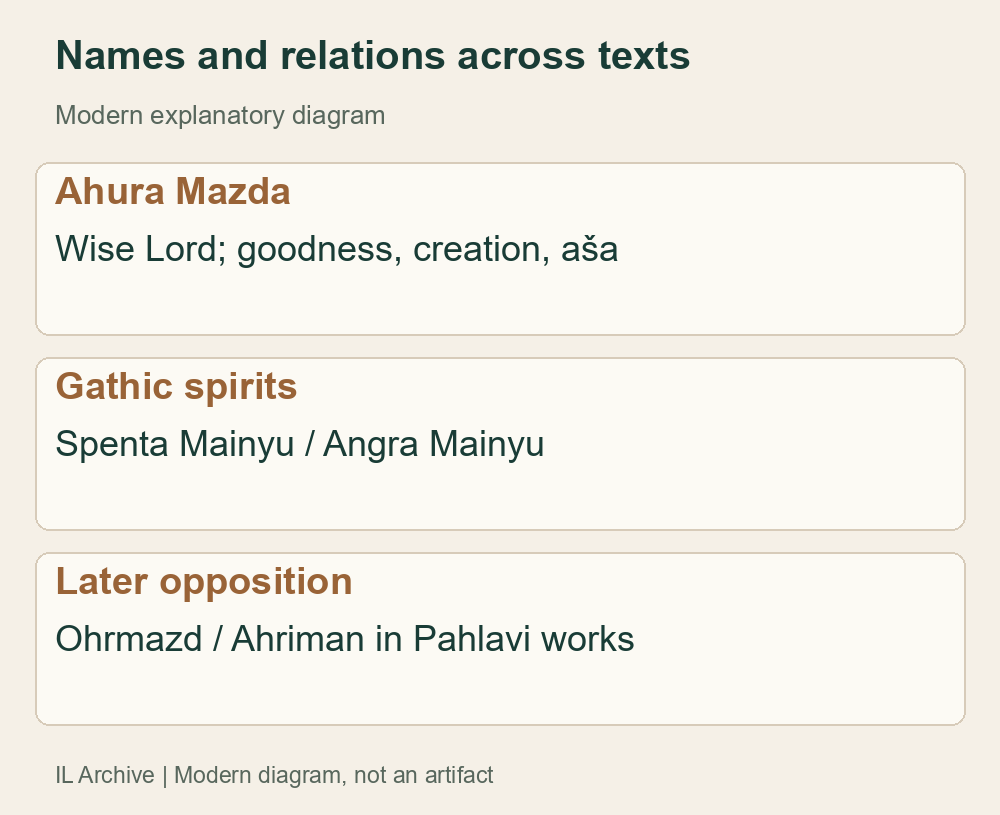
The accompanying modern diagram separates textual settings, not divine family relationships. Its paired names are conventional shorthand; the Gathic verses do not all use the same expressions. Neither an Iranian divine name nor a shared attribute such as creation makes Ahura Mazda simply a Persian name for YahwehYahwehThe proper name of Israel’s deity, written יהוה (YHWH), the Tetragrammaton. Its exact ancient pronunciation is not directly preserved; texts and inscriptions witness its history.Glossary · Click to read the explanation. Comparison requires identifiable witnesses and historical arguments, not name substitution.
References and notes (15)
- Mary Boyce (1984). “Ahura Mazdā.” Encyclopaedia Iranica. Name, creation and beneficent-spirit paragraphs; Boyce’s independent-principles interpretation is presented as a scholarly reading. Return to the text ↑
- Mary Boyce (1983). “Achaemenid Religion.” Encyclopaedia Iranica. Opening paragraphs on royal religion, objections and local cults; identification of the kings as Zoroastrian is the author’s thesis. Return to the text ↑
- Jean Kellens (1987). “Avesta i. Survey of the History and Contents of the Book.” Encyclopaedia Iranica. Opening discussion: linguistic strata and textual transmission; not a reading of the entire Avesta. Return to the text ↑
- L. H. Mills, trans. (1887). The Zend-Avesta, Part III. Sacred Books of the East 31. Yasna 44.3–7, creation questions including light and darkness; 44.1–11 read. Return to the text ↑
- L. H. Mills, trans. (1887). The Zend-Avesta, Part III. Sacred Books of the East 31. Yasna 30.3–6, compared with 45.2 and 47.1–6 in the same volume. This historical translation and its interpretation are not a critical Avestan text. Return to the text ↑
- Gherardo Gnoli (1996). “Dualism.” Encyclopaedia Iranica. Zoroastrian section: competing readings of spirits, choice and their relation to Mazda; the reconstruction is debated. Return to the text ↑
- Scott L. Harvey, Winfred P. Lehmann and Jonathan Slocum. Old Iranian Online, Lesson 9: Old Persian. University of Texas Linguistics Research Center. Darius’s DNa inscription, lines 1–14 and 30–36, with text, analysis and translation. Return to the text ↑
- E. W. West, trans. (1880). Pahlavi Texts, Part I. Sacred Books of the East 5. Bundahishn, chapter I, §§ 1–28; historical translation of the Indian recension, not a modern critical edition. Return to the text ↑
- D. N. MacKenzie (1989). “Bundahišn.” Encyclopaedia Iranica. Paragraphs on recensions, manuscripts and composition; redaction includes a ninth-century CE stage. Return to the text ↑
- Bruno Overlaet (2013). “And Man Created God? Kings, Priests and Gods on Sasanian Investiture Reliefs.” Iranica Antiqua 48, 313–354. DOI: 10.2143/IA.48.0.2184703. Publisher’s abstract only: inscriptional identification and proposed reinterpretation from priest to deity; full article not read. Return to the text ↑
- Almut Hintze (2014). “Monotheism the Zoroastrian Way.” Journal of the Royal Asiatic Society 24.2, 225–249. DOI: 10.1017/S1356186313000333. P.229, n.24: transmitted tā in Yasna 47.3, arguments for fatherhood and the grammatical alternative; full relevant passage read, not abstract only. Return to the text ↑
- Almut Hintze. “Avestan Literature” and “Yasna.” FEZANA, five-page introduction. Five-page introduction read in full; p.3 for proposed dating and liturgy, pp.3–5 for Yasna 35–41; not a reading of the complete Yasna translation. Return to the text ↑
- Jes P. Asmussen (1992). “Codices Hafnienses.” Encyclopaedia Iranica 5.8, 886–893. Manuscripts section, especially K1 and K5 entries and the dates of J2/L4; these date copies, not composition. Return to the text ↑
- K. F. Geldner, Avesta; TITUS Avestan Corpus, Yasna, full documentation. Yasna 30.3b, base text and critical apparatus; the editorial excerpt translation does not settle the spirits’ parentage. Return to the text ↑
- L. H. Mills, trans. (1887). The Zend-Avesta, Part III. Sacred Books of the East 31. Yasna 35.1–10, pp.282–284; compared with 37.1–5, pp.285–286, in the same volume. Both translations read in full, alongside Hintze’s modern account in note12. Return to the text ↑
Suggest a correction · Suggest a source for this record
Cite this record
IL Archive, «Ahura Mazda», https://ilarchive.com/en/entities/ahura-mazda
Continue reading