Study
Did Zoroastrianism Change Judaism?
An extended study of a topic, with evidence and references.
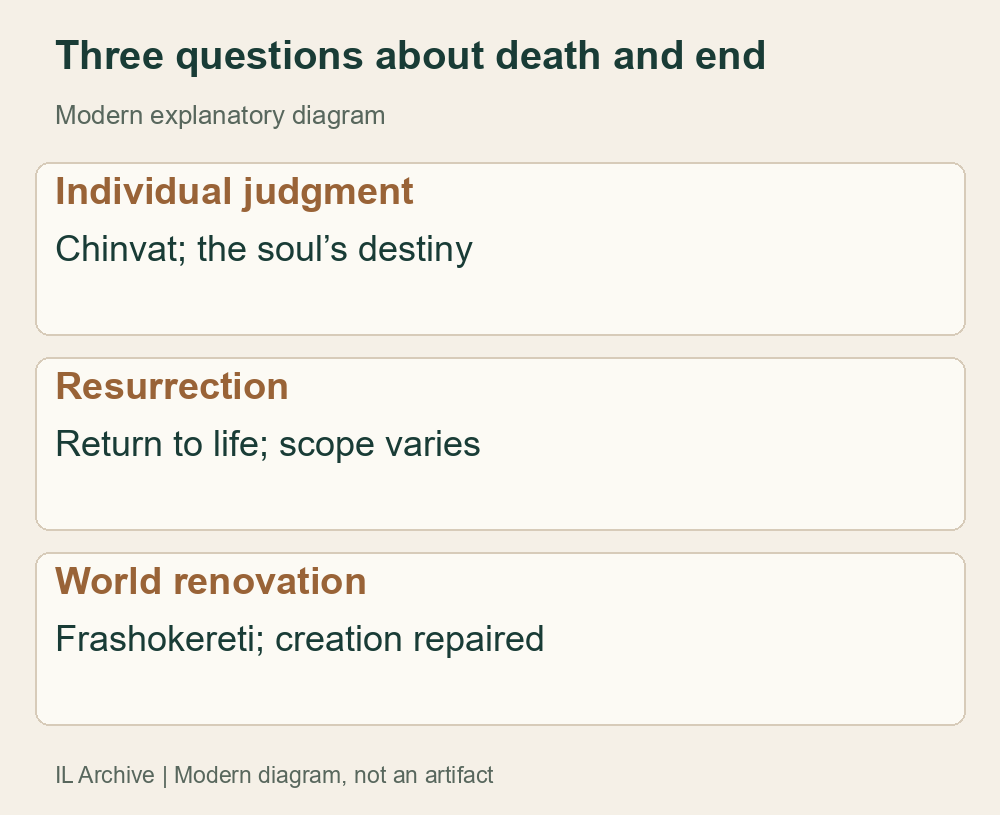
Established historical contact and debated influence: comparing Avestan layers with Jewish resurrection and angels while separating resemblance from transmission, narrative setting from composition.
Share article
Text
When two traditions meet
Many HebrewHebrewA Northwest Semitic language in the Canaanite group, with ancient and modern forms.Glossary · Click to read the explanation texts describe death differently from the worlds of angels, resurrectionResurrection of the deadThe dead returning to life, distinguished from soul immortality, with differing scope and form among texts.Glossary · Click to read the explanation and judgment found in Jewish writings of the last centuries BCE. These are differences among texts and layers, rather than a change made by all Jews simultaneously. Asking whether ZoroastrianismZoroastrianismIranian religious tradition associated with Zoroaster, with changing texts and conceptions of goodness, evil and endings.Glossary · Click to read the explanation changed Judaism is legitimate: historical contact is real, and some parallels are striking.
Resemblance alone cannot identify who transmitted an idea to whom. We need a history of the Iranian idea, a datable Jewish witness, a channel of contact, and comparison with alternatives. Borrowing may belong to the story; internal traditions can also explain parts of it. [6][9][13]
539 BCE: a long field of contact
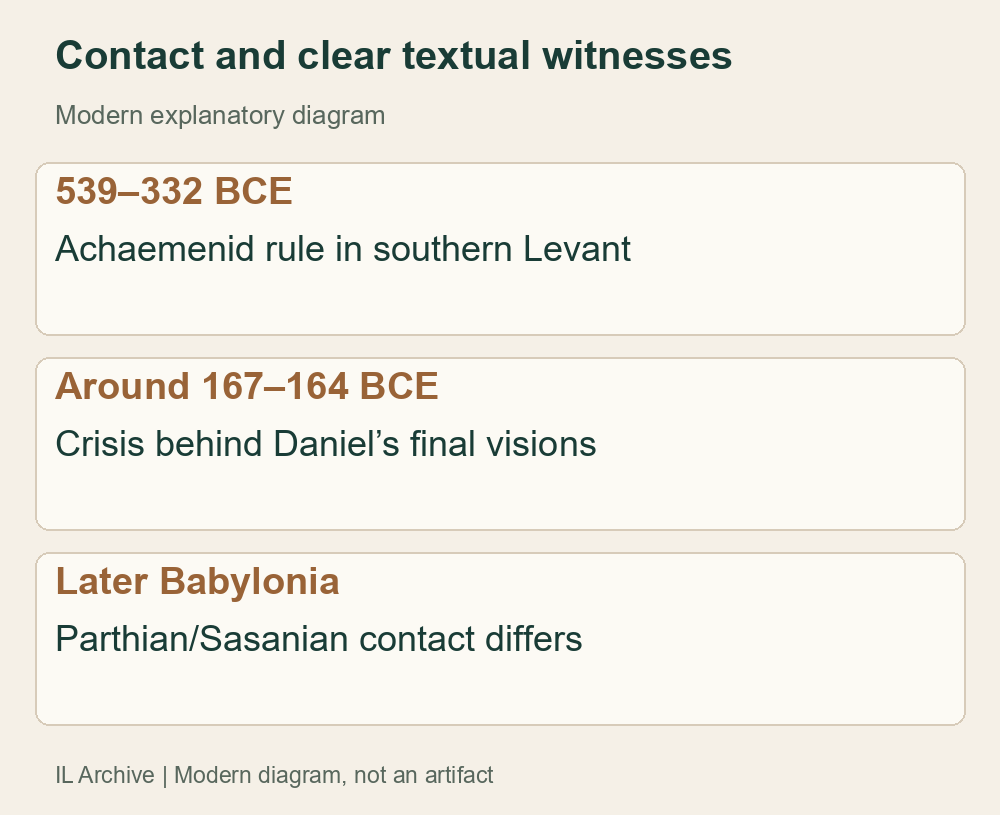
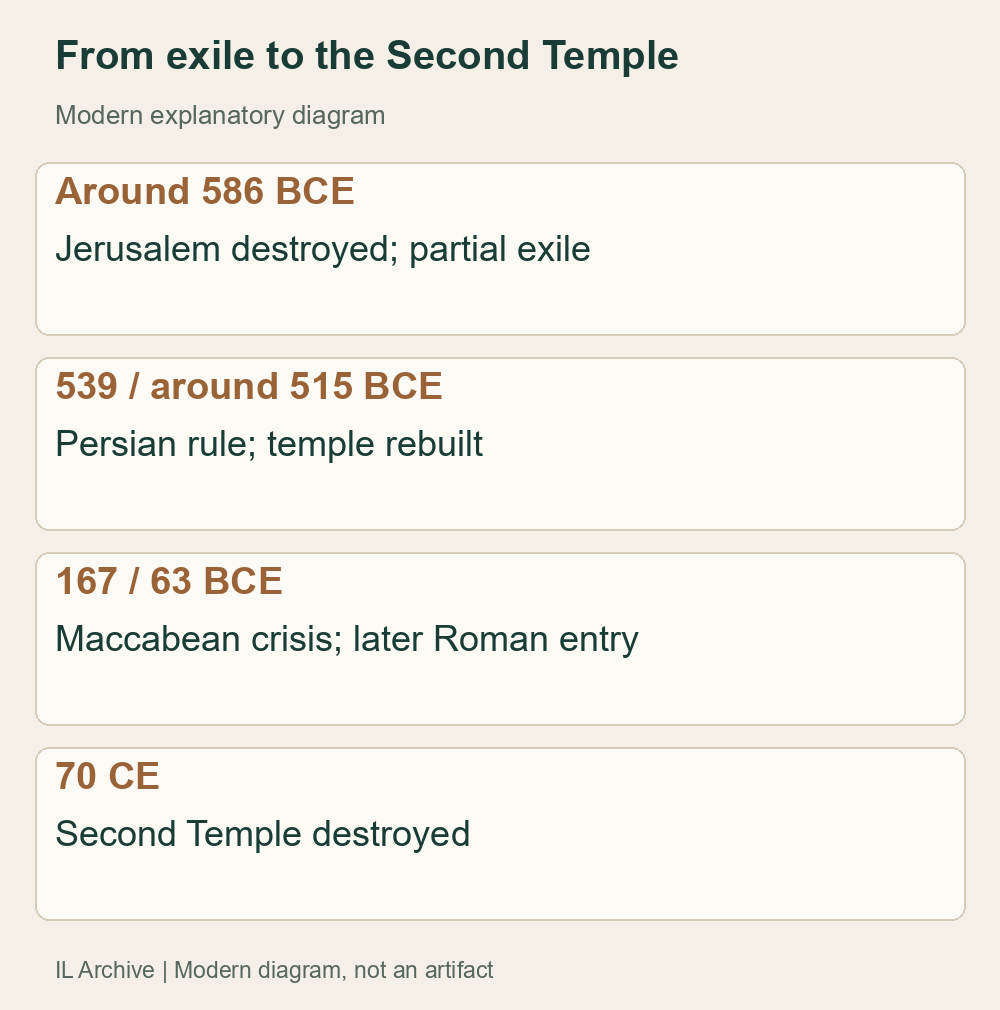
Cyrus captured BabylonBabylonBabylon is an ancient city in central present-day Iraq, south of BaghdadGlossary · Click to read the explanation in 539 BCE, bringing Jewish communities in Babylonia and Judah within the Achaemenid Empire. The Persian framework in the southern LevantThe LevantThe Levant is a regional name for lands along the eastern MediterraneanGlossary · Click to read the explanation lasted until Alexander’s conquests around 332 BCE. These centuries matter for the rebuilt temple, the province of Yehud, and developing texts and institutions.
Communities were not uniform. Judean residents, returnees from Babylonia, and Jews in Egypt or the diaspora had different experiences. “Judaism” and “Persia” were not two individuals exchanging a book. The imperial setting makes movement of ideas possible without identifying which ideas actually moved. [15]
How might ideas circulate?
Administration, trade, language, diaspora communities, oral stories and elites are possible channels. A Jewish writer need not have owned an AvestaAvestaAvestan-language religious corpus with layers and oral transmission, not a book composed in one year.Glossary · Click to read the explanation manuscript to hear an Iranian idea. Possibility of hearing it, however, does not prove that he heard it or incorporated it into his text.
We have no witness to an empire-wide Achaemenid program teaching Jews Zoroastrian eschatologyEschatologyStudy of destiny and endings, including individual judgment, resurrection and renewal; not one uniform creed.Glossary · Click to read the explanation. Different local cults continued under Persian rule. A proposed influence therefore needs a contact as specific as the evidence allows; political control cannot become a demonstrated channel for every doctrine. [2][15]
When did Zoroaster live?
Tradition attributes the oldest Avestan hymns, the Gathas, to Zoroaster/ZarathustraZoroaster / ZarathustraFigure to whom tradition attributes the Gathas; lifetime and location are uncertain.Glossary · Click to read the explanation. Their language is ancient, but no event fixes his lifetime. William Malandra describes widely differing estimates, treating around 1000 BCE with a broad margin as the nearest thing to scholarly convergence, rather than a certain date. [1]
This matters for comparison: a tradition predating Cyrus is possible, but it does not automatically date every idea in later Iranian works. The founder’s lifetime, a hymn’s age and a specific doctrine’s age are separate questions. Comparison needs the limits of each witness rather than an attractive exact year.
Was royal religion later Zoroastrianism?
Darius’s inscriptions clearly honor Ahura MazdaAhura MazdaWise Lord in Iranian traditions, associated with truth, goodness and creation; not a Persian name for Yahweh.Glossary · Click to read the explanation. Equating every king’s practice with detailed Avestan or Pahlavi theology is another matter. Mary Boyce argues for Achaemenid kings’ Zoroastrianism while discussing scholarly objections; her position must not be presented as uncontested consensus. [2]
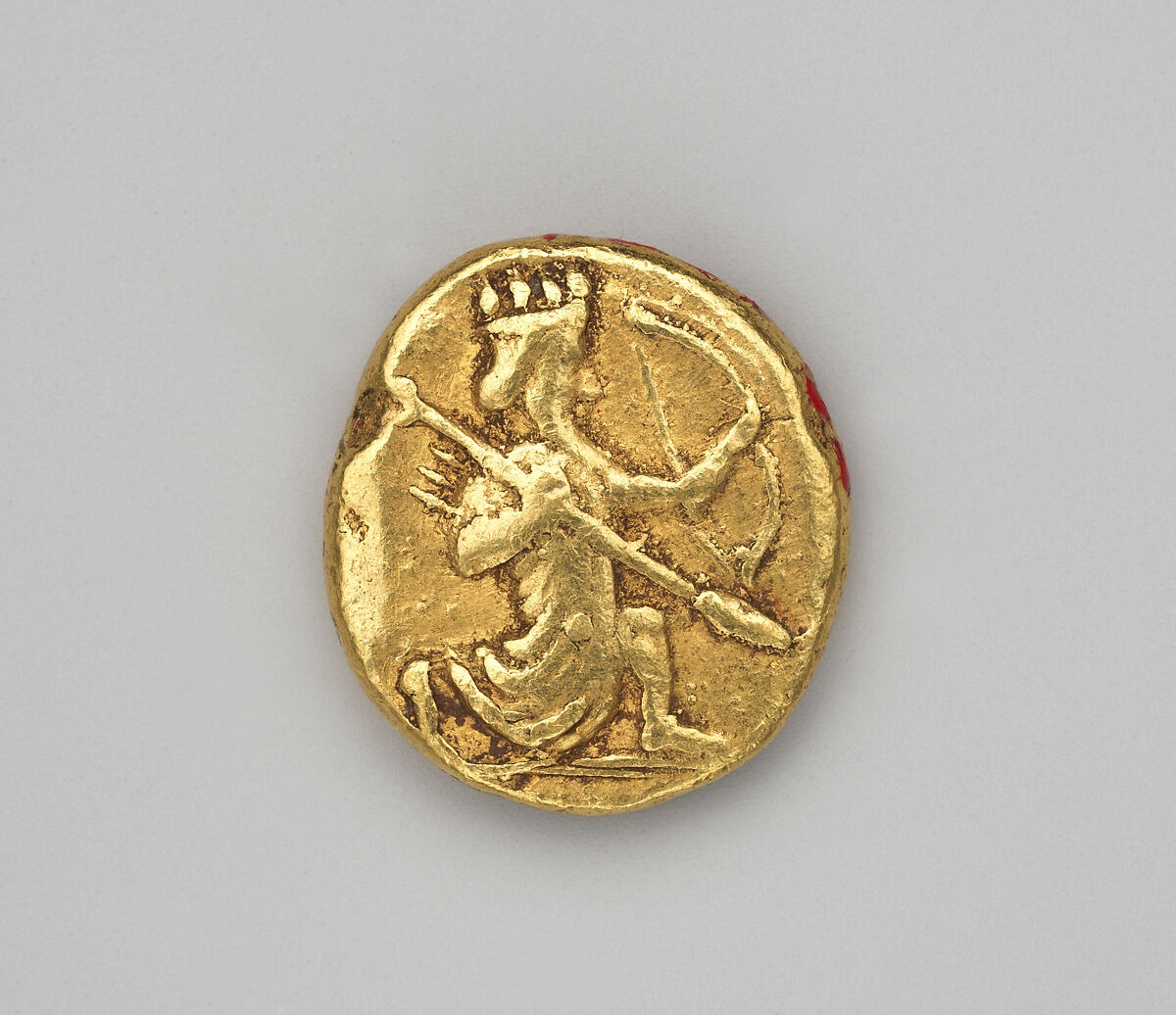
Royal support for a local temple does not make its deity Ahura Mazda under another name. Cyrus’s Babylonian rhetoric invokes MardukMardukBabylon’s god, elevated with the city’s history. Enuma Elish celebrates his rise and cosmic ordering; sources associate him with Nibiru and Jupiter. Earliest origins and functions remain uncertain.Glossary · Click to read the explanation within a local royal setting. The gold daric on the cover, dated by the museum to approximately the fourth century BCE, is Achaemenid royal imagery, not a portrait of Cyrus or Zoroaster or testimony to Jewish belief. [16]
Ahura Mazda and aša
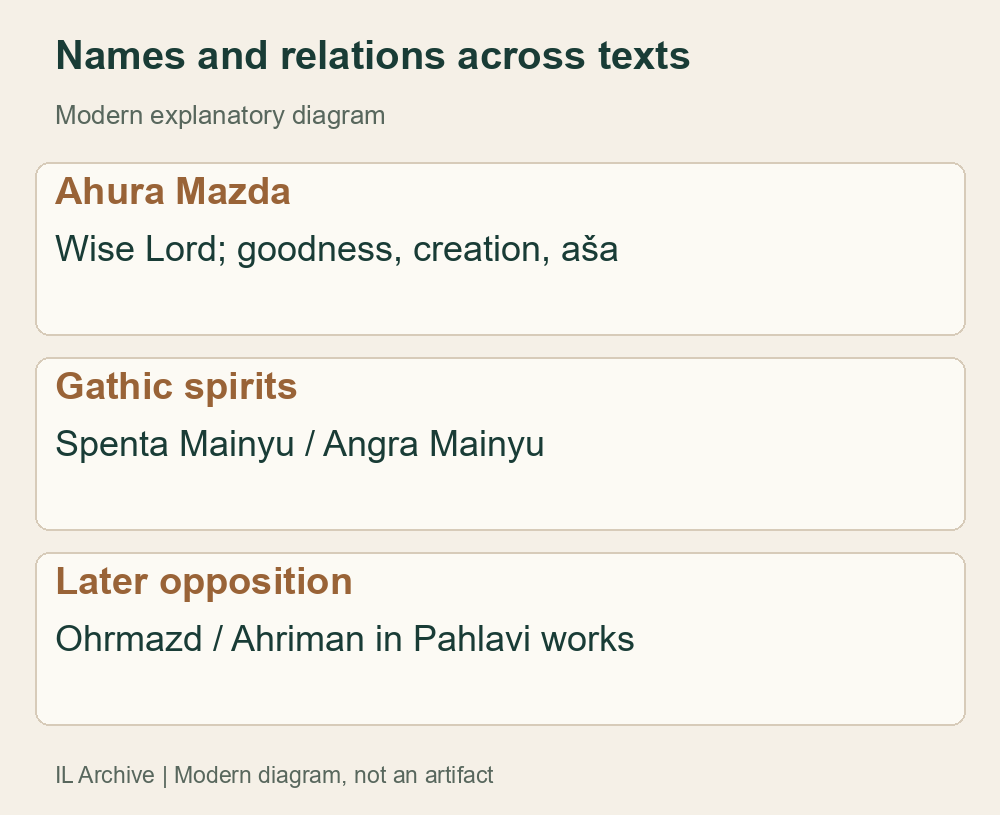
Ahura MazdaAhura MazdaWise Lord in Iranian traditions, associated with truth, goodness and creation; not a Persian name for Yahweh.Glossary · Click to read the explanation is usually rendered approximately “Wise LordRabbTitle of lordship, ownership or care by context; applied to God in Lord of worlds.Glossary · Click to read the explanation.” Goodness, creation and aša—truth, order and rightness—belong to his conceptual setting. These are Iranian linguistic and ritualRitualAn organised or distinguished practice meaningful to a community; it may leave traces, but its form alone does not reveal an associated doctrine.Glossary · Click to read the explanation traditions, not a Persian version of YahwehYahwehThe divine proper name written YHWH in the Hebrew Bible.Glossary · Click to read the explanation’s name. [3]
Comparing two images of a good deity cannot establish their identity. If an idea about judgment or history’s end travelled, the deity’s name and worship need not have travelled with it. A community can understand an outside idea through its own god and change its meaning in the process.
From Angra Mainyu to Ahriman
In the Gathas, the opposition involves Spenta Mainyu, the bounteous spirit, and Angra MainyuAngra Mainyu / AhrimanHostile spirit; Ahriman is a Middle Persian name in later traditions with changing theological relations.Glossary · Click to read the explanation, the hostile spirit. Their relationship to Ahura Mazda is disputed. In Middle Persian works, Ohrmazd and Ahriman’s opposition becomes central to cosmic history. These forms are not one unchanged theology across two millennia. [4]
We should therefore avoid “Angra Mainyu is the Jewish Satan” or “two forever-equal gods.” Even Iranian tradition changes the relationship between evil, creation and evil’s end. Functional resemblance permits comparison; it establishes neither personal identity nor a transmission route for the adversary image.
Moral choice and cosmic dualism
Knowing good and evil is not the same as believing in opposing heavenly camps. Comparison becomes imprecise when every statement about obedience and sin is equated with an Iranian dualistic system. We must distinguish human conduct, opposing spirits and a cosmic history culminating in goodness’s victory.
A real conflict also need not leave its parties forever equal. Zoroastrian traditions give history an outcome in which evil loses destructive power. In Judaism, YahwehYahwehThe divine proper name written YHWH in the Hebrew Bible.Glossary · Click to read the explanation remains sovereign even where adversaries gain power. Difference belongs to comparison rather than being removed to make it work. [4][6]
Israel did not begin with a blank page
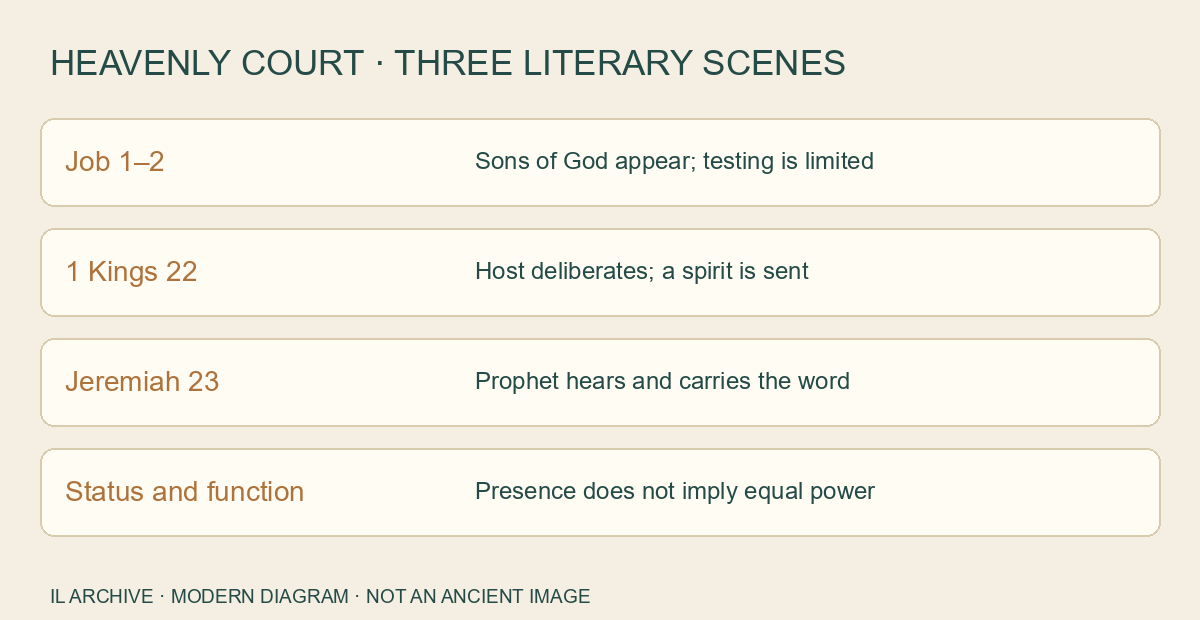
Israel had traditions of Yahweh, a heavenly councilDivine councilA representation of divine beings acting as an assembly with authority and differentiated roles.Glossary · Click to read the explanation, messengers, spirits and judgment before Persian rule. In many texts, SheolSheol: a Hebrew term for the realm of the deadHebrew textual term involving death, descent and lost return; it does not automatically mean later punitive Gehenna.Glossary · Click to read the explanation is the realm of the dead, rather than the organized moral hell of later conceptions. Justice often concerns land, descendants and political life.
This does not mean every Israelite believed the same thing or that all notions of postmortem destiny were absent. Surviving texts are selective and the dates of their layers debated. The question concerns organizing and connecting ideas, rather than inventing death, spirits or divine messengers for the first time under Persia. [9][13]
The Chinvat Bridge: an individual destiny
The Gathas refer to the Chinvat BridgeChinvat BridgeAvestan image of moral destiny after death, with passage elaborated in later traditions.Glossary · Click to read the explanation. Moral destiny relates to good existence or the world of deceit; later traditions describe the soul’s passage and judgment more explicitly. Early references matter without making every later detail equally ancient. [5]
An individual’s judgment after death must also be distinguished from the dead rising at history’s end. A surviving soul can be judged without bodily restoration; a later system can combine both. Compressing them into one sentence hides an important historical distance.
What do the Gathas say about the end?
The oldest Avestan layer contains language of destiny, recompense, improving life and truth’s victory. Shaked nevertheless stresses the difficulty of distinguishing individual from cosmic judgment, and bodily resurrection is hard to establish from this layer alone. “Ancient individual judgment” must not become a certain substitute for other interpretations. [6]
The Gathas therefore cannot be made to describe everything the Pahlavi books say about the savior, molten metal and final renewal. Nor should a cosmic horizon simply be denied them. Interpretation must remain tied to the passage and its actual clarity.
The dead rising and creation renewed
The Younger Avesta offers clearer evidence. Passages in Yašt 19 associate the dead rising with incorruptible life. FrashokeretiFrashokereti: final renovationCreation’s completion or renovation in Iranian tradition, linked to incorruptible life and evil’s retreat.Glossary · Click to read the explanation denotes final renovation or completion in which evil’s forces retreat. Almut Hintze traces connections with older expressions about making life excellent. [7]
This provides an important cluster for comparison: death is not final, and creation itself can be repaired. Yet relative linguistic layers are better known than the exact year of each passage or its circulation in Judah. Doctrinal clarity and absolute dating are different matters.
Pahlavi detail is not a document from Cyrus’s time
Middle Persian books give more systematic accounts of rising dead, a molten-metal ordeal, world purification and evil’s loss of power. They preserve older materials but do not agree in every detail. Even resurrection of “everyone” needs attention to variations and recorded exceptions. [6][7]
A detail in a late Pahlavi book resembling an earlier Jewish text cannot by itself establish Iranian transmission to that text. An earlier witness to the same idea is needed. A tradition’s antiquity does not date every sentence in its latest works to the first millennium BCE.
A text is not only as old as its manuscript
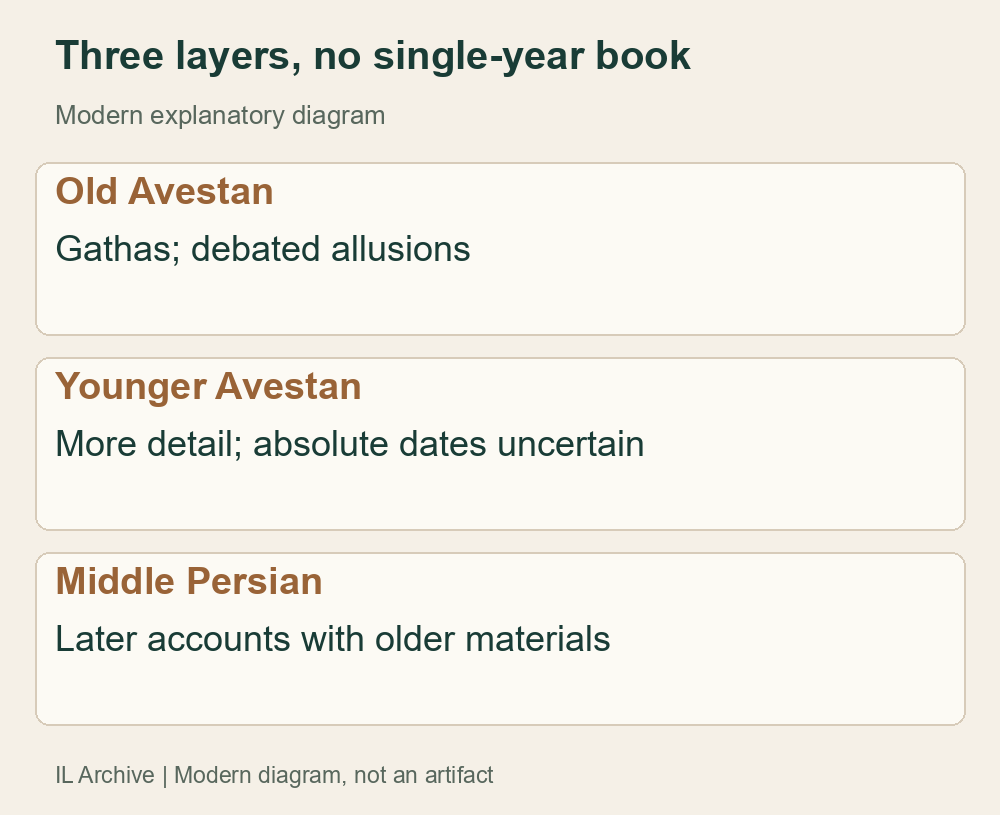
The opposite error treats everything in a late manuscript as its contemporary invention. Jean Kellens distinguishes AvestanAvestaAvestan-language religious corpus with layers and oral transmission, not a book composed in one year.Glossary · Click to read the explanation texts from translations and commentaries, emphasizes oral transmissionOral transmissionCirculation through performance and hearing, potentially involving change.Glossary · Click to read the explanation, and separates Old from Younger Avestan. A late manuscript can preserve much older language and text. [18]
We thus have at least three ages: an idea or hymn, the collection’s redaction, and the surviving copy. They must neither be equated nor selectively chosen to suit a hypothesis. Good comparison records demonstrable antiquity while leaving unprovable dates open.
Daniel 12: “many” rise
Daniel 12:2 describes many of the dead awakeningResurrection of the deadThe dead returning to life, distinguished from soul immortality, with differing scope and form among texts.Glossary · Click to read the explanation, with differing destinies of life and disgrace. It explicitly concerns individuals revived, but does not explicitly say every human rises. The scope of “many” is interpreted differently; the word should not be silently replaced with “all.” [12]
The visions’ final form relates to Antiochus IV’s second-century BCE crisis, around 164 BCE, while the book’s tales are older. This dates the final stage rather than the character’s life or every sentence. Clear resurrection language does not prove that Daniel invented it or directly borrowed it from an Iranian source. [11]
What about Isaiah, Hosea and Ezekiel?
Other texts use revival language without always doing the same work. Ezekiel 37 explains the bones through Israel’s restoration; Hosea 6 can describe the community’s return. Isaiah 26:19 is an important candidate for actual revival of the dead, with dating and interpretation debated. [20]
Daniel is therefore best called one of the clearest biblical witnesses, rather than the first resurrection idea in all Judaism. A text’s clarity must be separated from an idea’s origin, and national metaphor from an individual’s destiny; later writings can bring both images together.
The martyr and justice beyond death
When someone is killed for remaining faithful to God, earthly justice alone offers an incomplete answer. If death is final, who vindicates that person? Resurrection allows divine justice to surpass the persecutor’s temporary success. This is a powerful internal Jewish question, not evidence that religion began with Persia.
C. D. Elledge presents resurrection’s emergence and varied reception through renewed readings of scripture, creation and justice. This does not exclude external influence; it requires an Iranian hypothesis to explain what it adds beyond local tradition and historical crisis. [13]
No single Jewish eschatology
Later Jewish writings differed about resurrected bodies, who rises, the location of final life and the relation between resurrection and immortal souls. Daniel, Enoch, QumranDead Sea ScrollsJudaean Desert manuscripts, especially Qumran cave finds. Biblical copies and other works reveal textual diversity; a copy’s age is not the work’s initial date.Glossary · Click to read the explanation and rabbinic texts should not be assembled into one ready-made creed and given a single origin. [13]
EschatologyEschatologyStudy of destiny and endings, including individual judgment, resurrection and renewal; not one uniform creed.Glossary · Click to read the explanation groups questions of endings and destiny, not identical answers. One image may travel while another is rejected, and meanings can change between Jewish communities. No single verdict on “Iranian influence” fits all texts and stages.
Shaked’s argument: the whole cluster
Shaked argues for deep Iranian influence on Second Temple eschatology. His argument concerns a cluster—human responsibility, postmortem destiny, conflict, an ending, resurrection and renewed creation—within prolonged contact, rather than judgment alone. He acknowledges that the fullest Iranian accounts are late and the conclusion disputed. [6]
This is an influential scholarly position. Its advocate’s confidence cannot turn an undocumented transmission channel into a document. The cluster makes a hypothesis worth testing without exempting each component from dating and semantic examination.
The caution: comparison does not prove direction
Morton Smith cautions against establishing many proposed influences on angels, Satan and eschatology from broad comparison. He emphasizes prior Israelite traditions and different theological structures. Presenting him alongside Shaked exposes the real disagreement hidden by “scholarship proves.” [9]
Caution does not declare every resemblance accidental. Parallels can also arise from shared inheritance, similar questions, independent developmentIndependent developmentSimilar elements arising without historical transmission between them.Glossary · Click to read the explanation or later interaction. The task is to explain a particular witness, rather than selecting an entire religion as another’s source.
Angels existed before Persia
MalʾakhAngel / Divine MessengerHebrew malʾakh means messenger, human or celestial according to context; the word alone proves neither wings nor origin from a particular Canaanite god.Glossary · Click to read the explanation means a messenger, human or heavenly. Divine messengers, councils and spirits belong to Near Eastern and Israelite traditions predating Persian rule. Zoroastrianism therefore cannot simply be credited with giving Jews “the idea of an angel” for the first time. [9]
A narrower question remains possible: did Iranian contact contribute to particular later roles or organization? That differs from the being’s origin. A heavenly king surrounded by messengers identifies no source; the image extended beyond IranIranIran is the modern country containing Shush, ancient SusaGlossary · Click to read the explanation and had local antecedents.
When heaven became more detailed
Names, functions and histories of heavenly beings expand in Second Temple literature. MichaelMichael / MīkālTheophoric name asking who is like God; borne by humans and a heavenly figure in Daniel. It establishes no former Canaanite deity.Glossary · Click to read the explanation and GabrielGabriel / JibrīlName joining El with an element involving man or strength; interpreter in Daniel, messenger in Luke, named Jibrīl in the Qurʾan.Glossary · Click to read the explanation appear in Daniel, while other works elaborate fallen beings. Later organization does not erase the older messenger.
Annette Yoshiko Reed locates an important phase in written angelologyAngelologyStudy and organization of angels and heavenly beings: names, ranks and roles within particular traditions, without assuming one fixed system.Glossary · Click to read the explanation and demonologyDemonologyStudy or organization of harmful powers, names, origins and roles within specific traditions; no single doctrine or claim about existence beyond the text is assumed.Glossary · Click to read the explanation in the third century BCE, through AramaicAramaicA group of Northwest Semitic language varieties with a long history across the Near East.Glossary · Click to read the explanation literature and Hellenistic scribal settings. This adds scribes and the textualization of knowledge to the discussion; it neither dates the first Jewish heavenly being to that century nor independently proves a Persian cause. [10]
The Amesha Spentas are not a list of archangels
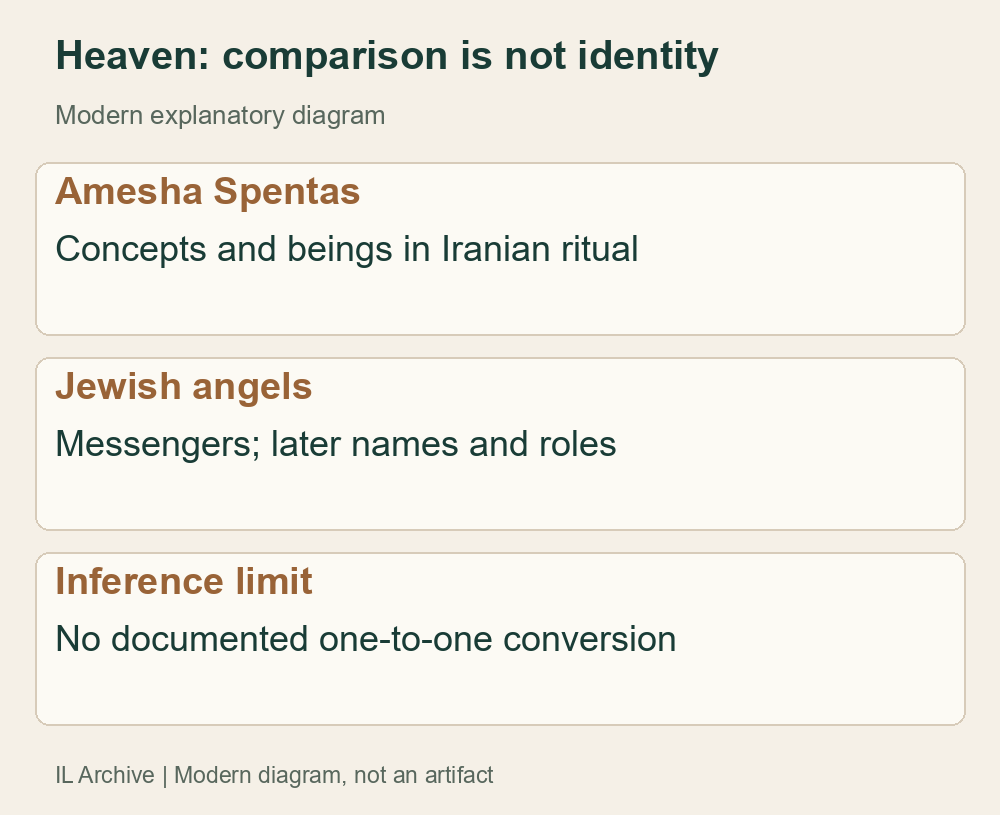
The Amesha SpentasAmesha SpentasBenevolent beings and concepts in Iranian tradition, approximately “holy/bounteous immortals.”Glossary · Click to read the explanation relate to good thought, truth, desirable dominion, devotion, wholeness and immortality. Usage varies, as does the six- or sevenfold grouping depending on the place of Ahura Mazda or the bounteous spirit. The number must not become one fixed table for all texts. [8]
These beings and concepts have Iranian theological and ritual positions. No transmission chain turns one into Michael or Gabriel. Organization, mediationIntercessionMediation subject in the cited Quranic texts to permission and approval, not divine independence.Glossary · Click to read the explanation and relationships with creation can be compared; matching names and personalities one to one needs additional evidence.
The adversary does not begin as independent enemy
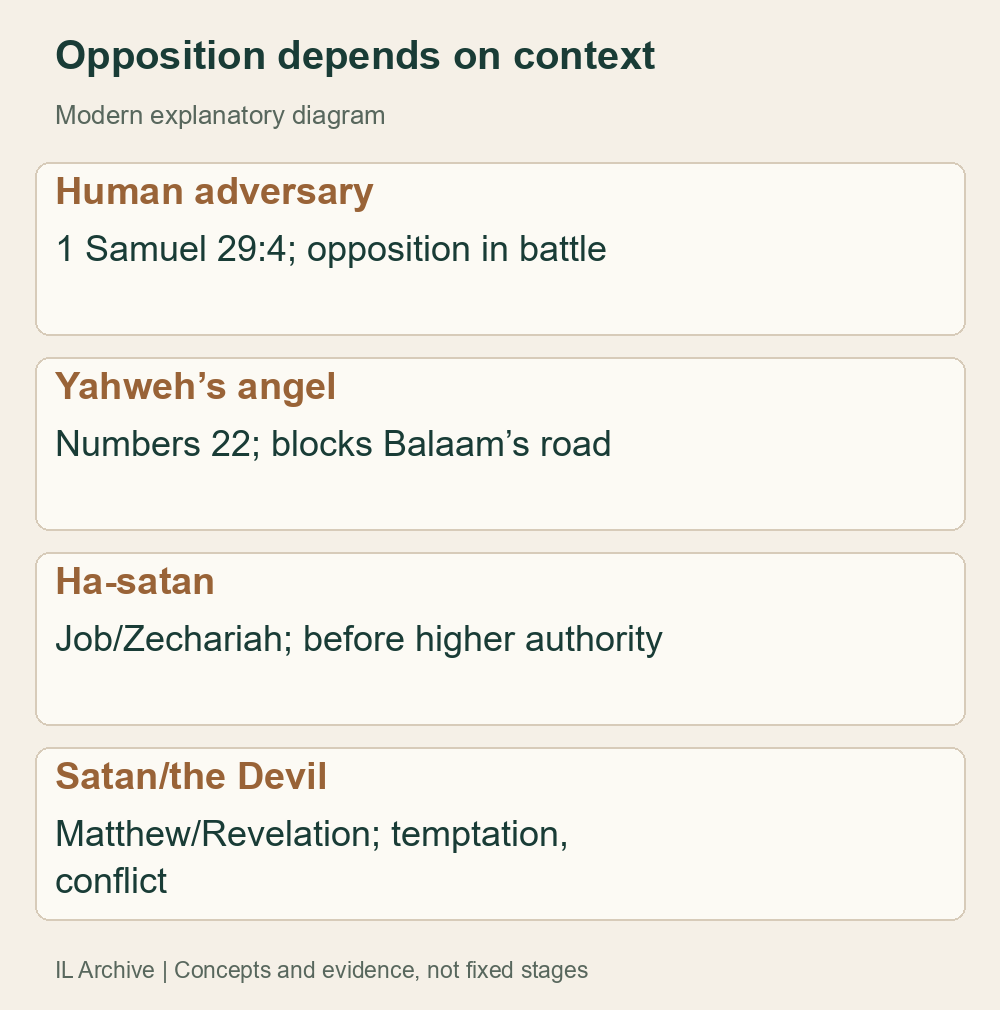
In Job, ha-satan, the adversary or accuserHa-satan in JobThe adversary or accuser in Job, with the Hebrew definite article; among the sons of God, acting within permission and limits rather than carrying every later Satanic trait.Glossary · Click to read the explanation, appears before Yahweh and acts under permission and limits. Later Jewish writings elaborate hostile beings and evil spirits with differing names and roles. No single trajectory through every work culminates in an identical Satan.
An Iranian role in organizing evil can be investigated, but adversaries and harmful spirits also have local roots. Calling Angra Mainyu “Satan before his name changed” exceeds the evidence. The Jewish model does not make its adversary Yahweh’s divine equal; careful comparison records that difference. [9]
Why might an idea change in transit?
When an evil power is interpreted within monotheismMonotheismBelief in a single God as the only deity, rather than merely the highest among several gods.Glossary · Click to read the explanation, full independence would constrain the supreme deity. A travelling idea may therefore change: its power becomes rebellious, created, limited or destined to end. An identical copy cannot be the only possible form of influence.
Flexibility, however, cannot make every difference evidence for hidden borrowing. A hypothesis needs testable particulars. If resemblance proves transmission and difference proves reinterpretation without another criterion, actual transfer becomes indistinguishable from independent development.
Qumran, light and darkness
Some Dead Sea ScrollsDead Sea ScrollsJudaean Desert manuscripts, especially Qumran cave finds. Biblical copies and other works reveal textual diversity; a copy’s age is not the work’s initial date.Glossary · Click to read the explanation use sons of light and darkness, spirits of truth and deceit, and conflict with a determined ending. This structure has made Iranian comparison important. It does not prove every light/dark expression borrowed, or one identical system across all Qumran texts.
Ethical or communal dualism does not automatically mean two eternal gods. God’s position, human responsibility, textual dates and the conflict’s structure need comparison. A connection can remain possible while its transmission channel and the particular stage of transfer remain open. [9][10]
Judgment alone does not identify a source
Moral assessment after death is not confined to Iran. Tiye’s Egyptian papyrus, dated about 975–945 BCE, depicts heart weighing before OsirisOsirisEgyptian deity associated with the dead and continued life, presiding over judgment in funerary papyri such as 66.99.142.Glossary · Click to read the explanation. It is used here to demonstrate that “judgment” extends beyond one cultural route, not to establish Egyptian transmission to Jews. [19]
Comparison gains value when details form a specific cluster: individual judgment, rising dead, renewed creation and evil’s defeat. Even then, dates and contact routes remain necessary. Judgment, resurrection, immortal souls and cosmic renewal are concepts that can coexist or remain separate.
Ending conflict, not simply leaving the world
In Zoroastrian renovation, the answer is not simply good souls escaping matter. Creation is restored to life uncorrupted by death. In Jewish apocalyptic works, oppressive history has an ending, God intervenes and the righteous are vindicated. Shared cosmic purpose is more specific than saying both religions believe in an afterlife. [7][13]
It does not equate the Iranian savior with the Jewish messiah or give every Jewish book the same expected renewal. This compares themes and structures without identifying religions or their personalities as identical.
Daniel is not a contemporary Persian court report
The narrative takes place in Babylonian and Persian settings, but its events’ date is not the visions’ final date. More than three centuries separate 539 from roughly 164 BCE, and generations separate the end of Achaemenid rule from final Daniel. Naming a king in a story cannot erase that distance. [11][15]
An idea can persist and move slowly, and contact outside Judah can continue after Alexander. The gap therefore does not disprove influence; it requires intermediary stages. A longer journey calls for a clearer explanation of its route.
Later interaction is clearer, but different evidence
Jewish communities lived in MesopotamiaMesopotamiaA historical region associated with the Tigris and Euphrates, home to many societies and civilisations.Glossary · Click to read the explanation under Parthian and Sasanian rulers for centuries. The Babylonian Talmud developed amid Iranian language, law and culture, and contains words, interactions and disputes tied to that setting. This is clearer evidence of later contact. [14]
It does not automatically prove resurrection teaching in fifth-century BCE Judah. The Achaemenid Empire, Hellenistic world and Sasanian setting are different frames. Later comparisons can illuminate later texts while the earlier question remains harder.
Was influence one-way?
Later Iranian works developed in a world familiar with Judaism, Christianity and other traditions. Samuel Thrope examines Zoroastrian polemic about Jewish angels in the Škand Gumānīg Wizār through rabbinic parallels. This is engagement with another tradition’s ideas, not a table converting Iranian beings into Jewish angels. [17]
For later witnesses, both directions and each tradition’s responses to neighbors must be considered. Preserved old material can still undergo later development. Persia’s political strength at an earlier stage cannot make it the source of every subsequent resemblance.
Six tests for a transmission hypothesis
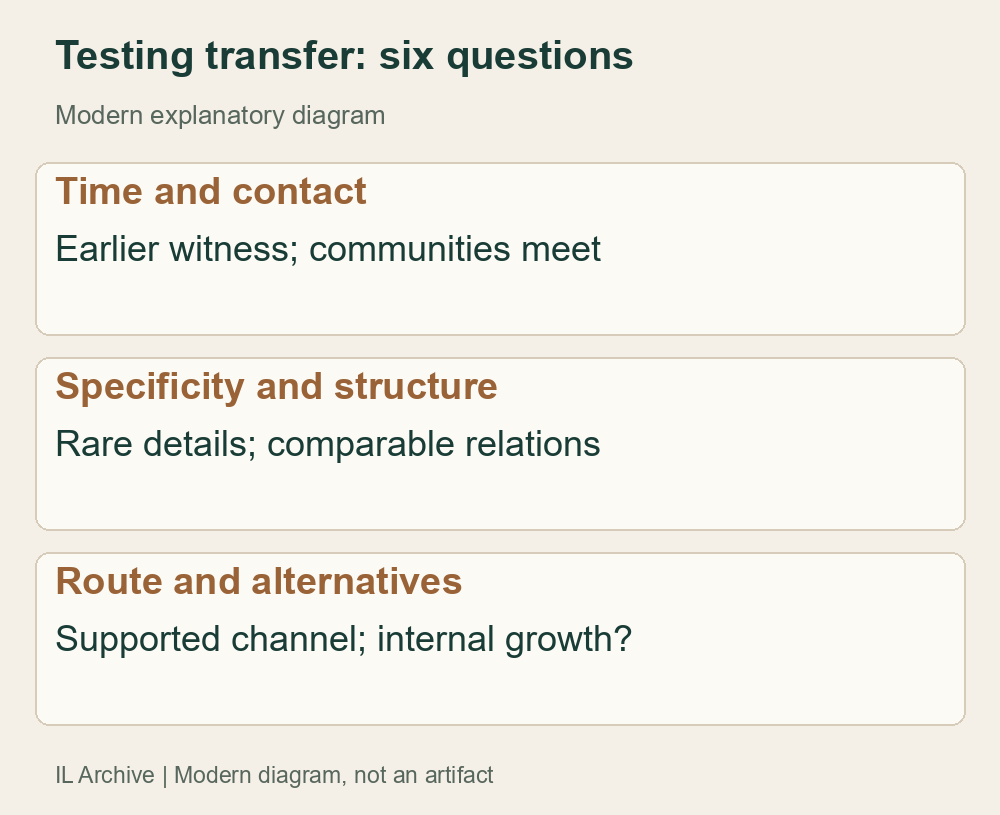
Begin with chronology: is the proposed source’s form demonstrably earlier? Then contact: did the communities meet in the relevant setting? Specificity: is the parallel unusual or generic? Structure: do relations and functions match, beyond words? Route: can an intermediary, language or community be supported? Alternatives: does transfer explain the evidence better than internal growth or later interaction?
Broad historical contact is established, but the other tests differ among judgment, angels and resurrection. One strong condition cannot make proposed transmission certain. If the route or priority of the precise form remains unproven, the hypothesis stays possible, however influential in scholarship.
Degrees that need separation
Historically established: Persian rule and prolonged contact, and Avestan and Jewish traditions about destiny and endings. Textually established: Daniel’s “many,” old bridge references, and clearer rising-dead language in the Younger Avesta. Disputed: Zoroaster’s date, the limits of royal Zoroastrianism and the ages of specific eschatological details. [1][2][5][7][12][15]
Possible and worth serious study: Iranian contributions to particular Jewish eschatologies, provided witnesses, contact and structure are examined. Unproven: a ready-made system imported all at once; Ahura Mazda renamed Yahweh; Ahriman directly becoming Satan; or Amesha Spentas individually becoming angels. Distinguishing these judgments prevents artificial certainty in either direction.
Did Zoroastrianism change Judaism?
The best answer turns resemblance into neither blanket rejection nor a list of certain borrowings. Iran was one of the worlds Jewish communities encountered over a long period, and eschatological comparison has real scholarly weight. Each particular contribution nevertheless requires its own evidence; an empire’s name is not an answer.
Even if an idea travelled, transmission was not copying. It entered traditions of creation, covenant, justice, council and prophecy and changed in the process. External influence could meet the internal demand to vindicate a righteous person killed unjustly. Iranian influence thus remains a serious possibility, with scope and routes assessed witness by witness. The better question is: which idea, in which layer, through which contact?
References and notes
- William W. Malandra (2009). “Zoroaster ii. General Survey.” Encyclopaedia Iranica. Date and place; broad estimates, no fixed year. Return to the text ↑
- Mary Boyce (1983). “Achaemenid Religion.” Encyclopaedia Iranica. Boyce argues for Zoroastrian kings; a scholarly position, not consensus; local cult support. Return to the text ↑
- Mary Boyce (1984). “Ahura Mazdā.” Encyclopaedia Iranica. Name, aša, goodness and creation; Boyce’s theology is not the only reading. Return to the text ↑
- Jacques Duchesne-Guillemin (1984). “Ahriman.” Encyclopaedia Iranica. Distinguishes Gathic spirits from the later Ohrmazd–Ahriman opposition. Return to the text ↑
- Aḥmad Tafażżolī (1991). “Činwad Puhl.” Encyclopaedia Iranica. Bridge of destiny; Gathic references and later detail, not an archaeological site. Return to the text ↑
- Shaul Shaked (1998). “Eschatology i. In Zoroastrianism and Zoroastrian Influence.” Encyclopaedia Iranica. Ambiguity of early layers; Shaked’s influence argument and dating caveat. Return to the text ↑
- Almut Hintze (2000). “Frašō.kərəti.” Encyclopaedia Iranica. Yasna 30.9, Yašt 19; renewal and rising dead, followed by varied Pahlavi detail. Return to the text ↑
- Mary Boyce (1989). “Aməša Spənta.” Encyclopaedia Iranica. Terminology and six concepts; no angel equivalence table. Return to the text ↑
- Morton Smith (1989). “Bible ii. Persian Elements in the Bible.” Encyclopaedia Iranica. Caution about inferring angelic/eschatological transfer from parallels; contrasts with Shaked. Return to the text ↑
- Annette Yoshiko Reed (2020). “Rethinking Scribalism and Change in Second Temple Judaism.” Demons, Angels, and Writing in Ancient Judaism, pp. 87–131. Summary situates textual organization in third century BCE; full chapter not read. Return to the text ↑
- Tawny Holm (2019). “Book of Daniel.” Oxford Research Encyclopedia of Religion. Tales precede visions; final form in the Maccabean crisis, around 164 BCE. Return to the text ↑
- Daniel 12, Hebrew text with English translation. Mechon-Mamre. 12:2–3: “many,” differing outcomes; not an explicit universal resurrection. Return to the text ↑
- C. D. Elledge (2017). Resurrection of the Dead in Early Judaism, 200 BCE–CE 200. Oxford University Press. Gradual development, diverse reception, justice and reinterpretation; full book not read. Return to the text ↑
- Jacob Neusner (2005). “Talmud, Persian Elements in.” Encyclopaedia Iranica. Later Babylonian setting, language and law; not projected into Achaemenid times. Return to the text ↑
- Morton Smith (1984). “Jewish Religious Life in the Persian Period.” The Cambridge History of Judaism, pp. 219–278. 539–332 BCE and community diversity; summary, not the whole chapter. Return to the text ↑
- The Metropolitan Museum of Art. “Daric with King,” 52.127.1. Gold daric, approximately fourth century BCE; royal image, not Zoroaster or proof of influence. Return to the text ↑
- Samuel Thrope (2015). “Unnecessary Angels: Jewish Angelology in the Škand Gumānīg Wizār.” Iranian Studies 48/1, pp. 33–53. Late Iranian polemic about Judaism; no fifth-century BCE angel-transfer chain. Return to the text ↑
- Jean Kellens (1987). “Avesta i. Survey of the History and Contents of the Book.” Encyclopaedia Iranica. Avestan texts distinguished from Zand; layers and oral transmission, no single composition date. Return to the text ↑
- The Metropolitan Museum of Art. “Book of the Dead Papyrus of Tiye,” 25.3.34. Ca. 975–945 BCE, heart weighing; another judgment tradition, no transfer route assumed. Image not reused. Return to the text ↑
- Isaiah 26, Hebrew text with English translation. Mechon-Mamre. 26:19 can imply real revival; date and interpretation vary, so Daniel’s absolute priority is not asserted. Return to the text ↑
Suggest a correction · Suggest a source for this record
Cite this record
IL Archive, «Did Zoroastrianism Change Judaism?», Edition 1, https://ilarchive.com/en/studies/zoroastrianism-judaism-influence
Continue reading

![Quran manuscript folio, Met 1979.201, late eighth–early ninth century, Central Islamic Lands; ink, colours and gold on parchment. Later codex transmission, not a seventh-century copy or an image of the verses cited here. [28]](/media/1332)