Entity · Concept
Resurrection of the dead
A reference page linking a name, group, or concept to the materials that discuss it.
Resurrection in Isaiah, Ezekiel, Daniel, Maccabees, early Jewish apocalypses and rabbinic texts, Iranian traditions, Christianity and the Quran: bodily life, justice, cosmic renewal, and the limits of influence claims.
Estimated reading time: 8 min Published Last reviewed:
Share article

Text
Introduction
What does “resurrection of the dead” mean in ancient texts? Does it describe a return to one's former life, a different life beyond death, or the renewal of the entire world? This entry examines the scope and development of resurrection language in Jewish, Iranian, early Christian, and Quranic sources, distinguishing it from the survival and judgment of the soul after death.
The date and purpose of each witness matter. A text may use the language of bodies rising to portray the recovery of a people, while another invokes it to answer the death of the innocent. Comparison can establish differences and historical opportunities for interaction; it cannot, by itself, provide a single family tree for a belief.
Contents
- What counts as resurrection?
- Earlier prophetic images: Isaiah and Ezekiel
- Persecution and martyrs in Second Temple literature
- After JerusalemJerusalemJerusalem is a city of religious importance in Judaism, Christianity and IslamGlossary · Click to read the explanation's destruction: what becomes of the body?
- Jewish disagreements and rabbinic reception
- Iranian traditions: the soul, resurrection, and cosmic renewal
- Early Christian formulations
- Resurrection in the QuranThe QuranThe central scripture of Islam, consisting of 114 Arabic surahs; its study distinguishes Quranic discourse from manuscript history, reading traditions, and historical inference.Glossary · Click to read the explanation
- Can we reconstruct a route of transmission?
- What the comparisons show
What counts as resurrection?
Resurrection here means the hope that the dead will live again through divine action. The question differs from the survival of the soul after death, an individual judgment after dying, the revival of someone who returns to ordinary mortal life, and the renovation of creation at the end of time. A tradition may combine these ideas, but they are neither synonyms nor obligatory steps in one sequence.
The Book of DanielBook of DanielA book combining court tales of wisdom and deliverance with visions of kingdoms and the future, formed in stages.Glossary · Click to read the explanation (12:2) says that “many” sleepers in the earth's dust will awake, some to everlasting life and others to disgrace. The HebrewHebrewA Northwest Semitic language of the Canaanite group, encompassing Iron Age epigraphy, Biblical, Rabbinic, medieval and Modern Hebrew; its scripts and pronunciations changed over time.Glossary · Click to read the explanation speaks of a multitude and does not explicitly say “every human being”; neither does that word by itself demonstrate that those unmentioned are excluded. The passage is concerned with a people in distress and divergent outcomes. [1] Scholar C. D. Elledge treats resurrection in early Judaism as a developing and contested response to questions of divine justice, death, and embodiment, rather than an assumption uniformly held from the outset. [2]
The vision is not simply a contemporary account from the Babylonian-exile setting in which Daniel's stories take place. Carol Newsom situates the visions of chapters 7–12 within the persecution under Antiochus IV and the Maccabean revolt in the second century BCE, while allowing a longer history of formation for other parts of the book. [3]
Earlier prophetic images: Isaiah and Ezekiel
In the Book of IsaiahBook of IsaiahProphetic collection in the Hebrew Bible; its first chapter addresses justice and the cases of the fatherless and widow.Glossary · Click to read the explanation (26:19), those who dwell in the dust are summoned to awake and live. Yet the same chapter concerns the fate of a people and its enemies, and in 26:14 speaks of other dead who do not rise. Scholars can read verse 19 as reaching beyond death, while also recognizing its poetic and collective setting. Taken by itself, the verse does not define the complete membership or mechanics of a universal future resurrection. [4]
Ezekiel 37 presents a striking vision of dry bones joining, acquiring flesh, and receiving breath. The interpretation explicitly given in verses 11–14, however, identifies those bones as “the whole house of Israel”: a people whose hope has dried up and who will be restored to their land. Subsequent readers drew on the imagery when describing embodied resurrection, but the chapter's immediate declared subject is national restoration. Its meaning within the vision must therefore be distinguished from later uses of that image. [5]
Persecution and martyrs in Second Temple literature
During Second Temple JudaismSecond Temple JudaismDiverse Jewish traditions between the rebuilding of Jerusalem’s temple around 515 BCE and its destruction in 70 CE: institutions, diaspora, groups and texts, with distinctions between events, composition, manuscripts and the limits of evidence.Glossary · Click to read the explanation, more than one expectation coexisted; there was no single switch from disbelief in an afterlife to universal agreement on resurrection. In 2 Maccabees (7:9, 11, 14, 23), brothers killed for remaining faithful to their ancestral law hope that God will restore life and even the bodily members they have lost. The account does not use precisely Daniel's two-outcome scheme for everyone: here the martyrs' hope is foregrounded, and 7:14 denies the persecutor a “resurrection to life.” The period of persecution depicted in the second century BCE must not be confused with the time when the Greek book was composed. [6]
Carol Bakhos's guide to the Posen Library also points to early resurrection language in strata of 1 EnochFirst EnochA composite Second Temple Jewish apocalyptic collection on the Watchers, parables, celestial cycles, historical visions, and judgment, preserved complete in Geʽez.Glossary · Click to read the explanation, including the Book of Watchers. It distinguishes resurrection as a prerequisite for judgment on both righteous and wicked persons from resurrection presented primarily as the vindication of the righteous. It is consequently misleading either to credit Daniel alone with inventing the idea or to say that every Jew of the period affirmed the same doctrine. [7]
After Jerusalem's destruction: what becomes of the body?
Fourth Ezra, an apocalypse written in the setting of debates following the Temple's destruction in 70 CE but voiced by the ancient Ezra, depicts the earth yielding up the dead and the divine judgment that follows (7:31–38). Rising thus precedes assessment and recompense; it is not necessarily a reward given only to the righteous. This work, often called 4 Ezra or the Jewish core of 2 Esdras, is not the canonical Book of Ezra. [8]
Second Baruch asks how those returned to life can be recognized. In 50:2–4, the earth first gives them back in recognizable form; 51:1–5 then describes transformation toward glory or disgrace. The passage consulted here is an older English translation from SyriacSyriacAn Aramaic literary language rooted in Edessa, first attested in non-Christian inscriptions and later prominent in Christian writing, scholarship, translation and liturgy.Glossary · Click to read the explanation, not a fresh comparison with a presumed earlier original. [9] Matthias Henze explains that the Jewish work was composed after Rome destroyed Jerusalem, even though the narrated scene is placed after the much earlier Babylonian destruction. The time of the story and the time of composition are not identical. [10]
Jewish disagreements and rabbinic reception
The first-century Jewish historian Flavius JosephusFlavius JosephusFirst-century Jewish historian who retold older narratives, including Abraham’s test, in Jewish Antiquities.Glossary · Click to read the explanation, in Jewish Antiquities 18.11–18, attributes postmortem rewards and a return to life for the righteous to the PhariseesPhariseesA Second Temple Jewish movement: its influence, ancestral traditions and hopes beyond death, examined through Josephus and the Mishnah’s purity debates.Glossary · Click to read the explanation. He contrasts them with the SadduceesSadduceesThe Sadducees were a Second Temple Jewish current, known mainly from external or rival accounts such as Josephus, the Mishnah and the New Testament rather than any surviving doctrinal writings of their own.Glossary · Click to read the explanation, whom he describes as denying the soul's survival, and describes EsseneEssenesA Second Temple Jewish movement known especially through Josephus and Philo; evidence supports a Qumran connection without identifying every Essene or manuscript with one uniform community.Glossary · Click to read the explanation belief in immortal souls in other terms. His portrayal is a historical witness written for his own audience, not an exhaustive record of every person's convictions or a transparent technical definition of resurrection. [11]
The MishnahMishnahThe Mishnah is a rabbinic compilation assembled around 200 CE, organizing teachings and discussions by topic.Glossary · Click to read the explanation, whose main compilation is usually placed around 200 CE, includes among those excluded from a share in the “world to come” a person who denies that resurrection of the dead is derived from the Torah (Sanhedrin 10:1). That precise claim should not be flattened into a simple denial of any afterlife at all. Nor did “the world to come” have one uncontested interpretation throughout later Jewish thought. [12]
Iranian traditions: the soul, resurrection, and cosmic renewal
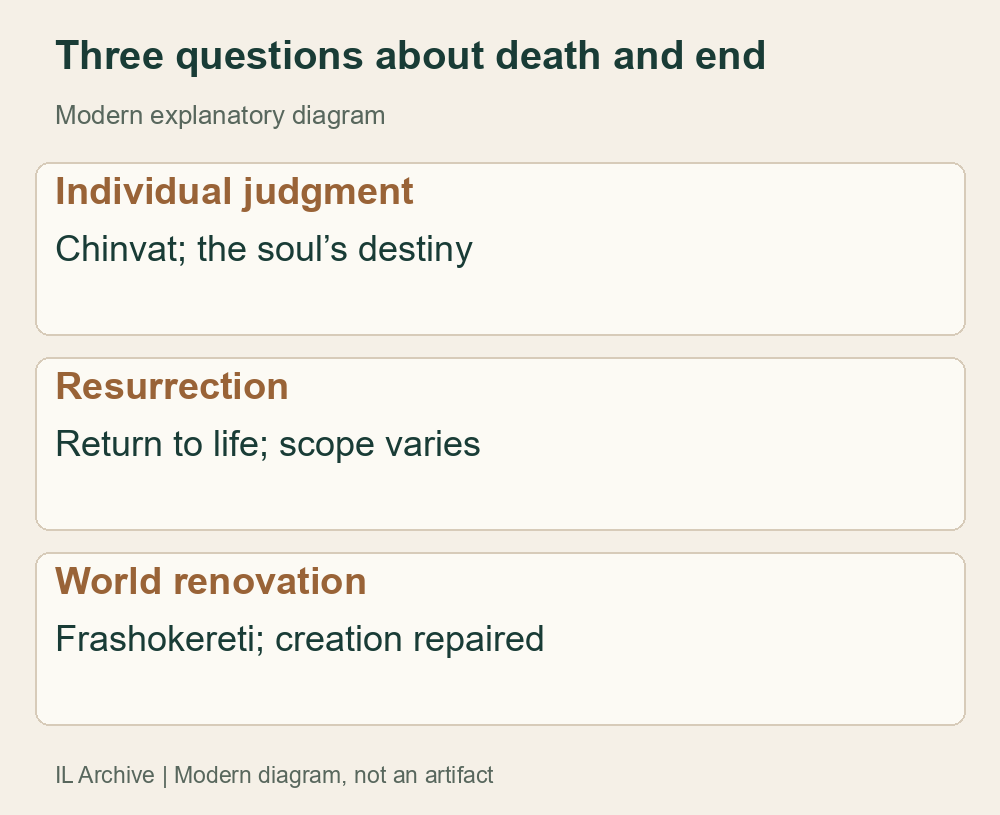
In ZoroastrianismZoroastrianism: Hymns, Rituals and the Changing TraditionA living Iranian religious tradition examined through Avestan hymns, Middle Persian writings and royal inscriptions, separating textual evidence, later interpretation and hypotheses of influence.Glossary · Click to read the explanation, the individual soul's judgment after death must be distinguished from the rising of the dead and FrashokeretiFrashokereti: final renovationCreation’s completion or renovation in Iranian tradition, linked to incorruptible life and evil’s retreat.Glossary · Click to read the explanation, the ultimate renovation of existence. In Encyclopaedia Iranica, Shaul Shaked distinguishes the relatively elusive hints of bodily resurrection in the older Gathas, the clearer references in the Younger AvestaAvestaThe Zoroastrian sacred corpus in Old and Younger Avestan, containing hymns, liturgy and prayers transmitted orally before later manuscript copying.Glossary · Click to read the explanation, and the developed but variable accounts in Middle Persian (Pahlavi) books. The Chinvat BridgeChinvat BridgeThe crossing associated with the soul’s judgment after death in Zoroastrian tradition. Named in the Gathas, it receives fuller descriptions of guardians, weighing and unequal passage in later texts; it is distinct from resurrection and world renovation.Glossary · Click to read the explanation is principally associated with the soul's passage and reckoning, not a name for resurrection itself. [13]
Yasht 19, the Zamyad Yasht, associates the future benefactor SaoshyantSaoshyantSaoshyant is an Avestan term for a benefactor, with an eschatological savior sense in Zoroastrian texts.Glossary · Click to read the explanation with the dead rising and the renewal of the world. Pallan Ichaporia describes Yasht 19 as a composite text with a history of transmission and notes parallel accounts of final renewal at 19:11–12 and 19:89–90. Details in the later Middle Persian BundahishnBundahishnThe Bundahishn is a Middle Persian Zoroastrian work on creation, the world and its final renovation.Glossary · Click to read the explanation cannot simply be projected back into every Avestan passage, nor assigned a single securely early date. [14]
Early Christian formulations
In the first-century First Letter to the Corinthians, PaulPaul the ApostlePaul was a first-century CE Christian letter writer whose letters preserve early Christian formulations.Glossary · Click to read the explanation relates the hoped-for resurrection of the dead to the proclamation that Jesus ChristJesus ChristJesus Christ is Christianity’s central figure, who lived in the first century CEGlossary · Click to read the explanation has been raised. Chapter 15 compares the transformation to a seed that dies and grows and contrasts what is perishable with a “spiritual body” (15:35–54). In Paul's argument this means transformed embodied existence, not merely a soul remaining alive without a body. It represents his position in an argument within an early Christian community, rather than every Christian interpretation across history. [15]
Resurrection in the Quran
The QuranThe QuranThe central scripture of Islam, consisting of 114 Arabic surahs; its study distinguishes Quranic discourse from manuscript history, reading traditions, and historical inference.Glossary · Click to read the explanation confronts the objection that decayed bones cannot live again in Yā Sīn (36:78–83). It answers by invoking the power of the one who created human beings in the first place. Its argument therefore establishes the possibility of renewed life and judgment by appealing to original creation. This seventh-century CE Quranic witness has its own literary setting: the shared imagery of bones does not, without further evidence, identify a direct quotation from Ezekiel or Daniel. [16]
Can we reconstruct a route of transmission?
Periods of contact between Iranian and Jewish communities offered opportunities for exchange. At the same time, Israelite prophetic imagery and the deaths of the innocent supplied resources for reinterpretation within Jewish traditions. Scholars have therefore considered Iranian influence, internal development, and more complex models of interaction. In the accessible abstract of his chapter “Origins, Contexts,” Elledge explicitly finds that the surviving literary evidence does not settle a single origin and stresses the challenges to inherited ideas of justice in the Hellenistic world. [17]
Common descriptions of the dead rising or the world being renewed do not by themselves prove literary borrowingLiterary borrowingUse of verbal or narrative material from an earlier text or tradition in a later work, distinguishing evidence of transfer from mere resemblance.Glossary · Click to read the explanation from one named text. Such proposals need the language and dates of particular textual layers, and historically plausible pathways of exchange; some detailed Iranian testimonies are preserved in later works. This is a limit on claims of one proven source, not an a priori denial that historical influence could occur.
What the comparisons show
These traditions share possibilities of life beyond death but ask distinct questions: the recovery of a people in prophetic vision, the vindication of persecuted martyrs, a resurrection leading to judgment, transformed embodiment in an early Christian letter, cosmic repair in Zoroastrian traditions, and divine creation and re-creation in the Quran. Who rises, in what condition, and when judgment occurs remain variable and debated. Each witness should first be read on its own terms.
The accompanying diagram is a modern editorial aid separating three questions, not an ancient object or a necessary chronology of beliefs. The shared cover is a modern AI-generated conceptual image, not an ancient witness or an authoritative portrayal of what life after death looks like.
References and notes (17)
- Book of Daniel 12:1–3, Hebrew text and English rendering, Mechon-Mamre. 12:1–3, especially 12:2; displayed passage read. Return to the text ↑
- C. D. Elledge, Resurrection of the Dead in Early Judaism, 200 BCE–CE 200, Oxford University Press, 2017; publisher abstract and contents only. Publisher abstract and table of contents only; full book not read. Return to the text ↑
- Carol Newsom, “Daniel,” Oxford Bibliographies in Biblical Studies (2010); accessible introduction extract. Published introduction extract on dating and composition; full bibliography not read. Return to the text ↑
- Book of Isaiah 26, Hebrew text with English rendering, Mechon-Mamre. Displayed chapter 26, especially 26:14, 17–19, 21. Return to the text ↑
- Book of Ezekiel 37, English rendering at Mechon-Mamre, including the interpretation in vv. 11–14. Displayed 37:1–20; no independent Hebrew collation. Return to the text ↑
- 2 Maccabees 7, English biblical text and notes, US Conference of Catholic Bishops. 2 Macc 7:1–29, especially 9, 11, 14, 23; Greek not collated. Return to the text ↑
- Carol Bakhos, “Resurrection in Early Jewish Texts,” Posen Library of Jewish Culture and Civilization, thematic guide. Entire short public guide; linked restricted primary-text pages not read. Return to the text ↑
- Fourth Ezra in 2 Esdras 7, NRSVA English translation, BibleGateway. 7:26–44, especially 7:31–38; modern English translation, not a manuscript. Return to the text ↑
- 2 Baruch 49–52, R. H. Charles’s English translation from Syriac (1913), reproduced via the Wesley Center; Syriac not read. 50:2–4 and 51:1–5, plus question in 49:1–3; reproduced page only. Return to the text ↑
- Matthias Henze, “Second Baruch,” Oxford Bibliographies in Biblical Studies, updated 2024; accessible introduction only. Published introductory extract on date and setting; restricted bibliography not read. Return to the text ↑
- Flavius Josephus, Jewish Antiquities 18.11–18, William Whiston English translation at Tufts Perseus; Greek not read. Discussion of Pharisees, Sadducees and Essenes, 18.11–18. Return to the text ↑
- Mishnah, Sanhedrin 10:1, Hebrew text and multiple English translations on Sefaria, including the “from the Torah” wording. 10:1 and explanatory note on world-to-come debates; no complete rabbinic treatise read. Return to the text ↑
- Shaul Shaked, “Eschatology i. In Zoroastrianism and Zoroastrian Influence,” Encyclopaedia Iranica, 1998 (updated 2014). Relevant sections on the Gathas, Younger Avesta, Pahlavi texts and world renovation; named originals not all independently read. Return to the text ↑
- Pallan Ichaporia, “Zamyād Yašt,” Encyclopaedia Iranica, 2006 (updated 2012). Article, particularly composite structure and sections 11–12, 78–96, 89–90; Avestan not independently read. Return to the text ↑
- Paul, First Corinthians 15, USCCB English biblical text and notes. 15:3–8, 12–26, 35–54 with explanatory notes; Greek critical edition not consulted. Return to the text ↑
- Quran, Yā Sīn 36:78–83, Arabic verse 78 and English context translation, Quran.com. Arabic v. 78 and published English vv. 77–83; no manuscript or variant-reading analysis. Return to the text ↑
- C. D. Elledge, “Origins, Contexts,” in Resurrection of the Dead in Early Judaism (2017), pp. 44–65; chapter abstract only. Published chapter abstract only; pages 44–65 not read. Return to the text ↑
Suggest a correction · Suggest a source for this record
Cite this record
IL Archive, «Resurrection of the dead», https://ilarchive.com/en/entities/resurrection
Continue reading