Entity · Religious group
Sadducees
A reference page linking a name, group, or concept to the materials that discuss it.
- Names
- Sadducean · Sadducees · Σαδδουκαῖοι · צדוקים
- Region
- Judaea and Jerusalem (Second Temple period)
The Sadducees, a Second Temple Jewish group known mainly from Josephus, the New Testament and the Mishnah, were said to reject unwritten Pharisaic traditions and to deny resurrection or the soul’s survival.
Estimated reading time: 8 min Published Last reviewed:
Share article
Text
Introduction
Who were the Sadducees, and how much can we know about a group that left no securely identifiable doctrinal library? This article situates them within Second Temple JudaismSecond Temple JudaismDiverse Jewish traditions between the rebuilding of Jerusalem’s temple around 515 BCE and its destruction in 70 CE: institutions, diaspora, groups and texts, with distinctions between events, composition, manuscripts and the limits of evidence.Glossary · Click to read the explanation and compares Josephus, New Testament narratives and the Mishnah. It distinguishes what each witness actually says from modern reconstructions of Sadducean social position and beliefs.
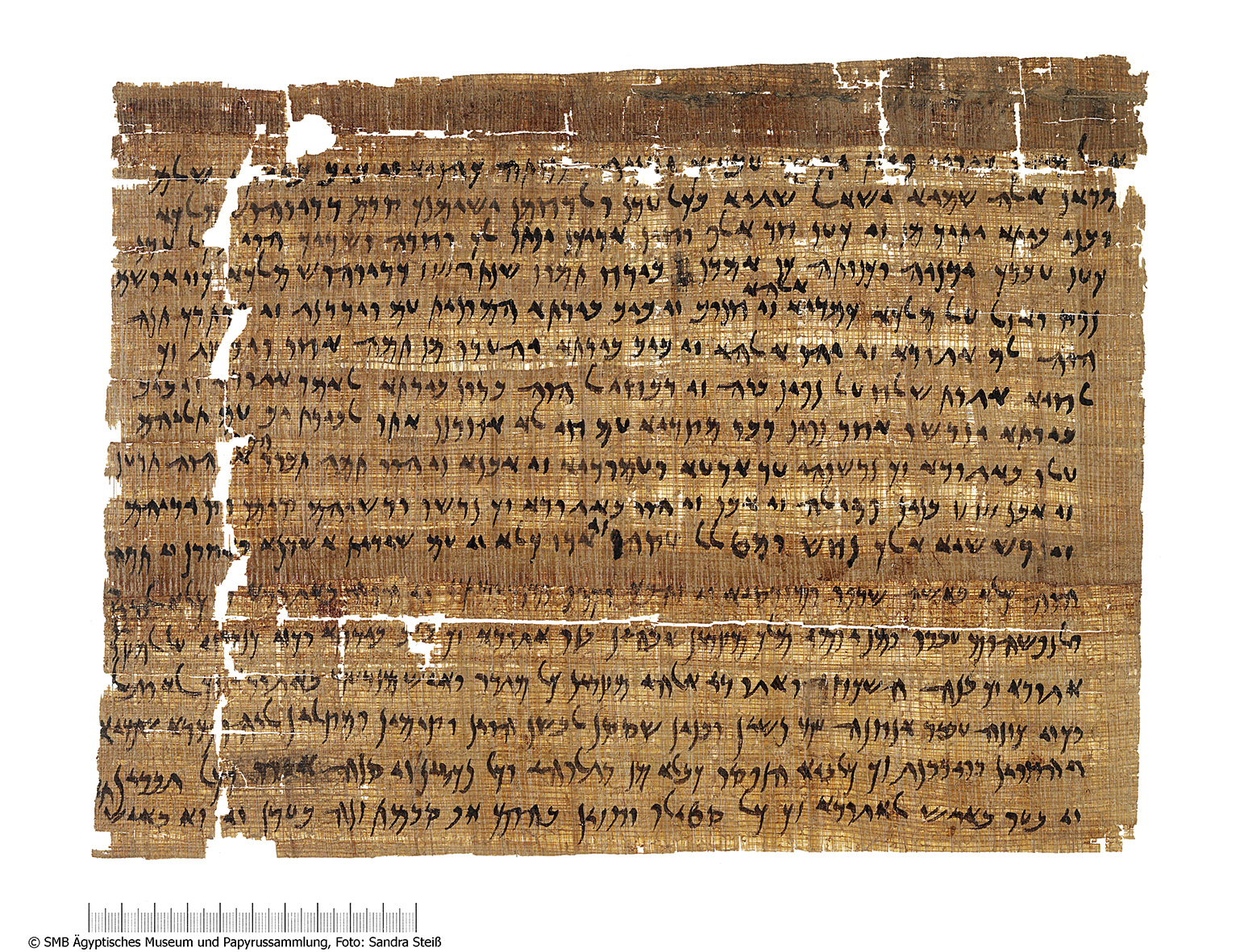
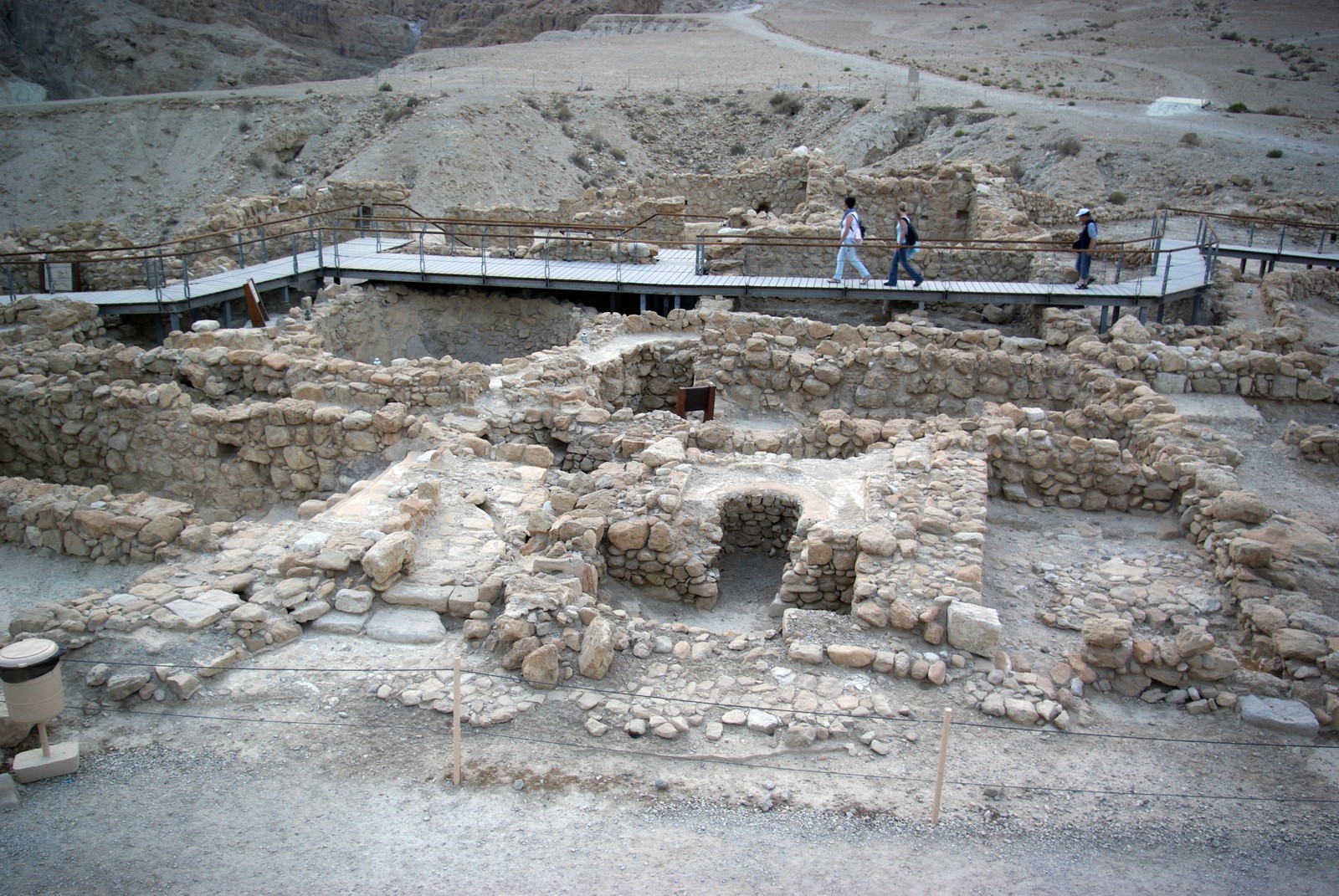
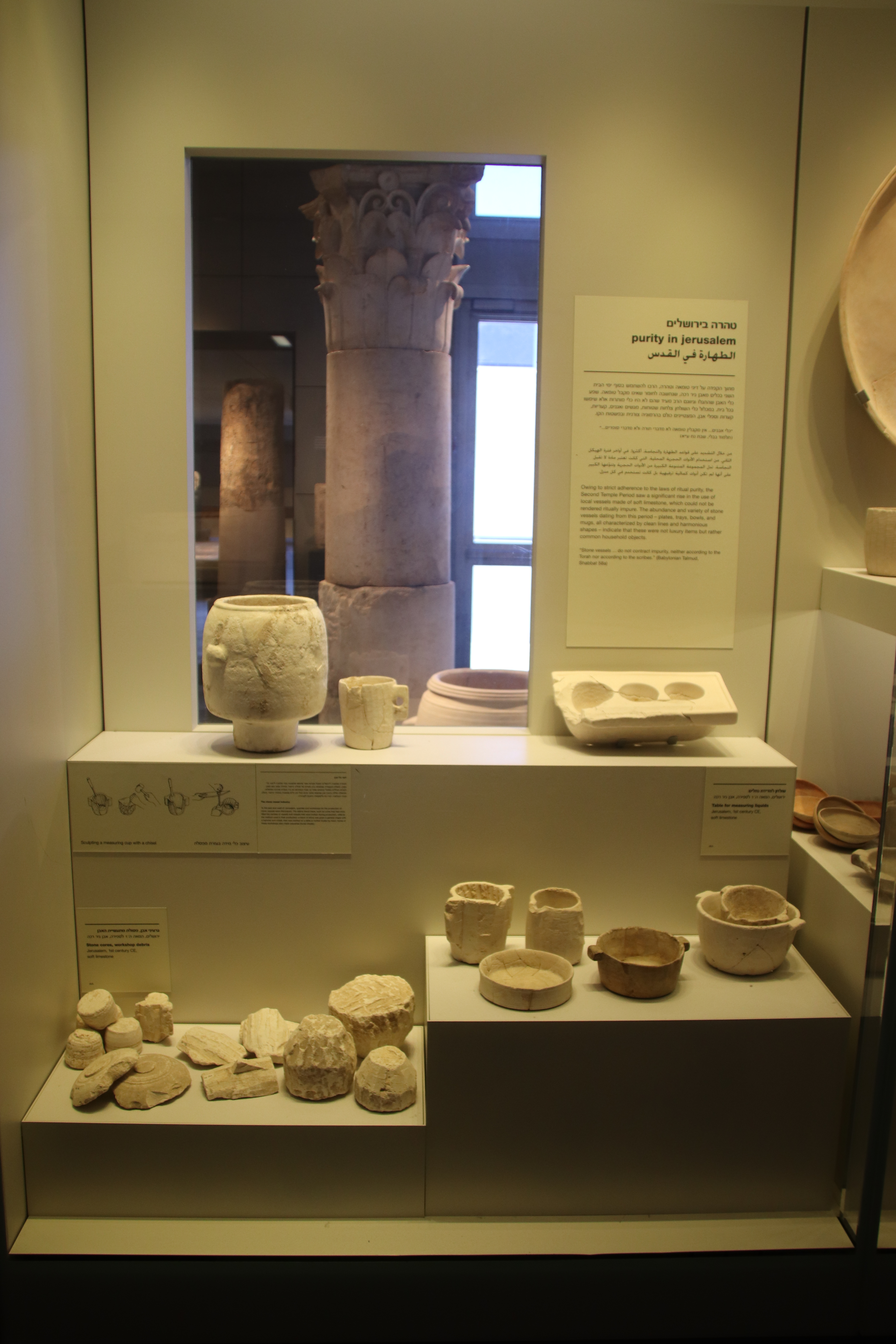
The question is not which side was right in ancient disputes, but who wrote the accounts, when and for whom, and how each author represented an opponent. The modern diagrams and illustrative cover accompanying this article are neither excavated Sadducean artefacts nor portraits of members of the group.
The group and its witnesses
The Sadducees, Greek Saddoukaioi and HebrewHebrewA Northwest Semitic language of the Canaanite group, encompassing Iron Age epigraphy, Biblical, Rabbinic, medieval and Modern Hebrew; its scripts and pronunciations changed over time.Glossary · Click to read the explanation Ṣədūqīm, were a religious, legal and political current within Second Temple JudaismSecond Temple JudaismDiverse Jewish traditions between the rebuilding of Jerusalem’s temple around 515 BCE and its destruction in 70 CE: institutions, diaspora, groups and texts, with distinctions between events, composition, manuscripts and the limits of evidence.Glossary · Click to read the explanation. They are named in narratives set in Hasmonean Judaea and continue to appear in accounts of the first century CE. There is no surviving body of doctrinal writings securely attributable to them. Their history must therefore be reconstructed from other people's texts, without turning disparate accounts into a complete and uniform “Sadducean creed.” [2] [4]
The most substantial witness is Flavius JosephusFlavius JosephusFirst-century Jewish historian who retold older narratives, including Abraham’s test, in Jewish Antiquities.Glossary · Click to read the explanation, a first-century Jewish historian who describes Sadducees alongside PhariseesPhariseesA Second Temple Jewish movement: its influence, ancestral traditions and hopes beyond death, examined through Josephus and the Mishnah’s purity debates.Glossary · Click to read the explanation and EssenesEssenesA Second Temple Jewish movement known especially through Josephus and Philo; evidence supports a Qumran connection without identifying every Essene or manuscript with one uniform community.Glossary · Click to read the explanation as schools or currents within Jewish society. In The Jewish War and Jewish Antiquities, he often uses a comparative framework reminiscent of Greek philosophy. That helps us understand his presentation, but it does not turn it into a manifesto written by the groups themselves. [1] [3] [13]
Name, beginnings and dating
The Hebrew name Ṣədūqīm may be connected with the priest Zadok or a priestly lineage associated with that name. Etymology by itself cannot establish that all members belonged to this lineage or reveal when their group was founded. Modern reference scholarship places their documented activity broadly between the second century BCE and the first century CE. This is a date range for attestation, not a known founding date. [4] [2]
In Antiquities 13.171–173, Josephus introduces three schools while narrating the Hasmonean age. At 13.293–298 he tells a story in which John Hyrcanus, angered in a conflict with Pharisees, supposedly transferred his allegiance to the Sadducees. Both accounts were written after the events they portray: their political narratives should not be mistaken for contemporary minutes of meetings. [3] [7]
Priesthood, elites and the Temple
Several sources connect Sadducees with leading social circles and some priestly office-holders, particularly in JerusalemJerusalemJerusalem is a city of religious importance in Judaism, Christianity and IslamGlossary · Click to read the explanation. Josephus associates their following with the wealthy and socially prominent, but he does not say every priest was a Sadducee or that all Sadducees were priests. Recent scholarship also notes ties to some high priests under Roman rule without identifying the group with the priesthood as a whole. [7] [4]
One unusually explicit individual identification concerns Ananus son of Ananus. In Antiquities 20.199 Josephus calls him an adherent of the Sadducees, then criticizes his severity in the narrative about the judicial proceeding against James, the brother of Jesus. This is evidence about one named office-holder in a particular political and judicial setting, not a representative sample of everyone's behavior. [5]
Written law and ancestral traditions
According to Antiquities 13.297–298, the PhariseesPhariseesA Second Temple Jewish movement: its influence, ancestral traditions and hopes beyond death, examined through Josephus and the Mishnah’s purity debates.Glossary · Click to read the explanation passed on ancestral rules not written in the Law of MosesMosesCentral figure in Exodus, Torah traditions and the Qur’an; childhood accounts differ in detail.Glossary · Click to read the explanation, whereas the Sadducees did not recognize those inherited rules as binding in the same way and insisted on what they understood to be required by written law. The passage concerns a dispute over the authority of interpretation and tradition. It does not prove that the Sadducees read without interpretation or lacked their own legal reasoning. [7] [12]
The familiar claim that they “accepted only the five books of Moses” goes beyond what this passage demonstrates. Rejecting the obligatory force of some ancestral regulations does not itself establish that they denied the existence or authority of every other sacred book. Nor should later rabbinic categories of “oral Torah” be mechanically imposed upon every first-century BCE disagreement. [2] [7]
Human choice and fate
In Antiquities 13.171–173 Josephus contrasts Sadducees, who deny the power of Fate, with Essenes, to whom he attributes a strong conception of Fate, and Pharisees, to whom he attributes a combination of divine determination and human agency. War 2.164 similarly has Sadducees maintain that people choose between right and wrong rather than having their actions determined by Fate. [3] [1]
This contrast is not, by itself, a complete Sadducean philosophy of free will. Josephus frames it using concepts intelligible to his Greek-speaking readers. It would go beyond his evidence to claim that the group denied every form of divine action, or that all Jews of the period could be exhaustively assigned to three neat systems. [13]
The soul, afterlife and resurrection
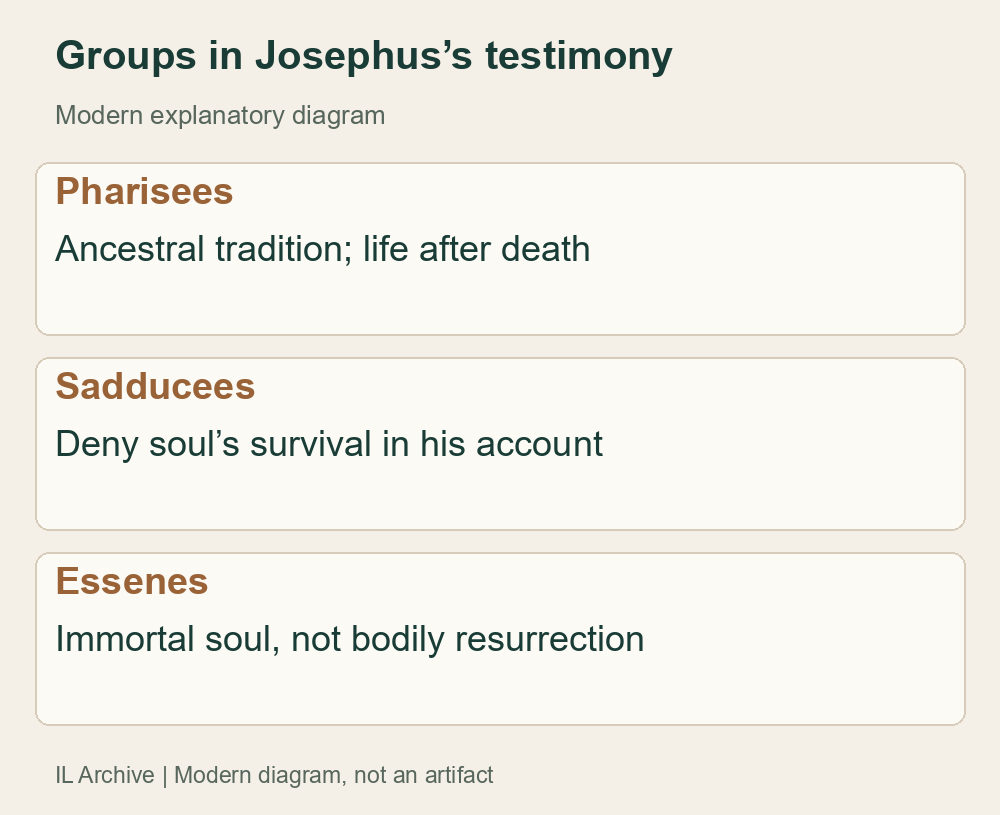
In War 2.164–165 Josephus attributes to the Sadducees a rejection of the soul's persistence after death, together with rewards and punishments in the world below. In Antiquities 18.16 he summarizes their position as the soul perishing along with the body. He quotes no Sadducean doctrinal tract or argument here; moreover, his language about “the immortality of the soul” is not simply interchangeable with every Jewish notion of bodily resurrection. [1] [6]
Josephus gives rather different descriptions of the afterlife views of the PhariseesPhariseesA Second Temple Jewish movement: its influence, ancestral traditions and hopes beyond death, examined through Josephus and the Mishnah’s purity debates.Glossary · Click to read the explanation and EssenesEssenesA Second Temple Jewish movement known especially through Josephus and Philo; evidence supports a Qumran connection without identifying every Essene or manuscript with one uniform community.Glossary · Click to read the explanation. These are categories imposed by a historian addressing a Greco-Roman readership. They cannot settle the precise beliefs of every adherent or the full range of resurrection language found in ancient Jewish literature. [1] [13]
A dispute in the Gospels
Mark 12:18–27 depicts Sadducees who reject resurrection asking Jesus about a woman successively married to seven brothers in accordance with the law concerning a brother's childless widow. The narrative has Jesus distinguish present life from resurrected life and cite Moses in his answer. This is valuable evidence for the portrayal of Sadducees in an early Christian argument, not neutral verbatim minutes of the encounter. [8]
The episode shows that resurrection was an explicit issue in controversy. It does not establish that every view imputed to the group in other writings formed a single institutional creed, or that the marriage question survives in mutually independent accounts from both sides. [8] [2]
Angels and spirits: a difficult passage
Acts 23:6–9 says that the Sadducees acknowledge neither resurrection nor “angel or spirit,” whereas Pharisees acknowledge these, as Paul provokes a dispute in an assembly. This wording should be attributed specifically to Acts' narrative. Precisely what the denial of “angel or spirit” encompasses remains difficult to determine from the passage alone; it is insufficient grounds for asserting that Sadducees denied every angelic manifestation found in the Torah. [9]
It is therefore necessary to distinguish resurrection, a recurring matter of controversy, from the precise interpretation of spiritual beings or experiences in Acts. Rephrasing the passage as “they rejected the entire supernatural world” would exceed the explicit evidence. [9]
Legal disputes preserved in the Mishnah
The MishnahMishnahThe Mishnah is a rabbinic compilation assembled around 200 CE, organizing teachings and discussions by topic.Glossary · Click to read the explanation, compiled around 200 CE, preserves traditions and discussions, some of them older. In Yadayim 4:6 Sadducees are represented objecting to the rule that holy writings “defile the hands” although works of HomerHomerThe name to which Greek tradition attributes the Iliad and Odyssey.Glossary · Click to read the explanation do not. Yohanan ben Zakkai replies with an analogy about the ritual impurityRitual impurityA religious status regulating contact with the sacred, especially in Leviticus and Numbers. Causes, duration, and remedies vary by context; it does not necessarily imply sin, disease, or diminished dignity.Glossary · Click to read the explanation of human remains. Ritual impurity here is a legal category, not a declaration that scripture is morally filthy. [10]
Yadayim 4:7 depicts disagreements over the flow of liquids between vessels and over a master's responsibility for damage caused by a slave as compared with an animal. These discussions suggest differences over practical legal reasoning as well as over the afterlife. Yet they are rabbinic formulations of older disputes; not every line can be treated as the direct speech of an identifiable historical Sadducee. [11] [2]
Qumran and parallels in legal interpretation
Certain positions ascribed to Sadducees in rabbinic writings resemble issues found in the Dead Sea ScrollsDead Sea ScrollsManuscript collections from the Judaean Desert, best known through Qumran: diverse works, languages and textual forms, with copying distinguished from composition.Glossary · Click to read the explanation, including Some Works of the Torah (4QMMT). Lawrence Schiffman proposes links between earlier legal currents and some works from QumranQumranArchaeological site northwest of the Dead Sea near manuscript caves; its settlement and the groups who deposited the scrolls are studied together but not assumed identical. It is not synonymous with all Dead Sea Scrolls.Glossary · Click to read the explanation, while expressly acknowledging the assumptions needed to reconstruct such a history. [12]
A parallel rule on purity, or an interpretation of a biblical verse, does not establish that every Qumran manuscript was authored by Sadducees or that the community at the site bore that name. Similar legal positions, hypothesized historical descent and demonstrated group identity are three different claims; the last does not automatically follow from the first. [12] [13]
After 70 CE and the limits of knowledge
The destruction of the Jerusalem Temple in 70 CE transformed the political and religious institutions associated with it. Unambiguous references to a continuing, separately identifiable Sadducean group become rare afterwards. That scarcity is not a record of the exact moment of its disappearance or of the fate of every former member. Modern scholarship also cautions against declaring a later Jewish movement to be the direct heir of the Sadducees without intervening evidence. [4] [2]
Assessment: There is strong external testimony for the group's name, its disagreement with Pharisees over ancestral traditions, the attribution to it of denying resurrection or the soul's persistence, and associations with some influential circles in Judaea. There is no surviving independent Sadducean statement settling its membership, full range of teaching, or internal diversity. Reading the witnesses alongside each other—without smoothing out their differences or forgetting their dates and agendas—is the soundest way to describe the group. [2] [13]
References and notes (13)
- Flavius Josephus, The Jewish War, Book II, 2.8, translated by William Whiston at the Perseus Digital Library; selected passages also compared with the Greek and parallel translations. Sections 2.164–166: fate, soul and characterization; English translation read, partial check against Greek. Return to the text ↑
- Günter Stemberger, “The Sadducees – their history and doctrines,” in The Cambridge History of Judaism, vol. 3 (Cambridge University Press, 1999), pp. 428–443. Publisher’s online chapter summary and bibliographic metadata only; pages 428–443 NOT read in full. Return to the text ↑
- Josephus, Jewish Antiquities 13.171–173, Richard Marcus’s English translation (1943), hosted by Attalus. §§171–173, comparison on Fate; English translation read, not a critical edition of the Greek. Return to the text ↑
- Eyal Regev, “Sadducees,” Oxford Classical Dictionary, first published 2016, extensively revised 22 February 2023. Abstract, general indexing and revision date only; full article inaccessible. Return to the text ↑
- Josephus, Jewish Antiquities 20.199 and narrative context concerning Ananus; a page presenting Greek text and English translations. §199 and immediate Ananus council narrative; specific Greek clause and English rendering checked, not entire book. Return to the text ↑
- Josephus, Jewish Antiquities 18.11–17, William Whiston’s historical English translation, LacusCurtius, University of Chicago. §§11–17: soul after death, standing of the group; English translation only. Return to the text ↑
- Josephus, Jewish Antiquities 13.293–298, translated by Richard Marcus (1943), hosted by Attalus. §§293–298, Hyrcanus narrative, ancestral regulations and elite support; English translation. Return to the text ↑
- Gospel of Mark 12:18–27, modern ESV English translation on the publisher’s website; wording is paraphrased rather than reproduced. Verses 18–27: levirate-marriage challenge and resurrection argument; translation, not Greek collation. Return to the text ↑
- Acts of the Apostles 23:8, with immediate dispute context; parallel English translations on BibleGateway. Verse 23:8 compared across English translations; 23:6–9 cited as narrative context. Return to the text ↑
- Mishnah, Yadayim 4:6, Hebrew text with English translation, Mishnah.org. Whole m. Yadayim 4:6 on the page, excluding later commentary as primary evidence. Return to the text ↑
- Mishnah, Yadayim 4:7, Hebrew text and English translation, Mishnah.org. Whole m. Yadayim 4:7, on liquid purity and liability for damage. Return to the text ↑
- Lawrence H. Schiffman, “The Sadducees,” excerpt from Reclaiming the Dead Sea Scrolls (1994), reproduced at the Center for Online Judaic Studies. Published excerpt on the Halakhic Letter and Temple Scroll, not the complete book. Return to the text ↑
- Eyal Regev, “Jewish Sects,” Oxford Bibliographies in Biblical Studies (2014), available Introduction. Available Introduction on Josephus’s labels and the limits of “sect” as a term only. Return to the text ↑
Suggest a correction · Suggest a source for this record
Cite this record
IL Archive, «Sadducees», https://ilarchive.com/en/entities/sadducees
Continue reading