Entity · religious_group
Pharisees
A reference page linking a name, group, or concept to the materials that discuss it.
Jewish group known through ancient testimony about law and human destiny.
Text
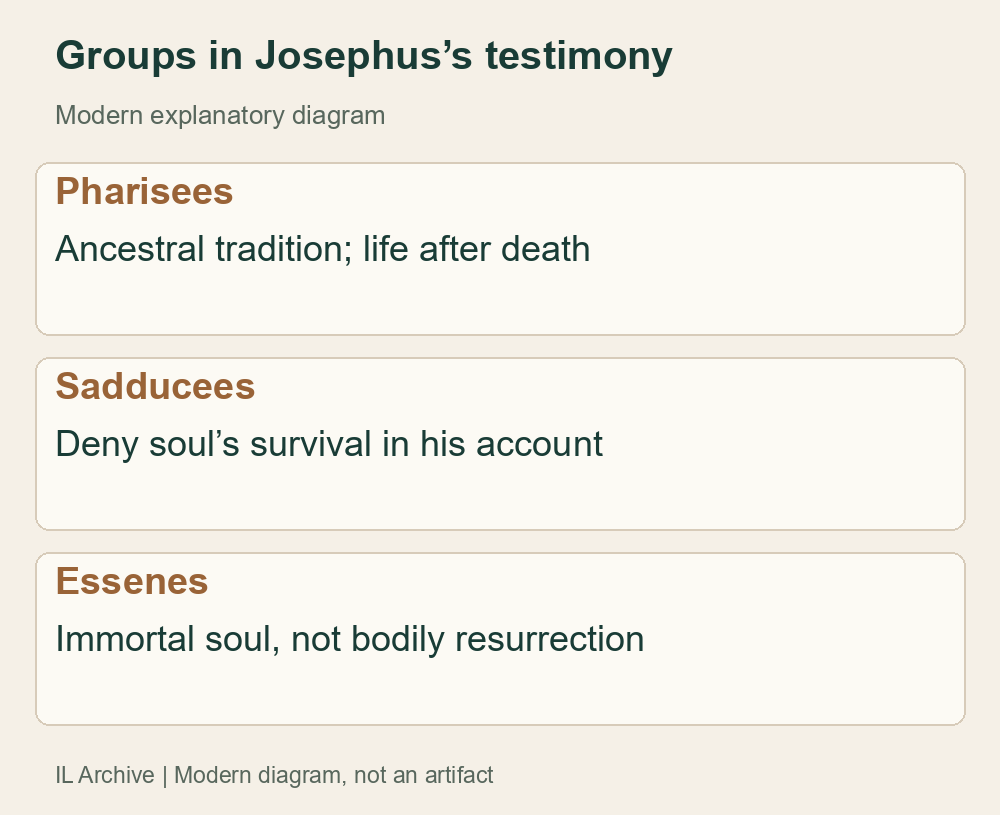
Josephus attributes ancestral traditions alongside written law to them, and hope beyond death. His Greek philosophical framing in Jewish War discourages equating every expression mechanically with bodily resurrectionResurrection of the deadThe dead returning to life, distinguished from soul immortality, with differing scope and form among texts.Glossary · Click to read the explanation. [1][2]
His account is important outside testimony, not a declaration by every member. The illustration is a modern comparison limited to that testimony.
References and notes
- Flavius Josephus, Jewish War 2.8; William Whiston translation, Perseus Digital Library. 2.8: souls, bodies and group comparison. Josephus’s Greek framing is his authorial choice. Return to the text ↑
- Flavius Josephus, Jewish Antiquities 13.10.6 (13.297–298); William Whiston translation, Perseus. Inherited observances, Pharisees and Sadducees; external report, not a Sadducean creed. Return to the text ↑
Research history
Substantive changes are retained here. Minor copy edits remain in the internal operational log.
-
Substantive record update
Suggest a correction · Suggest a source for this record
Cite this record
IL Archive, «Pharisees», Edition 2, https://ilarchive.com/en/entities/pharisees