Entity · Concept
Eschatology
A reference page linking a name, group, or concept to the materials that discuss it.
Eschatology: fate after death, resurrection of the dead, judgment and world renewal in Mesopotamian, Egyptian, Jewish, Iranian, Christian and Qur’anic witnesses, separating textual layers from hypotheses of influence.
Estimated reading time: 9 min Published Last reviewed:
Share article

Text
Introduction
What do we mean by eschatology? We might be asking about a person's fate after death, the resurrection and judgment of the dead, or the defeat of evil and renewal of the world. This article distinguishes these questions through specific evidence from MesopotamiaMesopotamiaHistorical region associated with the Tigris and Euphrates: Uruk, Ur, Eridu, cuneiform, Sumer, Akkad, Babylon and Assyria, their languages and cults, and the limits of archaeological evidence.Glossary · Click to read the explanation, ancient Egypt, Jewish and Iranian writings, early Christianity and the Qur'an. Its aim is to understand each witness on its own terms, rather than combine distinct traditions into one story about the “end of the world.”
These expectations do not form a single creed. A description of the underworld does not necessarily promise universal resurrection; a vision of cosmic disaster does not necessarily settle every individual's fate. Contacts between ancient Near Eastern societies are often historically established, but the date and direction of transmission of a particular religious image still require argument. [1][2]
Contents and route through the evidence
- The scope of eschatology: personal destiny, final judgment and cosmic renewal.
- Mesopotamian and Egyptian witnesses; HebrewHebrewA Northwest Semitic language of the Canaanite group, encompassing Iron Age epigraphy, Biblical, Rabbinic, medieval and Modern Hebrew; its scripts and pronunciations changed over time.Glossary · Click to read the explanation and early Jewish literature.
- Iranian textual layers, followed by Christian and Qur'anic passages.
- Historical comparison, levels of certainty and the limitations of images.
What does eschatology study?
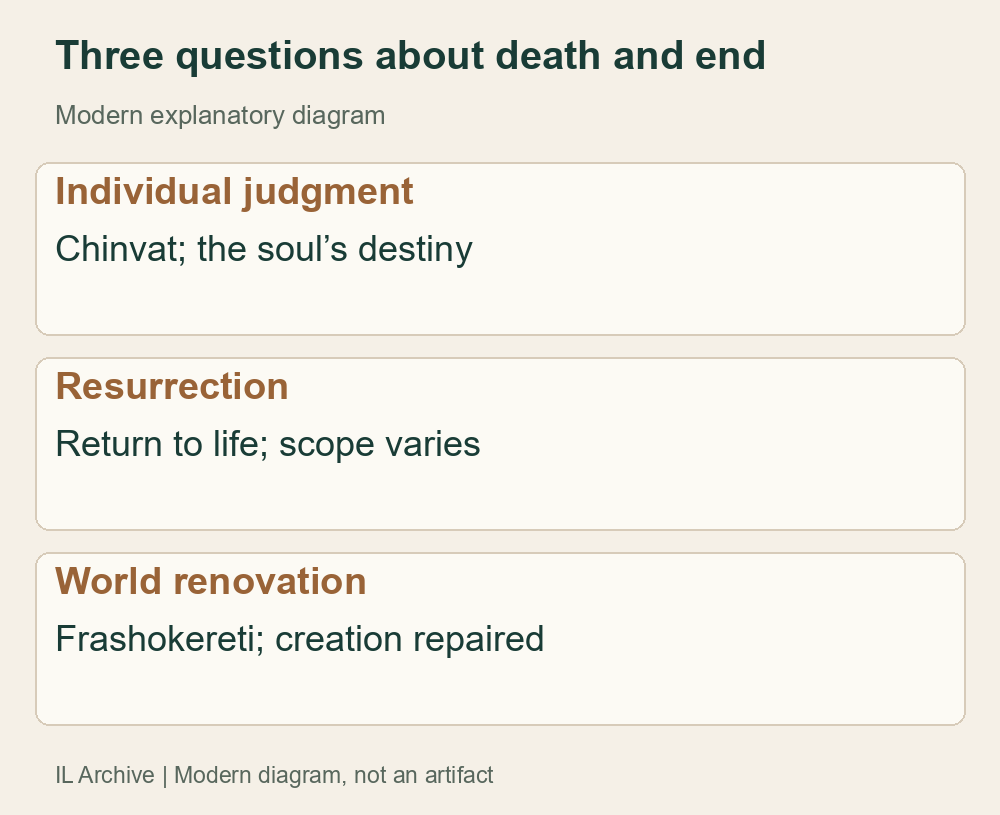
Eschatology is a modern analytical and theological term for questions about “last things”: death and what follows it, resurrection, recompense, the close of an era or of the world, and the transformation of existence. It is a comparative category, not a common doctrinal title used in every religion. Questions about what happens to one person after death fall under individual eschatology; those concerning humanity, history or creation as a whole belong to collective or cosmic eschatology.
It helps to distinguish survival after death, immortality of the soul, resurrection, in which the dead return to life, judgment according to conduct or divine decision, and world renewal. Some traditions connect these themes, but they need not form a prescribed sequence. Apocalyptic literatureApocalyptic literatureLiterary works narrating the disclosure of transcendent knowledge about heaven, history and destiny to a human seer, often by an angel; not every end-time belief or catastrophe prophecy is an apocalypse.Glossary · Click to read the explanation presents revelations of hidden or impending events; not every text concerned with the afterlife is apocalyptic. Shaul Shaked makes such distinctions in his study of Zoroastrian evidence, while C. D. Elledge investigates the varied reception of resurrection in early Judaism rather than positing one instantly completed doctrine. [1][2]
Mesopotamia: descent into the netherworld
In Sumerian literature, InanaInanna / IshtarA prominent Mesopotamian goddess whose Sumerian name Inanna became associated with Akkadian Ishtar across diverse traditions. She was associated with desire, war, royal authority and Venus, while local forms and genealogies varied among texts.Glossary · Click to read the explanation, known as Ishtar in AkkadianAkkadianAn ancient East Semitic language written in cuneiform from the third millennium BCE; its varieties include Babylonian and Assyrian, and it served in international diplomacy.Glossary · Click to read the explanation traditions, travels to a netherworld governed by her sister EreshkigalEreshkigalMesopotamian goddess ruling the netherworld; Inanna’s sister in descent texts, with varying accounts of her relationship with Nergal.Glossary · Click to read the explanation. The University of Oxford's Electronic Text Corpus of Sumerian Literature publishes a composite translation of Inana's Descent: the goddess reaches the gates, relinquishes insignia of status as she passes through, and her fate becomes a matter of divine intervention. The translation marks additions and variants between manuscripts. Its composite text is therefore not a verbatim transcription of one completely preserved tablet. [3]
The guarded realm ruled by a deity reveals ways some Mesopotamian writers imagined a boundary between life and death. It does not itself establish a universal resurrection of human beings or a moral trial equivalent to the Egyptian weighing of the heart. Ereshkigal is attested as a Mesopotamian ruler of the underworld; she is not securely identifiable with OsirisOsirisOsiris was an ancient Egyptian deity associated with the dead, life after death, renewal, and kingship. His roles appear in changing funerary texts, rituals, and judgment scenes, notably the weighing of the heart.Glossary · Click to read the explanation, nor with a universal “angel of death” shared across religions. [4]
Ancient Egypt: the heart, right order and continued existence
The Egyptian Book of the DeadEgyptian Book of the DeadA modern name for a variable collection of Egyptian funerary spells and images intended for the afterlife, not a single book with a fixed sequence.Glossary · Click to read the explanation is the modern name for sets of funerary spells and images whose selection and arrangement differ from manuscript to manuscript. A judgment scene before OsirisOsirisOsiris was an ancient Egyptian deity associated with the dead, life after death, renewal, and kingship. His roles appear in changing funerary texts, rituals, and judgment scenes, notably the weighing of the heart.Glossary · Click to read the explanation, preserved on a papyrus in the Metropolitan Museum of Art (66.99.142), includes a declaration of innocence and the weighing of the heart in relation to MaatMaatAn Egyptian principle of truth, justice, and right order, also embodied by the ostrich-feather goddess Maat; differently expressed in rule, ritual, and funerary judgment.Glossary · Click to read the explanation—right order, truth and justice, also personified as a goddess. The museum dates the particular papyrus to the Ptolemaic period, about 230–150 BCE. That is the date of this object, not the origin date of every Egyptian belief concerning judgment after death. [5]
An earlier funerary papyrus of Tiye, Metropolitan Museum 25.3.34, also depicts the weighing associated with spell 125. The museum dates it to approximately 975–945 BCE. Together these objects document the continuing importance of the theme and changes in its representation. They are not identical copies, and a deceased person's continued existence in the domain of Osiris must not automatically be called “cosmic resurrection” in the sense of other traditions. [6]
Hebrew writings: death, hope and the restoration of a people
The books of the Hebrew Bible do not speak with one voice about death. In some contexts SheolSheol: a Hebrew term for the realm of the deadHebrew word used for death, grave imagery and the abode of the dead in diverse texts; neither later punitive hell nor one specific physical tomb in every occurrence.Glossary · Click to read the explanation denotes descent into the realm of the dead and the loss of ordinary human agency. Ecclesiastes 9:2–10 stresses that death overtakes the righteous and the wicked alike and that the dead no longer work in the world of the living. This is the voice of a particular literary passage, not a demonstration that every Hebrew writer denied any hope beyond death. [7]
Ezekiel 37 employs the striking image of dry bones returning to life. The chapter itself, however, identifies the bones with “the whole house of Israel” and interprets their revival in terms of the people's restoration to their land. Treating the vision only as an unconditional promise of resurrection to every individual overlooks its own collective explanation. Isaiah 26:19 speaks poetically of the dead living and those in the dust awakening; how far that language implies literal personal resurrection, rather than a collective hope expressed in poetry, depends on its context and interpretation. [8][9]
Second Temple Judaism: resurrection and justice
In the Book of DanielBook of DanielA book combining court tales of wisdom and deliverance with visions of kingdoms and the future, formed in stages.Glossary · Click to read the explanation 12:1–3, many who sleep in the dust awaken, some to enduring life and others to lasting disgrace. The word “many” should not silently be changed to “everyone,” although later interpretation has debated how inclusive the passage is. The visions in the concluding part of Daniel belong to the context of persecution in the second century BCE. Events narrated as taking place in the Babylonian setting of Daniel's character do not date the composition of the entire book. [10][11]
In 2 Maccabees 7, brothers facing torture and death express confidence that God can raise them again. Resurrection here addresses justice for victims of persecution; it is not simply a claim that an immaterial soul survives bodily death. Yet Second Temple JudaismSecond Temple JudaismDiverse Jewish traditions between the rebuilding of Jerusalem’s temple around 515 BCE and its destruction in 70 CE: institutions, diaspora, groups and texts, with distinctions between events, composition, manuscripts and the limits of evidence.Glossary · Click to read the explanation encompassed varied responses to the question. The publisher's book abstract and a separate chapter abstract for Elledge's study describe the gradual growth, contested reception and reinterpretation of Jewish traditions under Hellenistic pressures. The complete book was not read for this review. [12][2]
Iranian traditions: the soul's passage and the renewal of creation
ZoroastrianismZoroastrianism: Hymns, Rituals and the Changing TraditionA living Iranian religious tradition examined through Avestan hymns, Middle Persian writings and royal inscriptions, separating textual evidence, later interpretation and hypotheses of influence.Glossary · Click to read the explanation is associated with ZoroasterZoroaster / ZarathustraFoundational figure associated with Zoroastrian tradition and the Old Avestan Gathas. His priestly role, teaching and relationship to the poems are subjects of research; his lifetime and biographical details remain disputed.Glossary · Click to read the explanation and the AvestaAvestaThe Zoroastrian sacred corpus in Old and Younger Avestan, containing hymns, liturgy and prayers transmitted orally before later manuscript copying.Glossary · Click to read the explanation, a body of texts with different layers and histories of transmission. Its traditions discuss both the fate of a soul after death and the ultimate transformation of creation. The Chinvat BridgeChinvat BridgeThe crossing associated with the soul’s judgment after death in Zoroastrian tradition. Named in the Gathas, it receives fuller descriptions of guardians, weighing and unequal passage in later texts; it is distinct from resurrection and world renovation.Glossary · Click to read the explanation is a passage that souls must cross; later Middle Persian sources elaborate varying descriptions of its crossing. References to the bridge in the Gathas do not demonstrate that every detail about its width or narrowness in later writings was already fixed in that earliest layer. [13]
Almut Hintze examines frašō.kərətiFrashokereti: final renovationCreation’s completion or renovation in Iranian tradition, linked to incorruptible life and evil’s retreat.Glossary · Click to read the explanation, often rendered “renovation” or “making existence excellent.” She distinguishes Gathic allusions, including Yasna 30.9, from fuller descriptions in the Younger Avestan Yasht 19, and from later narrative constructions in Pahlavi books such as the BundahishnBundahishnThe Bundahishn is a Middle Persian Zoroastrian work on creation, the world and its final renovation.Glossary · Click to read the explanation. Yasht 19 envisages the defeat of corruption and a return of the dead to life; later writings set out a far more elaborate process of resurrection and purification. Reading the full later sequence back into an early Avestan hymn would erase differences of date, language and genre. Equally, the age of a surviving manuscript is not the birth date of every idea it contains. [14]
Early Christianity: the dead raised and a new creation
First Corinthians 15 presents Christ's resurrection as the basis for hope in the resurrection of the dead. Paul also discusses the difference between mortal embodiment and the transformed condition of the resurrected body. This is an argument addressed to a first-century Christian community, not a simple repetition of either Egyptian heart-weighing or the Iranian bridge. Later Christian traditions have disagreed about the timing and nature of final events; this does not alter the identity of Paul's particular witness. [15]
Revelation 20 describes resurrection, judgment and opened books; Revelation 21:1–5 then presents a new heaven and a new earth in which death and mourning disappear. This is a sequence of visions in one apocalyptic text, not a universally agreed timetable within Christianity. The renewal of creation must also be distinguished analytically from the fate of a person immediately after death, even where later theological accounts relate them. [16][17]
The Qur'an: resurrection, reckoning and the Hour
Qur'an 22:7 explicitly announces the coming of the Hour and God's raising those in the graves. Qur'an 39:68–70 depicts the trumpet blast, people standing again and just judgment. Qur'an 99:6–8 emphasizes the disclosure of human deeds, however small. These are the passages themselves, not an attempt to reconstruct every development found in subsequent hadith collections, commentaries or systematic theology. [18][19][20]
Some of this vocabulary resonates with older language about justice, destiny and cosmic change, yet it belongs to a Qur'anic discourse with distinctive aims, notably responding to denials of resurrection and relating moral responsibility to recompense. A shared word such as “scales,” or an image of people rising, does not identify a particular Egyptian papyrus or a late Pahlavi work as its direct source. Historical relationships call for evidence about language, chronology and plausible contacts. [18][20]
Did these beliefs travel between traditions?
Shaul Shaked argues that Iranian-Jewish contact during imperial rule and the Second Temple period, together with a cluster of similarities in judgment and renovation, makes substantial Iranian influence likely. He also acknowledges a major chronological difficulty: the most complete Iranian formulations are preserved in Pahlavi sources later than important Jewish witnesses. His proposal is a documented scholarly argument, not a sequence of borrowings dated by direct surviving records. [1]
Elledge, by contrast, assesses proposals for external influence, internal development and combinations of the two. His account relates the evolving discourse of resurrection to persecution, justice and reinterpretation in the Hellenistic and Roman worlds. The abstracts actually consulted do not prove the route of any individual image or verse. They do, however, counsel against the false choice between total direct copying and complete cultural isolation. Political proximity and multilingual exchange enable contact but cannot alone determine who transmitted each motif to whom. [2]
How can we assess the evidence?
First ask: What does this particular source say? The Metropolitan Museum's papyrus 66.99.142 documents one Egyptian funerary scene and its approximate production date, not the beliefs of all societies. Daniel 12 speaks of “many” awakening in a work whose composition history differs from the era of its protagonist. Early and later Iranian texts must be separated by layer. And the Oxford translation of Inana's descent represents a critical composite, not a photograph or unmediated reading of one tablet. [3][5][11][14]
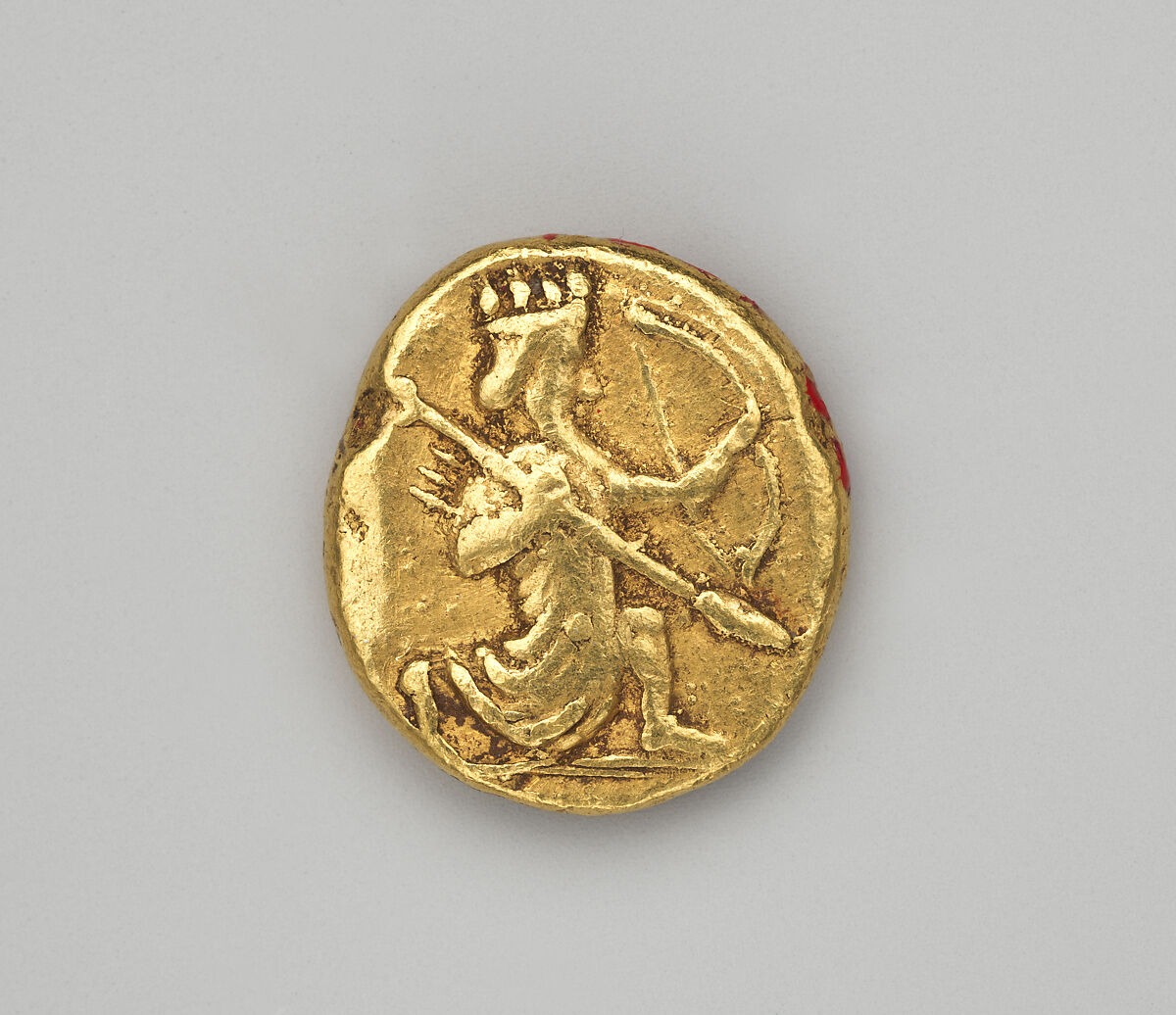
Next ask: What exactly is being compared? Individual judgment, resurrection and world renewal can be compared without becoming a single ritualRitualAn organised or distinguished practice meaningful to a community; it may leave traces, but its form alone does not reveal an associated doctrine.Glossary · Click to read the explanation. The narrated setting, composition date and manuscript date may differ; so may an original source, its edition and a modern scholar's inference. The supporting diagram in this article poses three conceptual questions rather than charting inevitable stages. Its expressive cover is a modern AI-generated illustration, neither an archaeological find nor an authenticated historical reconstruction.
Conclusion
Eschatology brings into view human questions about death, injustice, continued life and the destiny of creation. Yet a Mesopotamian netherworld, an Egyptian weighing of the heart, Jewish hopes of resurrection, Iranian renovation, and Christian and Qur'anic passages do not give interchangeable answers. A responsible comparison retains their differences: it identifies the text or object, dates the available witness, distinguishes the text's assertion from an interpretation, and discusses possible historical connections without deciding their direction in advance.
References and notes (20)
- Shaul Shaked, “Eschatology i. In Zoroastrianism and Zoroastrian Influence,” Encyclopaedia Iranica, vol. VIII (1998). Sections “General Observations,” “Historical Survey” and “Zoroastrian Influence”; Pahlavi dating caveat. Return to the text ↑
- C. D. Elledge, Resurrection of the Dead in Early Judaism, 200 BCE–CE 200, Oxford University Press, 2017. Publisher book abstract and the abstract of chapter 3, “Origins, Contexts” (chapter is pp. 44–65; full chapter not read). Return to the text ↑
- University of Oxford, Electronic Text Corpus of Sumerian Literature (ETCSL), “Inana’s Descent to the Nether World,” composite English translation, text 1.4.1. Composite English translation, lines 1–143 and marked manuscript variants; Sumerian not read independently. Return to the text ↑
- ORACC (University of Pennsylvania), Ancient Mesopotamian Gods and Goddesses, “Ereškigal (goddess).” Entry introduction and sections on functions and relationships. Return to the text ↑
- The Metropolitan Museum of Art, “Part of a funerary papyrus showing the judgment before Osiris,” object 66.99.142 (ca. 230–150 BCE). Object description, judgment scene, date, accession and public-domain designation. Return to the text ↑
- The Metropolitan Museum of Art, “Book of the Dead Papyrus of Tiye,” object 25.3.34 (ca. 975–945 BCE). Object description, spell 125 and accession date; restricted image not reused. Return to the text ↑
- Ecclesiastes (Qohelet) 9:2–10, New American Bible Revised Edition, USCCB online text. Ecclesiastes 9:2–10 in the published NABRE English translation; Hebrew not collated. Return to the text ↑
- Ezekiel 37:1–14, New American Bible Revised Edition, USCCB online text. Ezekiel 37:1–14, especially the identification of the bones in 37:11–14. Return to the text ↑
- Isaiah 26:19, New American Bible Revised Edition, USCCB online text. Isaiah 26:19 and chapter context in English translation; Hebrew not collated. Return to the text ↑
- USCCB, Introduction to the Book of Daniel, New American Bible Revised Edition. Introduction: composition during the persecution of Antiochus IV, 167–164 BCE. Return to the text ↑
- Daniel 12:1–3, New American Bible Revised Edition, USCCB online text. Daniel 12:1–3, especially “many”; English translation inspected, not the Hebrew/Aramaic originals. Return to the text ↑
- 2 Maccabees 7:9–14, 23, New American Bible Revised Edition, USCCB online text. 2 Maccabees 7:9–14, 23; martyrs’ expressed hope for resurrection. Return to the text ↑
- Aḥmad Tafażżolī, “Činwad Puhl,” Encyclopaedia Iranica, vol. V (1991). Bridge entry, Yasna 46 and 51, Videvdad 19 and distinct Middle Persian descriptions. Return to the text ↑
- Almut Hintze, “Frašo.kərəti,” Encyclopaedia Iranica, vol. X (2000). “Allusions in the Gathas,” “Younger Avesta,” and “Pahlavi Books”; Hintze on Yasna 30.9 and Yasht 19, not an independent Avestan reading. Return to the text ↑
- 1 Corinthians 15:3–28, 35–54, New American Bible Revised Edition, USCCB online text. 1 Corinthians 15:3–28 and 35–54 in English translation; Greek not collated. Return to the text ↑
- Revelation 20:4–15, New American Bible Revised Edition, USCCB online text. Revelation 20:4–15, resurrection, books and judgment; English translation. Return to the text ↑
- Revelation 21:1–5, New American Bible Revised Edition, USCCB online text. Revelation 21:1–5, new creation and death no more; English translation. Return to the text ↑
- Qurʾan 22:7 (Sūrat al-Ḥajj), Arabic verse and accompanying English translation, Quran.com. Sūrat al-Ḥajj 22:7, displayed Arabic text and English translation; no later commentary relied upon. Return to the text ↑
- Qurʾan 39:68–70 (Sūrat al-Zumar), Arabic verse and English translation, Quran.com. Sūrat al-Zumar 39:68 in Arabic and English, with 39:69–70 in the displayed English context. Return to the text ↑
- Qurʾan 99:6–8 (Sūrat al-Zalzala), Arabic verses and English translation, Quran.com. Sūrat al-Zalzala 99:6–8, displayed Arabic and English. Return to the text ↑
Suggest a correction · Suggest a source for this record
Cite this record
IL Archive, «Eschatology», https://ilarchive.com/en/entities/eschatology
Continue reading