Entity · Literary genre
Apocalyptic literature
A reference page linking a name, group, or concept to the materials that discuss it.
A modern literary category for narrated disclosure of heavenly or historical mysteries through visions and mediators; tested against Daniel, Enoch, 4 Ezra, 2 Baruch and Revelation while separating eschatology, chronology and manuscripts.
Estimated reading time: 9 min Published Last reviewed:
Share article

Text
Introduction
Apocalyptic literature is a modern critical designation for writings that narrate a human recipient’s access to knowledge unavailable through ordinary observation: the heavens are disclosed, or a crisis in history and humanity’s destiny are interpreted through a dream, vision, or otherworldly messenger. A narrative may join an unseen celestial realm to a hoped-for future; yet neither a catastrophe nor the prediction of an age’s end automatically makes a work an apocalypse.
This entry tests the category against ancient Jewish and Christian witnesses, distinguishing the time represented in a story from the time of composition and the date of a surviving manuscript. It also separates what the received text says from modern reconstructions of its formation, without imposing one model on every work. [3][13]
The name and the limits of the category
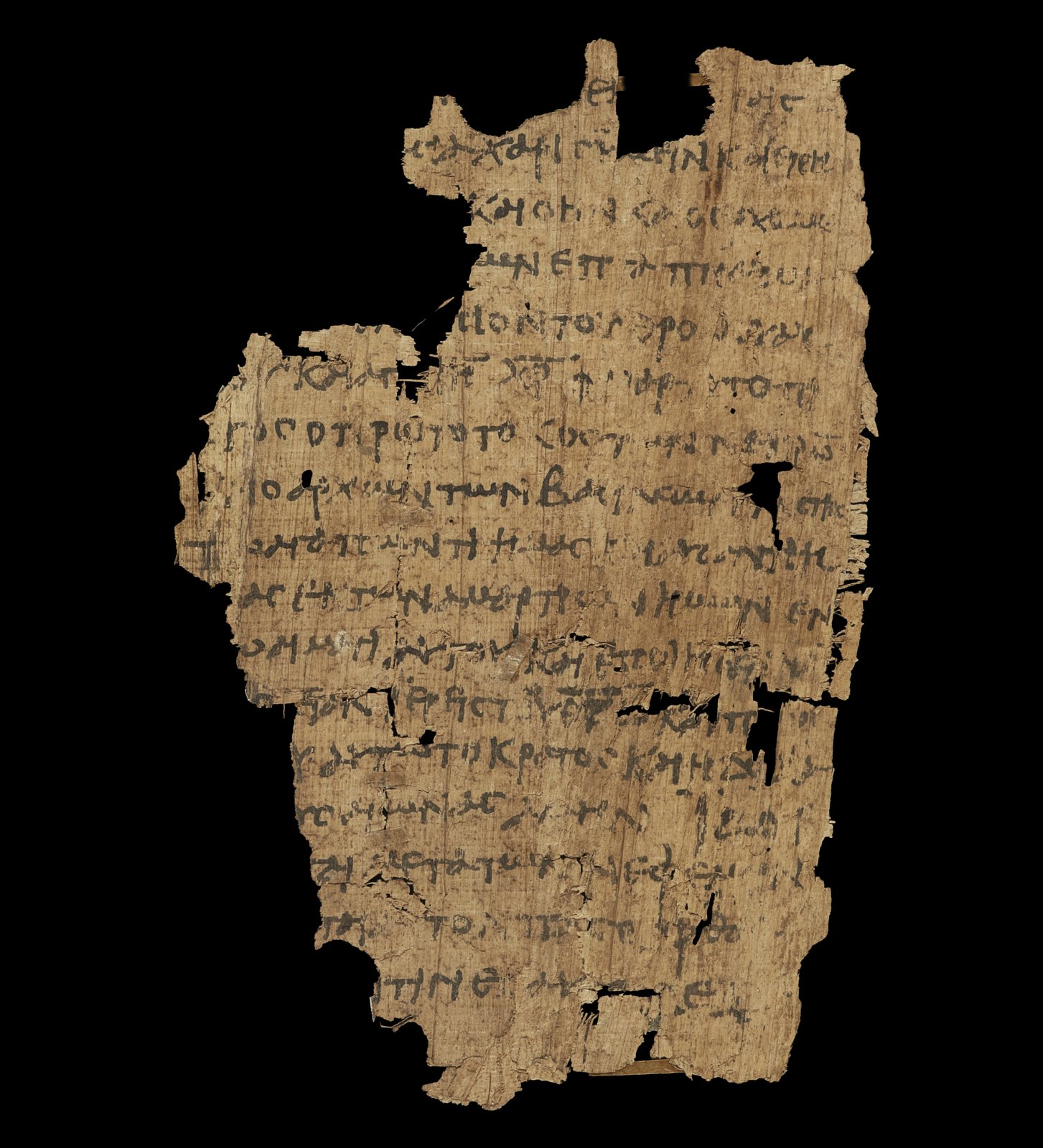
The scholarly term derives from Greek apokalypsis, an uncovering or disclosure of what was concealed. The word opens the Christian Book of RevelationBook of RevelationChristian apocalypse commonly dated in its present form to the late first century CE, reusing earlier scriptural imagery.Glossary · Click to read the explanation, but its ancient occurrence does not mean the writers of Daniel and Enoch identified their works as members of one genre called “apocalyptic literature.” The following is from a printed Greek text of the opening of Revelation, not from a particular manuscript: [11]
Our translation is “Revelation of Jesus Christ” (Rev 1:1). The Greek genitive can suggest disclosure coming from Jesus or disclosure concerning him; the phrase does not itself define the whole literary category.
Scholars distinguish an apocalypse, a narrative literary form, from apocalypticism, a worldview that interprets history and the cosmos in light of transcendent knowledge, and from eschatology, conceptions of judgment, resurrection, or cosmic renewal. Eschatological material can appear in an oracle, letter, or testament without an account of heavenly revelation. Prophecy and apocalypse are not watertight opposites either: Revelation calls itself “prophecy” at 1:3. [3][13]
How revelation becomes a narrative
In the landmark 1979 Semeia 14 genre project led by John J. Collins, an apocalypse is characterized by a narrative framework in which a supernatural being mediates a disclosure to a human recipient. What is disclosed exceeds ordinary experience along two axes: the temporal, concerning the course of history and salvation, and the spatial, concerning otherworldly places and beings. This is a modern comparative instrument, not an ancient checklist signed by the writers themselves. [3]
Modes of disclosure vary: a dream of symbolic beasts requiring explanation; an ascent into heaven; a tour revealing celestial bodies and angels; an exchange in which an intermediary answers the seer’s protests; or instructions to record and preserve a disclosure until an appointed time. A renowned figure of the past may be made the narrator—pseudonymous attribution—but an old narrative name does not date the writing of every section. No single work contains all these features, and an “end” may mean the collapse of an oppressive regime rather than the disappearance of the universe. [5][13]
Chronological bearings: narrative, composition, copy
- About the third century BCE, perhaps earlier for some units: early Enochic compositions develop, including the Book of the WatchersBook of the WatchersOpening unit of 1 Enoch (chapters 1–36), concerning the Watchers’ descent, offspring and judgment, Enoch’s mission and cosmic journeys; a composite work with multiple textual witnesses.Glossary · Click to read the explanation and materials on the movements of the heavenly lights. This is not a composition date for all of 1 EnochFirst EnochA composite Second Temple Jewish apocalyptic collection on the Watchers, parables, celestial cycles, historical visions, and judgment, preserved complete in Geʽez.Glossary · Click to read the explanation. [5]
- Approximately 200–150 BCE: the Aramaic Enoch parchment fragments designated 4Q201, among the manuscripts discovered at QumranQumranArchaeological site northwest of the Dead Sea near manuscript caves; its settlement and the groups who deposited the scrolls are studied together but not assumed identical. It is not synonymous with all Dead Sea Scrolls.Glossary · Click to read the explanation, are copied. The estimate dates a physical witness and proves some material was circulating; it does not date the whole collection. Its range overlaps the next event. [6]
- About 167–164 BCE: the later visions of Daniel are generally placed against the crisis under Antiochus IV and conflict over worship in JerusalemJerusalemJerusalem is a city of religious importance in Judaism, Christianity and IslamGlossary · Click to read the explanation, although the story locates the seer centuries earlier in Babylonia and Persia. [2]
- Following the Roman destruction of Jerusalem in 70 CE, especially the late first and early second centuries: the setting in which 4 Ezra and 2 Baruch took shape becomes intelligible. Christian Revelation is commonly dated to the late first century, with important details disputed. [7][10][12]
These are approximate dates for different works and strata, not a single evolutionary sequence culminating inevitably in the Christian book. A late translation or manuscript cannot itself establish the initial composition date of an older work.
Daniel: imperial beasts and historical time
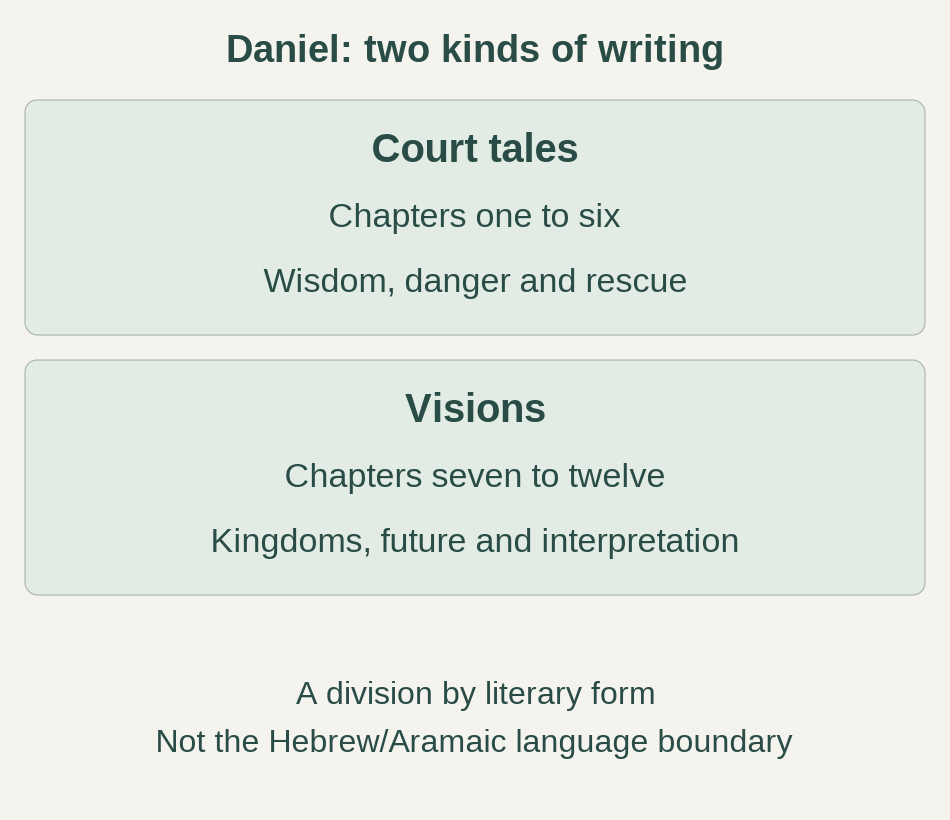
The Book of DanielBook of DanielA book combining court tales of wisdom and deliverance with visions of kingdoms and the future, formed in stages.Glossary · Click to read the explanation joins court narratives (chapters 1–6) to visions (7–12). The tales are situated under Babylonian rulers, but the detailed references in chapter 11 to struggles involving Seleucid and Ptolemaic dynasties, and their close fit with the Antiochus IV crisis, support locating the visionary section in the second century BCE, particularly about 167–164. The court traditions are usually thought to have an earlier history, although their formation and compilation remain debated. The date when Daniel supposedly speaks is not simply the date the visions were written. [2]
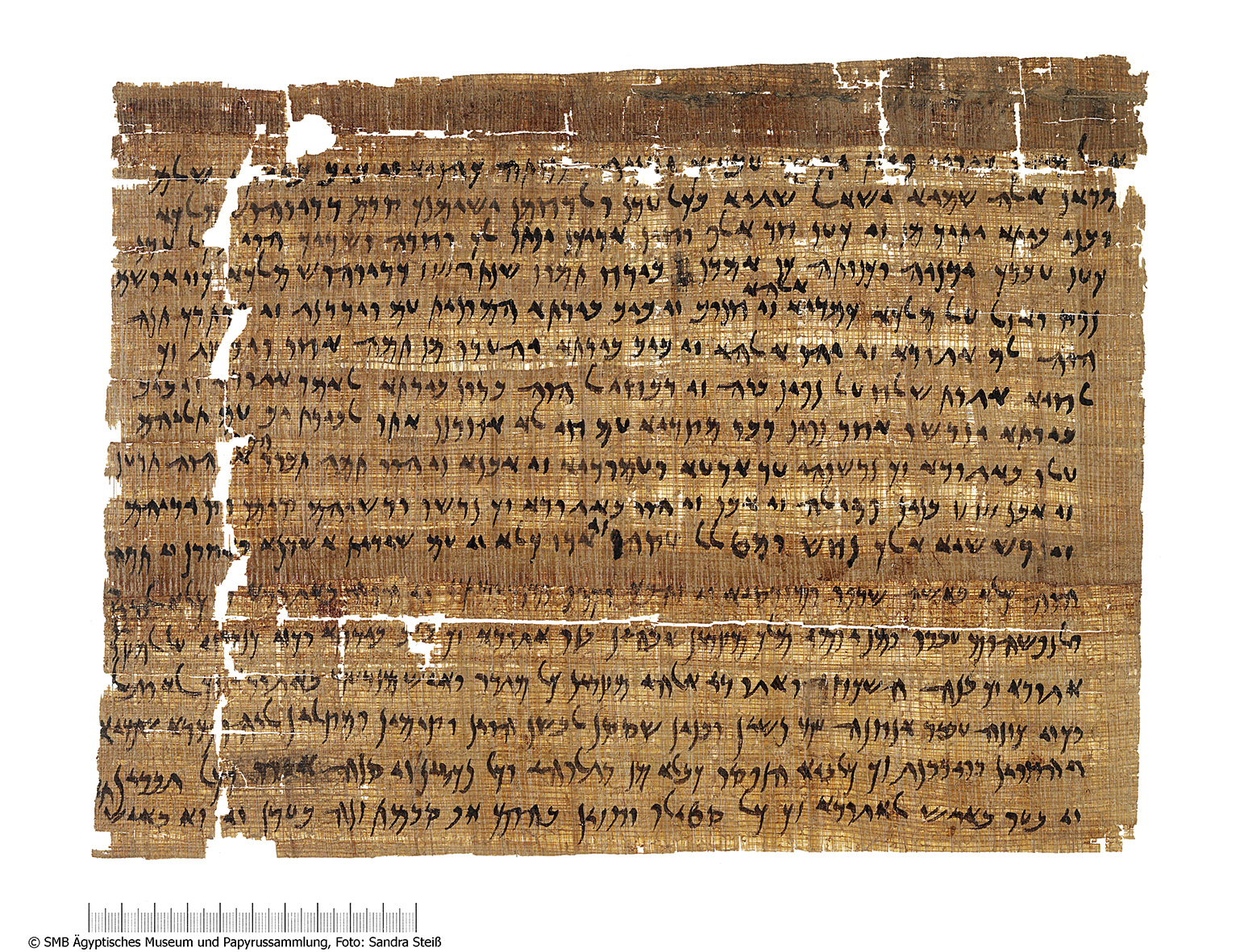
In chapter 7, terrifying beasts rise from the sea as images of kingdoms. Against them a different figure appears. An excerpt from 7:13 in the printed Masoretic Aramaic text reads: [4]
Our translation: “And there, with the clouds of heaven, one like a human being was coming.” That line alone does not settle the figure’s identity. The text itself interprets the beasts as kings and says that the “holy ones of the Most High” receive the kingdom (7:16–18). A corporate reading of the figure therefore has support from the vision’s internal interpretation; individual or messianic readings appeal to additional textual clues and later interpretive traditions. Those distinct levels of evidence must not be conflated. Daniel 12:2, meanwhile, envisages the awakening of some who sleep in the dust, within a promise of vindication after oppression. [4]
Enoch: more than one kind of heavenly knowledge
First EnochFirst EnochA composite Second Temple Jewish apocalyptic collection on the Watchers, parables, celestial cycles, historical visions, and judgment, preserved complete in Geʽez.Glossary · Click to read the explanation is a compilation, not a book composed in one sitting. It survives complete in the Ethiopic tradition, while earlier Greek and Aramaic witnesses preserve parts of it. Within its stories revelation is credited to EnochEnoch son of JaredEnoch son of Jared is a figure in the genealogy of Genesis 5, seventh when counted from Adam.Glossary · Click to read the explanation, the antediluvian figure of Genesis 5. The Book of the Watchers (1 Enoch 1–36) brings stories of descending angels and illicit knowledge into the seer’s journey and vision of the divine throne. The Dream Visions (83–90) retell a people’s history through animals and flocks. The Book of the Luminaries (72–82) also treats the movements and calendar of heavenly bodies; not every constituent composition is chiefly a prediction of final catastrophe. [1][5]
Michael E. Stone’s close comparison shows differences between the way Enoch receives revelation in the Book of the Watchers and in the Dream Visions, rather than presuming a uniform visionary narrator. Annette Yoshiko Reed examines how the Watchers tradition brings Enoch from Genesis 5 together with the sons of God from Genesis 6 in a layered literary construction. This helps explain a received composition; a publisher’s summary alone cannot establish the exact date of each passage. [1][5]
The Aramaic fragments 4Q201 are significant physical evidence, but they are not the “complete original” of the collection. Nor can they by themselves date the Enochic Parables, for which no Aramaic copy has been identified among the Qumran finds. The composition of a section, the compilation of sections, and the surviving copies must be considered separately. [5][6]
After Jerusalem’s destruction: 4 Ezra and 2 Baruch
4 Ezra speaks in the name of the biblical Ezra, a character associated with an earlier exile and the ruined Jerusalem of the story, yet its agonized questions about divine justice and victorious oppressors take on particular force after Rome destroyed Jerusalem in 70 CE. The angel Uriel answers the seer; a mourning woman becomes the vision of a city; a many-winged eagle is interpreted as part of a succession of kingdoms. Dialogue, interpretation, and disclosed destinies here belong to a literary vision, not a first-hand diary of a historical Ezra. [7][8]
Its naming requires care. 4 Ezra is the Jewish core, chapters 3–14, of what some English editions call 2 Esdras; chapters 1–2 and 15–16 are separate Christian additions. The presumed ancient source language is no longer extant, and the work survives through translations, especially Latin and other ancient versions. Chapter 7 provides a tangible warning: seventy verses disappeared from many known Latin copies and were recovered in a manuscript found in the nineteenth century, which explains divergent verse numbering between older and modern editions. One cannot present a surviving translation as a HebrewHebrewA Northwest Semitic language of the Canaanite group, encompassing Iron Age epigraphy, Biblical, Rabbinic, medieval and Modern Hebrew; its scripts and pronunciations changed over time.Glossary · Click to read the explanation original personally checked. [7]
2 Baruch, or the SyriacSyriacAn Aramaic literary language rooted in Edessa, first attested in non-Christian inscriptions and later prominent in Christian writing, scholarship, translation and liturgy.Glossary · Click to read the explanation Apocalypse of Baruch, casts Jeremiah’s scribe Baruch amid the Babylonian ruin of Jerusalem in the sixth century BCE. Its Jewish composition, however, is understood in the light of the Roman destruction of 70 CE. In chapters 36–40 a dream of a forest, vine, and cedar is followed by interpretation; chapters 49–51 consider the form of bodies after resurrection. The Syriac version by which the work became known, along with fragmentary witnesses in other languages, must be distinguished from any reconstructed earlier text. [9][10]
Christian Revelation: apocalypse, prophecy, and letter
The Book of Revelation addresses seven assemblies in cities of Roman Asia (chapters 1–3) and says that disclosure reached John through an angel (1:1). Scenes of the throne, seals, imperial beasts, judgment, and a new city then unfold. The book is more than an “end of the world”: it is also a symbolic critique of power, a source of hope, and writing directed to identifiable contemporary communities. It calls itself “prophecy” (1:3) and repeatedly reworks imagery found in Daniel, Ezekiel, and other earlier writings. [11][12]
A late-first-century date is common in scholarship, although its precise chronology and political circumstances are debated. BabylonBabylonBabylon is an ancient city in central present-day Iraq, south of BaghdadGlossary · Click to read the explanation and the beast can be interpreted against Roman imperial power, but this does not by itself demonstrate a universal state-directed persecution under a named emperor. The text’s rhetoric and independent evidence of Roman policy must be weighed separately. Nor would a much later Christian picture of the visions document what happened in the first century. [12]
Borderline cases and comparison across traditions
Borderline writings test the definition. JubileesBook of JubileesJewish retelling of Genesis and Exodus framed as angelic teaching to Moses, adding chronology, narratives and interpretation.Glossary · Click to read the explanation transmits information to MosesMosesCentral figure in Exodus, Torah traditions and the Qur’an; childhood accounts differ in detail.Glossary · Click to read the explanation through an angel, yet whether it qualifies as an apocalypse remains disputed. Qumran’s War ScrollWar ScrollDead Sea Scroll text portraying war between the sons of light and the hostile camp; its principal copy is designated 1QM.Glossary · Click to read the explanation envisages an end-time conflict without consistently adopting the narrative disclosure to a human seer familiar from Daniel. Ezekiel’s prophetic visions offer influential imagery of the heavenly realm, but not every prophecy involving angels is thereby an apocalypse. In a 2025 intervention, Lorenzo DiTommaso argues that the formal definition cannot by itself settle every broader use of the word apocalyptic; that is not to deny its value for comparing literary forms. [13]
Parallels have also been proposed between Jewish texts and Iranian traditions in accounts of angels, divided historical ages, cosmic conflict, and judgment. Do these prove borrowing? A general resemblance is insufficient. Arguments need independently dated witnesses, plausible channels of contact, a distinctive pattern not easily explained by parallel development, and a defensible direction of transmission—especially since many Iranian texts survive in later recensions. Even the Encyclopaedia Iranica discussion recognizes difficulties in dating and competing explanations for particular motifs. “Iranian influence” should therefore be treated as a testable hypothesis rather than an automatic inference. [14]
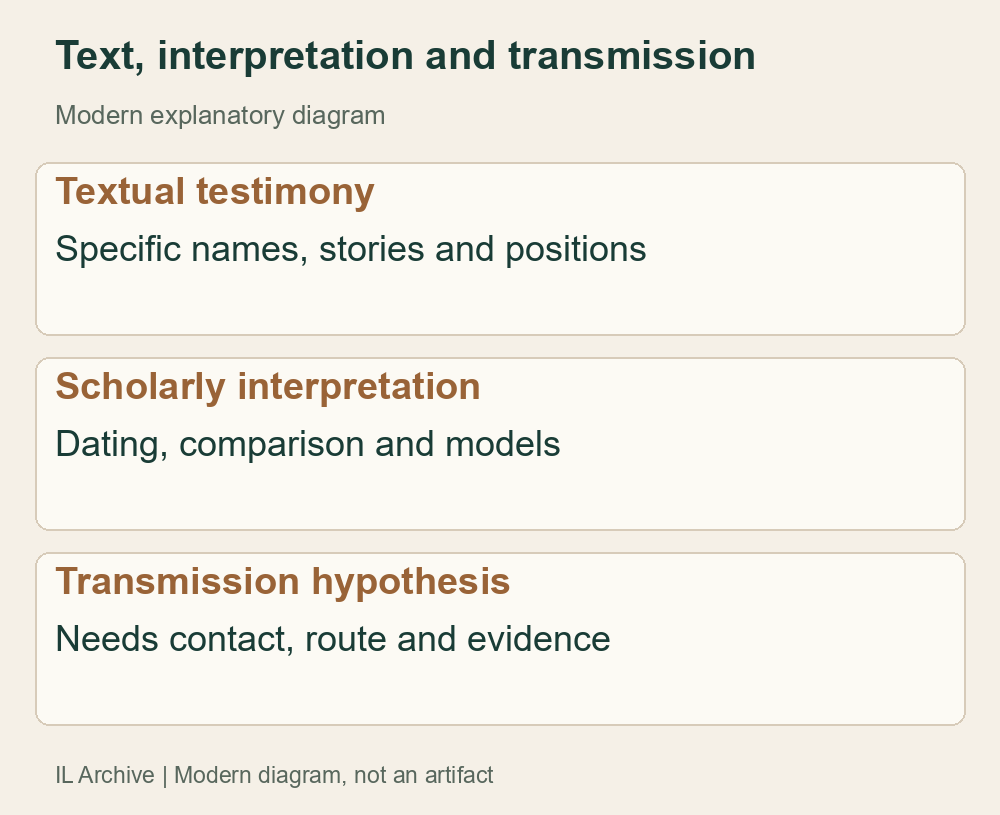
This is a modern editorial diagram, separating the textual witness, scholarly interpretation, and a proposed chain of transmission; it is not a fragment of an ancient apocalypse. Apocalyptic literature is ultimately a way of narrating disclosure as much as a way of thinking about an end. Its messenger, temporal and heavenly horizons, and promises to readers vary from work to work.
References and notes (14)
- Annette Yoshiko Reed, “Angelic Descent and Apocalyptic Epistemology,” in Fallen Angels and the History of Judaism and Christianity (Cambridge University Press, 2005), pp. 24–57. Publisher summary and chapter 1 metadata (print pp. 24–57) only, not the entire chapter; links Genesis 5 and 6 in the formation of the Watchers book. Return to the text ↑
- Carol A. Newsom, “Daniel,” Oxford Bibliographies in Biblical Studies (Oxford University Press, 2010). Read the accessible Oxford Bibliographies introduction only, not the full bibliography; tales 1–6, visions 7–12 and approximate Maccabean date. Return to the text ↑
- John J. Collins (ed.), Apocalypse: The Morphology of a Genre, Semeia 14 (Society of Biblical Literature, 1979). Publisher's online preview: displayed extracts attributed to print pages 3, 5–6 and 10; not the complete essay. Return to the text ↑
- Book of Daniel, Masoretic Aramaic (7:13–18) and Hebrew (chapters 11–12), Mechon-Mamre parallel edition. Directly inspected Daniel 7:1–18, 11:1–45 and 12:1–13 in the displayed Masoretic text; the Aramaic quotation is 7:13, not a Qumran manuscript transcription. Return to the text ↑
- Michael E. Stone, ‘Enoch’s revelations?’, Journal for the Study of the Pseudepigrapha 31.4 (2022), DOI:10.1177/09518207211059490. Full open article read, especially the five-composition overview and comparisons of 1 Enoch 1–36 and 83–90 and their modes of revelation. Return to the text ↑
- Library of Congress, ‘The Enoch Scroll’, Scrolls from the Dead Sea exhibition (1993), 4Q201 (En ar a), Israel Antiquities Authority credit. Directly read institutional exhibit caption identifying the parchment, its estimated copying date of 200–150 BCE and the fragment's scope; its photograph is not reused because image rights were not established. Return to the text ↑
- Roger A. Bullard and Howard A. Hatton, A Handbook on 1–2 Esdras (UBS Helps for Translators, 2019), ‘Translation introduction to 2 Esdras’, hosted by TIPs. Read institutional translator's introduction: parts 1–2, 3–14, 15–16, lost languages, Latin editions and restoration of chapter 7:36–105 in 1874; no claim to have inspected Klijn's edition. Return to the text ↑
- G. H. Box, ‘4 Ezra’, in R. H. Charles (ed.), The Apocrypha and Pseudepigrapha of the Old Testament (1913), digitized English translation at Tianmu. Read digital English translation and editorial apparatus for selected passages: 3:1–25, 9:26–10:59, 11–12 and 13:1–13, plus online introduction; not a reading of the lost Hebrew/Greek or print copy. Return to the text ↑
- R. H. Charles, ‘The Book of the Apocalypse of Baruch the Son of Neriah or 2 Baruch’, historical English translation, Wesley Center, Northwest Nazarene University. Read available English translation at sections 34–40, 48:1–25 and 49–51; no direct reading of Syriac or critical Syriac edition. Return to the text ↑
- Matthias Henze, ‘Second Baruch’, Oxford Bibliographies in Biblical Studies, Oxford University Press (2015; updated 2024). Published introduction/extract only: late-first-century composition contrasted with the sixth-century-BCE Babylonian narrative setting; not the complete annotated bibliography. Return to the text ↑
- Revelation 1:1–3, printed Greek critical text of Westcott and Hort (1881/1885, Perseus) compared with SBLGNT (2010) on Bible Gateway. Read printed Greek of 1:1–3 and checked opening against the modern SBLGNT display; the three-word quotation does not purport to transcribe an individual manuscript. Return to the text ↑
- Leonard L. Thompson, The Book of Revelation: Apocalypse and Empire (Oxford University Press, 1990). Publisher overview and available chapter abstract only; no claim of reading the full book. Supports caution in interpreting imperial rhetoric and assumed persecution. Return to the text ↑
- Lorenzo DiTommaso, ‘Apocalypses and apocalyptic: A response to Benjamin E. Reynolds’, Journal for the Study of the Pseudepigrapha 34.4 (2025), DOI:10.1177/09518207251338010. Read full open article, especially discussion of the 1979 genre definition, false positives/negatives, eschatology and examples of Jubilees and the War Scroll. Return to the text ↑
- John C. Reeves, ‘Enoch, Books of’, Encyclopaedia Iranica VIII.5 (1998), pp. 453–455; updated 2013. Read online article, especially its opening on 1 Enoch, proposed Iranian parallels, dating issues and alternative Mesopotamian readings; no conflation with 2 Enoch. Return to the text ↑
Suggest a correction · Suggest a source for this record
Cite this record
IL Archive, «Apocalyptic literature», https://ilarchive.com/en/entities/apocalyptic-literature
Continue reading