Entity · Group of deities
Amesha Spentas
A reference page linking a name, group, or concept to the materials that discuss it.
Six sacred ethical and ritual beings in Zoroastrian traditions, sometimes counted with Ahura Mazda as seven; they cannot simply be equated with Jewish angels.
Estimated reading time: 3 min Published Last reviewed:
Share article

Text
Introduction
The Amesha Spentas are “holy” or “bounteous immortals” in Zoroastrian tradition. The question is not merely their number, but how expressions of ethical value also function as divine beings associated with Ahura Mazda and ritualRitualAn organised or distinguished practice meaningful to a community; it may leave traces, but its form alone does not reveal an associated doctrine.Glossary · Click to read the explanation care for creation—and how far comparisons with other heavenly beings can legitimately go. [1]
Terms and textual strata
The six names appear in the Gathas, old Avestan hymns traditionally attributed to ZarathustraZoroaster / ZarathustraFoundational figure associated with Zoroastrian tradition and the Old Avestan Gathas. His priestly role, teaching and relationship to the poems are subjects of research; his lifetime and biographical details remain disputed.Glossary · Click to read the explanation, but the collective expression Amesha Spenta is not found there in that form. Yasna 39.3 provides an early occurrence of the words in reversed order, Spenta Ameshas. The Gathas, the Younger AvestaAvestaThe Zoroastrian sacred corpus in Old and Younger Avestan, containing hymns, liturgy and prayers transmitted orally before later manuscript copying.Glossary · Click to read the explanation and later Middle Persian writings should be distinguished as textual strata rather than collapsed into one simultaneous account. [3]
The six names
The six are Vohu Manah (Good Mind or Purpose), Asha Vahishta (Best Truth or Right Order), Khshathra Vairya (Desirable Dominion), Spenta Armaiti (Holy Devotion), Haurvatat (Wholeness), and Ameretat (Immortality). These are approximate renderings, not exact dictionary equivalences. Some qualifying adjectives that later became fixed parts of the names are not consistently attached to them in the oldest hymns. [1]
Six or seven?
In its narrower sense Amesha Spenta commonly designates the six. A heptad may include Ahura Mazda alongside them, or the Holy SpiritHoly SpiritName present in Christian texts and worship, whose relation to Father and Son was defined in Trinitarian formulations.Glossary · Click to read the explanation Spenta Mainyu as his representative, depending on the context. The term can also be used more broadly for beneficent sacred beings. One fixed count should not be imposed upon every Zoroastrian passage. [1]
Ethics and the material world
The names are more than abstract virtues. In ritual interpretation, the six are associated with aspects of creation: Vohu Manah with cattle or animals, Asha with fire, Khshathra with metals, Armaiti with earth, Haurvatat with water, and Ameretat with plants. These are theological and ritual correspondences developed in tradition; they do not establish that the six names originated as simple labels for natural substances. [4]
The witness of Yasna 47.1
Yasna 47.1 brings together the Bounteous Spirit, Best Mind, Asha, Dominion, Armaiti, Wholeness and Immortality in a passage concerning Ahura Mazda and divine bestowal. Their occurrence together attests the close connection of ethical and religious language, but it does not by itself establish when a fully elaborated system of six arose. English wording depends on translation choices, and is not presented here as a verbatim Avestan quotation. [5]
Comparison with angels
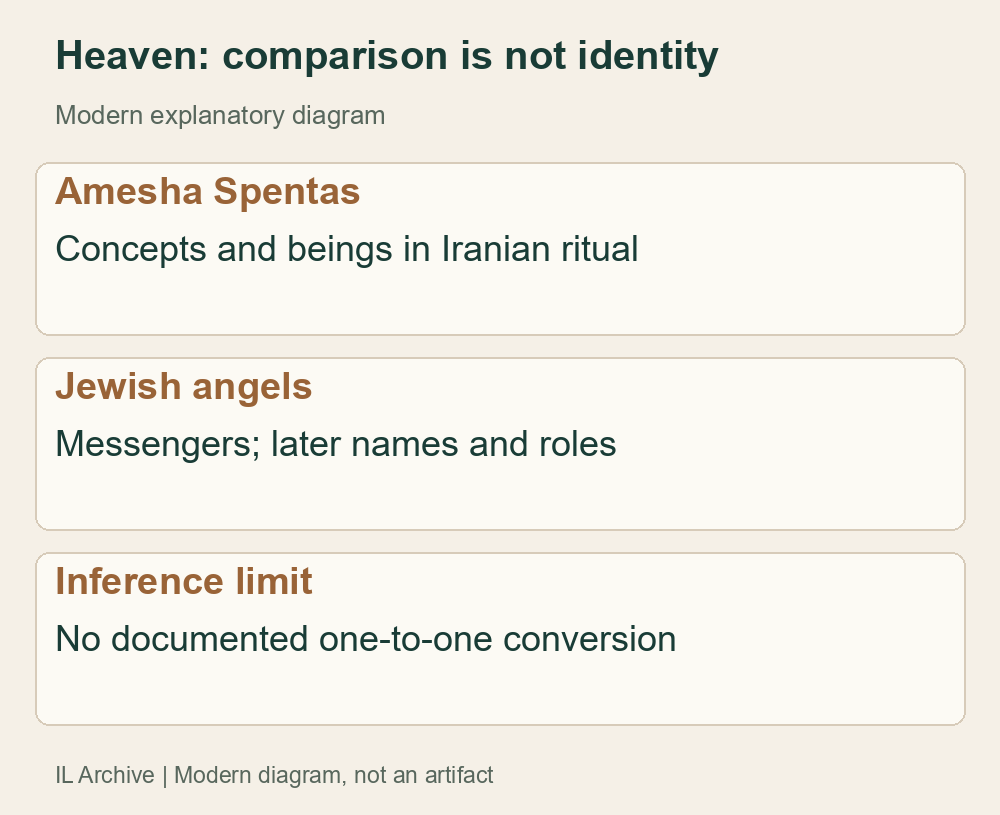
Scholars have compared Iranian heavenly organization with developments in Jewish angelologyAngelologyStudy and organization of angels and heavenly beings: names, ranks and roles within particular traditions, without assuming one fixed system.Glossary · Click to read the explanation, particularly in discussions of contact during Persian rule. Similarities of function or heavenly hierarchy do not demonstrate that Michael or GabrielGabriel / JibrīlA Semitic theophoric name for an interpreter of visions in Daniel and a messenger in Luke; named Jibrīl in the Qurʾan. His functions depend on each textual context.Glossary · Click to read the explanation was simply an Iranian being renamed. Different textual traditions, chronologies and possible channels of borrowing must be investigated independently. [2]
Limits and illustrations
The accompanying diagrams are modern comparisons of roles and ideas, not ancient depictions of the beings or Avestan manuscripts. The cover is a newly generated symbolic image of natural elements, not an archaeological object, real landscape or authenticated religious representation. Each name should be read in its specific textual setting, distinguishing earlier language, later ritual interpretation and modern analogy.
References and notes (5)
- Mary Boyce (1989). “Aməša Spənta.” Encyclopaedia Iranica. Terminology and six concepts; no angel equivalence table. Return to the text ↑
- Morton Smith (1989). “Bible ii. Persian Elements in the Bible.” Encyclopaedia Iranica. Caution about inferring angelic/eschatological transfer from parallels; contrasts with Shaked. Return to the text ↑
- Mary Boyce (1989), “Aməša Spənta,” discussion of Yasna 39.3 Boyce, passage on Yasna 39.3 Return to the text ↑
- Mary Boyce (1989), “Aməša Spənta,” creation correspondences Boyce, paragraph on creations and liturgy Return to the text ↑
- Yasna 47.1; L. H. Mills / Bartholomae-derived English translations collected by Avesta.org; comparison against Boyce Yasna 47.1 in available English translations; no full critical Avestan edition inspected Return to the text ↑
Suggest a correction · Suggest a source for this record
Cite this record
IL Archive, «Amesha Spentas», https://ilarchive.com/en/entities/amesha-spenta