Entity · Text or methodological concept
Oral transmission
A reference page linking a name, group, or concept to the materials that discuss it.
The handing-on of knowledge and narrative through speech, listening, performance and teaching; variable stability, interaction with writing, and the limits of reconstructing historical routes.
Estimated reading time: 8 min Published Last reviewed:
Share article
Text
Introduction
Oral transmission is the passing of words, knowledge, or narratives among people and communities through hearing, performance, and learning, whether or not some stages also involve writing. The historical question is not simply whether people can remember a story: it is what they preserve, who performs or regulates it, and how far a surviving text gives access to an earlier stage.
This entry considers mechanisms of continuity and change, the interaction of speech and writing, and the limits of evidence from Greek, Jewish, Christian, and Sanskrit sources. It distinguishes what a witness says about its own transmission from a route that a historian can independently establish.
What is transmitted?
The transmitted material may be a prayer formula, hymn, law, genealogy, account of battle, or story with characters and events. A community may learn the wording of a ritualRitualAn organised or distinguished practice meaningful to a community; it may leave traces, but its form alone does not reveal an associated doctrine.Glossary · Click to read the explanation passage with care while a storyteller reconstructs a tale during performance from familiar units rather than repeating every word. The historian Jan Vansina uses “oral tradition” in a narrower sense for messages based on earlier messages spanning at least a generation. Hearing a speech for the first time, or reading a written work aloud, does not by itself establish such a traditional chain. [2]
It helps to distinguish oral transmission, the reception and handing-on of material, from oral composition, in which a performer formulates a piece during performance, and from oral reading of a previously fixed text. Two or all three may coexist. Nor does the absence of a surviving early manuscript positively establish exclusive oral transmission: earlier written copies may simply have perished.
Memory, performance, and institutions
Memory is not merely a private store of words. Meter, recurrent formulas, ordered genealogies, and audience responses aid recall; schools, ritual settings, and correction between teachers and learners regulate what counts as a proper performance. Degrees of fixity vary by genre and occasion. Improvised verse permits kinds of variation unlike a ritual recitation learned through exacting instruction in stress and pronunciation. Neither the flexibility of one form nor the discipline of another warrants assuming perpetual corruption or absolute accuracy.
UNESCO describes the continuing oral teaching of Vedic chanting in India, including elaborate methods for preserving accents, sounds, and word sequences. It also records the loss of numerous branches of recitation. This is institutional evidence about living practices and their techniques, not an audio record from the period in which the ancient Vedic hymns were composed. [3]
Speech and writing: overlapping paths
In literate societies a learner may memorize a work from a teacher who consults a copy, a scribe may write down what he knows by recitation, or a written text may be read at a gathering and shape later performances. David Carr's comparative discussion of writing and memory in ancient Israel, MesopotamiaMesopotamiaHistorical region associated with the Tigris and Euphrates: Uruk, Ur, Eridu, cuneiform, Sumer, Akkad, Babylon and Assyria, their languages and cults, and the limits of archaeological evidence.Glossary · Click to read the explanation, Egypt, and Greece provides a framework for these relations, not a ladder that every society must climb from the “oral” to the “written.” [4]
Alberto Cantera's work on the Zoroastrian Avestan liturgy examines a case in which priestly memory and manuscripts interact: oral performance survived the use of writing, and some copying variants could affect recitation. It is a finding about a particular body of evidence and history, not a ready-made account of all cultures. [5] A Babylonian school tablet from the second millennium BCE shows instruction in writing signs: according to the Metropolitan Museum of Art, the teacher supplied a model and the student repeated it. It attests scribal learning, not an actual recorded chain of oral storytelling. [15]
The Iliad: poetic language, not a recording of the first performance
Greek tradition attributes the IliadIliadGreek epic attributed to Homer, narrating a phase of the Trojan War.Glossary · Click to read the explanation to HomerHomerThe name to which Greek tradition attributes the Iliad and Odyssey.Glossary · Click to read the explanation. The epic concerns wrath and war in the narrative world of the siege of Troy. In the Greek text edited by Monro and Allen it opens by invoking a goddess:
Our translation is “Sing, goddess, the anger of AchillesAchillesImportant hero of the Iliad, whose anger and participation shape the poem’s warfare.Glossary · Click to read the explanation, son of Peleus” (Book 1, line 1.1). The word “sing” in a poem preserved in writing does not record the earliest performance. Metrical formulas and recurrent epithets offer poets resources for composition in performance. Milman Parry and Albert Lord developed this approach by comparing Homeric diction with epic singers studied in the field. Such ethnographic comparison helps explain a possible mechanism; it is not direct observation of a particular ancient Greek singer. [6] [7]
Proposed periods for the formation of the Homeric epics stretch roughly across the eighth and seventh centuries BCE, with continuing debate about how and when they were written down. The earliest surviving Homeric papyri date to the third century BCE, while the complete manuscript known as Venetus A, which preserves the quoted opening line, dates to the late tenth century CE; earlier textual witnesses also survive. The date of that manuscript is not the composition date, and no modern edited wording can simply be equated with every earlier performance. [8] [9]
“Received” and “handed on”: two different religious witnesses
Paul the ApostlePaul the ApostlePaul was a first-century CE Christian letter writer whose letters preserve early Christian formulations.Glossary · Click to read the explanation wrote to the Christian community in ancient CorinthAncient CorinthCorinth was an ancient Greek city with a strategic position between central Greece and the Peloponnese.Glossary · Click to read the explanation in a letter usually dated about 53–55 CE. At 1 Corinthians 15:3 he says in the edited Greek text:
Our translation: “For I handed on to you, as a matter of first importance, what I also received.” The passage proceeds to give a message about Christ's death and resurrection. The verbs attest Paul's presentation of himself as a recipient and transmitter; they do not, on their own, identify every person in a chain or demonstrate that he received each word only orally. The first-century letter must also be distinguished from the papyrus P46, which preserves this passage of chapter 15 and is dated by the Chester Beatty Library to the third century CE. [10] [11] [12]
The MishnahMishnahThe Mishnah is a rabbinic compilation assembled around 200 CE, organizing teachings and discussions by topic.Glossary · Click to read the explanation is a collection of rabbinic teaching compiled in Palestine around 200 CE. The opening of its tractate Avot (“Fathers”), 1:1, reads in HebrewHebrewA Northwest Semitic language of the Canaanite group, encompassing Iron Age epigraphy, Biblical, Rabbinic, medieval and Modern Hebrew; its scripts and pronunciations changed over time.Glossary · Click to read the explanation:
Our translation: “MosesMosesCentral figure in Exodus, Torah traditions and the Qur’an; childhood accounts differ in detail.Glossary · Click to read the explanation received Torah from SinaiSinai: peninsula and biblical mountainSinai is a peninsula in eastern Egypt; in the Torah the name also denotes the mountain of revelation to MosesGlossary · Click to read the explanation and transmitted it to Joshua.” The text continues with elders and prophets. The opening expresses a rabbinic conception of educational authority and continuity; it is not a document contemporary with Moses, nor independent proof of each historical link it recounts. The Oxford Classical Dictionary cautions that Avot is unlike most other Mishnah tractates in genre and may have been attached after the collection's initial compilation. [13] [14]
A tale that changes: Cyavana
In a 2017 study Emily West compares five Sanskrit versions of a tale about the ascetic Cyavana and Sukanyā, including Brāhmaṇa texts and passages of the MahābhārataMahābhārataSanskrit epic formed over centuries, preserving a version of Manu, the fish and the seeds.Glossary · Click to read the explanation and Purāṇas. A shared core includes the rejuvenation of the ascetic and the twin gods Aśvins. Yet the endings differ: one connects the story to the Soma ritual, another returns to the couple, and others move into genealogy. West examines variations in episode functions, ordering, and motifs, using them to test conventional criteria for detecting relationships between narratives rather than treating such criteria as established rules. [1]
The witnesses in this comparison are written versions with complex literary histories; they are not sound recordings of early narrators. Clusters of distinctive correspondences, a plausible circulation setting, and an intelligible textual sequence may increase the probability of a relationship without specifying an oral route. Reworking in writing can also generate differences between texts. Not every difference is evidence of “corruption,” nor every similarity proof of word-for-word retention.
How should a claim of transmission be tested?
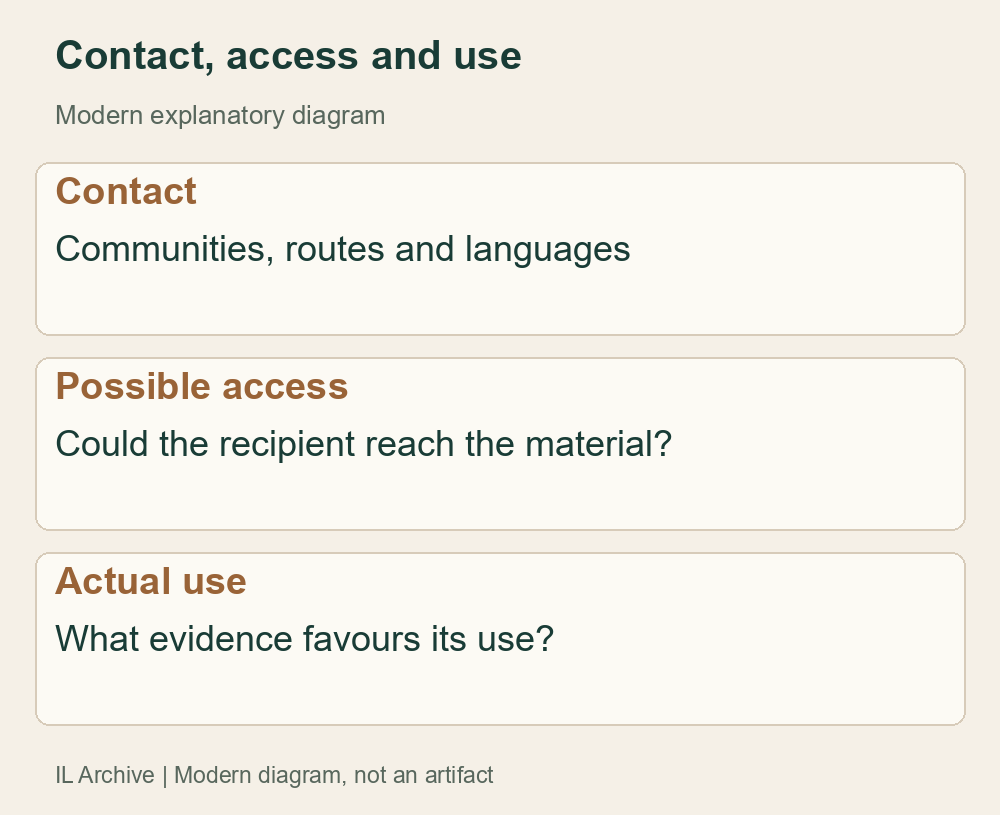
The accompanying original diagram separates three propositions: contact between communities able to meet, possible access to a particular account, and actual use of that account by a later author or performer. Unusual agreements in episode order or wording carry more weight when contact is historically plausible and competing explanations—common genre conventions, written borrowing, or coincidence—are comparatively weak. Similarity alone cannot name an otherwise unattested mediator, although a particular intermediate manuscript need not be discovered for every historically persuasive inference. [1] [2]
Begin with the surviving witness. What date is proposed for the composition or redaction of the work? When was the physical copy or translation made? Does the argument depend on attested wording, a reconstructed critical text, or a modern translation? Then ask about genre, speaker and audience, training and correction, and variation across witnesses. Social memorySocial memoryA concept for how groups shape, transmit and revise relationships to the past through narratives, rites, objects and places, without assuming unanimous recollection or fixed meanings for material traces.Glossary · Click to read the explanation preserves what a community finds meaningful in its present; this helps explain both continuity and reframing without supplying undocumented events. [2]
A brief chronology of the evidence
- Second and early first millennia BCE: strata of Vedic literature were formed over different periods; proposed composition dates are not dates of recorded contemporary chants. [1] [3]
- Approximately eighth–seventh centuries BCE: a commonly proposed period for the formation of Homeric epic; the Trojan events within the poem belong to its story world, not to a dated historical witness. [9]
- Third century BCE: among the earliest surviving Homeric papyri; the complete Venetus A manuscript is from the tenth century CE. [9] [8]
- About 53–55 CE: composition of 1 Corinthians; the P46 leaf preserving 15:3–5 dates to the third century CE. [11] [12]
- Around 200 CE and thereafter: compilation of the Mishnah, possibly followed by the addition of Avot; its narrated chain refers to a far earlier claimed past. [14]
- Twentieth century: field studies of singers and institutional documentation of chanting allow scrutiny of living mechanisms, not direct recording of ancient practice. [3] [6]
What follows from the evidence?
Oral and written are not fixed rungs on a single ladder. The stronger question is who transmitted what, how, before whom, under which controls, and in which surviving witness. A document may attest a group's belief that its tradition was inherited; comparison may establish a literary relationship; convergent evidence can make historical transmission plausible. Voices, generations, and intermediaries that have left no evidence remain explicit hypotheses, not discovered facts.
References and notes (15)
- Emily West, “The Transformation of Cyavana: A Case Study in Narrative Evolution,” Oral Tradition 31/1 (2017), pp. 77–122; comparison of five written versions. Indexed PDF excerpts from pp. 77, 83 and 112; the full PDF could not be opened. Tigay 1993 is mediated through West, not read directly; the inherited note cited pp. 77–81. Return to the text ↑
- Jan Vansina, Oral Tradition as History, University of Wisconsin Press, 1985. JSTOR table of contents and visible chapter-opening previews for chs. 1, 4, 6, 7; not the complete book. Return to the text ↑
- UNESCO, “Tradition of Vedic chanting,” Intangible Cultural Heritage, element 00062, inscribed 2008. Indexed institutional description on recitation training and branches; direct page access was challenged. Return to the text ↑
- David M. Carr, “Torah on the Heart: Literary Jewish Textuality Within Its Ancient Near Eastern Context,” Oral Tradition 25/1 (2010). Journal abstract only, not the full article; used only for its stated comparative framework. Return to the text ↑
- Alberto Cantera, “On the Edge between Literacy and Orality: Manuscripts and Performance of the Zoroastrian Long Liturgy,” Oral Tradition 35/2 (2022), pp. 211–250. Indexed extracts around pp. 223–224 and section “The Interplay of Memory, Performance, and Written Sources”; not the full article. Return to the text ↑
- Harvard Center for Hellenic Studies, Homer Multitext project, “A Multitextual Approach to Homer” (edited by Casey Dué and Mary Ebbott). Full visible “A Multitextual Approach” section on performance, formulae, variants and witnesses; not the manuscript corpus. Return to the text ↑
- Homer, Iliad 1.1, Greek text edited by D. B. Monro and T. W. Allen, Homeri Opera (Oxford, 1908–1920), Scaife ATLAS / Perseus. Greek line 1.1 viewed in Scaife; translation in this entry is our own. Return to the text ↑
- Homer Multitext, “The Venetus A (Marciana 454 = 822),” manuscript metadata; compare its transcription of 1.1 on folio 12r. Manuscript overview: late tenth century and earliest complete witness; 1.1 checked, not the whole codex. Return to the text ↑
- University of Chicago Library, “Homer Before Print,” Homer in Print exhibit on manuscript transmission. “Homer Before Print” passage on proposed composition, possible writing down, and earliest papyri; approximate dates. Return to the text ↑
- 1 Corinthians 15:3, Greek text on Bible Gateway, comparing Westcott–Hort (1881) and SBLGNT (2010). Opening clause of 15:3 only; short Greek excerpt, independent translations; no full critical apparatus reviewed. Return to the text ↑
- Oxford Bibliographies in Biblical Studies, “1 Corinthians,” scholarly reference entry on the letter and its dating. Publicly accessible entry extract dating the letter to 53–55 CE; not the full subscription text. Return to the text ↑
- Chester Beatty Library, “1 Corinthians 14.34–15.5; 15.6–15,” folio BP II f.57 of papyrus P46. Object catalogue description, passage identification and third-century dating; not a full palaeographic reading of the image. Return to the text ↑
- Mishnah, Avot 1:1, Hebrew text as published by Daat (educational Hebrew text edition). Opening Hebrew wording and immediate transmission-chain context; not a particular ancient manuscript. Return to the text ↑
- Martin Goodman, “Mishnah,” Oxford Classical Dictionary (2015), doi:10.1093/acrefore/9780199381135.013.4222. Public extract: compilation around 200 CE, distinctive genre of Avot and possible later addition; full entry gated. Return to the text ↑
- The Metropolitan Museum of Art, “Cuneiform tablet: student exercise tablet,” object 86.11.251, Old Babylonian, ca. 20th–16th centuries BCE. Full catalogue account of teacher/student exercise and object identity; object image not reproduced here. Return to the text ↑
Suggest a correction · Suggest a source for this record
Cite this record
IL Archive, «Oral transmission», https://ilarchive.com/en/entities/oral-transmission
Continue reading