Entity
Angra Mainyu / Ahriman
A reference page linking a name, group, or concept to the materials that discuss it.
The hostile spirit in Zoroastrian texts: Gathic wording, Younger Avestan counter-creation and Ahriman in Middle Persian cosmology.
Estimated reading time: 6 min Published Last reviewed:
Share article
Text
Introduction
Angra Mainyu is the hostile spirit of Iranian Zoroastrian texts; Ahriman is the familiar later name associated with Middle Persian tradition. His role concerns the origin and defeat of evil, but the surviving sources do not give one unchanging account. Reading the hymns, the Younger AvestaAvestaThe Zoroastrian sacred corpus in Old and Younger Avestan, containing hymns, liturgy and prayers transmitted orally before later manuscript copying.Glossary · Click to read the explanation and medieval cosmology separately clarifies both the continuities and the differences.
A name and a problem of interpretation
The AvestaAvestaThe Zoroastrian sacred corpus in Old and Younger Avestan, containing hymns, liturgy and prayers transmitted orally before later manuscript copying.Glossary · Click to read the explanation is the sacred corpus of ZoroastrianismZoroastrianism: Hymns, Rituals and the Changing TraditionA living Iranian religious tradition examined through Avestan hymns, Middle Persian writings and royal inscriptions, separating textual evidence, later interpretation and hypotheses of influence.Glossary · Click to read the explanation. Its oldest linguistic layer includes the Gathas, hymns traditionally attributed to ZarathustraZoroaster / ZarathustraFoundational figure associated with Zoroastrian tradition and the Old Avestan Gathas. His priestly role, teaching and relationship to the poems are subjects of research; his lifetime and biographical details remain disputed.Glossary · Click to read the explanation, whose lifetime is uncertain. Younger Avestan texts and the later Middle Persian books are different witnesses, not contemporary chapters of a single author's work. Their transmitted forms are also much later than the beginnings of the oral tradition. [3]
“Angra Mainyu” is conventionally translated “hostile spirit”, while “Spenta Mainyu” designates the beneficent spirit. In Yasna 30.3 the opposition is expressed with “better” and “evil”, rather than simply listing two fixed proper names. Yasna 45.2 calls one spirit more beneficent and the other harmful. Capitalized names in modern summaries should not obscure this variation in expression. [1][4]
The contrast can be inspected in the Old Avestan itself, in Latin transcription from the Geldner-based TITUS text, Yasna 30.3b:
“In thought and speech and action: better and bad” (editorial rendering of the excerpt). The line contains vahiiō and akəm, not the two complete conventional names. We retain the base text’s manahicā, rather than silently adopting the apparatus’s proposed deletion of its final connective. Spelling and segmentation vary among witnesses; those variants do not turn the line into an explicit genealogy. [9]
Choice in the Gathas
Yasna 30.3–6 links the spirits' opposition to thought, word, deed and choice. Their encounter involves life and non-life and divergent final destinies. The passage also speaks of the daevas, divinities rejected by the text, failing to choose rightly. Yasna 45.2 makes the disagreement comprehensive: the spirits do not share thoughts, teachings or actions. These are religious-poetic statements with an ethical dimension, not a systematic account of two empires and their populations. [4]
Their relation to Ahura MazdaAhura MazdaWise Lord in Iranian traditions, associated with truth, goodness and creation; not a Persian name for Yahweh.Glossary · Click to read the explanation, the Wise Lord, is contested. Some interpreters take twinship and divine parenthood as pointing to a shared origin; others defend independent principles and a nonliteral understanding of twinship. The connection between Mazda and the beneficent spirit is central to this disagreement. Neither “Ahriman is certainly Mazda's son” nor “the Gathas plainly teach the entire later system” adequately represents the range of readings. [1][5]
The common-parent reading takes “twins” in 30.3 seriously and combines it with divine parenthood elsewhere. Its weakness is that this combination supplies a genealogy not stated in that verse. The independent-principles reading preserves the sharp moral opposition, but must explain twinship metaphorically and cannot simply erase the verbs of choice. On this evidence, choice and incompatibility are better established than either complete account of origins. This entry therefore does not translate “twins” into “two eternally equal gods”. [1][4][5]
Counter-creation in the Younger Avesta
The first chapter of the Videvdad, a Younger Avestan work concerned with purity and religious order, sets the hostile spirit against lands created by Ahura Mazda. The sequence repeatedly answers a good land with a destructive counter-creation. For the first land it names a serpent and winter; later responses include threats to cattle and conduct condemned by the text. [6]
This witness already places Ahura Mazda and Angra Mainyu in direct narrative opposition. Consequently, a simple scheme in which Mazda never faces the hostile spirit until Middle Persian times is misleading. Yet the chapter's catalogue is not identical with the later Bundahishn's organized cosmic history. Its religious geography must not be treated as a transparent itinerary of actual population movements. [6]
Ahriman in the Bundahishn
The BundahishnBundahishnThe Bundahishn is a Middle Persian Zoroastrian work on creation, the world and its final renovation.Glossary · Click to read the explanation is a Middle Persian compilation with older materials and successive redactions, including a substantial ninth-century CE stage. Its opening contrasts Ohrmazd's foreknowledge with Ahriman's limited awareness. Ahriman discovers the light, attacks, retreats and produces destructive forces. He rejects an offer to assist the good creation and accepts a contest bounded in time, without understanding that its limit makes his defeat possible. [7][8]
The account distinguishes an initial spiritual creation of three thousand years from the nine thousand years allotted to the contest. These are the narrative's cosmic periods, not historically measured dates. Ohrmazd's recitation of the Ahunavar formula reveals the eventual overcoming of evil and the creatures' undisturbed future. Ahriman is thus dangerous, but neither omniscient nor destined to rule forever. [7]
Evil is not identical with matter
The first chapter of the Bundahishn makes Ohrmazd the creator of sky, water, earth, vegetation, animals and humanity. Its good creation includes bodies and the environment in which life is possible. Accordingly, the opposition is not a moral division between good spirit and evil matter. Its problem is the assault on creation, rather than the existence of matter itself. [7]
The modern philologist Almut HintzeAlmut HintzeAlmut Hintze studies ancient Iranian languages, the Avesta and Zoroastrian traditions.Glossary · Click to read the explanation distinguishes Avestan bodily counter-creations from later statements denying Ahriman a material creation of his own. [10] This matters when reading the Videvdad: a serpent is not merely an abstract vice, while a destructive response is not automatically a second complete universe. The narrative’s repeated dependence on Mazda’s prior creation supports the term “counter-creation” more directly than an assumption of two symmetrical worlds. [6]
Chronology of the evidence
- Old Avestan hymns and liturgy: their language is older than that of the Younger Avesta; a late second-millennium BCE setting is one scholarly proposal, not a securely dated composition. Their cultural background is usually sought in eastern Iranian or southern Central Asian regions, not simply at the later Persian court. [11]
- Younger Avestan works: a later linguistic layer with its own internal history; relative sequence does not provide a single calendar date for every passage. [3]
- Middle Persian theological books: older materials were collected and reworked after the Sasanian period; the Bundahishn includes ninth-century CE redaction. Its beginning-of-the-world narrative is not a report composed at that beginning. [8]
- Surviving copies: the Yasna manuscripts J2 and K5 date to 1323 CE, whereas the Videvdad witnesses L4 and K1 were copied in 1323 and 1324. They preserve older texts through transmission, not contemporary manuscripts of Zarathustra. [12]
Comparison without identity
Iranian and Jewish accounts of evil can be compared, but resemblance does not identify Ahriman with the biblical adversary. In particular, ha-satan in JobHa-satan in Job: Title, Role, and InterpretationHebrew “the adversary” in Job 1–2, who challenges Job’s motives with Yahweh’s permission. “Accuser” is a common functional interpretation, but “enforcer” has been argued; later Satan traditions cannot simply be read back into the passage.Glossary · Click to read the explanation operates with divine permission, a different narrative position from the attacking adversary of the Bundahishn. Historical contact makes influence possible, not automatic.
The historian of religions Morton SmithMorton SmithHistorian of ancient religions associated with Columbia University’s history department.Glossary · Click to read the explanation proposed Persian influence in some biblical developments while denying that parallels establish a broad transfer of angelologyAngelologyStudy and organization of angels and heavenly beings: names, ranks and roles within particular traditions, without assuming one fixed system.Glossary · Click to read the explanation or a clear derivation of Satan. His position was not a blanket rejection of contact. Competing interpretations must be tested claim by claim, with attention to the dates and differences of the relevant texts. [2]
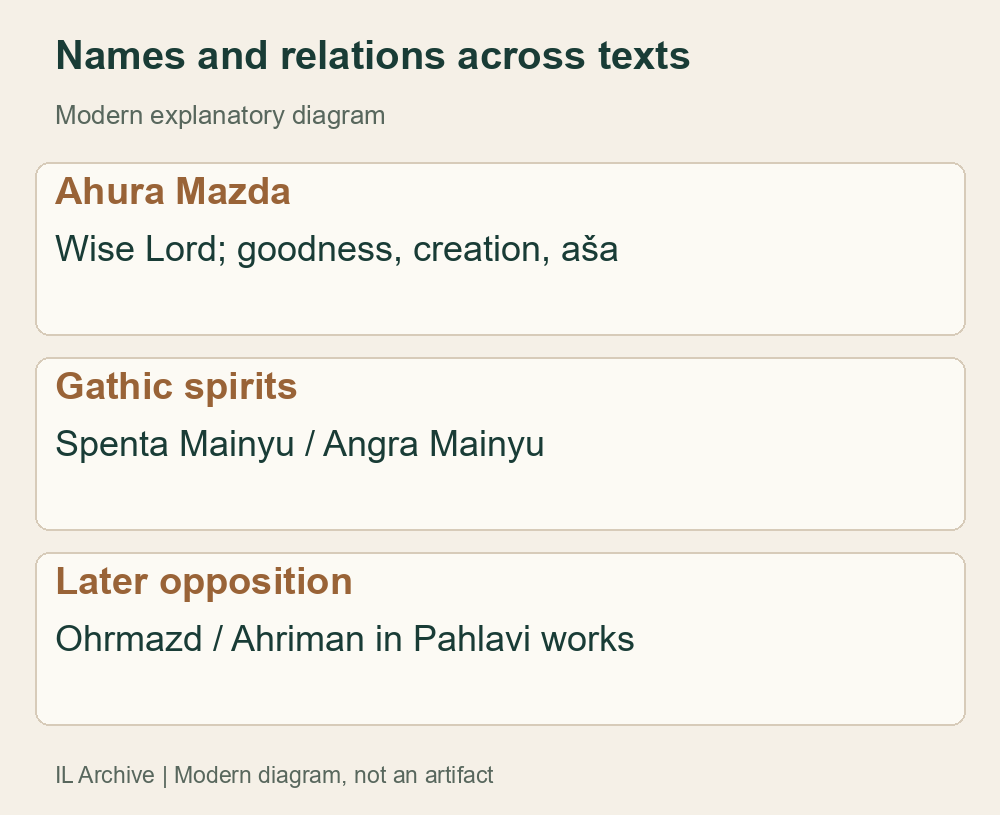
The following figure is a modern terminology diagram, not an ancient image of the spirit. Its names summarize a comparison between textual settings; they do not assert a divine genealogy or an exclusively Middle Persian beginning for direct opposition to Mazda.
References and notes (12)
- Jacques Duchesne-Guillemin (1984). “Ahriman.” Encyclopaedia Iranica. Gathic, Younger Avestan and Pahlavi sections; the interpretation of parenthood and twinship is disputed, not a consensus. Return to the text ↑
- Morton Smith (1989). “Bible ii. Persian Elements in the Bible.” Encyclopaedia Iranica. Opening paragraphs and discussion of angels and Satan: the author proposes some influences while rejecting other inferences; not a blanket denial of contact. Return to the text ↑
- Jean Kellens (1987). “Avesta i. Survey of the History and Contents of the Book.” Encyclopaedia Iranica. Opening discussion: linguistic strata and textual transmission; not a reading of the entire Avesta. Return to the text ↑
- L. H. Mills, trans. (1887). The Zend-Avesta, Part III. Sacred Books of the East 31. Yasna 30.3–6, compared with 45.2 and 47.1–6 in the same volume. This historical translation and its interpretation are not a critical Avestan text. Return to the text ↑
- Gherardo Gnoli (1996). “Dualism.” Encyclopaedia Iranica. Zoroastrian section: competing readings of spirits, choice and their relation to Mazda; the reconstruction is debated. Return to the text ↑
- James Darmesteter, trans. (1880). The Zend-Avesta, Part I. Sacred Books of the East 4. Videvdad, Fargard I, §§ 1–21, especially §§ 1–4; full translation of this chapter read, not the whole Videvdad. Return to the text ↑
- E. W. West, trans. (1880). Pahlavi Texts, Part I. Sacred Books of the East 5. Bundahishn, chapter I, §§ 1–28; historical translation of the Indian recension, not a modern critical edition. Return to the text ↑
- D. N. MacKenzie (1989). “Bundahišn.” Encyclopaedia Iranica. Paragraphs on recensions, manuscripts and composition; redaction includes a ninth-century CE stage. Return to the text ↑
- K. F. Geldner, Avesta; TITUS Avestan Corpus, Yasna, full documentation, prepared by Sonja Fritz, Jost Gippert, Michiel de Vaan and collaborators. Yasna 30.3b: base text and apparatus for manahicā and akəmcā; Yasna 30.3–6 compared with the text and analysis in Texas lesson 4. Return to the text ↑
- Almut Hintze (2014). “Monotheism the Zoroastrian Way.” Journal of the Royal Asiatic Society 24.2, 225–249. DOI: 10.1017/S1356186313000333. Pp.233–234, §4: bodily counter-creation and its relation to Pahlavi formulations; full relevant passage read, not abstract only. Return to the text ↑
- Almut Hintze. “Avestan Literature” and “Yasna.” FEZANA, five-page introduction. Five-page introduction read in full; p.3 for proposed dating and liturgy, pp.3–5 for Yasna 35–41; not a reading of the complete Yasna translation. Return to the text ↑
- Jes P. Asmussen (1992). “Codices Hafnienses.” Encyclopaedia Iranica 5.8, 886–893. Manuscripts section, especially K1 and K5 entries and the dates of J2/L4; these date copies, not composition. Return to the text ↑
Suggest a correction · Suggest a source for this record
Cite this record
IL Archive, «Angra Mainyu / Ahriman», https://ilarchive.com/en/entities/angra-mainyu
Continue reading