Entity · Concept
Ha-satan in Job: Title, Role, and Interpretation
A reference page linking a name, group, or concept to the materials that discuss it.
Ha-satan (with the Hebrew article) in Job 1–2 tests Job’s motives for piety under Yahweh’s limited permission. The entry separates the story from readings of him as prosecutor or enforcer and from later images of Satan.
Estimated reading time: 7 min Published Last reviewed:
Share article

Text
Introduction
Who is ha-satan in the opening of the Book of JobBook of JobHebrew wisdom text exploring suffering, justice and the limits of human knowledge through dialogue and poetry.Glossary · Click to read the explanation? This speaker enters a heavenly assembly, questions the sincerity of JobJobCentral figure of the Book of Job, introduced as upright and subjected to suffering after a heavenly discussion of his fidelity.Glossary · Click to read the explanation’s piety, and is followed by a series of disasters. Understanding the scene calls for attention to its HebrewHebrewA Northwest Semitic language of the Canaanite group, encompassing Iron Age epigraphy, Biblical, Rabbinic, medieval and Modern Hebrew; its scripts and pronunciations changed over time.Glossary · Click to read the explanation vocabulary, the limits imposed on the figure, and the place of the prose prologue in a book about undeserved suffering.
This entry separates what the narrative states from later interpretations, and compares biblical uses of satan without assuming that every adversary is the same being or that Job’s figure already possesses all the characteristics of the Devil in later traditions.
The Hebrew expression: title or personal name?
The Hebrew is הַשָּׂטָן, approximately ha-satan: ha- is the definite article, and satan denotes an opponent or adversary in a given context. “The adversary” is therefore a sound rendering; “the accuser” is a common interpretation of the figure’s activity rather than the only possible dictionary meaning. Since Hebrew proper names ordinarily lack this article, its presence strongly favours a designation or title, though it does not on its own establish the figure’s identity or rank.[1]
Here the expression identifies the specific figure in Job’s prologue. It should not be made into a universal name for every hostile being in later texts. Unarticulated uses of satan elsewhere, and translations that capitalize “Satan” like a personal name, need separate evaluation.[15]
Appearance before the heavenly council
In Job 1:6 the “sons of GodSons of God“Bene elohim” is a Hebrew expression in Job and Genesis whose interpretation depends on context; it also appears in Qumran 4Q37 at Deuteronomy 32:8. It does not itself establish biological descent or a fixed divine roster.Glossary · Click to read the explanation” come before YahwehYahwehThe proper name of Israel’s deity, written יהוה (YHWH), the Tetragrammaton. Its exact ancient pronunciation is not directly preserved; texts and inscriptions witness its history.Glossary · Click to read the explanation, and ha-satan comes among them. This is a literary scene of a divine councilDivine councilA divine council is a religious and literary scene in which divine beings gather before a superior authority for discussion, commissioning or judgment; it is not identical to a pantheon list.Glossary · Click to read the explanation: a heavenly assembly with differentiated activity, not a complete roster or a historical institution whose organization can be reconstructed. Yahweh asks where the visitor has come from; the answer describes roaming the earth. Yahweh then draws attention to Job’s upright character.[1]
The passage does not depict ha-satan as an equal independent power opposed to Yahweh, nor does it identify him as a particular Canaanite god. His presence and return in chapter 2 place him within the story’s proceedings; calling him an “angel” or “court officer” is a classification offered by readers, not the narrator’s explicit title for him.
Does Job fear God “for nothing”?
The challenge is not that Job secretly committed a specified offence. It targets his motivation: does he fear God for nothing, or because his household, prosperity and work are protected? The Hebrew ḥinnām (“gratuitously”, “for nothing”) in Job 1:9 reappears with the sense “without cause” in Yahweh’s reference to Job’s destruction at 2:3. This verbal echo connects disinterested goodness to unmerited suffering at the heart of the prologue.[1]
Job does not hear the exchange in heaven; only readers do. The story thus gives its audience information withheld from the sufferer, without making the adversary’s challenge a complete solution to the wider book’s treatment of suffering.
Permission, boundaries, and what the narrator attributes
In the first round Yahweh allows ha-satan power over Job’s possessions but forbids him to lay a hand on Job himself (1:12). The ensuing messengers report raiders, fire and a destructive wind; the story does not specify ha-satan’s precise mechanism in each calamity. During the second audience, after Job retains his integrity, permission extends to his body, provided his life is spared (2:6). This time the narrator explicitly says ha-satan strikes Job with sores (2:7).[2]
The character therefore does harm within the plot; he is no harmless observer. Yet he acts subject to expressed permission and limits. Calling the event a “test” must not soften its violence, and describing the agent as harmful need not import a theology of two equal independent deities.
His role in the book’s literary structure
Ha-satan appears in the prose frame of Job 1–2 and does not reappear as a participant in the discussions with Job’s friends or in Yahweh’s speeches from the whirlwind. In the ending (42:7–17), Yahweh rebukes Job’s friends for speaking wrongly, Job is consoled, and his fortunes are restored; there is no new hearing of ha-satan or indication that Job has learned of the initial heavenly exchange.[14]
Warren Zev Harvey distinguishes the prose framework from the extended poetic speeches that probe the problem of evil and suffering. That distinction illuminates the literary form but does not by itself prove separate dates or compositional stages. Harvey’s philosophical critique of the heavenly “wager” is his argued reading, not historical testimony to an assembly that actually took place.[3]
Related council scenes, not identical actors
In ZechariahBook of ZechariahProphetic book of the Hebrew Bible whose third chapter depicts the high priest and an adversary.Glossary · Click to read the explanation 3:1–5, Joshua the high priestJoshua son of Jehozadak, high priestHigh priest opposed by ha-satan and ritually reclothed in Zechariah 3.Glossary · Click to read the explanation stands before Yahweh’s angel with ha-satan at his right to oppose him. The opponent is rebuked and Joshua’s soiled garments are replaced. This scene has a more overtly forensic appearance than Job’s test, but neither the trial nor its result is simply the same.[5]
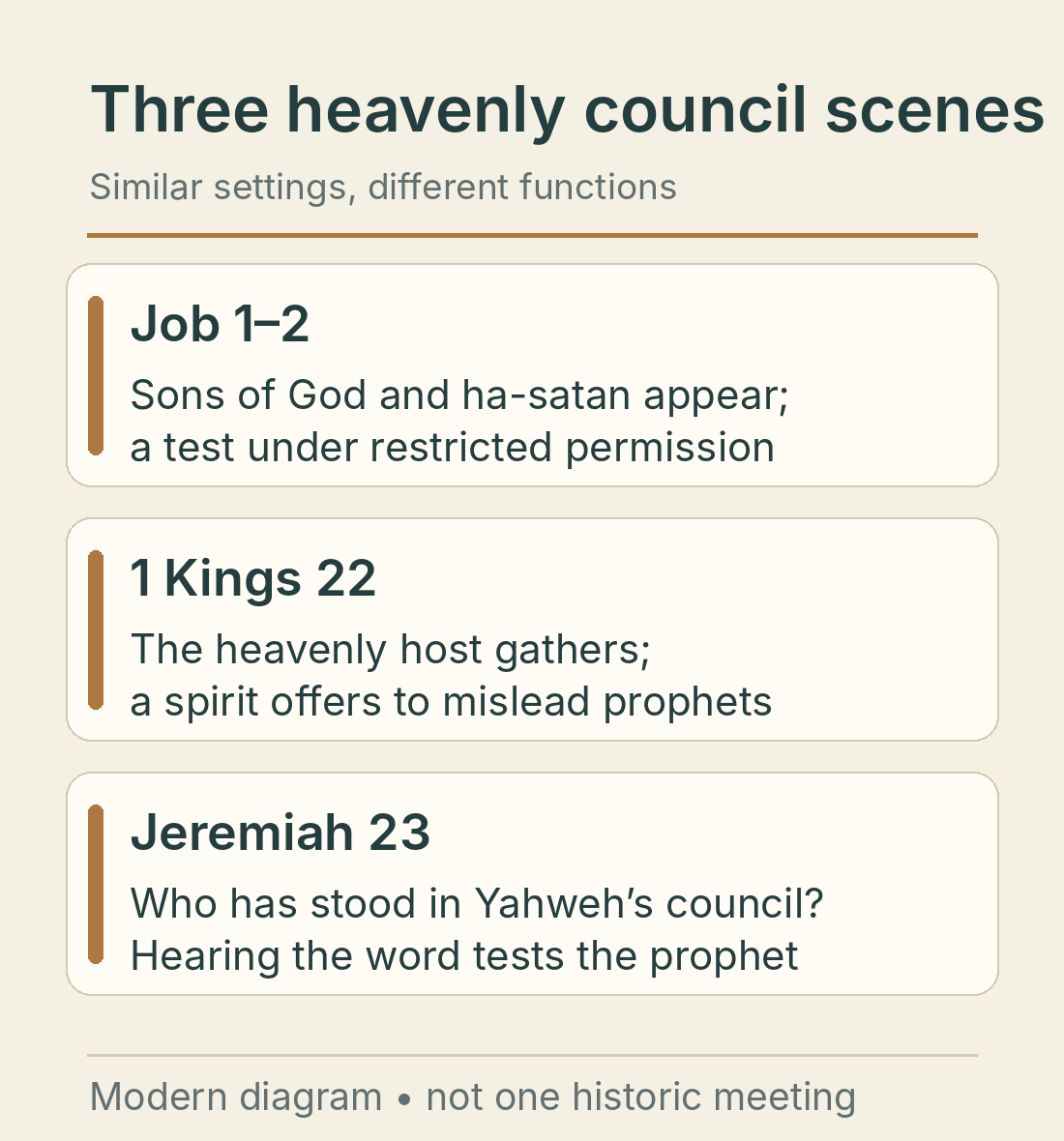
In 1 KingsBooks of KingsBiblical books narrating the kingdoms' history, including the campaign against Mesha in 2 Kings 3.Glossary · Click to read the explanation 22:19–23, Micaiah son of ImlahMicaiah son of ImlahThe prophet who recounts the throne and heavenly-host scene in 1 Kings 22.Glossary · Click to read the explanation reports Yahweh enthroned among the heavenly hostHeavenly HostA heavenly group whose meaning varies: celestial bodies in some texts, attendants around the throne deliberating in 1 Kings 22.Glossary · Click to read the explanation; a spirit volunteers to mislead prophets. That spirit is not called ha-satan. JeremiahBook of JeremiahProphetic book addressing Judah and the Babylonian crisis; chapter 34 recounts liberation followed by renewed subjection.Glossary · Click to read the explanation 23:18, 22 instead makes standing in Yahweh’s council and hearing his word a test of prophetic authenticity, not an examination of Job. The scenes share literary imagery without identifying their participants or events.[6][7]
Human and heavenly “adversaries”
In NumbersBook of NumbersTorah book addressing daughters’ inheritance and tribal retention of land.Glossary · Click to read the explanation 22:22, 32 Yahweh’s messenger stands in BalaamBalaam son of BeorA figure in Numbers whose path is blocked by the angel of Yahweh acting as his “adversary”.Glossary · Click to read the explanation’s way “as an adversary”; the word describes a blocking role and does not give the angel Job’s title. In 1 Kings 11:14, Hadad the Edomite, a human political opponent of Solomon, is called a satan. These examples show the breadth of the noun, not one figure behind every instance.[4][8]
A different problem arises in 1 ChroniclesFirst Book of ChroniclesBiblical retelling of Israel’s monarchy; its census passage ascribes the incitement of David to “satan”.Glossary · Click to read the explanation 21:1, where satan without the article incites DavidDavid, the biblical kingRoyal figure in Samuel and Kings, cited here in an instance of “adversary” applied to a human.Glossary · Click to read the explanation to conduct a census, whereas 2 Samuel 24:1 connects the incitement to Yahweh’s anger. The Chronicler’s use can be understood as movement towards a personal name or as another adversarial designation; its degree of personification is debated. The directly attested point is the difference in attribution between these two accounts, not a firmly datable birth of the later Devil.[9][10]
Prosecutor or enforcer? A real scholarly dispute
The idea of a prosecutor in a heavenly court has long been influential: The heavenly challenger questions the integrity ascribed to Job, and Zechariah puts the opponent in a position of contestation. Ryan E. Stokes, however, argues that reading the Hebrew as a modern courtroom prosecutor is misleading, and proposes an executioner or agent of attack instead. The publisher’s abstract documents his proposal but does not supply all the argumentation needed to declare the traditional reading disproved.[11]
Peggy L. Day has studied celestial uses of satan across four biblical passages; the publisher’s description establishes the scope of her book, not all its findings. Thomas J. FarrarThomas J. FarrarStatistics academic at Cape Peninsula University of Technology who also publishes on the New Testament and ancient conceptions of evil.Glossary · Click to read the explanation emphasizes variation among supernatural opponents in Second Temple Jewish literature; this caution rules out a neat, uniform and securely dated progression from Job’s figure to all later understandings of Satan.[15][12]
Greek translation and later reception
At Job 1:6, the Greek SeptuagintSeptuagintA name for the varied ancient Greek translations and writings associated with Jewish scripture; beginning with the Torah, the texts differ across books and manuscripts.Glossary · Click to read the explanation renders “sons of God” as “angels of God” and uses ὁ διάβολος for the character named ha-satan in Hebrew. This documents a later translator’s lexical and interpretive choices; it does not mean that the Hebrew text used a Greek term for “Devil” or already implied every feature later attached to that figure.[13]
Jewish and Christian interpreters subsequently developed varied readings of the figure. Historical analysis must locate each within its own textual witness and period, rather than reading the fully developed rebellious Devil back into Job’s first scene. Nor does that scene alone establish derivation from any named Canaanite deity or a direct, identifiable Iranian source.
Conclusion and dating limits
The strongest conclusion from Job 1–2 is that ha-satan is an adversarial participant in a narrated heavenly assembly, challenging Job’s motives while acting within limited permission. The problem of undeserved suffering remains for the rest of the book. “Accuser” is a useful interpretive rendering; “executioner” is a competing scholarly proposal; neither captures every aspect of the episode.
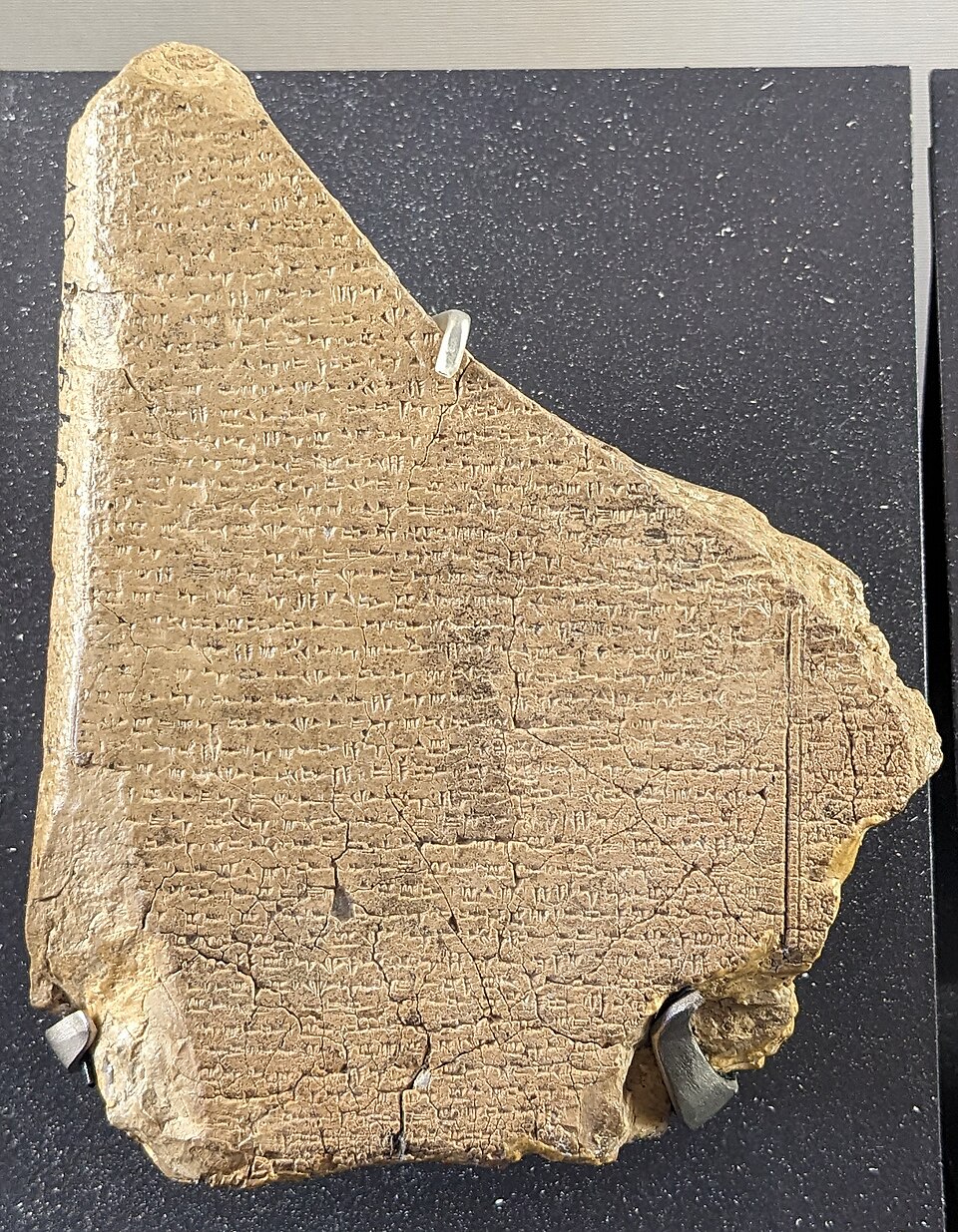
The story’s setting, the book’s composition and the dates of surviving textual witnesses are different questions. Scholars place Job’s literary formation at various points within the first millennium BCE; Harvey favours the sixth or fifth century BCE. This is an estimate, not a fixed date for the character or the narrated council. No historically verifiable appearance of ha-satan can be derived from the modern visual accompanying this entry.[3]
References and notes (15)
- Hebrew Bible, Job 1; pointed Hebrew alongside the JPS 1917 English rendering, Mechon-Mamre. Job 1:6–12, 13–22: definite article, sons of God, ḥinnām question, restriction against touching Job, successive disaster reports. Return to the text ↑
- Hebrew Bible, Job 2; Hebrew text and JPS 1917 translation, Mechon-Mamre. Job 2:1–13, particularly 2:3, 2:6–7: “without cause”, permission concerning the body, spared life and explicit attribution of sores. Return to the text ↑
- Warren Zev Harvey, “Questions on the Book of Job,” Religious Studies 59, S1 (2023), S7–S16, online 9 February 2022, doi:10.1017/S0034412521000585. Read the introduction and “The Framework Story” section in the open HTML (ha-satan, prose frame vs poetry, Harvey’s sixth/fifth-century BCE estimate); not a claim to have read all sections. Return to the text ↑
- Hebrew Bible, Numbers 22, Mechon-Mamre, Hebrew and JPS 1917 English. Numbers 22:22 and 22:32: Yahweh’s messenger opposes Balaam “as an adversary”; lexical use only. Return to the text ↑
- Hebrew Bible, Zechariah 3, Mechon-Mamre, Hebrew and JPS 1917. Zechariah 3:1–5: opponent at Joshua’s right, rebuke and change of garments; not presumed the same proceedings as Job. Return to the text ↑
- Hebrew Bible, 1 Kings 22, Hebrew and JPS 1917, Mechon-Mamre. 1 Kings 22:19–23: Micaiah’s vision of the heavenly host and the volunteer spirit; that spirit is not called ha-satan. Return to the text ↑
- Hebrew Bible, Jeremiah 23, Mechon-Mamre, Hebrew and JPS 1917. Jeremiah 23:18 and 22: standing in Yahweh’s council and hearing his word, as a criterion for prophets. Return to the text ↑
- Hebrew Bible, 1 Kings 11, Mechon-Mamre, Hebrew and JPS 1917. 1 Kings 11:14, 23–25: Hadad and Rezon are human political adversaries of Solomon. Return to the text ↑
- Hebrew Bible, 1 Chronicles 21, Mechon-Mamre, Hebrew and JPS 1917. 1 Chronicles 21:1: unarticulated satan incites David to conduct a census; status as proper name is debated. Return to the text ↑
- Hebrew Bible, 2 Samuel 24, Hebrew and JPS 1917, Mechon-Mamre. 2 Samuel 24:1: Yahweh’s anger linked to the census incitement; comparison with 1 Chronicles 21:1. Return to the text ↑
- Ryan E. Stokes, “Satan, Yhwh’s Executioner,” Journal of Biblical Literature 133/2 (2014), 251–270, doi:10.15699/jbibllite.133.2.251. Publisher metadata and abstract only; paywalled full PDF not read. Abstract sets out the “executioner” proposal and objections to the prosecutor analogy. Return to the text ↑
- Thomas J. Farrar, “New Testament Satanology and Leading Suprahuman Opponents in Second Temple Jewish Literature,” Journal of Theological Studies 70/1 (2019), 21–68, doi:10.1093/jts/fly165. Publisher abstract plus accessible indexed excerpt from the “Hebrew Bible” subsection; full paper not read. Used for diverse conceptual trajectories and the definite article. Return to the text ↑
- Greek Septuagint, Job 1:6–7, Greek text displayed by BiblIndex (CNRS/HiSoMA). Greek text of Job 1:6–7 read: οἱ ἄγγελοι τοῦ θεοῦ and ὁ διάβολος; no exhaustive manuscript collation claimed. Return to the text ↑
- Hebrew Bible, Job 42, Hebrew text and JPS 1917 translation, Mechon-Mamre. Job 42:7–17: Yahweh’s response to the friends, Job’s consolation and restored fortunes; the adversary does not reappear. Return to the text ↑
- Peggy L. Day, An Adversary in Heaven: “satan” in the Hebrew Bible, Scholars Press, 1988; Harvard Museum of the Ancient Near East catalogue. Institutional catalogue metadata and abstract only: identifies four passages involving a heavenly satan; the book itself was not read. Return to the text ↑
Suggest a correction · Suggest a source for this record
Cite this record
IL Archive, «Ha-satan in Job: Title, Role, and Interpretation», https://ilarchive.com/en/entities/ha-satan
Continue reading